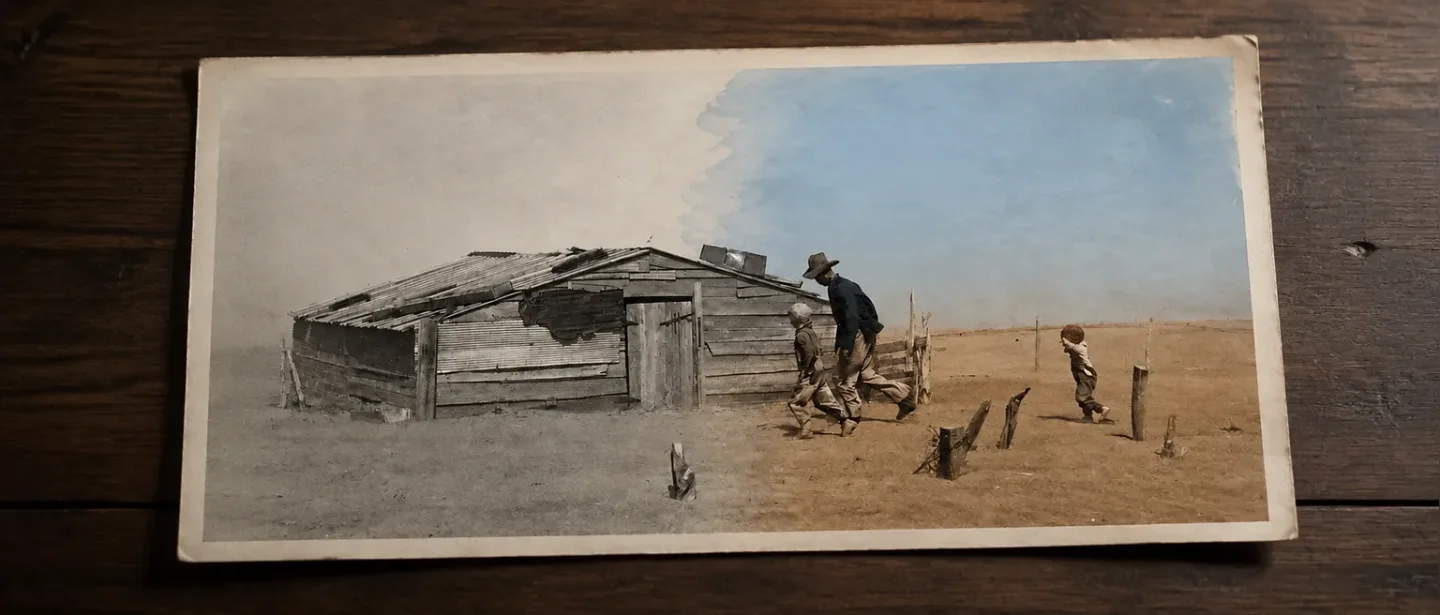
When history gets its color back
Five iconic Library of Congress photographs — from Migrant Mother to a Dakota Territory cowboy — shown as originals beside fresh AI colorizations, with the photographers and the moments behind each frame.

Black-and-white history is not incomplete. It is how the cameras of the day saw. Still, when color returns to a face or a field, the distance shrinks. The people look less like symbols and more like neighbors who happened to live earlier.
This piece pairs five public-domain originals from the Library of Congress with AI colorizations made for the article. The color is an informed guess, not recovered truth — plausible skin, cloth, and sky, not sworn testimony.
Each section shows the original first, then the colorization, then the photographer and the moment the shutter caught.
Migrant Mother, Nipomo, California, 1936
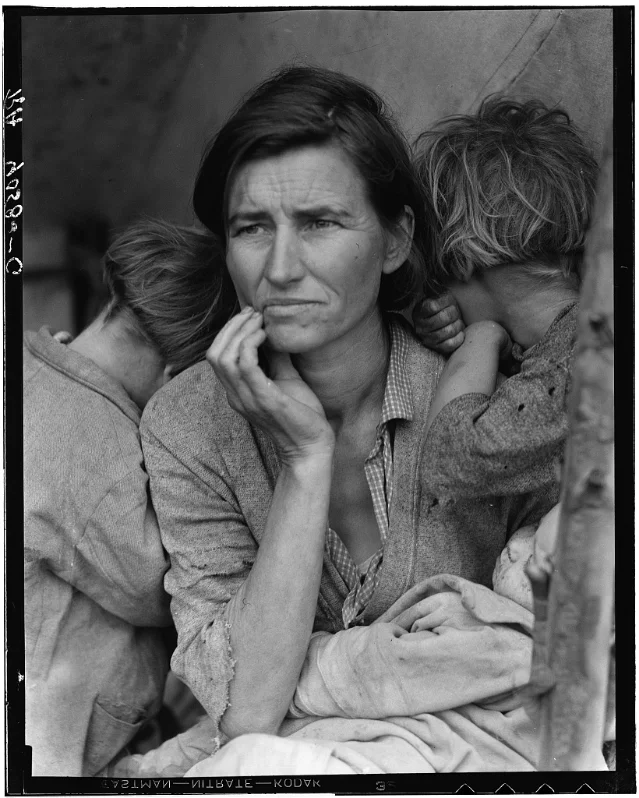
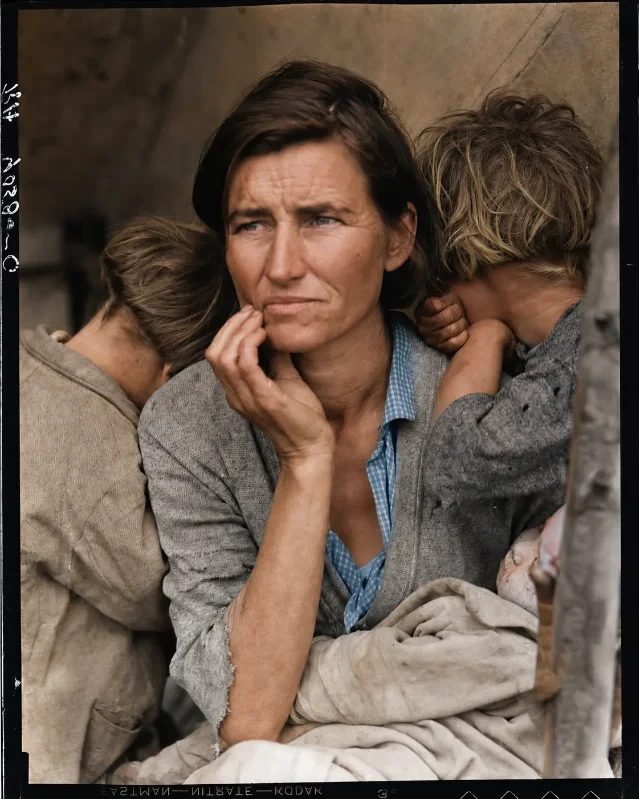
In March 1936, Dorothea Lange was ending a month on the road for the Resettlement Administration, photographing migratory farm labor across California. At a pea-pickers' camp in Nipomo she stopped the car, walked toward a lean-to tent, and made a short series of exposures with a Graflex on 4×5 film.2
She later wrote that she approached "the hungry and desperate mother, as if drawn by a magnet," that the woman asked no questions, and that she worked closer with each frame without learning a name. The mother said she was thirty-two; she and the children had been living on frozen vegetables from the fields and birds the children killed; she had sold the car's tires for food.2
The woman was Florence Owens Thompson, later identified publicly. Born in Oklahoma and of Cherokee heritage, she had been supporting children through migrant field work after her first husband's death. She and her family had stopped at the camp when their car broke down on the way to lettuce work. Decades later she said she felt exploited by the fame of the picture.3
Lange herself was born in Hoboken in 1895, survived childhood polio that left her with a limp, trained in New York, and opened a portrait studio in San Francisco before the Depression pulled her into the streets and, soon after, into federal documentary work.4 Migrant Mother became the face of FSA photography and of Depression-era hardship — a factual record and a carefully framed portrait at once.5
Farmer and sons in a dust storm, Cimarron County, Oklahoma, 1936
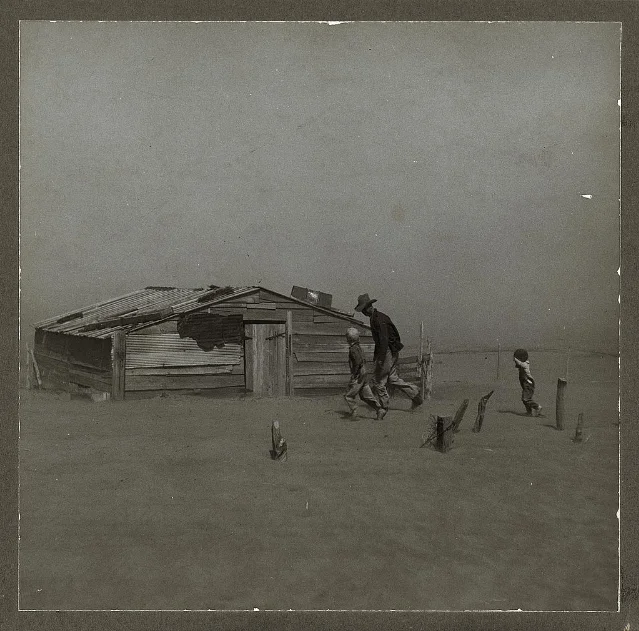
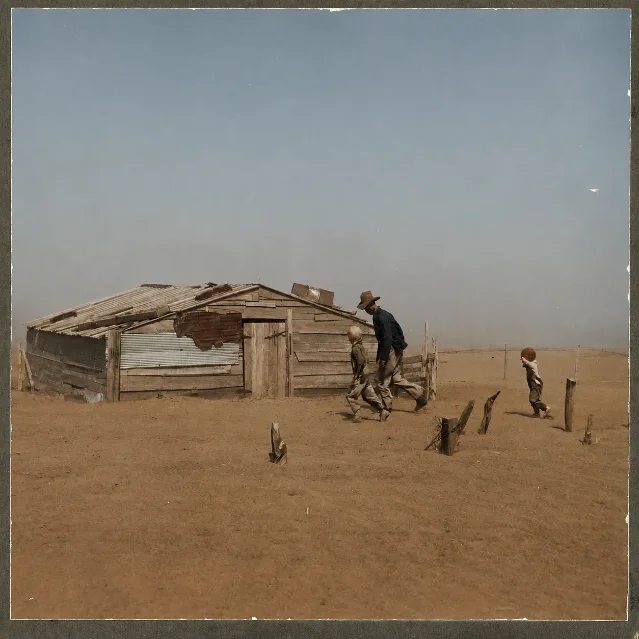
Arthur Rothstein was twenty-one, fresh from Columbia and the first photographer hired by Roy Stryker at the Resettlement Administration, when he reached the Oklahoma Panhandle in April 1936. South of Boise City, on the homestead of Art Coble near Felt, he turned back toward the farmer and two boys just as dust turned sky and ground into one field of grit. He raised the camera once. "One photograph, one shot, one negative," he later said.7
The print is usually titled Farmer and sons walking in the face of a dust storm. The adults and children are identified as Arthur Coble and his sons Milton and Darrel. Claims that the scene was staged have circulated for years; the Coble family maintained it was not.8 Either way, the frame did the political work the FSA needed: it made drought and soil collapse legible to people who had never stood in a black blizzard.
Rothstein stayed five years with the agency, then led photography at Look and later Parade. The Cimarron County negative remained the image most people attach to his name.7
"The Cow Boy," Sturgis, Dakota Territory, c. 1888
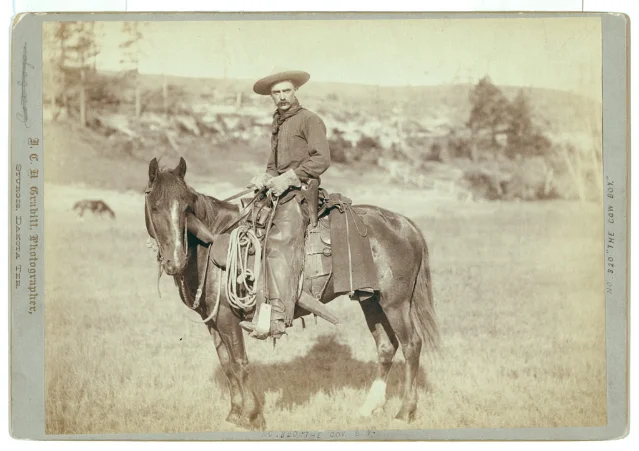
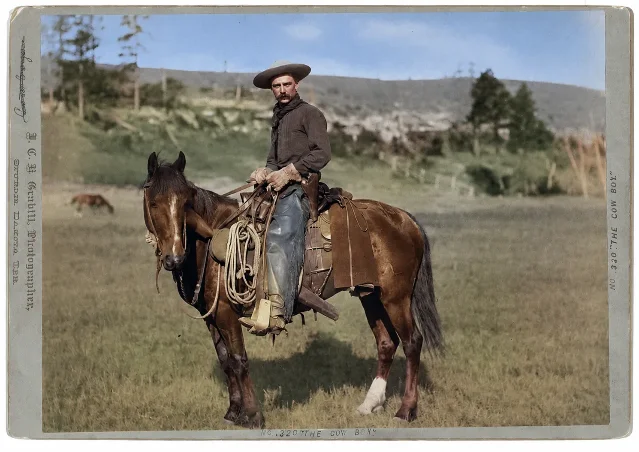
John C. H. Grabill (1849–1903) photographed frontier life in South Dakota and Wyoming in the late 1880s and early 1890s. He opened a studio in Sturgis, Dakota Territory, in 1886 and sent 188 photographs to the Library of Congress for copyright between 1887 and 1892.10
"The Cow Boy" is almost a type specimen: a rider in profile on open ground, looking toward the camera, the horse paused mid-step. It is studio-trained portraiture meeting an outdoor myth already half-formed in Eastern magazines. In color the hat and leather stop being pure silhouette, and the prairie stops being a gray void. The legend gets a weather report.
Alamo bar, North Platte, Nebraska, 1938
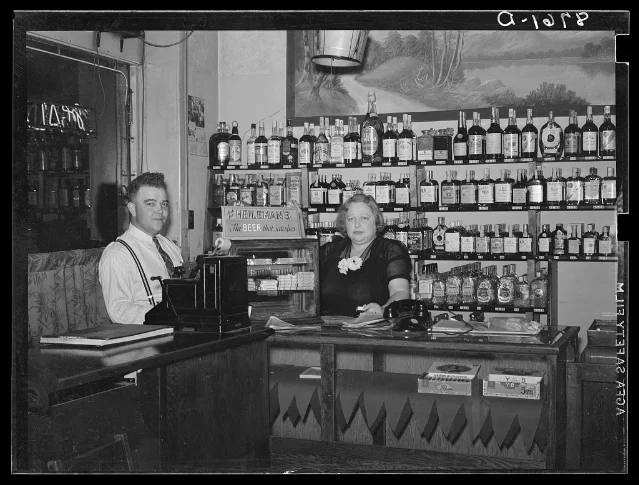
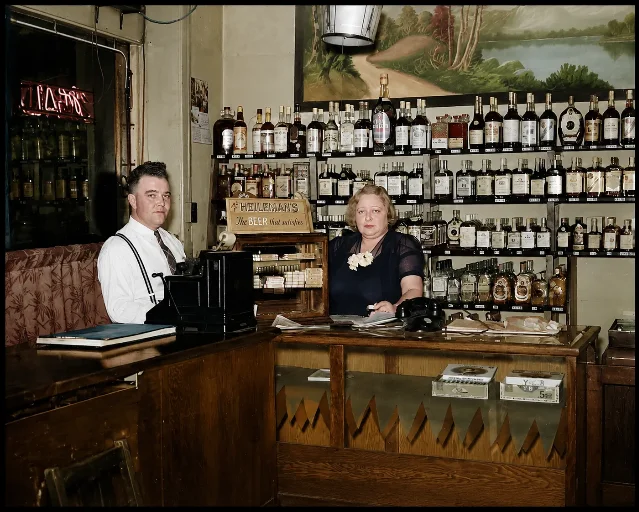
John Vachon (1914–1975) grew up in St. Paul, left graduate school in Washington, and took a messenger job at the FSA. Roy Stryker lent him a camera; Walker Evans taught him large format. In 1938 Stryker sent him on his first long solo trip through the Midwest. He later said Omaha was where he became a real photographer.12
This October 1938 frame from North Platte is pure Vachon: not a dust storm, not a breadline, but a working bar. The manager stands at a cash register; Mildred Irwin, listed as an entertainer, stands beside shelves of bottles under a painted landscape. Vachon liked rooms other FSA photographers skipped — saloons, picket lines, the ordinary commerce that kept towns running.12
In color the wood grain and bottle glass do most of the work. The neon smear in the window and the Heileman's beer sign stop being gray geometry.
Thanksgiving dinner, Ledyard, Connecticut, 1940
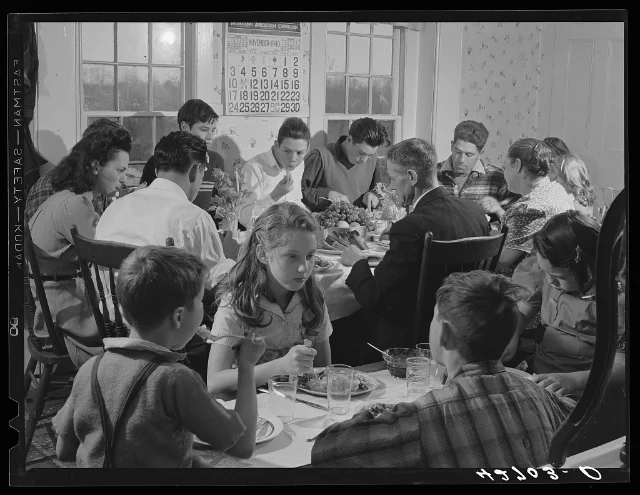
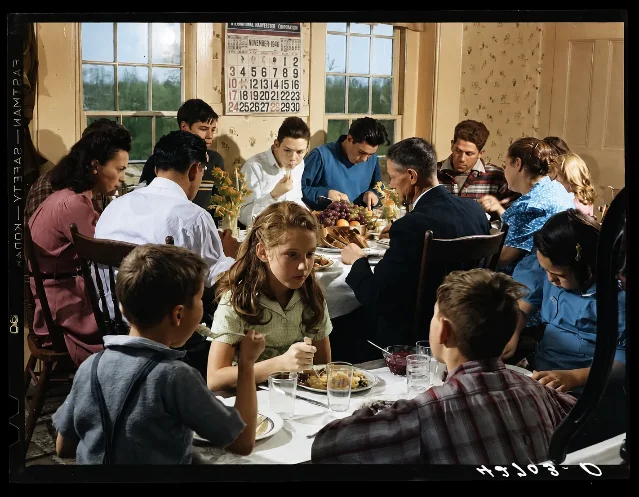
Jack Delano was born Jacob Ovcharov in Kiev in 1914, grew up in Philadelphia, and trained in music and art before the FSA hired him in 1940. His eastern assignments ran from New England factories to Puerto Rico; he settled in Puerto Rico after the war and kept working in film and music there.14
In November 1940 he photographed the family of Timothy Levy Crouch, a Rogerene Quaker in Ledyard, Connecticut, at their annual Thanksgiving dinner. The agency caption notes that a twenty-pound turkey "was dispensed with in short order."13 A November 1940 calendar hangs on the wall. Kids crowd the table. Someone still has work clothes on. This is not a studio Thanksgiving; it is a full house after hard years, recorded by a federal photographer whose brief was American life as it actually looked.
Color turns the plaid shirts, fruit bowl, and wallpaper pattern into details memory usually invents later. The original already had the warmth; the palette only makes the claim harder to ignore.
What color can and cannot do
Automatic colorization is no longer a rare craft project. Tools built on models such as DeOldify, licensed into consumer products like MyHeritage In Color, can flood a scan with plausible hues in seconds.15 Artists including Marina Amaral still spend hours or months layering color by hand after archival research, aiming for historical accuracy rather than a default guess.16
Neither method recovers the true dyes of 1888 wool or 1936 denim unless someone measured them. Both can still change how a viewer enters the past. The originals above remain the primary documents. The colorizations are a second look — useful, persuasive, and provisional.
If a pair stops you, follow the Library of Congress link under it. The archive holds the full series, captions, and neighbors of each frame. That is where the story continues after the color fades back to gray.
References
- 1
- 2LOC research guide: Dorothea Lange's Migrant Motherguides.loc.gov
- 3
- 4Wikipedia: Dorothea Langeen.wikipedia.org
- 5
- 6
- 7
- 8Wikipedia: Farmer and Sons Walking in the Face of a Dust Stormen.wikipedia.org
- 9
- 10Wikipedia: John C. H. Grabillen.wikipedia.org
- 11
- 12
- 13
- 14Howard Greenberg Gallery: Jack Delanohowardgreenberg.com
- 15
- 16My Modern Met: Marina Amaral colorized photosmymodernmet.com
History in Color
Weekly illustrated articles pairing public-domain historical black-and-white photographs with AI colorizations and the photographer and event backstories behind each frame.
This story was produced automatically by a channel. One sentence is all it takes for Neodrop to keep producing for you.
Related content
- Sign in to comment.