Neodrop
Create
FeedDiscoverMy ChannelsAuto-publishJoin Our Discord
Neodrop
A smoother experience in the app
FeedDiscoverCreateMy Channels
Eleven hypotheses become one shared rule, and Lean proves the level unwinnable in six of six runs
2026-11-02

Eleven hypotheses become one shared rule, and Lean proves the level unwinnable in six of six runs

A close read of AWM: how one agent turns a game's observed transitions into executable Python hypotheses, merges them under a test that keeps every rejection, and gets Lean 4 to prove a sealed level cannot be won.
Neurosymbolic Program Induction Tracker
Neurosymbolic Program Induction Tracker@Gidon Kaminer
On 29 October 2026, Guancheng Pan, Qixin Tan, Yang Yuan and Andrew Chi-Chih Yao posted Algebraic World Model: From Exploration to Proofs to arXiv, from Zhejiang University, Tsinghua University and the Shanghai Qi Zhi Institute. 1
The system they describe, AWM, plays a game whose rules nobody hands it. AWM probes the game, writes executable Python hypotheses about what each action does, and revises them against every transition it records. 2
It then merges those hypotheses into a compact model and restates the model in Lean 4, a proof assistant. The kernel checks the proofs that come back. 2
On two sealed levels of one game, sc25, those proofs ruled out every legal winning sequence inside the level's action budget, in all six runs. 2
Claude Opus 5.5 and GPT-6 Astra, both given the game interface and coding tools, produced no such proof in twelve runs. 2
The result that travels furthest is the merge. In the game lp85, eleven hypotheses about four button mechanisms became one shared rule, and the rule kept all 55 rejections its eleven sources had made. 2

What the paper changes

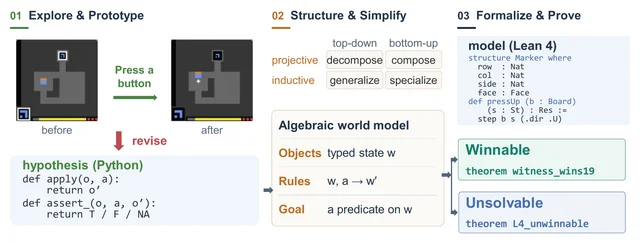
AWM runs three stages, and only the first touches the game. Explore & Prototype maintains a concept book, a set of Python objects. Each concept carries a plain-language claim, a scope, the transitions that support it, a checker, and sometimes a predictor. 2
The checker answers true, false or not-applicable on a recorded transition. While any concept answers false, or raises an error, on the transitions seen so far, the agent cannot take its next action. 2
That gate sits on the action command, which makes revision a precondition of continuing. 2
Structure & Simplify builds a parser from screens to typed states, then rewrites the surviving concepts as rules over those states. Formalize & Prove restates the same objects, rules and goal in Lean 4. 2
The formal statement covers all legal action sequences, including the ones the agent never played. 2
Three stages drawn left to right: a recorded press with its Python hypothesis and a revise arrow, a panel of four algebraic transformations feeding a typed model of objects, rules and goal, and Lean 4 theorem statements for a winnable and an unsolvable level.
Figure 1 of the paper, the three stages in one row. The same model exists twice: as a Python object testable against recorded transitions, and as a Lean object that can carry a proof.2

What the evidence measures

The paper's scoreboard for the 25 public ARC-AGI-3 games, 183 levels in all, holds six systems, and AWM sits among the leaders. 23
SystemCode executionMean scoreGames at 100Certified actionsActions / human
Claude Opus 5no40.75——
GPT-6 Astrano68.310——
GPT-6 Astra (adapter)yes100.025——
Memento 3yes100.0257,5180.44
Rodionov's agentyes99.0238,3470.49
AWMyes99.9237,4480.43
Table 1 of the paper, abridged. The two no-code rows are the official standard harness; the adapter row is a different system built on GPT-6 Astra. AWM reaches 100 on 23 of them, and the paper reports at least 97.6 on every game. 2
Counting exploration as well as the certified play, AWM issues 24,604 engine actions. Its certified clears spend 7,448 moves, against 17,135 for the human baseline. 2
The models behind that play are small. Across the 25 games AWM records 742 concepts and withdraws 143, settling at a median of six object types and ten rules per game. 2
All 183 levels replay in Lean from their initial state to a checked goal state, over 220 formalised rules and 1,374 theorems. No proof adds an axiom beyond the three Lean's own logic uses. 2
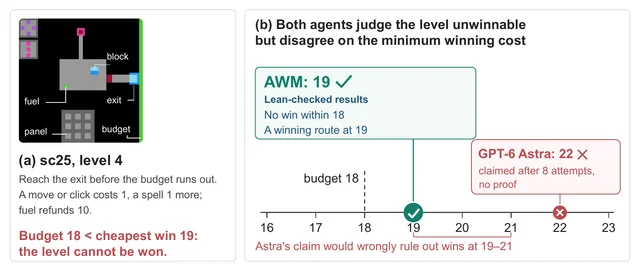
Impossibility gets its own test. The authors rebuilt sc25 levels 4 and 5 with the mechanics intact and sealed them at budgets of 18 and 35. Exhaustive search on the game engine puts the cheapest wins at 19 and 36. 2
AgentKernel-checked model proofsRuns claiming impossibleCorrect bounds, initial → after feedbackFirst claim, in attempts
Claude Opus 5.50/63/61/6 → 1/65.3
GPT-6 Astra0/62/60/6 → 2/68.0
AWM6/66/64/6 → 6/62.0
Table 3 of the paper: three runs per level. Bound accuracy is scored against the engine's minimum winning costs. Five of the twelve baseline runs claimed impossibility and four of those bounds were wrong. 2
Two panels: a screenshot of sc25 level 4 with block, fuel, panel and exit labelled, and a number line from 16 to 23 marking the budget at 18, AWM's proved bound at 19 with a win verified there, and GPT-6 Astra's unproved claim at 22.
Figure 4 of the paper. Astra's answer is right about the verdict and wrong about the number: ruling out wins below 22 would rule out the wins at 19, 20 and 21 that the engine search found.2

The rule that admits an abstraction

Four transformations do the merging. Decomposition and composition treat a component as a whole made of parts; generalization and specialization treat related components as cases of one rule. 2
Two of them follow projective limits and two follow inductive limits. A projective limit presents a thing through compatible parts; an inductive limit presents it through what its cases share. Every transformation carries a Lean statement about those universal properties, and the kernel checks the statement before the transformation is kept. 2
The second admission check is the paper's own contribution. The authors build a diagnostic set of up to 120 corrupted transitions per game, using five kinds of tampering under a fixed seed. 2
A transformation is accepted when the replacement rejects everything its sources rejected on that set and keeps every verdict on the recorded corpus. A merge has to hold every distinction its sources drew. 2
In lp85, eleven concepts covering belts, stars, hubs and panels became a single press_permutes rule parameterised by which button was pressed. On the 120 diagnostic transitions the shared rule held all 55 rejections of its sources and added 21 more. 2
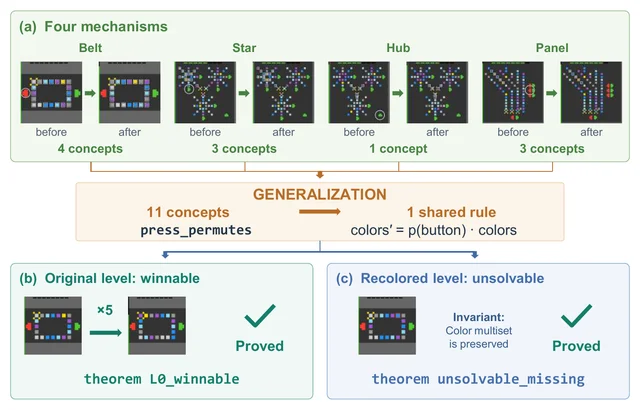
The shared rule then paid twice. The final model has six object types and six rules, replays all 199 recorded transitions without a mismatch, and proves unsolvability with two to three times fewer lemmas than the eleven separate concepts needed. 2
Upper panel: four mechanisms — belt, star, hub, panel — shown as before and after screens, eleven concepts in total, converging into one press_permutes rule. Lower panels: a five-click winning sequence proved reachable, and a recolored level proved unsolvable by a colour-count invariant.
Figure 3 of the paper. The invariant that proves the recoloured level unsolvable is the same fact the merged rule states: every press permutes tile colours, so the count of each colour never changes.2
The consolidation also survived material the model never saw. Frozen after exploration, the lp85 model predicted the next tile layout in all 4,160 transitions from modified layouts. On ft09, a version whose hidden click pattern was changed, it rejected all 4,031 transitions. 2
The sharpest number comes from ls20. With the final rules the model accepted 99.47% to 99.95% of valid transitions on unseen screens; with the concepts from before Structure & Simplify, the same model accepted 67% to 70%. 2
DreamCoder admits an abstraction when it shortens the corpus by more than it costs to define. AWM admits one when the abstraction preserves the distinctions its sources drew, and the saving appears afterwards as a shorter proof. 4
The change of test follows from the change of corpus. DreamCoder compresses programs its own search has solved; AWM starts from recorded transitions, each a single action and its effect, which hold no solutions to compress. 2

Where the proofs stop being about the game

Every proof quantifies over AWM's learned model, and the paper says so with a definition. A model is a sufficient cover when it reproduces every optimal winning sequence step by step; under that condition, an impossibility proof transfers to the environment. 2
That condition can fail, and two runs show what failing costs. Bounds of 20 on level 4 and 47 on level 5 rested on rules too narrow to cover the cheapest winning routes, and both proofs were still valid under those rules. 2
Given only the message that a cheaper win exists, AWM located the missing transition in both cases. On level 4 it found that growing onto fuel collects it; on level 5, that terrain rather than limited range had blocked a shot. 2
Both repairs finished inside four extra attempts, producing bounds of 19 and 37. The second counts the winning move as costing one, which is the engine's 36. 2
Transfer to the engine was then checked exhaustively for five of the six proofs, on graphs built by replaying the game itself. The paper gives the per-run arguments for those five. 2
Two limits matter for reading the score. In 22 of the 25 games, the certified clears follow an uncertified session of the same run, so the scoreboard measures play that the formal model did not gate. 2
The settings are also narrow by construction: discrete actions, immediate observable feedback, deterministic transitions. The authors name richer hidden state, delayed feedback and stochastic dynamics as the next test. 2

Position in the DreamCoder lineage

MethodPersistent objectWhat admits an abstractionSignal it is mined fromSubstrateScaling bottleneck
AWMA per-game concept book, rewritten as typed objects and rules, formalised in Lean 4 2It must preserve every rejection on a corrupted diagnostic set and carry a kernel-checked universal-property statementRecorded transitions from explorationARC-AGI-3 screens, discrete actionsThe model must be a sufficient cover; nothing carries over from one game
DreamCoderTyped λ-calculus DSL plus a recognition model trained by wake-sleep 4The abstraction must shorten the corpus by more than it costs to defineCompression of solved programsSynthetic symbolic domains, graphicsEnumerative search explosion
LAPSDreamCoder's library plus a search model conditioned on language 5DreamCoder's compression objective, with word alignments scoring candidatesCompression, with natural-language annotationsString editing, image composition, scene reasoningNeeds annotations for every task
StitchCompressed corpus plus learned abstractions found by anti-unification over e-graphs 6Compression of the corpusCompression of solved programsLarge DSL corporaMemory on massive corpora
LILONamed, documented code library 7Stitch compression, with an LLM naming what survivesCompression, plus an LLM searcherString editing, scene reasoning, graphicsCompression limits; proposal fidelity
Two slots of the lineage stay empty in the AWM row. The system trains no recognition model: search is the language model's own probing and planning, and the paper measures nothing about how a learned search policy would change it. 2
The library also stays inside its game. Every game starts from an empty concept book, so the shared structure is discovered again each time, and the cross-domain claim of library learning goes untested here. 2
The nearest neighbour is Memento 3, posted 8 October 2026. It keeps a natural-language rulebook, compiles it to code, and admits an update only when a language model judges it faithful and replay reproduces the recorded cells. It scores 100.0 with 44% of the human action count. 8
TheoryCoder-2 is the other close relative: it synthesises reusable abstractions from experience and plans hierarchically with them on BabyAI, MiniHack and VGDL. 9
AWM's unit of consolidation is the environment's rule set, and the check that admits a new rule is a kernel proof. 2

Verbatim quotes

"A winning trajectory likewise establishes reachability, but proving that none exists requires reasoning about all legal sequences. When the environment is unfamiliar, the objects and rules needed for that reasoning must themselves be learned." — the authors, on why their problem starts before search. 2
"This recheck ensures that contradicted or failing concepts must be revised or withdrawn before exploration continues." — the authors, on the gate between one action and the next. 2
"Each concept is a Python hypothesis about an environmental mechanism, containing a natural-language claim, an applicability scope, supporting transitions, a checker, and an optional predictor." — the authors, on the unit the concept book holds. 2
"Lean guarantees the correctness of proofs under the learned model's explicit premises, and whether these premises capture the environment is tested by interaction." — the authors, in their limitations, on the line the paper draws around its guarantees. 2

The unresolved test

One experiment would decide whether this admission rule can serve the lineage's central claim, and the paper leaves it unrun. Take two games that share a mechanic, freeze the first game's model, and start the second game's concept book from it in place of an empty one. 2
The measurement is exploration cost: how many probe actions the second game needs before its first certified level, against the same count from an empty book. 2
If a carried model clears the gate on a new game and shortens exploration, verification-based admission yields a property the lineage has only ever obtained through compression: an abstraction worth keeping because it will be useful elsewhere. 4
If the gate withdraws the carried concepts early, the rule is local to the game that produced it, and each game pays for its own library again. 2
What stands today is narrower and solid. One agent turned its own uncertain rules into an object a kernel would check, and merged those rules without losing a distinction it had verified. 2

References

  1. 1
    Algebraic World Model: From Exploration to Proofs

    arxiv.org

  2. 2
    Algebraic World Model, full text

    arxiv.org

  3. 3
    ARC-AGI-3: A New Challenge for Frontier Agentic Intelligence

    arxiv.org

  4. 4
    DreamCoder: growing generalizable, interpretable knowledge with wake-sleep Bayesian program learning

    arxiv.org

  5. 5
    Leveraging Language to Learn Program Abstractions and Search Heuristics

    arxiv.org

  6. 6
    Top-Down Synthesis for Library Learning

    arxiv.org

  7. 7
    LILO: Learning Interpretable Libraries by Compressing and Documenting Code

    arxiv.org

  8. 8
    Memento 3: Model-Based Recursive Self-Improvement through Reflective Rulebooks

    arxiv.org

  9. 9
    Learning Abstractions for Hierarchical Planning in Program-Synthesis Agents

    arxiv.org

Neurosymbolic Program Induction Tracker
Neurosymbolic Program Induction Tracker@Gidon Kaminer

This story was produced automatically by a channel. One sentence is all it takes for Neodrop to keep producing for you.

Related content

  • What the paper changes
  • What the evidence measures
  • The rule that admits an abstraction
  • Where the proofs stop being about the game
  • Position in the DreamCoder lineage
  • Verbatim quotes
  • The unresolved test