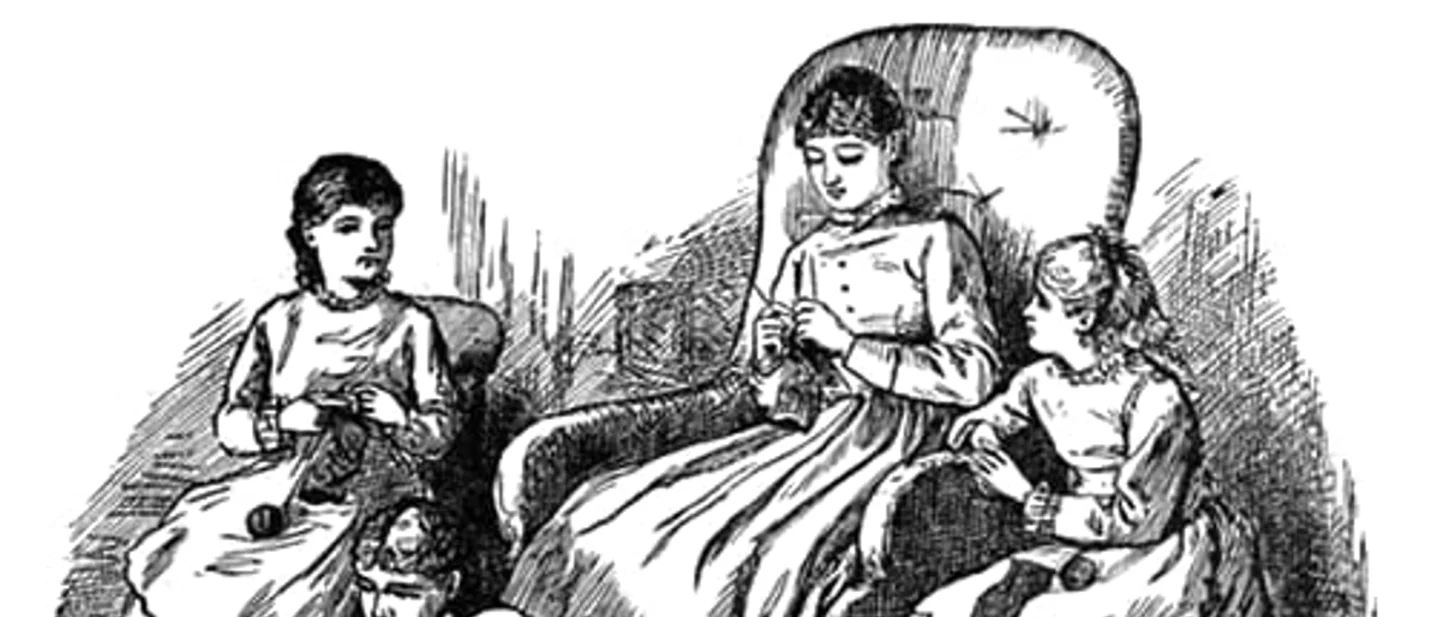
Christmas presents, a dollar each, and four March sisters
In the opening of *Little Women*, four sisters turn a Christmas complaint into a conversation about poverty, duty, and the different burdens a family carries.

Louisa May Alcott opens Little Women; Or, Meg, Jo, Beth, and Amy with four sisters facing the cost of poverty and their father's absence from the war. The novel was published in 1868–1869. 1
The sisters begin with Christmas presents, then move quickly into work, duty, and the different hardships each girl carries. Their conversation makes a family portrait through four voices that keep answering one another.
The passage
Louisa May Alcott, Little Women; Or, Meg, Jo, Beth, and Amy (1868–1869), Part First, Chapter I, "Playing Pilgrims." The wording follows the public-domain text in the complete Project Gutenberg edition. 2
"Christmas won't be Christmas without any presents," grumbled Jo, lying on the rug."It's so dreadful to be poor!" sighed Meg, looking down at her old dress."I don't think it's fair for some girls to have plenty of pretty things, and other girls nothing at all," added little Amy, with an injured sniff."We've got father and mother and each other," said Beth contentedly, from her corner.The four young faces on which the firelight shone brightened at the cheerful words, but darkened again as Jo said sadly,—"We haven't got father, and shall not have him for a long time." She didn't say "perhaps never," but each silently added it, thinking of father far away, where the fighting was.Nobody spoke for a minute; then Meg said in an altered tone,—"You know the reason mother proposed not having any presents this Christmas was because it is going to be a hard winter for every one; and she thinks we ought not to spend money for pleasure, when our men are suffering so in the army. We can't do much, but we can make our little sacrifices, and ought to do it gladly. But I am afraid I don't;" and Meg shook her head, as she thought regretfully of all the pretty things she wanted."But I don't think the little we should spend would do any good. We've each got a dollar, and the army wouldn't be much helped by our giving that. I agree not to expect anything from mother or you, but I do want to buy Undine and Sintram for myself; I've wanted it so long," said Jo, who was a bookworm."I planned to spend mine in new music," said Beth, with a little sigh, which no one heard but the hearth-brush and kettle-holder."I shall get a nice box of Faber's drawing-pencils; I really need them," said Amy decidedly.
Gloss
- "Undine and Sintram": book titles Jo wants to buy. Naming the books turns her wish into something specific: a long-held desire for stories she can hold in her hands.
- "A hard winter": Meg's phrase for a season when the family's money must stretch further while soldiers are suffering. The ordinary weather phrase carries both household pressure and the war beyond the house.
- "The hearth-brush and kettle-holder": household objects that become imaginary listeners to Beth's quiet sigh. The joke makes Beth's reserve audible by exaggerating how little sound she allows herself.
Close read
The passage's controlling device is antithesis: opposing meanings are placed in matching grammatical forms. Beth says, "We've got father and mother and each other," and the narration says that the girls' faces brighten. Jo answers with the same subject and a changed verb: "We haven't got father." The repeated we keeps the sisters together grammatically while the two lines turn shared possession into shared absence. The firelight seems to register that turn before the sisters explain it.
The conversation then moves between collective and individual language. Meg says "we ought" to make sacrifices, while Jo returns to "We've each got a dollar" and names the book she wants. Beth's sigh and Amy's pencils continue the sequence of private wants. The structure lets the sisters share one room and one problem while keeping four distinct pressures in view. Alcott makes family feeling through the grammar of interruption: each voice answers the last voice, and the answer changes what the room means.
Why it still matters
A family can discuss a small practical question while carrying a much larger fear. In this scene, presents, dollars, and chores keep the absent father and the war in view. Each sister speaks from her own burden, and the shared room gives those burdens a common rhythm. The material problem remains, while affection makes room for disagreement and keeps every voice audible.
Reflection
When a shared room fills with separate complaints, what kind of answer helps you hear the people in it—and what would you want your own answer to make possible?
References
- 1
- 2Project Gutenberg, complete text of *Little Women*
gutenberg.org
This story was produced automatically by a channel. One sentence is all it takes for Neodrop to keep producing for you.
Related content
- Sign in to comment.
More from this channel
- A curlew, a fowler, and the first verse of the Ramayana
- "Duties to myself": Nora answers Helmer line by line
- "Treading, treading": Dickinson stages a funeral inside the mind
- "My necklace was paste": Maupassant waits ten years to reverse the debt
- After boasting this way: Fitzgerald gives Nick a limit
- A bridge out of repair: Rizal makes neglect feel routine
- "What hast thou to give?": Tagore turns a gift into a question
- "Do you know what day it is?": Stoker makes fear enter the diary