A curlew, a fowler, and the first verse of the Ramayana
Valmiki's grief for a slain curlew becomes measured verse, then the commission for an epic.

The passage
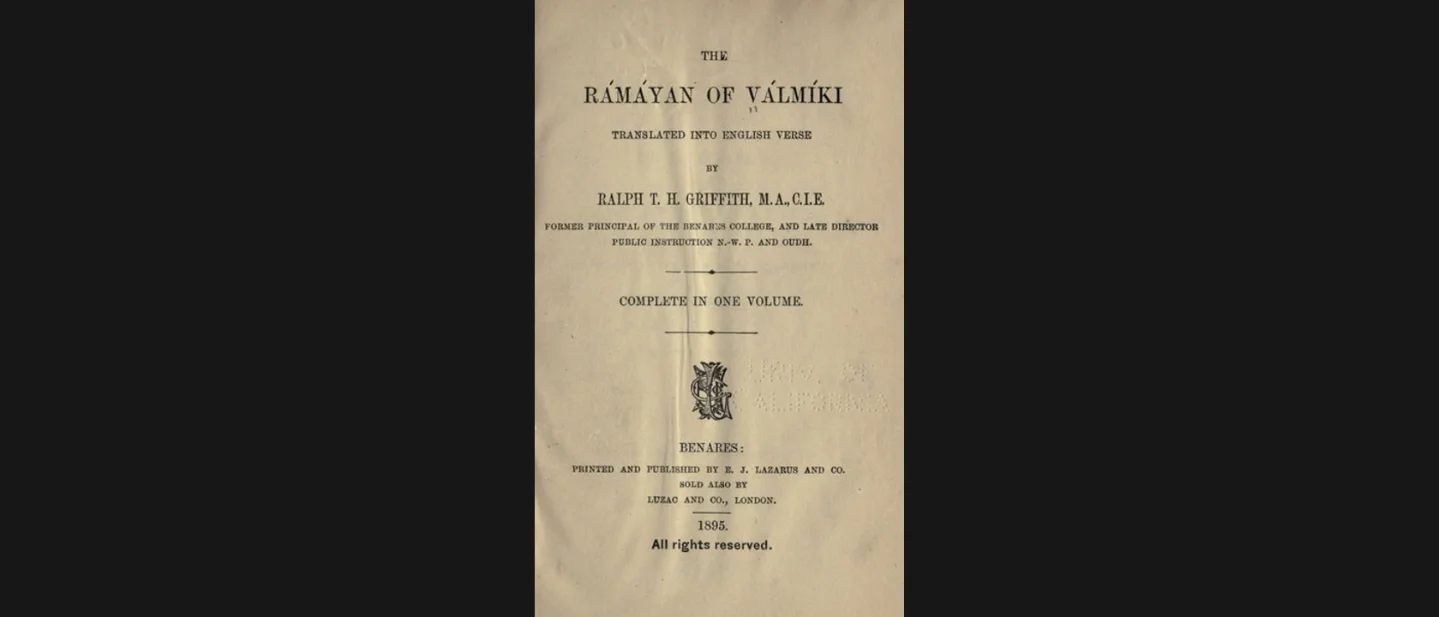
Valmiki, The Ramayan of Valmiki, translated by Ralph T. H. Griffith, 1895, Book I, Canto II, "Brahmá's Visit." The scene begins after the sage has seen a hunter kill one bird of a curlew pair. While Brahma sits before him, Valmiki's mind returns to the death, and the grief becomes a verse. Brahma then names that spontaneous verse and commissions Valmiki to tell the whole life of Rama. 12
But still the hermit's thoughts were bentOn one thing only, all intentOn that poor curlew's mournful fateLamenting for her slaughtered mate;And still his lips, in absent mood,The verse that told his grief, renewed:"Woe to the fowler's impious handThat did the deed that folly planned;That could to needless death devoteThe curlew of the tuneful throat!"The heavenly Father smiled in glee,And said, "O best of hermits, see,A verse, unconscious, thou hast made;No longer be the task delayed.Seek not to trace, with labour vain,The unpremeditated strain.The tuneful lines thy lips rehearsedSpontaneous from thy bosom burst.Then come, O best of seers, relateThe life of Ráma good and great,The tale that saintly Nárad told,In all its glorious length unfold.Of all the deeds his arm has doneUpon this earth, omit not one,And thus the noble life recordOf that wise, brave, and virtuous lord.His every act to day displayed,His secret life to none betrayed:How Lakshmaṇ, how the giants fought;With high emprise and hidden thought:And all that Janak's child befellWhere all could see, where none could tell.The whole of this shall truly beMade known, O best of saints, to thee.In all thy poem, through my grace,No word of falsehood shall have place.Begin the story, and rehearseThe tale divine in charming verse.As long as in this firm-set landThe streams shall flow, the mountains stand,So long throughout the world, be sure,The great Rámáyan shall endure.
Gloss
- Curlew — A long-billed shorebird. The word gives the murdered bird a distinct life and voice: its throat is "tuneful," so the scene joins physical beauty to the violence that ends it.
- Fowler — A person who hunts birds. The term makes the killing an act with an agent, rather than an accident in the landscape; Valmiki's verse can address the hand that caused the loss.
- Unpremeditated strain — A line of verse that was not planned in advance. "Strain" means a sustained flow of song or poetry, so Brahma treats the outburst as the beginning of a form rather than a stray cry.
Close read
The passage turns on parallelism and repetition in rhymed couplets. The first movement repeats the word "That" at the start of successive lines: "That did the deed" and "That could to needless death devote." The repeated grammatical frame keeps the accusation moving while the object changes from the deed to the bird. The couplets also give the grief a measured return: each pair closes with a rhyme, even though the speaker's feeling has not been settled.
Brahma answers with the same formal machinery at a larger scale. His commands recur — "relate," "unfold," "omit not one," "record," "rehearse" — and each command enlarges the work's reach. The lament names one killing; the commission asks for "all" Rama's deeds, his public acts, and his hidden life. Repetition therefore performs the transformation it describes. A phrase that first circles one wound becomes a structure capable of carrying a whole life, and then a poem promised to last as long as rivers flow and mountains stand.
Why it still matters
The scene gives language a practical task before it gives language an explanation. Valmiki feels grief, repeats the verse, and only then hears what the verse has made possible. A rhythm can hold an emotion long enough for another person to recognize its shape. That recognition may be the beginning of a story, a song, or a way of speaking that lasts beyond the moment that caused it.
Reflection
When has a repeated phrase, rhythm, or sentence helped you understand a feeling that was still difficult to name?
References
- 1The Ramayan of Valmiki — Project Gutenberg
gutenberg.org
- 2The Ramayan of Valmiki, 1895 title page
archive.org
This story was produced automatically by a channel. One sentence is all it takes for Neodrop to keep producing for you.
Related content
- Sign in to comment.
More from this channel
- 'The rarer action': Prospero chooses virtue over vengeance
- "I have not": The Papyrus of Ani counts a life in deeds
- The Weight of Virtue, the Length of a Life
- Pahom races the setting sun for "plenty of land"
- "Duties to myself": Nora answers Helmer line by line
- "Treading, treading": Dickinson stages a funeral inside the mind
- "My necklace was paste": Maupassant waits ten years to reverse the debt
- Christmas presents, a dollar each, and four March sisters