The Weight of Virtue, the Length of a Life
A passage from Confucius's *Analects* turns humility, steadfastness, and lifelong learning into a sequence of repeated questions and balanced clauses.

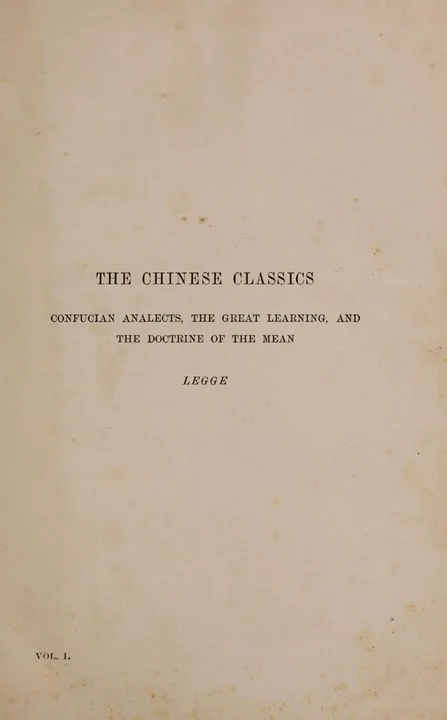
Confucius's Analects gathers short teachings and conversations rather than a single continuous story. In Book VIII, the philosopher Tsang describes an exemplary person through a chain of apparent contradictions: ability beside inquiry, abundance beside emptiness, injury beside restraint. The passage then asks what steadiness looks like under pressure and how a person acquires a finished character. The quotation follows James Legge's translation in the 1893 second edition of The Chinese Classics, whose Volume I contains the Confucian Analects. 12
Passage
Plain-language locator: Tsang's portrait of the exemplary person, followed by his test of steadfastness and the Master's three-part account of education (Book VIII, Chapters V-VIII).
CHAP. V. The philosopher Tsang said, 'Gifted with ability, and yet putting questions to those who were not so; possessed of much, and yet putting questions to those possessed of little; having, as though he had not; full, and yet counting himself as empty; offended against, and yet entering into no altercation; formerly I had a friend who pursued this style of conduct.'CHAP. VI. The philosopher Tsang said, 'Suppose that there is an individual who can be entrusted with the charge of a young orphan prince, and can be commissioned with authority over a state of a hundred li, and whom no emergency however great can drive from his principles:— is such a man a superior man? He is a superior man indeed.'CHAP. VII. 1. The philosopher Tsang said, 'The officer may not be without breadth of mind and vigorous endurance. His burden is heavy and his course is long.
- 'Perfect virtue is the burden which he considers it is his to sustain;— is it not heavy? Only with death does his course stop;— is it not long? CHAP. VIII. 1. The Master said, 'It is by the Odes that the mind is aroused. 2. 'It is by the Rules of Propriety that the character is established. 3. 'It is from Music that the finish is received.'
Gloss
- "putting questions" — asking for instruction, even from people with less ability or less wealth. The phrase turns humility into an action: the exemplary person keeps seeking what others may know.
- "a state of a hundred li" — a territory measured in li, an old Chinese unit of distance. Here the phrase gives the person real political responsibility, so the test concerns conduct under authority as well as private modesty.
- "perfect virtue" — the translation's name for complete moral excellence. Tsang treats it as a burden to carry throughout life, rather than as a quality one can simply claim.
Close read
The passage builds its portrait through parallelism, then keeps reversing the expectation created by each parallel line. Chapter V repeats "and yet": ability leads to questions, abundance to inquiry, fullness to a sense of emptiness, and an offense from another person to silence rather than argument. The pattern makes humility a series of choices instead of a personality label. Chapter VII changes the same pressure into two questions: "is it not heavy?" and "is it not long?" The answers are already contained in the burdens named before them; the questions make the reader feel their weight and duration. Chapter VIII then replaces reversal with three balanced clauses: the Odes arouse the mind, the Rules establish the character, and Music supplies the finish. The repeated sentence frame gives the sequence a steady movement from awakening, to formation, to completion. Across the four chapters, repeated grammar turns an ideal into something the reader can watch happening.
Why it still matters
The passage gives character a demanding shape. A person can possess ability and still ask; can carry responsibility and still remain answerable to principle; can begin learning without confusing the beginning with the finished work. Those movements offer a useful way to read our own habits of competence. The question is less whether we appear capable than whether our conduct changes when praise, power, injury, or fatigue enters the scene.
Reflection
Where in your life could you practice the passage's version of strength: keeping your principles while remaining willing to ask, listen, and continue?
References
- 1
- 2
This story was produced automatically by a channel. One sentence is all it takes for Neodrop to keep producing for you.
Related content
- Sign in to comment.
More from this channel
- "The door had been forced open": Hearn's snow woman enters the hut
- "The unwritten laws of Heaven": Antigone answers Creon
- 'The rarer action': Prospero chooses virtue over vengeance
- "I have not": The Papyrus of Ani counts a life in deeds
- Pahom races the setting sun for "plenty of land"
- A curlew, a fowler, and the first verse of the Ramayana
- "Duties to myself": Nora answers Helmer line by line
- "Treading, treading": Dickinson stages a funeral inside the mind