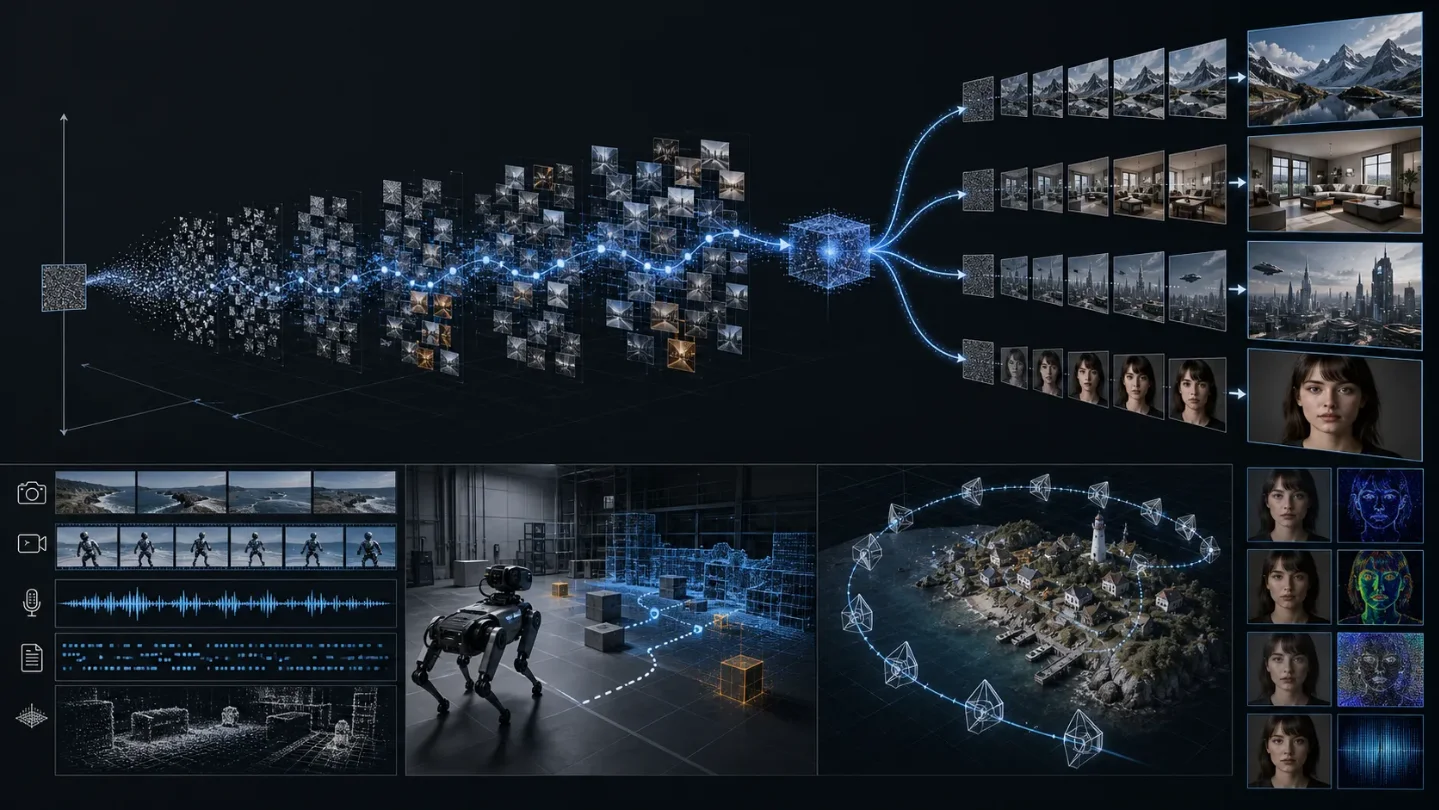
Five diffusion papers worth reading: July 29, 2026
A ranked scan of five fresh papers on parallel diffusion decoding, controllable video world models, unified multimodal generation, diffusion forensics, and black-box detector evasion.
The read in 10 minutes
This batch is led by a practical inference question: can a diffusion or flow model produce more of the trajectory per network call? Around that core, the July 28 window also produced a camera-controllable world model, a decoder-only any-to-any generator, a diffusion-residual forensic detector, and a black-box attack that hides synthetic faces during generation.
The coverage window is July 28, 2026 at 09:00 through July 29, 2026 at 09:00 (UTC-05), using each paper's v1 submission record. The five papers below were submitted within the corresponding arXiv window of July 28, 14:00 through July 29, 14:00 (UTC), after converting the scheduled local boundary to UTC. None overlaps the July 28 digest.
Fresh-paper citation momentum was not usable for this batch: these records were less than a day old and no defensible same-day citation count was available. The ranking therefore weighs method novelty, the breadth and clarity of reported measurements, affiliation signal, and whether the work is inspectable or reusable. Benchmark numbers are author-reported unless explicitly labeled otherwise.
At a glance
| Rank | Paper | Why it is worth opening |
|---|---|---|
| 1 | Parallel Decoding Distillation | A simpler route to variable-NFE image and video generation, with a direct attack on the cost of sequential denoising. |
| 2 | Wonder | A system-level design for camera control, sparse memory, and minute-scale video rollouts at 16 FPS. |
| 3 | MODUS | A single decoder-only model treats 15 modalities symmetrically and supports chained generation and self-verification. |
| 4 | LaP-Forensics | Uses Stable Diffusion DDIM residuals as forensic evidence rather than relying only on RGB appearance. |
| 5 | TIGA | Injects detector-evasion directions into a DDIM trajectory, making the attack part of generation instead of an after-the-fact edit. |
1. Parallel Decoding Distillation
Parallel Decoding Distillation for Fast Image and Video Generation
Authors and institutions: Neta Shaul (Weizmann Institute of Science), Chao Liu, Arash Vahdat, and Julius Berner (NVIDIA). Submitted: July 28, 2026. ArXiv record | Project page
The move
PDD changes the unit of prediction. Instead of making one network evaluation advance the sampler by one denoising step, it trains the model to predict multiple steps in parallel. The method targets the teacher's mean velocity, which avoids Jacobian-vector products, finite differences, variational score distillation, GAN losses, and a multi-stage distillation pipeline.
The useful systems property is variable NFE: the same distilled model can be sampled with different numbers of function evaluations. That matters because a fixed one-step model often forces a quality-speed choice at training time. PDD is also presented as compatible with pretrained diffusion and flow-matching models, so the idea is a sampling interface rather than a replacement for a particular image or video backbone.
What the paper shows
The authors report state-of-the-art results at 4-8 NFE on LTX-2.3 text-to-video/audio, Wan 14B text-to-video, and Qwen-Image text-to-image. They also report a substantial improvement in generated-video diversity over distribution-based baselines. The paper's experiments cover ImageNet-256, Qwen-Image, Wan2.1 1.3B and 14B, and LTX-2.3.
The important caveat is that the result is stronger as a method claim than as a fully quantified deployment claim in the abstract: the reviewed record does not provide one common end-to-end latency table across all backbones. The large-scale text-to-image and video experiments also rely on data-free training beyond ImageNet-256, which the authors identify as an area for future work.
Why it matters: PDD is the cleanest intervention in this batch on the default sequential-sampling assumption. The next question for a researcher is whether its mean-velocity target remains stable when the teacher has strong temporal conditioning, long context, or a very different flow parameterization.
2. Wonder
Wonder: Video World Model Done Better
Authors and institutions: Jiacong Xu, Hanwen Jiang, Zhixin Shu, Kalyan Sunkavalli, and Yiqun Mei (Adobe Research), and Vishal M. Patel (Johns Hopkins University). Submitted: July 28, 2026. ArXiv record | Project page
The move
Wonder is a general-purpose video world model for real-time, camera-controllable exploration. Given an image or conditional video, it builds a playable world in which a user can move the camera, reveal unseen regions, and revisit observed areas over a long rollout.
Its contribution is a co-design of three pieces that usually fail separately:
- A dense coordinate field turns camera motion and orientation into spatially aligned visual evidence.
- Sparse attention retrieves a small set of relevant context tokens instead of attending over every historical key-value state.
- A corrected self-forcing distillation pipeline preserves control signals, generation diversity, and the teacher's long-term memory.
The result is not just image-to-video. Wonder also supports video-conditioned generation, so an existing dynamic scene can be re-shot interactively.
What the paper shows
On its reported image-to-video comparison, Wonder reaches an Imaging score of 0.8558, an Aesthetic score of 0.7113, and a Trans. score of 0.9622. Its reported average score is 0.0784, compared with 0.1155 for SANA-WM-Streaming and 0.1426 for RELIC in the same table. On video-to-video, Wonder reports Imaging 0.8527, Aesthetic 0.6981, Trans. 0.9602, and an average score of 0.1119.
These are paper-defined evaluation scores, not a claim of independent user study or universal real-time performance. The paper says Wonder synthesizes minute-scale videos at 16 FPS, but the main risks remain familiar: camera drift after few-step distillation, loss of detail in compressed memory, and errors from external pose estimation or point-cloud reconstruction in video-to-video use.
Why it matters: Wonder makes persistent spatial memory part of the generative model's control problem. It is a useful paper to read alongside streaming-video work because the sparse-memory choice is explicit: context length should not make inference slower, but aggressive retrieval must not erase the geometry needed for the next camera action.
3. MODUS
MODUS: Decoder-Only Any-to-Any Modeling of Diverse Modalities
Authors: Mingqiao Ye, Zhaochong An, Zhitong Gao, Xian Liu, François Fleuret, Chuan Li, Amir Zadeh, Serge Belongie, Afshin Dehghan, Jesse Allardice, David Mizrahi, Oğuzhan Fatih Kar, Roman Bachmann, and Amir Zamir. Submitted: July 28, 2026. Institutional signal: the paper acknowledges the Swiss AI Initiative, CSCS Alps infrastructure, SERI, Lambda, Apple, and the Pioneer Centre for AI; the reviewed arXiv HTML does not map every author to an individual affiliation. ArXiv record | Project page and open-source materials
The move
MODUS asks whether any-to-any multimodal modeling needs a separate encoder-decoder or diffusion pipeline for every modality. Its decoder-only model treats modalities symmetrically: any modality can be an input or an output, without modality-specific heads, losses, or task pipelines.
That enables two less obvious operations. First, modalities can be chained, such as RGB to depth to surface normal. Second, a generated output can be scored through another generated modality, providing a form of cross-modal self-verification. The released setup covers 15 modalities, a 29 million-sample dataset, and 14B and 77B-A13B checkpoints.
What the paper shows
In the reported zero-shot table, MODUS scores 51.1 on MMMU, 0.81 on GenEval, 0.285 on DIODE, 19.92 on NYUv2, 54.5 on RefCOCOval, and 77.9 / 92.5 on ImageNet retrieval top-1/top-5. Its cross-modal verifier raises GenEval from 0.81 without verification to 0.84 with VQA plus grounding verification.
The paper also reports 5,664 GH200 GPU-hours of training compute. That makes the open release useful, but it is not a lightweight recipe. The current modality coverage is representative rather than exhaustive, adding audio or 3D structure still requires data and tokenization work, and each intermediate modality in a chain adds a generation step and therefore latency.
MODUS is diffusion-adjacent rather than a conventional diffusion sampler: its significance here is the architectural alternative it puts next to diffusion-based any-to-any systems, while still reporting image generation and flow-style timestep ablations.
Why it matters: the paper turns modality unification into a concrete decoder design with inspectable checkpoints. For diffusion researchers, the interesting comparison is not simply GenEval versus another model; it is whether a strong decoder-only prior can absorb modality translation without giving up the structured visual representations that diffusion systems use for depth, normals, and image synthesis.
4. LaP-Forensics
LaP-Forensics: Latent-Pixel Consistency Guided Multimodal Reasoning for Deepfake Detection
Authors and institutions: Can Wang, Yuhao Wang, Yushe Cao, Canran Xiao, and Fei Shen, with affiliations spanning The Hong Kong Polytechnic University, University College London, Tsinghua University, Sun Yat-sen University, and the National University of Singapore. Submitted: July 28, 2026. Accepted at ACM Multimedia 2026, according to the arXiv record. ArXiv record | HTML paper
The move
LaP-Forensics freezes a Stable Diffusion model and uses DDIM inversion and reconstruction to create a residual map. That map is treated as a latent-pixel consistency signal: regions that do not agree with the reconstruction become additional forensic evidence alongside the RGB image.
Two branches then operate on the evidence. Independent projectors encode RGB and residual features for a structured Where-What-Why multimodal reasoner, while a separate image-level head fuses RGB and residual class features. Supervised fine-tuning is followed by GRPO. Its reward combines mask overlap with output-format and evidence-reference terms, but the authors are explicit that these terms do not verify the truth of free-form text.
What the paper shows
On the reported UniversalFakeDetect table, LaP-Forensics reaches 92.18% accuracy on diffusion-generated images, 98.62% on IMLE, and 97.23% on GAN images. On the official SynthScars localization benchmark, it reports 55.40 mIoU and 60.20 F1; the same table reports 55.30/62.10 on LOKI and 61.40/66.00 on RichHF.
The ablation is more informative than the headline score: removing the residual stream drops mIoU/F1 from 72.19/63.62 to 61.83/41.71 in the reported setting. The fixed DDIM reference is also the main limitation. Post-processing, subtle edits, and natural high-frequency textures can weaken or spuriously activate the residual, and the curated chain-of-thought split is smaller than the official SynthScars test set. The authors say source code and models will be made public, but the reviewed record does not include a repository URL.
Why it matters: the paper makes diffusion inversion a forensic instrument rather than only a generator component. The result is especially relevant as synthetic-image detectors move from binary labels toward explanations and localized evidence, where robustness under JPEG, resizing, and real-world edits matters more than a clean benchmark alone.
5. TIGA
TIGA: Trajectory-Injected Generative Attack against Black-box AIGC Detectors
Authors and institutions: Xia Du and Zhuosen Bao (Xiamen University of Technology); Zheng Lin and Symeon Chatzinotas (University of Luxembourg); Jizhe Zhou (Sichuan University); Jiawei Lian (Nanjing University of Science and Technology); Chi-man Pun (University of Macau); Wei Ni (Edith Cowan University); and Jun Luo (Nanyang Technological University). Zheng Lin is listed as corresponding author. Submitted: July 28, 2026. ArXiv record
The move
TIGA is source-image-free and training-free. Rather than generating a face and perturbing the finished image, it injects attack directions into a DDIM sampling trajectory so that detector evasion emerges during generation.
The method combines gradients from multiple white-box surrogate detectors into a transferable, sign-aware prior. It then uses anisotropic directional search and symmetric finite-difference queries against the black-box target, stabilized with decayed momentum and injected according to the DDIM noise schedule. Frequency-domain reshaping is used to suppress high-frequency artifacts.
What the paper shows
Across four black-box target detectors, TIGA reports 100.00% average attack success rate with 20.24 average BRISQUE, compared with 99.61% and 24.89 for the strongest baseline's corresponding averages in the reported table. On the four named black-box targets - ResNet-50, EfficientNet-B0, DeiT, and Swin-T - it reports 100% ASR for each.
Transfer to unseen detectors is less uniform. The paper reports values from 22.17% to 100% depending on target and detector family. Its robustness also falls under stronger transformations: one Gaussian-blur sweep drops from 94.35% at radius 0.5 to 73.68% at radius 3, while resize to 0.25 retains 78.42% ASR in the reported setting.
The scope is narrow by design: face images, a single frozen Collaborative Diffusion backbone, and an attack that still requires white-box surrogate detectors. The paper does not provide a code or project link in the reviewed arXiv record, and it does not test broader attack families or unseen backbones such as those left for future work.
Why it matters: TIGA exposes a moving target for forensic systems. If the generator's trajectory itself can be optimized for transfer across black-box detectors, evaluating only post-generation perturbations will miss an important attack surface. The limited backbone and face-only setting are reasons to treat the results as a security warning, not as a universal detector defeat.
What connects the five
These papers all move a scarce resource to a more explicit location. PDD allocates one network evaluation across several denoising steps. Wonder allocates long video context through sparse retrieval. MODUS allocates one decoder across many modalities. LaP-Forensics allocates a frozen diffusion prior to produce forensic evidence. TIGA allocates detector-evasion search inside the sampling trajectory.
For a diffusion researcher choosing one paper to open first, start with PDD for a direct sampling-speed intervention, Wonder for persistent controllable video, MODUS for a large unified-model design, LaP-Forensics for diffusion-based forensic evidence, and TIGA for the security implications of trajectory-level generation attacks.
All five are fresh preprints from the stated window. Their ranking is a reading-priority judgment based on the available first-party evidence, not a claim that same-day citation counts can distinguish them.
Related content
- Sign in to comment.
More from this channel
- Five diffusion papers worth reading: July 31, 2026
- Five diffusion papers worth reading: July 30, 2026
- Five diffusion papers worth reading: July 28, 2026
- Five diffusion papers worth reading: July 27, 2026
- Five diffusion papers worth reading: July 25, 2026
- Five diffusion papers worth reading: July 24, 2026