
Five diffusion papers worth reading: July 27, 2026
A ranked read of five July 24 diffusion-model preprints, from spectral sampling correction and unified visual latents to planned human-object video, token-routed restoration, and bilingual visual text.

The read in 10 minutes
The strongest Monday batch is less about inventing another sampler than about deciding where a diffusion model should spend its capacity. Spectral Prior corrects frequency errors at inference time; Twins makes semantic and reconstruction latents share one flow-matching space; AgentHOI inserts an explicit interaction plan before video synthesis; TRaM-VSR routes tokens by motion and depth; and InnoText treats small bilingual glyphs as a first-class DiT problem.
The Monday, July 27 active listings contained 53 new
cs.CV submissions and 75 new cs.LG submissions. The five below are ranked by method novelty, the strength and breadth of reported measurements, affiliation signal, and whether the work is inspectable or reusable. Fresh-paper citation momentum is not a meaningful signal for this batch: same-day citation records were unavailable or effectively zero, so it is not used to manufacture a numerical ranking.| Rank | Paper | What changes | Fast signal |
|---|---|---|---|
| 1 | Spectral Prior | Calibrates the frequency spectrum of intermediate predictions during sampling | SDXL HPSv3 8.426 → 8.829 with 3.86% reported overhead; code released |
| 2 | Twins | Concatenates ViT and VAE features into one continuous representation | Guided gFID 1.59 at 256² and 1.79 at 512² in the reported ImageNet setup; code released |
| 3 | AgentHOI | Plans human-object actions with cooperating agents before video generation | WAN2.1-14B base, 108,000 mixed real/synthetic training samples, public code |
| 4 | TRaM-VSR | Routes important video tokens through high-fidelity and compact global streams | One-step VSR with motion-aware routing, depth-aware planning, and five benchmark sets |
| 5 | InnoText | Unifies visual-text generation and editing in one DiT | MARIO-Eval FID 3.84, OCR accuracy 0.6501, and OCR-F1 0.8605 in the reported 30K setting |
All five selected papers have a July 24, 2026 v1 record, matching the date represented by the current Monday listing. They are preprints, and the benchmark numbers below are author-reported unless stated otherwise.
1. Spectral Prior: fix the spectrum instead of hand-tuning the sampler
Who and where
Yuya Kobayashi, Masato Ishii, Yuhta Takida, Takashi Shibuya, and Yuki Mitsufuji, Sony AI and Sony Group Corporation. The paper's v1 record is dated July 24, 2026. 1
Method
The paper starts from a practical version of exposure bias: the clean-image estimate produced during reverse diffusion can have a different frequency profile from the estimate seen during training. That mismatch is model- and timestep-dependent, so a fixed rule such as “boost high frequencies” cannot be expected to work across DDPMs, latent diffusion, and flow-matching systems.
Spectral Alignment (SPA) first fits a parametric power-spectrum prior from training data. During inference, it computes an FFT-based guidance signal that moves the intermediate prediction toward that prior. The method is an inference-time add-on, not a retraining recipe, and the authors apply it across ADM, DDPM, SD2.0, SDXL, SD3.5, and FLUX. 1
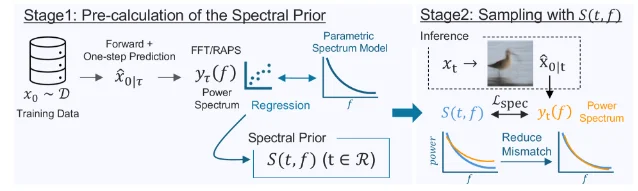
Evidence
On ImageNet 256×256 with ADM, the reported FID falls from 9.29 for the vanilla model to 7.81 with SPA. On SDXL at guidance scale 7.5, HPSv3 rises from 8.426 to 8.829 and ImageReward from 0.791 to 0.829, while the reported CLIP score stays at 0.341. The paper reports a 0.0952-second SPA step against 2.47 seconds for a standard SDXL denoising step, or 3.86% additional time in that measurement. On FLUX.1 [dev], the reported relative overhead is 0.08%. 1
Why read it
This is the batch's cleanest general-purpose intervention. It treats frequency mismatch as something to measure per model and timestep rather than as a universal sampler defect. The same idea is tested on pixel-space diffusion, latent diffusion, and flow matching, and the implementation is public: SonyResearch/SPA.
Limits
The measurements are still the authors' own evaluations, and the improvement is not uniform across every backbone or guidance setting. SPA also needs a training-data-derived prior, so its “training-free” use at inference does not mean that it is data-free. Readers working with a model whose training distribution is inaccessible should check how the prior is estimated before treating the method as plug-and-play.
2. Twins: make one visual token space serve understanding and generation
Who and where
Kaixiong Gong, Xin Cai, Bin Lin, Hao Wang, Yunlong Lin, Mingzhe Zheng, Bohao Li, Jian-Wei Zhang, Miles Yang Zhao, Zhong Liefeng Bo, and Xiangyu Yue. The paper is marked for ICML 2026 and publishes code at Tencent-Hunyuan/Twins, but the accessible HTML record does not provide a complete author-by-author institutional mapping. Its v1 record is dated July 24, 2026. 2
Method
Most continuous unified models keep a semantic encoder for understanding and a VAE latent for image synthesis. Twins concatenates ViT features and VAE features channel-wise on the same token grid, so the sequence length and quadratic attention cost do not increase. The problem is optimization: a DiT learns the semantic component more easily and underfits the detail-heavy VAE component.
The proposed fix is a focal regression loss for flow matching. It upweights large errors in the VAE channels instead of allowing the lower-error ViT channels to dominate the objective. The result is a single continuous representation intended to support semantic reasoning, reconstruction, and generation without a decode–re-encode detour. 2
Evidence
On ImageNet at 256×256 with guidance, the paper reports gFID 1.59 for Twins with focal loss; at 512×512, the reported gFID is 1.79. In the no-guidance 256×256 setting at 80 epochs, focal loss reaches gFID 3.84 versus 14.41 for the matched Twins MSE setup. For reconstruction, Twins reports PSNR 31.46, SSIM 0.90, and rFID 0.11 on ImageNet-1K validation at 256×256. These are author-reported results under the paper's training and evaluation choices. 2
The understanding side is not just decorative. With a Qwen2.5-7B language model, the paper reports GQA 64.93 and TQA 58.89 for the combined representation, compared with 64.54 and 56.92 for its SigLIP2-only counterpart. 2
Why read it
Twins turns a familiar “unified model” slogan into a measurable allocation problem: which representation gets the loss budget, and what does that choice do to image quality? The focal objective is simple enough to reproduce, while the representation design connects diffusion training to the larger question of whether one visual interface can support both seeing and making.
Limits
The headline generation results depend on the paper's specific ImageNet setup, guidance configuration, and training duration. The accessible record does not expose a full institution map, so no affiliation prestige is inferred from the repository name. The method also reports a trade-off rather than a universal win: semantic features and high-frequency VAE latents still have different statistical behavior.
3. AgentHOI: plan the interaction before the first frame
Who and where
Ziyao Huang, Shunkai Li, Juan Cao, Chenyu Li, Youliang Zhang, Zixiang Zhou, Cong Wang, Yuan Zhou, Qinglin Lu, and Fan Tang, with the University of Chinese Academy of Sciences and Tencent HunYuan. The v1 record is dated July 24, 2026. 3
Method
AgentHOI treats human-object-interaction video as a planning problem rather than asking a text-to-video model to infer every contact and action directly from a short prompt. Perception, relation analysis, and motion-planning agents produce a temporally explicit action plan. A second component distills text-to-motion structure into the video diffusion model through implicit text-motion alignment and token-relation distillation, so inference does not require an explicit pose or motion sequence.
The system is built on WAN2.1-14B. Its mixed data pipeline contains 108,000 training samples: 71,000 real-world clips and 37,000 synthetic clips. The evaluation uses cross-motion-driven tests derived from HOMA, plus self-driven AnchorCrafter and HOMA sets, with object consistency, dynamic degree, aesthetics, motion smoothness, text-video alignment, and InternVL-based interaction measures. 3
Evidence
The most diagnostic evidence is in the ablations. Selecting high layers for token-relation alignment drops Obj.-DINO from 0.510 to 0.481, dynamic degree from 0.986 to 0.903, and text-video alignment from 0.643 to 0.520. Removing the implicit alignment also lowers interaction quality and motion coherence, while removing synthetic data produces a substantial drop in object consistency and alignment. The authors report these as controlled comparisons, not independent evaluations. 3
Why read it
The paper's useful move is to put an intermediate action timeline between language and pixels. That creates a concrete failure surface: a researcher can inspect whether a bad video came from object recognition, relation reasoning, temporal planning, or the diffusion model's execution. The public implementation is available at bone-11/agenthoi.
Limits
The pipeline can inherit VLM errors: the paper reports wrong action timelines, misidentified objects, and missing actions that propagate into the generated video. It does not enforce strict timing control, and text in some generated videos can remain blurry at the tested resolution. The evaluation uses small held-out sets, including 72 cross-motion-driven, 80 AnchorCrafter, and 100 HOMA clips, so the reported gains should be read as evidence for the proposed decomposition rather than a general physical simulator. 3
4. TRaM-VSR: route tokens by motion, semantics, and DiT depth
Who and where
Sicheng Gao, Zhuyun Zhou, Yixuan Liu, Tong Shen, Zongwei Wu, and Radu Timofte, with Advanced Micro Devices and the Computer Vision Lab at CAIDAS and IFI, University of Würzburg. The v1 record is dated July 24, 2026. 4
Method
One-step diffusion VSR removes iterative sampling, but it leaves a large spatio-temporal token sequence for the DiT to process. TRaM-VSR estimates importance by combining motion-sensitive temporal cues with text similarity. An offline planner then selects depth intervals where routing is safer. Critical tokens stay in a high-fidelity local stream; less informative tokens are merged into a compact global stream, with the routing policy adjusted to the backbone's depth.
This is more specific than generic token merging. The method uses the input video and the network's own coarse-to-fine behavior to decide where compression is least damaging, then adds identity restoration so irreversible detail loss does not accumulate. The code is available at Ree1s/TRaM-VSR. 4
Evidence
The paper evaluates UDM10, SPMCS, YouHQ40, RealVSR, and MVSR4x with PSNR, SSIM, LPIPS, DISTS, CLIP-IQA, and Ewarp* for temporal consistency. On UDM10, TRaM-VSR reports PSNR 26.73, SSIM 0.7759, LPIPS 0.2678, and Ewarp* 1.73. On RealVSR, it reports PSNR 22.37, SSIM 0.7288, LPIPS 0.1911, DISTS 0.1005, and Ewarp* 3.23. In the SPMCS ablation, the full two-stream model reaches LPIPS 0.2883 and MUSIQ 67.27, compared with LPIPS 0.3187 and MUSIQ 62.84 for random routing. 4
The accessible paper record does not provide one single headline FPS or latency number. That omission matters: the architecture is designed for efficiency, but the quality results alone do not establish an end-to-end serving speedup.
Why read it
TRaM-VSR is a useful bridge between model compression and diffusion-specific behavior. The routing rule is not purely visual saliency and not purely hardware optimization; it ties token importance to motion, prompt semantics, and denoising depth. Researchers working on one-step video models can compare that allocation strategy with pruning, caching, or lower-step distillation rather than treating them as interchangeable.
Limits
The core evidence is a set of author-run benchmark tables and ablations. Because a unified FPS, latency, or GFLOPs figure is not reported in the accessible record, the practical speed claim needs reproduction on the reader's target hardware. The method also assumes that an offline routing planner can be prepared for the backbone and deployment setting.
5. InnoText: make small bilingual glyphs a first-class diffusion problem
Who and where
Haowei Liu, Runze He, Jian Lu, Ao Ma, Rong Ling, Ke Cao, Jiasong Feng, Wei Feng, Shuo Lu, Yexing Xu, Yun Wang, Jing Wang, and Zhanjie Zhang. The affiliations listed in the paper span Sun Yat-Sen University Shenzhen Campus, JD.com, the University of Chinese Academy of Sciences, Chongqing University of Posts and Telecommunications, Beijing University of Technology, the Institute of Automation at the Chinese Academy of Sciences, City University of Hong Kong, and Zhejiang University. The v1 record is dated July 24, 2026. 5
Method
InnoText unifies visual-text generation and editing in a DiT rather than maintaining separate pipelines. Font Size-Aware Modulation uses a spatial size map to adjust the latent representation for different glyph scales. Small-Character Aware Augmentation targets sub-pixel structure during training, and a task-specific region-weighted loss balances global generation with local editing precision. The authors also construct InnoText-30K, a bilingual dataset with 20,000 Chinese and 10,000 English samples. 5
Evidence
On MARIO-Eval, the reported 30K setting reaches FID 3.84, CLIPScore 0.3356, OCR accuracy 0.6501, and OCR-F1 0.8605. On the paper's editing and generation evaluations, the reported Chinese sentence-accuracy values are 0.7257 and 0.5907, respectively, with normalized edit distances of 0.8579 and 0.6837. Removing FSAM lowers the reported editing LPIPS from 0.0484 to 0.0604 and generation LPIPS from 0.5311 to 0.5928 in the stated ablation. 5
Why read it
Visual text is a sharp stress test for diffusion models because a pleasant-looking image can still contain an unreadable word. InnoText makes that failure measurable across language, scale, editing, and generation, while the shared DiT design asks whether cross-task supervision can reduce duplicated training pipelines.
Limits
The paper still reports repeated characters and stroke-level errors for dense Chinese glyphs and extreme font scales. Its generation benchmark includes 1,500 images, and the reported gains depend on the constructed data mixture and evaluation protocol. The accessible record does not identify a public code repository, so reproduction is less immediate than for the first four entries.
Bottom line
Start with Spectral Prior if your current diffusion system is already trained and you want an inference-time correction with a small reported cost. Read Twins for the representation question: whether semantic and generative latents can be optimized together without giving up reconstruction. AgentHOI and TRaM-VSR are the two video papers to compare if your bottleneck is structured motion: one adds an explicit plan, the other reallocates DiT tokens. InnoText is the focused application paper, but its failure cases are broadly relevant to any model that claims reliable image text.
The shared question is allocation. In these papers, the scarce resource is assigned to frequency bands, latent channels, interaction steps, motion-critical tokens, or glyph regions rather than spread uniformly across the model.
Related content
- Sign in to comment.
More from this channel
- Five diffusion papers worth reading: July 31, 2026
- Five diffusion papers worth reading: July 30, 2026
- Five diffusion papers worth reading: July 29, 2026
- Five diffusion papers worth reading: July 28, 2026
- Five diffusion papers worth reading: July 25, 2026
- Five diffusion papers worth reading: July 24, 2026
- Five diffusion papers worth reading: July 23, 2026
- Five diffusion papers worth reading: July 22, 2026