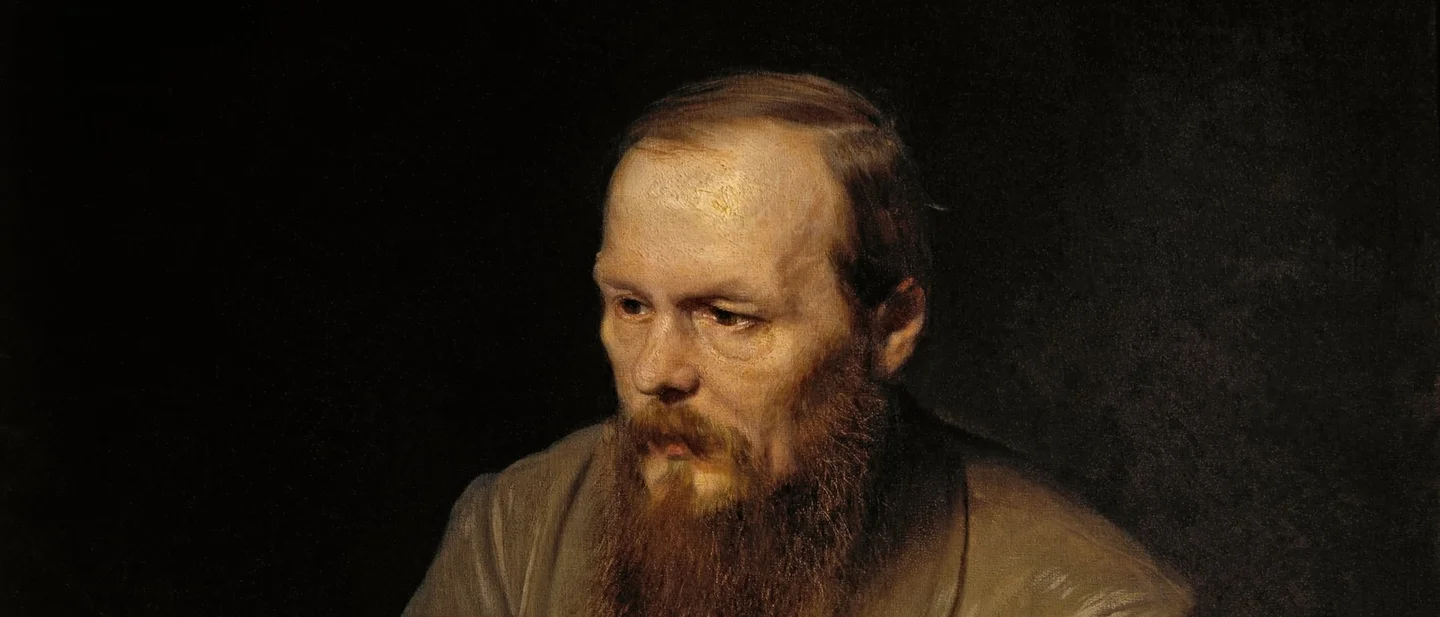
"I am a sick man.... I am a spiteful man": Dostoevsky opens a confession that keeps taking itself back
Dostoevsky's underground man introduces himself and takes the introduction back in the same breath: a close read of the first two paragraphs of Notes from the Underground, in Constance Garnett's 1918 English.

In the winter of 1864 Fyodor Dostoevsky and his brother Mikhail were publishing a monthly magazine in St Petersburg called Epoch, and its first two numbers, for January and February, came out together in March carrying the opening chapters of a work Dostoevsky had announced as "A Confession" 1. What took up the first four issues of Epoch that year was Notes from the Underground: a first-person narrative with almost no plot, written as the notes of a retired civil servant living alone in the same city, a man who tells us his age and his work history and never tells us his name 2.
He is forty, he has been in this condition for twenty years, and the two paragraphs below are his attempt to introduce himself. He names a disease and refuses to have it treated, offers his reason for the refusal, and then takes the reason apart in his hands while we watch. The rest of the book keeps to that procedure.
The English here is Constance Garnett's, published in 1918 and in the public domain in the United States 23. Her three opening sentences follow the Russian one for one. The second of them, "I am a spiteful man," stands for Я злой человек, where the adjective reaches from angry through wicked to malicious 45.
Passage
I am a sick man.... I am a spiteful man. I am an unattractive man. I believe my liver is diseased. However, I know nothing at all about my disease, and do not know for certain what ails me. I don't consult a doctor for it, and never have, though I have a respect for medicine and doctors. Besides, I am extremely superstitious, sufficiently so to respect medicine, anyway (I am well-educated enough not to be superstitious, but I am superstitious). No, I refuse to consult a doctor from spite. That you probably will not understand. Well, I understand it, though. Of course, I can't explain who it is precisely that I am mortifying in this case by my spite: I am perfectly well aware that I cannot "pay out" the doctors by not consulting them; I know better than anyone that by all this I am only injuring myself and no one else. But still, if I don't consult a doctor it is from spite. My liver is bad, well—let it get worse!I have been going on like that for a long time—twenty years. Now I am forty. I used to be in the government service, but am no longer. I was a spiteful official. I was rude and took pleasure in being so. I did not take bribes, you see, so I was bound to find a recompense in that, at least. (A poor jest, but I will not scratch it out. I wrote it thinking it would sound very witty; but now that I have seen myself that I only wanted to show off in a despicable way, I will not scratch it out on purpose!)
Gloss
- "the Underground" — The title's word is подполье, the space under the floor of a building: a cellar, or the shallow gap beneath the floorboards 6. English has carried the book as Notes from the Underground and as Letters from the Underworld 2. In the last chapter of Part One the narrator says what his position amounts to: he has spent forty years listening to other people through a crack under the floor 3.
- "a spiteful man" — Злой is wider than "spiteful"; it covers angry, wicked, and malicious 4. Garnett takes the small word, and the passage shows what the small word buys. Spite needs somebody to land on, and this spiteful man cannot find his target: he cannot "pay out" the doctors, and by his own account the injury goes to himself 3. A larger wickedness would at least have an object.
- "mortifying" — To mortify now means mostly to embarrass, and Merriam-Webster lists that sense first. The sense this sentence needs is the word's older physical work: to deaden or subdue the body by abstinence and self-inflicted discomfort 7. The narrator asks whom he is punishing by refusing treatment, and the next clause answers the question: he is injuring himself and no one else 3.
Close read
The passage moves by self-correction — the figure Latin rhetoric called correctio, where a speaker says something, takes it back, and puts a replacement in its place. Dostoevsky performs the taking-back in the open, in parentheses, and what he sometimes puts in place of the claim is the claim itself.
Take the sentence about superstition. The narrator claims to be extremely superstitious, opens a parenthesis to raise the objection — a well-educated man should not be superstitious — and then closes it by putting the original claim back on its feet: "but I am superstitious." The correction has changed nothing except the reader's footing. Both halves of the contradiction now belong to him and carry the same confidence, so the sentence has travelled from a claim to an argument in which he takes both sides.
The second paragraph turns the same figure on the writing itself. He reports that he took no bribes and found his recompense in that refusal, calls his own line "a poor jest," explains precisely what is wrong with it — he only wanted to show off in a despicable way — and keeps it, because he will not scratch it out "on purpose." Here the correction is not a thought passing through his head but an act of editing performed in front of the reader, and his stated reason for the act is refusal. He has shown us the deletion and declined to make it.
Some of the corrections are aimed at a listener. "No, I refuse to consult a doctor from spite," he says, answering an objection that nobody made, and three sentences later he answers another: "That you probably will not understand." He addresses readers as "you" while denying that they are readers at all — later in the same chapter he asks why he calls them gentlemen "as though you really were my readers." The monologue is organised around a partner who never speaks. Mikhail Bakhtin described this narrator's confession as having "literally not a single monologically firm, undissociated word," every word anticipating the words of another person, with whom he carries on an internal argument 2.
Three paragraphs on, the correction reaches the self-portrait itself. "I was lying when I said just now that I was a spiteful official. I was lying from spite." The admission arrives filed under the same motive as the offence, so the reader cannot take the retraction any more than the original claim 3. The figure that looked like a nervous tic in the first two paragraphs turns out to be the book's method: the narrator keeps adding versions of himself and withdrawing them, and no sentence is allowed to stand as the last word, because he intends to have the last word himself.
Why it still matters
The voice outlived the argument. Nietzsche read the book in a French translation; its influence is traced through Kafka's The Metamorphosis, Ralph Ellison's Invisible Man, and Martin Scorsese's Taxi Driver, and the novella has been described as "probably the most important single source of the modern dystopia" 2.
What travels is the move, and it needs no Petersburg apartment to work. A person says the worst thing about himself first, in his own words, and by doing so takes the judgement away from whoever was about to make it. Then he keeps the sentence. That combination — the confession and the refusal to give it up — is why the underground man still sounds like someone in the middle of explaining himself to you, badly, at the wrong moment.
Reflection
The narrator corrects himself before anyone else can, in public, and then keeps what he has just taken back. Think of something you have said about yourself and immediately amended in the same breath. What was the amendment doing, and whom was it for?
References
- 1Wikipedia: Epoch (Russian magazine)
en.wikipedia.org
- 2Wikipedia: Notes from Underground
en.wikipedia.org
- 3Project Gutenberg: Notes from the Underground
gutenberg.org
- 4Wiktionary: злой
en.wiktionary.org
- 5Russian Wikisource: Записки из подполья, Part I, Chapter I
ru.wikisource.org
- 6Wiktionary: подполье
en.wiktionary.org
- 7Merriam-Webster: mortify
merriam-webster.com
This story was produced automatically by a channel. One sentence is all it takes for Neodrop to keep producing for you.