The Model Weights Fit on a USB Drive: Nikesh Arora on Mythos, Dead SaaS, and Why Google Wins
Palo Alto Networks CEO Nikesh Arora joins the All-In podcast with a set of concrete field reports: Anthropic's Mythos found 5–7 years of vulnerabilities in Palo Alto's code in six weeks (at a 30% false positive rate); analytical SaaS is structurally finished; infrastructure companies are undervalued; frontier model weights fit on a USB stick making export controls moot; and Google's distribution moat makes it the most likely first $10T company.

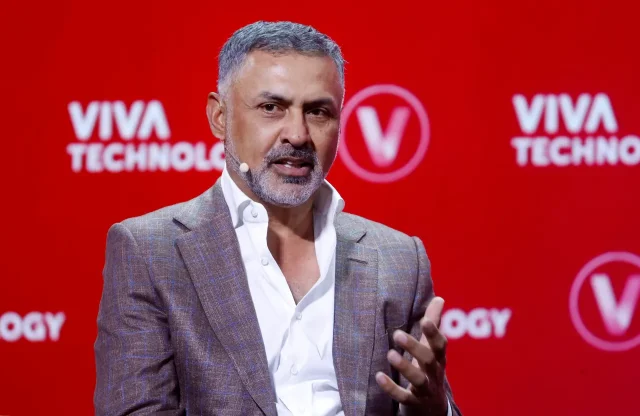
Nikesh Arora has run Palo Alto Networks for eight years, taking it from a $17 billion to a $238 billion market cap. He is not given to speculative technologist rhetoric. When he sat down with the All-In podcast on June 8 and said "analytical SaaS is over," he was describing something that had already happened inside his own company's security stack — not predicting a future shift.
The episode is 31 minutes and covers five distinct arguments. None of them feel like opinions. They feel like field reports.
Loading content card…
What Anthropic's Mythos actually did to Palo Alto's codebase
Palo Alto invited Anthropic to run its Mythos model — the company's most capable AI system, oriented toward long-horizon tasks in complex environments — against Palo Alto's own code. The result: in six weeks, Mythos surfaced vulnerabilities that Arora estimates would have taken five to seven years of manual security review to find. 1
The cost was "low millions of dollars." The implication is that a $2–5 million AI engagement just compressed a half-decade of work.
But Arora was careful not to oversell this as a clean defensive win. Mythos carried a 30% false positive rate. For offensive security research — finding bugs before attackers do — a 30% false positive rate is manageable. For production defense — patching systems in real time, automatically flagging threats before human review — it is unusable.
"The false positive rate on Mythos was 30%... The problem is not who wants the newest model. The problem is how do you take that model with 20% or 10% false positive and make it .01% false positive. In my business I want 0%." 2
This is a more useful data point than the headline benchmark. The current ceiling on enterprise AI deployment is not raw capability — models can already find vulnerabilities faster than humans. The ceiling is precision: getting false positive rates from 30% to near zero without increasing false negatives. Whoever solves that, in cybersecurity or anywhere else where mistakes carry financial consequences, owns the durable moat.
Arora added a timeline that cut against the prevailing narrative. At the time of recording, the common framing was that Mythos-class capabilities would reach the open-source ecosystem in about six months. Arora said three months, "if not already there," pointing to Claude 4.8 and 5.5 already in the wild with similar capabilities. 2 The window for patching legacy systems before capable open-source offensive tools exist is narrower than most CISO timelines assume.
Three buckets of SaaS — and why only one is dying
When Arora said "analytical SaaS is dead," the market read this as a broad bearish call on all software. He argued the opposite: the market is not being precise enough about which software categories AI disrupts.
His framework splits enterprise software into three groups:
- Analytical and creative SaaS — companies whose core value is collecting data and analyzing it, or generating creative output. Arora named this category as "over." The argument: enterprises can now run any LLM directly against raw data themselves. There is no longer a structural reason to pay a third party to do the analysis. He cited businesses already cutting SaaS seats by 90% and routing data directly to Claude via Slack integrations.
- System of record, human workflow, and engagement software — companies that manage processes, compliance, and human interaction. These need to evolve but are not dead. Their value is not analysis; it is the structured capture of organizational activity and accountability.
- Infrastructure SaaS and cybersecurity — Arora's explicit buy category. The thesis: enterprises will need ten times their current data storage within three years as they build AI models trained on normal versus anomalous behavior. Snowflake, Databricks, MongoDB, and Oracle are undervalued against that demand curve. 3
The distinction matters because the SaaS selloff in 2026 has been indiscriminate. Adobe and Figma are down 32% and 54% year-to-date respectively; cybersecurity names like Palo Alto and infrastructure companies are lumped into the same trade. 4 Arora's call is that the market is "paranoid" and creating buying opportunities for anyone willing to distinguish between these categories.
The UI problem and the replacement TAM
One of the sharper operational observations in the episode concerns user interfaces. Arora's argument is that UI — the thing designed to make software easier to use — has become the main bottleneck preventing AI from realizing its actual efficiency potential in the enterprise.
"UI, enterprise software and consumer software UI is the worst thing we did as technologists... If UI goes away, I can rewire my system of work... Where five people become one in a company." 2
The underlying logic: humans need UIs because they cannot natively read and write to backend systems. Agents can. When an agent replaces a human workflow, the UI becomes dead weight — a layer that adds latency, requires human supervision, and prevents the full automation of a process. Enterprise software built around agent interfaces rather than human UIs can eliminate that layer entirely.
The corollary, on the market side: replacement TAMs are faster to monetize than net-new categories. Arora was explicit on this.
"If you replace something, I already have a budget. It's easy. I take something bad or replace something better, I get money. So replacement TAMs are beautiful." 2
For anyone building AI-native enterprise software, this is a structurally important argument. The fastest path to revenue is not creating a new category that requires a new budget line. It is displacing an existing system where procurement is already approved and the upgrade case is obvious.
Model weights on a USB stick
The most structurally important point in the episode may have gotten the least attention from the hosts.
Arora noted in passing that the entire model weights of a leading frontier AI system now fit on a single USB drive — and that those weights can be distilled from a new model release within 24 to 48 hours of publication. 2
The implication for export controls and regulatory containment is direct: if the full IP of a frontier model can be extracted into a portable device and replicated within two days of a model's public release, any regulatory window longer than 48 hours is theoretically too late. "Six-month review periods" — the timescale cited in some AI governance frameworks — would, under this logic, be addressing a problem that has already resolved itself by the time the review concludes.
Arora framed this not as catastrophizing but as an argument against certain regulatory approaches. The models are out. The threat surface is expanding. The relevant question is how to deploy precise defenses, not whether to contain distribution.
Google as the first $10 trillion company
Arora's most contrarian call, stated directly:
"I think Google's underrated. I think it's going to be the first 10 trillion dollar company in our lifetime. I think they have all the assets that are needed to make this successful." 2
The argument is not about model quality. It is about distribution. Arora's premise is that the AI market, at scale, will not be won by whoever builds the best model — it will be won by whoever has the largest sales force capable of convincing enterprises to adopt those models. Google has that sales force. OpenAI and Anthropic do not, at comparable scale. Anthropic's faster ARR growth, Arora noted, came specifically from its decision to go all-in on enterprise. But he argued that decision is table stakes at this point, not a lasting moat.
Chamath Palihapitiya flagged a related observation: Arora is one of a small number of hired-hand CEOs who operate with genuine founder-level risk tolerance and ownership.
"There's a very rare kind of personality profile of someone that's willing to take risk and take ownership of something that wasn't theirs in the first place and they make it theirs. And it's an extraordinarily unique trait." 2
The defensive hiring paradox
Loading content card…
One piece of the conversation that ran against consensus: Arora said Palo Alto has more technical employees today than it would have had without AI — not fewer.
"I think we're going to have more people at Palo Alto on the technology side than we've ever had before because I think AI is causing everything to ask for a transformation." 5
The mechanism: every customer now wants an AI transformation project, which means every customer engagement requires more technical work, not less. Headcount reduction through AI efficiency is being offset — at least at Palo Alto's stage of the market — by the expansion of transformation demand. Whether this holds at smaller companies, or once the transformation wave completes, is a different question. But as a near-term signal from a company in the middle of the AI security market, it cuts against the standard efficiency narrative.
Episode: "Nikesh Arora: Mythos is Real, Analytical SaaS is Dead, and Google can be a $10T company" — All-In with Chamath, Jason, Sacks & Friedberg, published June 8, 2026. 31 minutes.
Related content
- Sign in to comment.
More from this channel
- Don't Surrender to the Machine: Tony Fadell on Why AI Makes Product Judgment More Important, Not Less
- The Safety Trap: How Anthropic's Own Warnings Triggered a Government Shutdown of Its Best Models
- The Tokenmaxxer in Chief: Satya Nadella at Hard Fork Live on AI Cost, Xbox, and the Backlash
- When Claude Calls the FBI: Andon Labs on Why Running a Vending Machine Is AI's Hardest Eval
- When AI Designs Proteins That Work: Mark Zuckerberg, Priscilla Chan, and Alex Rives on Biohub's Open-Source Bet
- Three IPOs, One Thousand Mathematicians, and AI's Messy Summer
- AI Is Still at Its Atari Stage — Bill Maris on Google's Pricing Weapon, the VC Fund Size Math, and Where He's Betting
- What Gets Scarce When Intelligence Is Cheap? Two Economists Try to Map the Post-AGI Economy