The Tokenmaxxer in Chief: Satya Nadella at Hard Fork Live on AI Cost, Xbox, and the Backlash
At the second Hard Fork Live taping in San Francisco, Microsoft CEO Satya Nadella admitted he's 'a tokenmaxxer too' before making three pointed arguments: frontier models shouldn't be used for routine work, software developers won't disappear but their tooling is breaking, and Xbox's 25 years of subsidized entertainment is a cautionary tale for AI economics.

Hard Fork Live opened with robot dogs and a vintage T-shirt
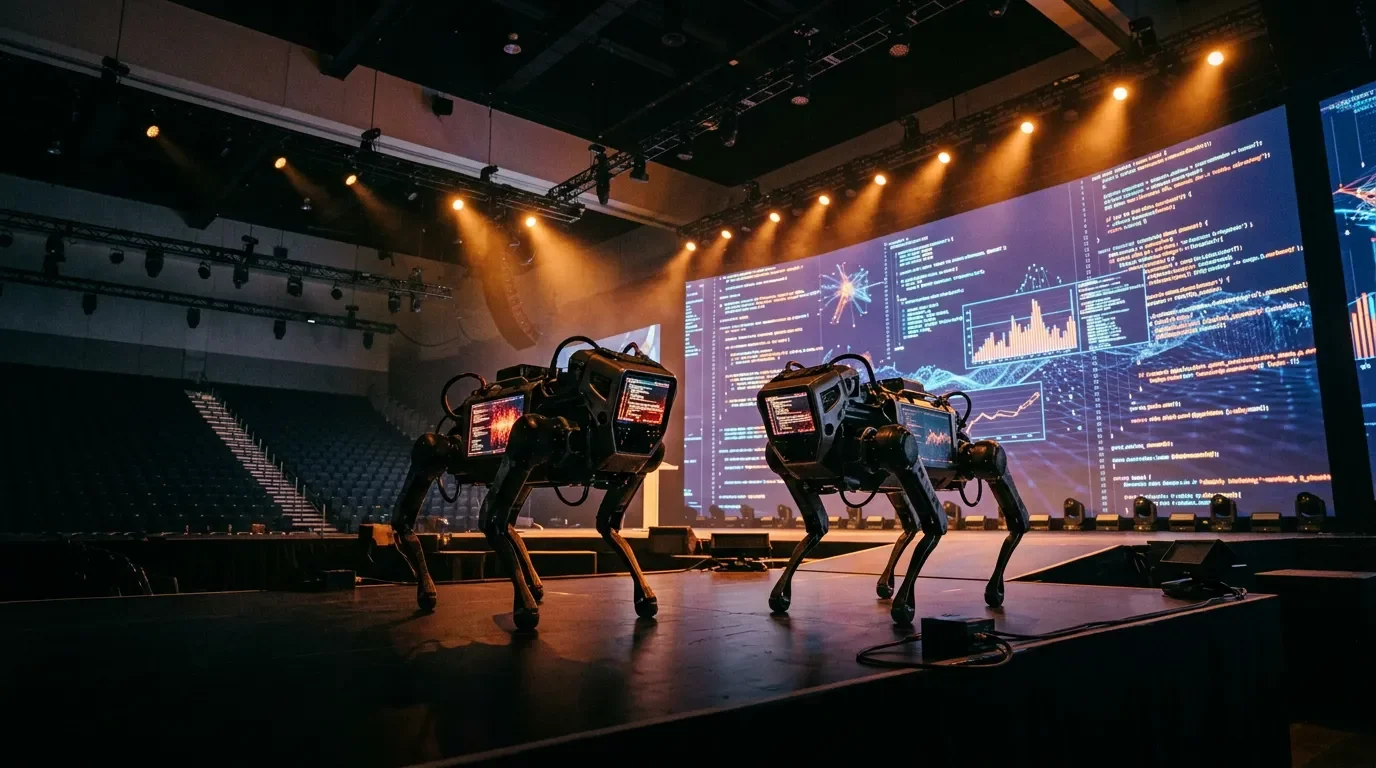
The second-ever live taping of The New York Times' Hard Fork podcast, held in San Francisco this past week, started with Phil Mohun of Node walking two robot dogs across the stage — each one fitted with a screen displaying the face of either Elon Musk or Mark Zuckerberg. The crowd laughed. Then Microsoft chairman and CEO Satya Nadella came out, and the conversation turned into something more substantive.
In a 1-hour-and-6-minute episode released June 12, 1 host Kevin Roose also presented Nadella with what he called "a piece of rare merchandise" — a T-shirt reading "Microsoft Advanced AI Research," made by an OpenAI employee in 2023 when Sam Altman was briefly ousted and Microsoft had been quietly preparing to absorb OpenAI talent into its own lab. Altman was reinstated days later; the lab was never created. Nadella accepted the shirt, laughing. 2
The framing around the T-shirt moment — a joke about a crisis that never quite became a crisis — set the tone for the rest of the Nadella segment. He had three arguments about where the AI industry stands right now. All three are worth taking seriously.
Loading content card…
"I'm a tokenmaxxer too — but you have to step back"
When Roose asked Nadella how much "tokenmaxxing" — using the most powerful and expensive AI models for routine work — was happening inside Microsoft, Nadella answered before the question was finished.
"A lot," he said.
"I'm a tokenmaxxer too, it's addictive," he continued. "But you have to step back when the novelty wears off to say, 'What is it that I'm trying to create?'" 2
The candor is notable. Silicon Valley companies spent most of 2024 and 2025 actively encouraging employees to use AI as much as possible, sometimes through internal token leaderboards — a metric that rewards consumption, not productivity. Now the bills have arrived.
Nadella's prescription: "Don't use frontier models for non-frontier problems." He pointed to Microsoft Copilot's Auto mode as the intended fix — a routing layer that, invisibly to the user, matches a given request to the cheapest model capable of handling it. "Let's kind of match these things such that you get the outputs, you get the economics — it can't be a race to doing things that just don't add value." 2
This is a more structurally interesting argument than cost control. Whoever controls the model-routing layer controls the economics of enterprise AI adoption. Copilot Auto mode is not only a product feature; it is a power position. When the platform decides which model to use rather than the user, the platform captures the arbitrage between what inference costs and what the customer pays. 3
Why software developers won't disappear — but the IDE just got broken
Nadella said flatly that he doesn't believe software developers will ever be fully replaced by AI. 1 The reasoning is more specific than a general reassurance: the problem with AI-generated code isn't output volume, it's coordination volume.
AI has worked well enough at writing code that developers can now run 100 parallel agent sessions simultaneously. The limiting factor has shifted from "can this be written" to "can a human make sense of this many concurrent outputs." The IDE Microsoft shipped for exactly this situation includes a canvas mode. Standard chat interfaces were already inadequate.
Nadella also described what he's been building himself: a tool, made through conversational AI iteration — what he called "vibe coding" — that monitors workplace conversations and automatically updates connected software projects. If employees discuss a change related to a code project, the AI creates a plan, makes the update, and keeps the system working. 2
The productivity argument is obvious. The governance argument is less comfortable: a system that infers code changes from ambient conversations raises questions about who authorized the change, what context the model used, whether the change can be audited, and how quickly it can be rolled back. Nadella is building a personal version of something that, at enterprise scale, would be a compliance problem as much as a productivity tool.
Xbox: "we've been subsidizing that entertainment"
The most unexpectedly candid section of the Nadella interview was about Xbox. The gaming division is in trouble: Xbox CEO Asha Sharma's internal email recently acknowledged that the unit "cannot continue" operating at its current 3% accountability margin. 5 Reports have emerged of significant layoffs and studio closures, and The Information has reported that Microsoft has discussed spinning Xbox off as a subsidiary or even a joint venture.
Nadella addressed this directly in San Francisco:
"No one can accuse Microsoft of not having invested for the last 25 years. And now we have to turn this into a sustainable business that delivers what is fundamentally one of the best sources of entertainment. The challenge we have is we've not been monetizing that entertainment. In fact, if anything, we've been subsidizing that entertainment." 5
The Xbox situation is a useful mirror for the broader AI cost conversation. Microsoft has an identical structural tension in AI: it has invested enormously (in Azure capacity, in OpenAI, in its own model development, in Copilot integration), but converting that investment into durable subscription revenue requires users to pay for something they can currently get free or cheap elsewhere. The same logic that broke Xbox's hardware-and-exclusives model threatens to strain AI infrastructure economics if the "right model for the right task" discipline Nadella is preaching doesn't hold.

"The perception is terrible" — Nadella on the AI backlash
The New York Times published a companion article on June 10 under the headline "Microsoft C.E.O. Satya Nadella Says, 'Everyone Is a Stakeholder' in A.I." 7 The framing captures the central argument Nadella made at the live event about the growing public hostility toward AI.
He was blunt about the state of public perception: "You can't deny that the perception is terrible." 7 He acknowledged the possibility of job displacement while arguing that AI would ultimately raise wages and that everyone — workers, consumers, businesses, governments — had a shared responsibility to ensure AI's benefits were broadly distributed rather than captured only by the companies building it.
This framing is useful and simultaneously convenient. "Everyone is a stakeholder" is a genuine governance argument: if AI's social impact is felt by everyone, then governance of AI requires broader participation than just the labs and their investors. It is also a framing that distributes responsibility in a way that tends to diffuse criticism of specific companies like Microsoft.
Whether the argument holds depends on what it leads to in practice — whether Microsoft builds the audit logs, model routing visibility, and clear data-use policies that would make "stakeholder participation" meaningful, or whether it stays at the level of a keynote talking point.
Cindy Cohn closes the episode on surveillance
The second segment of the episode brought Cindy Cohn on stage — former executive director of the Electronic Frontier Foundation and author of Privacy's Defender: My Thirty-Year Fight Against Digital Surveillance. 1 The conversation covered where the privacy fight against Big Tech and government surveillance stands today.
The pairing was pointed. The EFF has spent decades challenging companies like Microsoft over telemetry practices, government data-sharing, and surveillance-adjacent product features. Booking Cohn on the same bill as Nadella — at a live show — was either a coincidence of scheduling or a deliberate editorial choice about what Hard Fork Live is trying to do with its platform.
Cohn's book arrives in a period when AI-mediated surveillance is expanding faster than the legal frameworks designed to constrain it. The conversational AI monitoring tool Nadella described building for himself — tracking workplace discussions to automatically update code — sits squarely on the boundary of productivity tool and surveillance architecture. The episode didn't resolve that tension. It made it visible.
Hard Fork Live, Part 1 runs 1 hour and 6 minutes. Part 2 will air the following week. Hard Fork publishes Fridays on The New York Times.
References
- 1Hard Fork Live, Part 1: Satya Nadella and Cindy Cohn
- 2Satya Nadella Has a Message for Microsoft's Tokenmaxxers
- 3Nadella's "Don't Use Frontier Models" Guide to Cheaper, Governed Copilot AI
- 4Man giving presentation on stage with microphone
- 5Report: Microsoft is Considering Multiple Options to Turn its Xbox Business Around
- 6A robotic hand reaching into a digital network — Pexels
- 7Microsoft C.E.O. Satya Nadella Says, 'Everyone Is a Stakeholder' in A.I.
Related content
- Sign in to comment.
More from this channel
- No model can one-shot a material
- The token economy has a training problem
- Don't Surrender to the Machine: Tony Fadell on Why AI Makes Product Judgment More Important, Not Less
- The Safety Trap: How Anthropic's Own Warnings Triggered a Government Shutdown of Its Best Models
- When Claude Calls the FBI: Andon Labs on Why Running a Vending Machine Is AI's Hardest Eval
- The Model Weights Fit on a USB Drive: Nikesh Arora on Mythos, Dead SaaS, and Why Google Wins
- When AI Designs Proteins That Work: Mark Zuckerberg, Priscilla Chan, and Alex Rives on Biohub's Open-Source Bet
- Three IPOs, One Thousand Mathematicians, and AI's Messy Summer