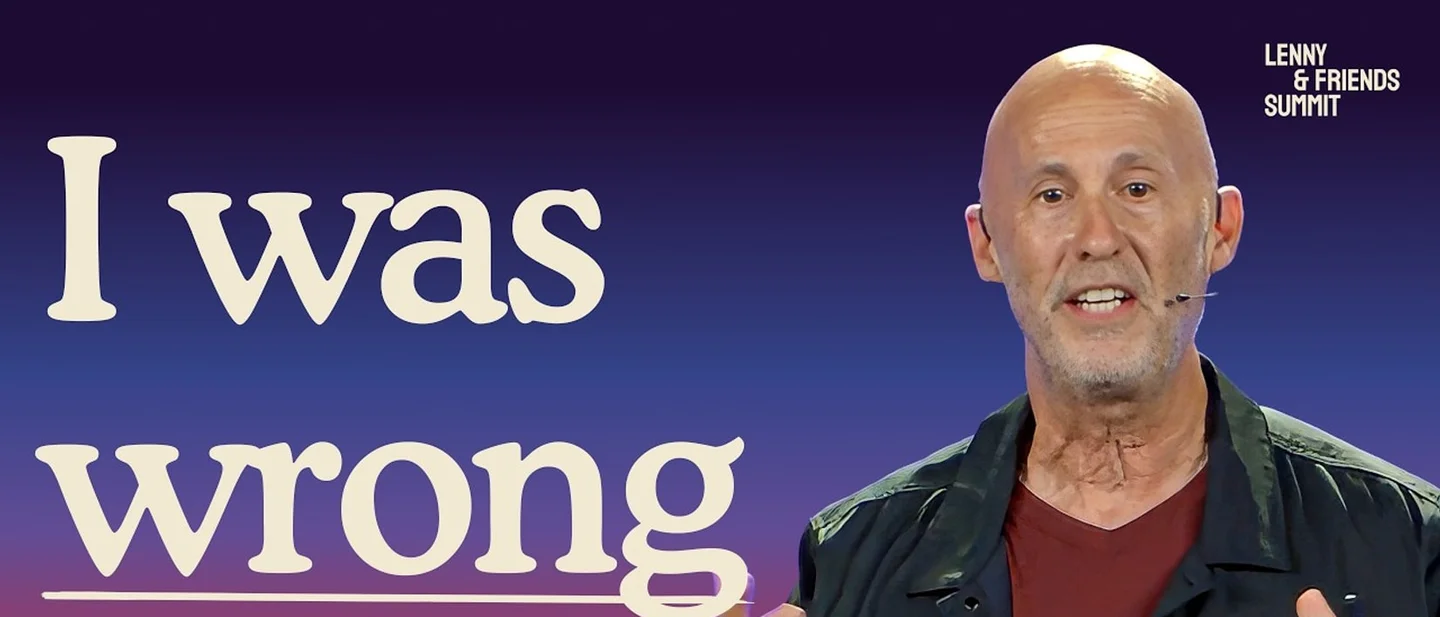
《启示录》作者认错:Marty Cagan 谈他给出的产品建议里那十条遗憾|Lenny's Podcast
《启示录》作者 Marty Cagan 在 Lenny 峰会上逐条讲自己产品建议里真正后悔的十条——从低估商业可行性、把问题发现讲得太重,到把路线图与 PRD 当成「我们确定知道答案」的证明,最后给了一个反转;文末附中英双语逐字稿。

Lenny and Friends Summit 是莱尼·拉奇茨基(Lenny Rachitsky)办的年度线下峰会,面向产品与工程负责人,2026 年这一届在 9 月 10 日于旧金山举行1。峰会现场演讲会陆续发在他的播客频道上,这一条 22 分 31 秒的视频就是其中之一,标题是《马蒂·卡根:强烈的观点,松散的持有》2,2026 年 9 月 25 日上线。
讲话人马蒂·卡根(Marty Cagan)是硅谷产品集团(SVPG)的创始人兼合伙人,做产品做了三十多年。他在惠普实验室做过十年软件开发,之后加入网景(Netscape)直接向联合创始人马克·安德森汇报,负责过平台与工具、后来又负责电商应用,最后在 eBay 做到产品与设计高级副总裁,2001 年创办 SVPG3。他写的那本《启示录》(INSPIRED)是很多产品团队的入门书,另外还有《EMPOWERED》与《TRANSFORMED》。
这期视频在做什么:它是一场单人口播的观点演讲,没有访谈者。卡根要做的是一件对他来说很难的事——当着满场同行的面,逐条讲自己给出去的产品建议里哪些是错的、哪些说轻了。他挑了十条真正后悔的,时间线划在 2008 年《启示录》第一版;讲完十条之后,他给了一个反转:AI 让「造东西」变便宜之后,他这二十年讲的那些原则反而更重要了。想决定要不要看,读完下面这份摘要就够了;想核对原话,文末附了完整的中英双语逐字稿。
他为什么现在讲这个
开场他没有先讲遗憾,先讲了一个观察。全天听下来,他发现有两种产品:一种按项目模型做,一种按产品模型做,台上大约一半讲者属于前者、一半属于后者,两种人对「这份工作是什么」的定义差别极大。
他说自己不是对最新流程或最新框架感兴趣的人,也不关心你用智能体自动化了什么——那只是工具,不是这份工作本身。这份工作是替客户解决问题、替生意拿到结果。他之所以现在敢回头审自己,是因为他一直在拿自己的内容当产品做发现:每次新技术浪潮来了,他都要看一遍「这会不会让那些原则失效」。
他给自己划线的方式也很具体:以 2008 年《启示录》第一版为界,之前的东西不再追究;但要说清的是,写那本书的时候他已经做了 25 年产品,在工程侧和产品负责人位置上待了二十多年。
十条遗憾
他把十条分成两组讲:前几条关于判断的盲区,后几条关于组织与代价。
一、商业可行性(business viability)。 这是他自认最尴尬的一条:他完全低估了商业可行性的分量。他给的定义是,产品经理要保证方案既是客户愿意买的,也是生意能承受的——能推广、能卖、能服务、合法合规、尊重隐私与安全伦理。问题在于 2008 年第一版里,他列的三个风险只有价值(value)、可用性(usability)、可行性(feasibility),可行性被埋在里面,直到十年后的第二版才补上。
他解释了这处盲区的来源,也顺手说了一段自己的经历:他职业生涯大部分时间做的是开发者工具与平台,这类产品的商业可行性相对简单,是少数几个产品经理可以靠很弱的基本功混过去的地方。他过去把「工程背景」当自己的超能力,现在他认为,真正要补的是从系统角度看商业可行性。
二、他把问题发现讲得太重。 产品发现分两半:问题发现(到底要解决什么问题)和方案发现(怎么解决)。他的错误是没料到人们会那么强烈地往问题发现那一侧靠,很多人把自己当守门人,认为自己的工作就是确认「这个问题值得做」。他不否认要理解问题、理解为谁解决、成功的定义是什么,但他的原话是:这件事并不难。在一个问题上花太多时间,就没有时间去做真正拿工资的那部分——方案发现。他还纠正了一个常见归因:产品失败时人们总说需求不够大,但只要有别人拿出更好的方案,就知道问题从来不在需求。
三、「传教士」那句话太容易做到了。 这句话(我们需要传教士式的团队,不要雇佣兵式的团队)不是他发明的,出自约翰·多尔(John Doerr),广为流传。他现在说,让人理解「为什么做这件事」是重要的,但太容易了——只要有一份产品策略,做这些问题的理由就清清楚楚写在全公司面前了。他认为更重要的是另一个 why:人们为什么不用我们的产品。他说自己不断试新产品,绝大多数是垃圾,然后就流失了,几乎没有公司会来问一句为什么——不是问卷,不是邮件,什么都没有。而这恰恰是打开创新的钥匙,绝大多数团队从来不问。
四、谦逊。 他做了几十年产品,越来越觉得谦逊和真正开放的心态对每个层级的产品人都重要。它的意思是知道自己不可能知道什么、承认自己不知道什么。让他不舒服的是,大多数人从他书里带走的信息是「产品经理应该是产品的 CEO」——恰好是谦逊的反面。他强调这不是性格问题,而是很多产品失败的直接根因。
五、对可预测性的渴望——他说这是自己最大的一条遗憾。 他完全没料到这种渴望有这么强、扎得有这么深,无论在产品人还是在高层身上都是如此;也没料到它跟谦逊、创新、结果导向有多冲突。他拿产品世界里的两份核心文件开刀:路线图(roadmap)和产品需求文档(PRD)。他的判断是,这两份文件本身就是「我们比实际知道得更多」这种错觉的推手。他强调争点不在文件该不该存在——争点是你拿那份 PRD 干什么用。如果你出于自负认为自己已经知道答案,把方案写成需求丢给工程师照着做,那就是项目模型,是大量产品失败的根因;如果你已经学过、测过、攒够了证据,知道要造的东西能带来结果,那么 PRD 只是一份沟通工具,不但无害而且有用。路线图同理:把一堆「某个人觉得可能行」的功能配上日期,就会把大部分工程能力浪费掉——他补了一句,工程时间确实变便宜了,但浪费依然是浪费,token 也不是免费的。
六、政治。 他承认自己当年认为把产品做好就能赢,这个想法很天真;政治无处不在,是每家公司织物的一部分。他给出的证据是自己的内容结构:过去三年的文章,一半在讲怎么处理政治,一半在讲 AI 的冲击。
七、产品领导力被他讲轻了。 他最初的内容全在产品团队和产品发现上,因为他真正喜欢的是产品这门手艺,也认为多数人只是在造东西、发出去、看哪个能站住。这个选择造成了后果:很多公司读了《启示录》,以为组建有权力的产品团队、配一个强产品经理就够了——他今天说这依然成立。而现实是,有权力的产品团队需要的不是更少的管理,是更好的管理。产品的领导角色因此更关键,其中最基础的一件事就是产品策略,也就是一份排过序、要解决的问题清单。
八、公司治理。 他坦言自己当年认为这不是产品能改变的事。这些年最痛的教训,是帮一家公司把产品做顺、产品越做越好,结果它成了另一批动机完全不同的人的目标,产品被拉向另一个方向。他推荐大家去读埃里克·莱斯(Eric Ries)的新书《Incorruptible》4。
九、产品比他写的凶得多。 书里那句话听起来几乎像学术命题——你的工作是解决问题,用客户喜欢、同时生意也能成立的方式。他说这话是真的,但它掩盖了一件事:想让人换过来,你的解决方案必须比竞争对手好得多。在他的说法里,公开市场上的产品竞争是一场「全接触的血腥运动」,很多团队并没有为此做好准备。
十、人们会想尽办法逃避思考。 他最新的认识是,产品这门手艺的核心是思考,而他自己当年没有意识到人们为了不思考肯走多远。它的表现形式是想念流程、框架和可预测性。他把《启示录》的结构定成「人、流程、产品」,并说这是个大错误。他还担心大模型会被当成思考的替代品——同时指出这件事在流程上早就发生过,并引用马斯克那句话:很多公司里,流程被用来替代思考。
他的反转
讲完十条,他说了一件听上去矛盾的事:他对内容的整体判断反而更乐观了,对产品的未来也是,并且愿意解释为什么。
他说,二十年来对自己内容最常见的批评只有两条:一是所在公司上瘾于产出(output)和产出的可预测性,二是「照书里那样做太难了」。他现在的判断是这两条都在松动:AI 让越来越多的公司明白要的是结果(outcome)而不只是产出;而工作本身也真的变得容易多了。
他给这层反转加了一组对照,用纽约那套「建造有两种」的说法:为了学而造(build to learn)与为了赚而造(build to earn)——也就是产品发现与产品交付的区别5。他的原话很直白:如果你就是想在前端做几个 pull request,那你去当开发者好了;如果你要保证工程师造出来交付给客户的东西能拿到结果,那你做的是另一件工作,完全不同的方法。
他的结论只有一句:多亏有了 AI,产品模型的那些原则、产品策略与产品发现的手艺,从来没有像现在这样重要。
先弄明白几个词
三个风险(value / usability / feasibility / viability):产品要成立同时要过的几道关——客户觉得有价值、能用、技术上做得出来、以及生意上撑得住。他在第一条遗憾里讲的正是第四道关被自己写轻了。
项目模型与产品模型:他用来区分两类团队的词。项目模型把产品当一组要交付的需求,工程师照着做;产品模型把产品当要解决的问题,团队有权决定怎么做并承担结果。他说这两种模型在当天台上各占一半。
产品发现与产品交付(product discovery / delivery):发现是搞清楚该造什么、值不值得造,交付是把它做出来并上线。他反复强调发现里有方案发现这一半。
路线图与 PRD:路线图是「接下来做什么、大概什么时候做」的清单,PRD 是描述要做成什么样的文档。他并不主张废掉它们,争点在于你是拿它当沟通工具,还是当「我们确定知道答案」的证明。
有权力的产品团队(empowered product team):他在《EMPOWERED》里推的那套组织形态——团队被授予解决某个问题的权力,并为结果负责。他这一场补上的话是,这种团队对管理的要求更高。
这一场值不值得看
如果只看一段,看第五条遗憾那几分钟(大约第 13 到 15 分钟):把路线图和 PRD 当作「确定性错觉的载体」,而不是当作该不该存在的文件,是这场演讲里最有增量的一句判断。
还需要说明两件事。第一,这十条遗憾全部是他的自我批评,不是对行业的调研结论,听的时候要把它当成一位从业者的复盘。第二,这场演讲跟同一天其他几场是同一场讨论的分工:卡根讲的是这套做法在二十年后要修哪里,同一天台上的克莱尔·沃讲路线图失效,丹·希珀(Dan Shipper)讲怎么在主线之外养一个实验室,杰夫·查尔斯(Geoff Charles)讲工厂里的瓶颈。他在开场还专门点了一句:当天台上已经有人把「人们为什么不用你的产品」这件事讲过了。
人物背景与外部对照
SVPG 与他的书:SVPG 是他 2001 年创办的咨询与写作机构,他为大公司做产品转型的顾问与教练3。三本书里最重要的是 2008 年首版、2018 年第二版的《启示录》6,这一场的时间线就是从那本书的第一版划起的。
约翰·多尔与「传教士、雇佣兵」:多尔是凯鹏华盈(Kleiner Perkins)的董事长,也是《Measure What Matters》的作者7。卡根在第三条遗憾里把这句话归给他,并说它好听到容易让人以为做到它就够了。
埃里克·莱斯与《Incorruptible》:莱斯是《精益创业》的作者,新书谈的是好公司为什么会变坏、以及治理可以怎么设计4。他被卡根在第八条遗憾里点了名。
他在结尾致谢的两位同行:特蕾莎·托雷斯(Teresa Torres)是产品发现教练、《Continuous Discovery Habits》作者,长期给 SVPG 的书做推荐8;什雷亚斯·多希(Shreyas Doshi)是产品顾问、曾在 Stripe 与 Twitter 负责产品9。两人都给他这场演讲的早期版本提过意见。
这一场的形态:现场演讲的录像,没有访谈与提问环节;他在台上引用了当天其他讲者的内容,这说明这场在议程里排得比较靠后。
完整中英双语逐字转录稿
逐字稿说明:本稿取自本期官方视频的英文原始字幕轨(YouTube 的 en-orig 轨),措辞未作改动,仅对少量专名做了订正(如 John Doerr、Eric Ries、INSPIRED、Shreyas Doshi),并保留了演讲者的口语停顿与重复;中文译文由机器翻译生成,只对专名做了统一。这是一场单人口播演讲,全篇讲话人均为 Marty Cagan,时间轴每 10 分钟标注一次;字幕轨本身不含掌声与观众反应,故未收入。
00:00 - 10:00
Marty Cagan:
Thank you. Um, also thank you to Lenny for running this and for inviting me actually to be a speaker. Um, I don't actually go to a lot of conferences. Uh, but when I do, um, I really enjoy them and I will tell you I can't I lost track of the people that came up to me and thanked me for content for books. People ask me to they have tattered copies of INSPIRED and they ask for signatures and it's you know hugely uh flattering and humbling to see that.中文:谢谢你。嗯,也感谢 Lenny 举办这个活动,并且实际上邀请我作为演讲者。嗯,我其实不经常参加很多会议。呃,但当我参加时,嗯,我真的很享受,我要告诉你,我已经数不清有多少人走过来感谢我提供的内容和书籍。有人会拿破烂的《启示录》书本来找我签名,这真的让我感到非常受宠若惊和谦卑。
Marty Cagan:
I did warn several of them that my talk was actually all about my regrets uh of which there are uh quite a few. So that is what I wanted to talk about. But I have been here with you all day listening to every one of the talks. And um I learned something really interesting from every single one of them. I observed and I'm sharing this for a reason, but I observed that there are two kinds of product in the world.中文:我确实警告过他们中的几个人,我的演讲实际上完全是关于我的遗憾,呃,这些遗憾其实有很多。因此,这就是我想要谈的内容。但我今天一整天都在这里听你们每一个人的演讲。嗯,我从每一个演讲中都学到了一些非常有趣的东西。我观察到了,我分享这个是有原因的,但我观察到世界上有两种产品。
Marty Cagan:
Two kinds. I've always called them the project model and the product model. About half the speakers were from each. Obviously, I'm highly biased, but my world is both of them. And so, it's super interesting for me to hear, but hopefully you all can think back on the day and you saw dramatically different definitions of the job. Now, the truth is, as I was listening, I was like, "Oh, I got to talk about this and I got to talk about that.中文:两种。我一直称它们为项目模式和产品模式。大约一半的演讲者来自每种模式。显然,我的观点高度主观,但我的世界包括它们两者。因此,对我来说,听这些内容非常有趣,但希望你们都能回想起那天,看到对工作的定义有明显不同的理解。事实上,当我在听的时候,我心想,“哦,我得谈谈这个,也得谈谈那个。”
Marty Cagan:
I don't want them to leave thinking this. " But then Robbie from Google and Ki basically said what I would have said. loved it. Again, I'm biased, but loved them. What I want to talk about here is a little different. Honestly, it's uh something I've known I've needed to do for a long time, but I kept sort of procrastinating on it because uh this is a really hard question, especially for me. I have spent decades arguing certain points.中文:我不希望他们带着这种想法离开。但随后谷歌的罗比和 Ki 基本上说了我本来会说的话。很喜欢。再次声明,我有偏见,但真的很喜欢他们。我在这里想谈的有些不同。老实说,这是我很久以来就知道自己需要做的事情,但我一直在拖延,因为这是一个非常难的问题,尤其是对我来说。我花了几十年时间辩论某些观点。
Marty Cagan:
Now, for those that don't know my work, I am actually one of those people. I'm not interested in the latest process. I'm not interested in the latest framework. I don't really care what you created an agent to automate. I don't care because that's not actually the job of product. That might give you some tooling to help you do the job, but that's not the job. The job of product is to solve problems for our customers and achieve outcomes for our business.中文:现在,对于那些不了解我工作的人来说,我实际上就是这样的人。我对最新的流程不感兴趣。我对最新的框架不感兴趣。我并不真正关心你创建了一个代理来自动化什么。我不关心,因为那实际上不是产品的工作。这可能会给你一些工具来帮助你完成工作,但那不是工作本身。产品的工作是为我们的客户解决问题,并实现我们业务的目标。
Marty Cagan:
That's what this is about. So that's what I'm interested in. And because I focus on principles, the truth is they're pretty durable. In fact, every time a new technology wave, you heard a very polite way of saying I must be very old to have seen all of these waves. But yeah, every wave you're like, will this invalidate those principles? You don't really know until you look at it. And of course, as as you know, all those waves were actually a lot of fun.中文:这就是这件事的核心。这也是我感兴趣的原因。因为我注重原则,事实是它们相当持久。事实上,每当出现新的技术浪潮,你听到的人会很有礼貌地说,我一定很老了才能看到所有这些浪潮。但确实,每一次浪潮时,你会想,这会否让这些原则失效?在看之前你真的无法知道。当然,如你所知,所有这些浪潮实际上都非常有趣。
Marty Cagan:
I am one of those. I mean, the reason I'm a product person is because I love the fact that what's just now possible is changing all the time. That's what makes it cool. Otherwise, I would not be doing this this area. I wouldn't have chosen this as a career. But with AI, I feel like I had to look at everything. Even the things that honestly I was taught are sacred. It's like you don't mess with this principle.中文:我是其中之一。我的意思是,我之所以成为产品人员,是因为我喜欢这种事实:刚刚可能实现的东西一直在变化。这就是它酷的原因。否则,我不会从事这个领域。我也不会选择这作为我的职业。但有了人工智能,我觉得我必须重新审视一切。即便是那些坦率地说我被教导为神圣的东西。就像你不能随意触碰这个原则一样。
Marty Cagan:
I wanted to look at everything. That's what I did. Now, the first thing I had to figure out was where do I start? Because the truth is I treat my content as my product and I am literally doing product discovery every single week with product teams. In fact, a lot of many of you have been with me to know that's what I'm doing. I'm learning. That's what I've been doing here today is really discovery on product content.中文:我想看看所有的东西。这就是我所做的。现在,我首先要弄明白的是从哪里开始?因为事实是,我把我的内容当作产品来看待,而且我实际上每周都在和产品团队进行产品探索。实际上,很多和我在一起的你们都知道,我就是在做这个。我在学习。这就是我今天在这里所做的,真正是在产品内容上的探索。
Marty Cagan:
And it was very good for me to hear these other views, all of the other views. But anyway, the truth is I have a lot of things I've learned. Now most of the time I just write articles and publish stuff on more minor learnings. But what I wanted to do was to identify what I thought that I mean honestly I started brainstorming a list and it's a big list. It's kind of depressing but there's a big list.中文:对我来说,听到这些不同的观点,所有其他观点,都非常好。不过无论如何,事实是我学到了很多东西。现在大多数时候,我只是写文章,并发布一些关于较小收获的内容。但我想做的是确定我认为的重要内容,说实话,我开始列一个清单,这是一个很长的清单。有点令人沮丧,但确实是一个很长的清单。
Marty Cagan:
I wanted to pick the top 10 things that I genuinely regret. I genuinely if I knew then what I knew now now I decided to draw the line with the publication of the first edition of INSPIRED which was in 2008 which I some of you weren't even born then but that's when I'm drawing the line but you have to realize I had been doing product for 25 years when I wrote that. So I had been a product manager.中文:我想挑出我真正后悔的前十件事。如果我那时知道我现在知道的东西,我真的会后悔。我决定以《Inspired》第一版发布为界,那是在 2008 年,你们中的一些人那时甚至还没出生,但我就是以那一年为界。但你必须明白,当我写那本书的时候,我已经从事产品工作 25 年了。所以我一直是一名产品经理。
Marty Cagan:
I went through the whole engineering side and I was a product leader for two and a half decades. So I had learned a lot from amazing people at some, you know, honestly the anthropics of the day, really good companies. So I decided let's draw the line there. Even though some of the things I'm going to talk about are regrets that are less than six months old. Let's do that. Let's talk about it. 10 big things.中文:我经历了整个工程领域,并且担任了二十多年产品负责人。所以我从一些非常棒的人那里学到了很多东西,说实话,是当时的一些顶尖公司。所以我决定就在这里划上一条界限。即使我接下来要谈的一些事情的遗憾还不到六个月,也没关系。我们来谈谈吧,十件大事。
Marty Cagan:
The first one I want to start with is business viability because that's honestly the most embarrassing of them. There is no way for me to get around this. I completely understated the importance of business viability. Just so that everybody knows what I'm talking about here. Business viability. This is a product manager's job is to make sure at least in the product model is to make sure that the solutions are both the customer will buy it and it works for the business.中文:我想首先要谈的是商业可行性,因为老实说,这是最令人尴尬的一点。我无法回避这一点。我完全低估了商业可行性的重要性。为了让大家明白我在说什么,商业可行性。作为产品经理的工作是确保至少在产品模型中,解决方案既能被客户购买,也能对企业有利。
Marty Cagan:
That means you can afford to market it, you can sell it, you can service it, it's legal, it's compliant, it respects privacy, safety, ethics. This is a big thing even before AI. It's big. Those of you working on AI products, you know it's even harder. Business viability is a really big area. But the embarrassing truth is in the first edition of Inspire. I didn't even talk about it as a risk. Value, usability, feasibility. There were three risks that we talked about.中文:这意味着你有能力进行市场营销,你可以销售它,你可以提供服务,它是合法的,是合规的,尊重隐私、安全和道德规范。这在人工智能出现之前就是一件大事。这很重要。那些从事人工智能产品的人,你们知道这甚至更难。商业可行性是一个非常重要的领域。但令人尴尬的事实是,在《Inspire》的第一版中,我甚至没有把它作为一种风险来讨论。价值、可用性、可行性,这是我们讨论的三个风险。
Marty Cagan:
Viability was buried in there. I'm embarrassed to say that. Now, I fixed it in the second edition, but that was 10 years later. This is one of those I had a lot of introspection because the truth is I kept asking how could I have gone so long with such a huge blind spot around products and I believe I know the answer to that and I want to share it with you because it's very relevant even today maybe even especially today because in my career for those that might know I almost all of my career I was working on developer tools and platforms which I still absolutely love that space.中文:可行性被埋在里面。说出来我很尴尬。现在,我在第二版中修正了它,但那是十年之后。这是那种让我深刻反思的例子,因为事实是我不断问自己,我怎么能在产品方面有如此大的盲区却持续这么久。我相信我找到了答案,我想与大家分享,因为即使在今天,这仍然非常相关,甚至可能尤其相关。因为在我的职业生涯中,对于那些可能了解的人来说,我几乎整个职业生涯都在从事开发者工具和平台的工作,我仍然非常热爱这个领域。
Marty Cagan:
Who doesn't love claude code? I mean I love that space. However, you need to understand this. It's one of the few areas where a product manager can get away with pretty weak skills. Now, that's not the only one, but it's one of them. Now, that's not a a criticism. It's kind of a an advantage for those kinds of products. It's a much simpler space for viability. But for most products, especially for AI products, that is not true.中文:谁不喜欢 Claude 代码呢?我是说,我很喜欢那个领域。不过,你需要明白这一点。它是为数不多的一些产品经理可以凭借相对较弱的技能也能应付的领域之一。当然,这不是唯一的一个,但确实是其中之一。需要说明的是,这不是批评。这对那类产品来说是一种优势。它是一个在可行性方面更简单的领域。但对于大多数产品,尤其是 AI 产品,这一点并不成立。
Marty Cagan:
And in fact, I used to be very excited about my um knowledge of engineering because I felt like it helped me learn new technologies. I came from an engineering background. That's what I studied. And it was like big advantage. I felt like that was my my sort of superpower. But today I would argue going forward and for all of you to succeed at every level, business viability, especially from a holistic systems thinking perspective. Second, problem discovery.中文:事实上,我过去对自己的工程知识非常兴奋,因为我觉得它帮助我学习新技术。我来自工程背景,那是我的专业。这对我来说是一个很大的优势。我觉得那是我的某种超能力。但今天我认为,为了未来以及让你们在各个层面上取得成功,尤其是从整体系统思维的角度来看,商业可行性,其次是问题发现。
Marty Cagan:
Now the tr you know, I've always talked about product discovery has got problem discovery, figuring out what problem you're going to solve and solution discovery, solving that problem. The truth is the mistake I made was I just did not understand how strongly people would be drawn to the problem discovery side of that equation. In fact, a lot of people view themselves as the gatekeeper. That's their job as product managers to make sure they agree this is a problem to solve.中文:现在,你知道的,我一直在谈论产品发现,它包括问题发现,弄清楚你要解决什么问题,以及解决方案发现,解决那个问题。事实是,我犯的错误是我根本没有理解人们会多么强烈地被这个问题发现环节吸引。实际上,很多人把自己看作是守门人。作为产品经理,他们的职责就是确保大家同意这是一个需要解决的问题。
Marty Cagan:
Yes, you obviously need to make sure you understand the problem, who you're solving it for, and what the definition of success is. But honestly, that's not very hard. It's not very hard. And if you spend a lot of time on that, you're not going to do the real part you're paid for, which is solution discovery. You might think when a product fails, it's because you didn't um you know, it wasn't a big enough demand, not enough people had that problem.中文:是的,你显然需要确保你理解问题,理解你为谁解决它,以及成功的定义是什么。但说实话,这并不难。并不难。如果你花太多时间在这上面,你就不会去做你真正受薪的部分,那就是解决方案的发现。当一个产品失败时,你可能会认为那是因为需求不够大,不够多人有那个问题。
Marty Cagan:
you're almost always wrong because what's going on is as soon as somebody else comes out with a better solution all of a sudden we know that that was never the issue. So problem discovery I should have emphasized yes problem discovery important little bit of time save time for solution discovery that's the essence that's where innovation happens the next big issue um and this is another one all of these kind of have uh you know good and bad sides but um I spent a lot of time talking about how important it is to understand the reason why we're working on whatever we're working on, whatever problem we're working on.中文:你几乎总是错的,因为实际情况是,一旦有人提出了更好的解决方案,我们就会突然明白,那从来都不是问题所在。所以,我本应该强调的问题发现,是的,问题发现很重要,花一点时间节省解决方案发现的时间,这就是本质,这就是创新发生的地方,下一个大问题,这是另一个,这些都有好坏两面,但我花了很多时间谈论理解我们为什么要处理当前的问题,无论我们处理的是什么问题,这一点有多重要。
10:00 - 20:00
Marty Cagan:
I didn't make this phrase up. John Doerr did, but we need teams of missionaries, not teams of mercenaries. If you want missionaries, you have to make sure they understand the reason. And yeah, that is important, but that's so easy. And in fact, if you have a product strategy, which you should, we'll talk about that in a little bit. the reasons you're working on these problems is spelled out for the whole organization to see. So there's no big mystery.中文:我不是编这个短语的人。是约翰·多尔编的,但我们需要的是传教士团队,而不是雇佣兵团队。如果你想要传教士,你必须确保他们理解原因。是的,这很重要,但这很容易。实际上,如果你有一个产品战略,你应该有的,我们稍后会谈到这一点。你们之所以在处理这些问题的原因,会对整个组织明示。所以没有什么大秘密。
Marty Cagan:
So what I want to talk about and I was really happy to see that Robbie called this out. There is a much more important why than why are we working on this problem and that is why are people not using our product. He called that out. I would love seeing that. And honestly that's kind of a surprise for Google. for for a while they thought it was all based on data and we're not going to talk to No, we need to actually talk to our customers to figure out why.中文:所以我想谈的是,我真的很高兴看到 Robbie 提出了这个问题。比起‘我们为什么要研究这个问题’,有一个更重要的问题,那就是‘人们为什么不使用我们的产品’。他提出了这一点,我很喜欢看到这一点。老实说,这对谷歌来说有些意外。曾经一段时间他们认为一切都是基于数据的,不需要与人交谈,但事实上,我们需要真正与客户交谈来弄清原因。
Marty Cagan:
I try products constantly. I bet most of you do too. That's what product people do. We're early adopters. We try it out. Most of them are crap products. You know this, right? We try it. We're not good. So, I churn. Almost nobody follows up anyway. Nothing. Not a survey, not a email, nothing to ask me why I churn. Probably the single most important question is why are people using our product or not using our product?中文:我不断地试用产品。我敢打赌你们大多数人也会这样做。这就是产品人员的工作。我们是早期用户。我们会去尝试。大多数产品都是垃圾产品。你们知道的,对吧?我们去尝试。我们使用得不好。所以,我会放弃。几乎没有人会跟进。什么都没有。没有调查,没有邮件,没人问我为什么会放弃。可能最重要的问题就是,人们为什么会使用我们的产品,或者为什么不使用我们的产品?
Marty Cagan:
And the part that really gets me is that's the key to unlocking so much innovation. And yet most teams never ask that question. The next one, humility. You know, the longer I go, the more important I realize that humility and a a truly open mind is so important to product people at every level. What does that really mean? Humility. It means knowing what you can't know and admitting what you don't know. Many of you know this, but instead most people the message they took away from my books was the C the product manager should be CEO of the product, which is kind of the opposite of a humility message.中文:真正让我感到震惊的是,这正是开启如此多创新的关键。然而,大多数团队从未提出过这个问题。下一个要点是谦逊。你知道的,我走得越远,就越意识到谦逊和真正开放的心态对于各个层级的产品人员来说是多么重要。这到底意味着什么?谦逊意味着知道自己无法知道的事情,并承认自己不知道的事情。你们中许多人可能知道这一点,但大多数人从我的书中得到的信息,却是认为产品经理应该是产品的 CEO,这有点与谦逊的信息相反。
Marty Cagan:
And yeah, this might sound like a personality trait to you, but it's not. I would argue this contributes directly to the root cause of so many failed products, which really leads me to maybe my single biggest regret. I honestly had no idea and I just didn't appreciate how powerful and deeply rooted the desire for predictability was. And that's from both product people and senior executives and how at odds that desire for predictability is with not just humility but innovation and outcomes.中文:是的,这听起来可能像是一个性格特征,但其实不是。我认为这直接导致了许多产品失败的根本原因,这也确实让我想到我可能最大的一个遗憾。我真的毫不知情,也没有意识到对可预测性的渴望是多么强大且根深蒂固。这种渴望存在于产品人员和高级管理人员中,而这种对可预测性的渴望与谦逊、创新以及成果之间是多么不一致。
Marty Cagan:
Consider for a second I'm opening a can of worms here. I probably shouldn't but consider for a second the two big artifacts in the product world maps and PRDS. So road maps of course the prioritized lists of features we think we need to build and when and the PRDS which is how we describe the requirement of those features. Now for a second consider how much of an enabler those artifacts are for thinking that we know more than we really do.中文:请暂时考虑一下,我在这里打开了一个潘多拉盒子。我可能不应该这样做,但请暂时考虑一下产品世界中的两个重要文档:路线图和 PRD。路线图当然是我们认为需要构建的功能以及构建时间的优先级列表,而 PRD 则是我们描述这些功能需求的方式。现在请考虑一下,这些文档在让我们觉得自己知道的比实际更多方面有多大的促进作用。
Marty Cagan:
This is such an important point and so many people misunderstand this. You know, people keep asking the question, do you still need PRDs? Do we still need road maps? I I never heard that one posed till this morning. Uh despite Claire's optimism, I guarantee your road maps are not going away. We all know that the issue is not whether they are there. And it's never been whether they are there. The issue is what are you using that PRD for?中文:这是一个非常重要的观点,而且很多人对此存在误解。你知道,人们一直在问这个问题,你们还需要 PRD 吗?我们还需要路线图吗?我直到今天早上才听到有人提出这个问题。尽管 Claire 很乐观,但我保证你们的路线图不会消失。我们都知道问题不在于它们是否存在,而问题从来不是它们是否存在。问题在于你们到底在用 PRD 做什么?
Marty Cagan:
If you're using it because you're forgive me arrogance and you think you know the answer so you're putting it in terms of requirements for your engineers to build that's the project model that's the root cause of so many failed products. If however you have learned and tested and and gathered the evidence you need to know what's going to be built is going to achieve the outcome then the PRD is just your communication device. It's not only harmless, it's actually useful.中文:如果你使用它是因为你原谅我的傲慢,并且你认为你知道答案,所以你把它表述为工程师需要构建的要求,那就是项目模型,那是导致许多产品失败的根本原因。然而,如果你经过学习、测试并收集了足够的证据来确认所要构建的东西能够达成预期成果,那么 PRD 只是你的沟通工具。它不仅无害,实际上还很有用。
Marty Cagan:
The same is true with road maps. If you put a bunch of features that are somebody's idea of what might work and you put dates there, you're going to waste most of your time. you're going to end up wasting most of the engineering capacity. And yes, the engineering time has gone way down. You're still wasting it. And the tokens aren't free. So predictability is at the root of this. And predictability is important, but it's not as important or worth uh trading off outcomes or trust.中文:路标也是同样的道理。如果你把一些某人认为可能可行的功能放上去,并且标上日期,你将浪费大部分时间。你最终会浪费大部分工程资源。而且,是的,工程时间已经大幅减少,但你仍然在浪费它。而且代币并不是免费的。因此,可预测性是这一切的根本。可预测性很重要,但它并不像牺牲结果或信任那么重要或值得去交换。
Marty Cagan:
Politics. The truth is I I we all know politics is important, but I thought good product work will carry the day. That was of course naive. And the truth is politics are everywhere. They're in the fabric of every company. And I now if you look at the last three years of my content, half of it is with dealing with politics and the other half is dealing with the impact of AI. It is a big topic.中文:政治。事实上,我——我们都知道政治很重要,但我曾以为好的产品工作会胜出。当然,那是天真的。其实政治无处不在。它们存在于每家公司日常运作的方方面面。如果你看看我过去三年的内容,其中一半是在处理政治问题,另一半是在处理人工智能的影响。这是一个重要的话题。
Marty Cagan:
This is probably the one with the long long most damage created from uh like the book INSPIRED. My initial work was all about product teams and product discovery because to me I what I really love is the craft of products and I wanted to write about the craft of product because there's a lot of principles and a lot of techniques and most people were just building stuff and shipping it and seeing what sticks and that's still true today.中文:这可能是那个创造了非常非常多伤害的东西,就像受那本书启发的。我最初的工作完全是关于产品团队和产品发现的,因为对我来说,我真正热爱的是产品的工艺,我想写关于产品工艺的内容,因为有很多原则和很多技巧,而大多数人只是构建东西并发布它,看看什么能成功,这在今天仍然是正确的。
Marty Cagan:
And that was an intentional choice to focus on the on the teams and the craft of product discovery. What I didn't appreciate was I I almost hardly mention product leadership, but I didn't realize the consequences of that choice. And the result is so many companies and I'm I'm sad to say this, this is still true today because by far somehow all these years later, INSPIRED is still selling like crazy. A lot of teams just read INSPIRED and they think all they need to do is set up product teams, empowered product teams, a strong product manager, you can be awesome, and they think that's all they need to do and they'll be good.中文:这是一个有意的选择,专注于团队和产品发现的技能。我没有意识到的是,我几乎很少提到产品领导力,但我没有意识到这个选择的后果。结果是很多公司——我很遗憾地说,这在今天仍然是真的——因为多年来,《Inspired》仍然卖得非常好。许多团队只是读了《Inspired》,他们以为只需要建立产品团队,赋权产品团队,一个强大的产品经理,你就可以很出色,他们认为只要做到这些就够了,他们就会做得很好。
Marty Cagan:
And of course, what so many companies have learned is that in empowered product teams, you don't just need less management, you need better management. And the role of product leadership is so critical. You just heard from Kyrie the point about context. That is what's so critical. At a minimum, it's the product strategy, which is your your prioritized list of problems to be solved. Another one that just um it's tough corporate governance. I I'm not talking about PMO, which is process governance governance.中文:当然,许多公司已经意识到,在有权赋能的产品团队中,你不仅需要更少的管理,更需要更好的管理。而产品领导的角色至关重要。你刚刚从 Kyrie 那里听到了关于背景的观点。这一点非常关键。至少,它涉及产品战略,也就是你优先级排列的需要解决的问题清单。还有一个就是——这就是艰难的公司治理。我不是指 PMO,而是流程治理、管理。
Marty Cagan:
I'm talking about corporate governance here. Oversight of the company. I I we've own all known that's a problem, but um I said this isn't something product can do anything about. And uh one of the most painful lessons over the years is helping so many companies actually get better at shipping great products only to see they become a target for people with very different motivations that are pro going to pull the product in a different direction.中文:我这里说的是公司治理。对公司的监督。我,我,我们都知道这是一个问题,但是,我说这不是产品能解决的事情。在多年来最痛苦的教训之一,就是帮助这么多公司实际上在推出优秀产品方面变得更好,但最终看到他们成为那些动机截然不同的人们的目标,而这些人会把产品引向不同的方向。
Marty Cagan:
So that's sad. If you've I would encourage everybody to read Eric Ries's new book incorruptible. You know that this is a funny one. product is just not as gental as I made it sound in my books. It almost sounds academic, right? Where okay, your job is to solve problems in ways your customers love but work for your business. Yes, that's true. But it kind of hides the fact that it's not enough. You actually have to solve problems in ways that are dramatically better than your competition if you're going to get people to switch.中文:那真令人难过。如果你有机会,我会鼓励大家阅读埃里克·里斯的新书《不可腐蚀》。你知道,这本书很有趣。这个产品并不像我在书里描述的那么温和。它听起来几乎像学术作品,对吧?‘好吧,你的工作是以客户喜欢但对你的业务有利的方式解决问题。’是的,这是真的。但这在某种程度上掩盖了一个事实,那就是仅此还不够。如果你想让人们改变选择,你实际上必须以比竞争对手大幅更好的方式解决问题。
Marty Cagan:
And the truth is that product today a comp in the competitive open market product is a full contact blood sport and most people from my content you would not get that and a lot of teams aren't prepared. And the last point uh and you know I uh this is a point a few people have brought up which I'm thrilled to see but fundamentally good product work is about thinking. It's about thinking and I here's what's the the mistake.中文:事实是,今天的产品,在竞争激烈的公开市场中,是一种全接触的血腥运动,而我接触的大多数人都不会理解这一点,而且很多团队没有准备好。最后一点,嗯,你知道,我,这一点有几个人提到过,我很高兴看到,但从根本上说,好的产品工作是关于思考的。它是关于思考的,而这是错误所在。
Marty Cagan:
I did not appreciate the lengths that people would go to in order to avoid thinking. Uh, I wish I was joking. Uh, what does it show up as? It shows up as a craving for process, frameworks, and predictability. I structured INSPIRED as people, process, and product. Big mistake. And I am worried that large language models will be used as an alternative to thinking, but the truth is that's already happened with process. And the truth is Elon Musk was right about this.中文:我以前没有意识到人们会为了避免思考而付出多大的努力。呃,我希望我是在开玩笑。呃,它显示出来是什么样子呢?它显示出对流程、框架和可预测性的渴望。我把灵感结构化为人、流程和产品。这是一个大错误。我担心大型语言模型将被用作避免思考的替代品,但事实是,这在流程上已经发生过了。事实是,埃隆·马斯克对此的看法是正确的。
Marty Cagan:
In many companies, process is used as a substitute for thinking. So, please don't fall. I should have called that out. Called out thinking, called out the necessary foundation of product sense much more loudly and clearly. All right, those are the 10 big things that um I really genuinely regret. However, I will tell you, funny enough, ironically, I am feeling really good about the content overall, but more importantly, about all of our future as products.中文:在许多公司里,流程被用作思考的替代。所以,请不要陷入其中。我本应该指出这一点。大声而清楚地指出思考,指出产品感知所必需的基础。好的,这些就是我真正遗憾的十件大事。然而,我会告诉你,有趣的是,讽刺的是,我对整体内容的感觉非常好,但更重要的是,对我们所有产品的未来感到非常乐观。
20:00 - 30:00
Marty Cagan:
And I want to try to explain why. The main criticism that I've received on my content, honestly, over the last 20 years is that um people wish they could work like is described in Inspire. They wish they could. And they tell me there are two problems. One, their company is addicted to output and the predictability of that output. And two, it's hard. They think it's going to be hard to work that way. But look, in no small part, thanks to AI today, more places than ever understand the need for outcomes and not just output.中文:我想尝试解释原因。坦率地说,在过去的二十年里,我收到的关于我内容的主要批评是,人们希望他们能像《启示录》中描述的那样工作。他们希望能做到。他们告诉我有两个问题。第一,他们的公司对产出以及产出的可预测性上瘾。第二,这很难。他们认为这样工作会很难。但是看,现在多亏了人工智能,比以往任何时候都更多的地方理解了注重成果而不仅仅是产出的必要性。
Marty Cagan:
And also, it is dramatically easier. You know, we talk about product discovery is build to learn. Everybody in this room, I hope you don't leave this session without an understanding that there's two kinds of building. Building to learn and building to earn. I that comes from many of you know a guy named Jeff Patton as a term, but we have lots of terms for this. But it's the difference between product discovery and product delivery.中文:而且,这要容易得多。你知道,我们谈论产品发现是为了学习而构建。我希望在座的每个人在离开这个会议之前,都能明白有两种构建方式:为了学习而构建和为了盈利而构建。这来自于你们中很多人都知道的一个叫 Jeff Patton 的人提出的术语,不过我们对此有很多术语。但这就是产品发现和产品交付之间的区别。
Marty Cagan:
If you want to spend your time doing some pull requests on the front end, fine. Maybe you should just go be a developer. But if you want to make sure that what your engineers do build and provide to your customers, you should be building the learned, it's a totally different approach, totally different job. Your job is to make sure that when they do build that thing, you achieve the outcome you need. So here's the thing.中文:如果你想花时间在前端做一些 pull request,那可以。也许你干脆去当开发者算了。但如果你想确保你的工程师所构建和提供给客户的东西,你应该专注于构建学习型,这是完全不同的方法,完全不同的工作。你的工作是确保当他们构建那个东西时,你达成你所需要的结果。所以事情是这样的。
Marty Cagan:
Thanks to AI, the principles of the product model, the craft of product strategy and product discovery have never been more important. All right, I really hope this was useful to everybody. I do want to thank Shreyas Doshi and Teresa Torres who gave me feedback on early versions of this. And I again I want to thank Lenny for putting this party together. I hope this was useful. Thank you very much.中文:多亏了人工智能,产品模型的原理、产品策略与产品发现的技巧从未像现在这样重要。好了,我真的希望这对大家都有帮助。我想感谢 Shri Doshi 和 Teresa Torres,他们对我早期版本提供了反馈。我也再次感谢 Lenny 组织了这个聚会。希望这对大家有帮助,非常感谢大家。
References
- 1The Lenny and Friends Summit is back!|Lenny's Newsletter
lennysnewsletter.com
- 2
- 3
- 4Incorruptible|Eric Ries,Simon & Schuster 官方书页
simonandschuster.com
- 5
- 6
- 7John Doerr|Kleiner Perkins
kleinerperkins.com
- 8
- 9
This story was produced automatically by a channel. One sentence is all it takes for Neodrop to keep producing for you.