"Suppose that I ask the brilliant humming-bird": a sixteenth-century Nahuatl song from Mexico sends a poet hunting flowers
Song I of the Cantares Mexicanos in Daniel G. Brinton's 1890 English: a Nahuatl poet walks out to hunt flowers, asks the birds where they grow, and is handed the songs he wanted to write.

The Cantares Mexicanos is the largest songbook the Nahua world left behind: ninety-one poems written down in the sixteenth century and kept today in the National Library of Mexico. It holds more than half of all the traditional Nahuatl songs known to survive 1.
These poems were made to be performed. The singers worked with two drums, the upright skin drum called the huehuetl and the horizontal log drum called the teponaztli, and a full programme could include costumed dancing 1. The language is Classical Nahuatl, the lingua franca of the Valley of Mexico when the Spanish arrived 2.
The English below is the earliest of these songs in a European language. Daniel Garrison Brinton, a Pennsylvania physician and ethnologist who taught American linguistics and archaeology at the University of Pennsylvania, published Ancient Nahuatl Poetry in Philadelphia in 1890, as the seventh volume of his Library of Aboriginal American Literature 3.
Brinton worked from a copy made by the French abbé Brasseur de Bourbourg, and his preface says that no line of these songs had been put into a European tongue before his own attempt 4.
The poem he placed first is a hunt for flowers. Its singer has none, wants them badly, and asks the birds where they grow.
Passage
I am wondering where I may gather some pretty, sweet flowers. Whom shall I ask? Suppose that I ask the brilliant humming-bird, the emerald trembler; suppose that I ask the yellow butterfly; they will tell me, they know, where bloom the pretty, sweet flowers, whether I may gather them here in the laurel woods where dwell the tzinitzcan birds, or whether I may gather them in the flowery forests where the tlauquechol lives. There they may be plucked sparkling with dew, there they come forth in perfection. Perhaps there I shall see them if they have appeared; I shall place them in the folds of my garment, and with them I shall greet the children, I shall make glad the nobles.Truly as I walk along I hear the rocks as it were replying to the sweet songs of the flowers; truly the glittering, chattering water answers, the bird-green fountain, there it sings, it dashes forth, it sings again; the mocking bird answers; perhaps the coyol bird answers, and many sweet singing birds scatter their songs around like music. They bless the earth pouring out their sweet voices.I said, I cried aloud, may I not cause you pain ye beloved ones, who are seated to listen; may the brilliant humming-birds come soon. Whom do we seek, O noble poet? I ask, I say: Where are the pretty, fragrant flowers with which I may make glad you my noble compeers? Soon they will sing to me, "Here we will make thee to see, thou singer, truly wherewith thou shalt make glad the nobles, thy companions."They led me within a valley to a fertile spot, a flowery spot, where the dew spread out in glittering splendor, where I saw various lovely fragrant flowers, lovely odorous flowers, clothed with the dew, scattered around in rainbow glory, there they said to me, "Pluck the flowers, whichever thou wishest, mayest thou the singer be glad, and give them to thy friends, to the nobles, that they may rejoice on the earth."
— Song I, "Song at the Beginning" (Cuicapeuhcayotl), stanzas 1–4. Anonymous, from the Cantares Mexicanos songbook, written down in sixteenth-century Mexico. Quoted from Ancient Nahuatl Poetry, Containing the Nahuatl Text of XXVII Ancient Mexican Poems, Nahuatl text, translation and notes by Daniel G. Brinton (Philadelphia: D. G. Brinton, 1890; Brinton's Library of Aboriginal American Literature, No. VII), pages 55 and 57 4, with the same text transcribed at Project Gutenberg 5. The wording was read from page images of that printing.
Gloss
- Cuicapeuhcayotl — Brinton's Nahuatl title for the song, which he renders as "Song at the Beginning". The word is built on peua, to begin, and he reads it as the mark of a piece chanted to open an evening 4. This one, he adds, has longer lines, plainer phrasing, and none of the interjections and drawn-out vowels of the songs that follow it, "all of which indicate that the time was slow, and the actions of the singer temperate" 4.
- "the tzinitzcan birds" and "the tlauquechol" — the two birds the singer asks for directions, and both are real. The tzinitzcan is the trogon, called by Brinton "renowned for its beautiful plumage" 4; the elegant trogon is the small forest bird of that family in Central America 6. The tlauquechol is the roseate spoonbill, the pink wading bird whose colour comes from what it eats 7.
- "the folds of my garment" — Brinton's note explains nocuexanco, built on cuexantli, the loose gown that ran from waist to knee and was used like an apron: "Articles were carried in it as in an apron" 4. The singer carries his flowers home the way a shopper carries vegetables.
Close read
The song is about writing, and it speaks about writing through flowers. Every action it gives those flowers belongs to a performance: the singer gathers them into the folds of his gown, greets the children with them, makes glad the nobles. A gardener would have planted them.
Nahuatl has a name for this way of speaking. A difrasismo pairs two words into a single metaphor, and the best-known pair in the tradition is in xochitl in cuicatl, "flower and song", which stood for any artistic work at all 8. This song runs the same substitution across four stanzas rather than two words. Brinton read it exactly that way: "By the flowers which he sets forth to seek, we are to understand the songs which he desires to compose" 4.
The second stanza turns the landscape into a conversation. The rocks reply, the water answers, the fountain sings, the mocking bird answers, and other birds scatter their songs around like music. Things that own no voice are handed the verbs of speech, and the valley the singer is walking through turns out to be talking back at him.
The third stanza shows what the answer sounds like. The birds put the question to him — "Whom do we seek, O noble poet?" — and the answer that comes back converts his flowers into a purpose: "wherewith thou shalt make glad the nobles, thy companions". A flower hunt turns out to be a job description, and the job is to please the people sitting in the room.
The fourth stanza walks him into the place the answer pointed at. He is led to "a fertile spot, a flowery spot", where the flowers are clothed with dew and scattered in rainbow glory, and a voice tells him to pluck whichever he wishes. Brinton's English doubles its adjectives the way the Nahuatl doubles its words — pretty, sweet flowers, lovely fragrant flowers, lovely odorous flowers.
Even the coined words in the stanza are loaded. "The emerald trembler" is Brinton's rendering of chalchiuh huitzitzicatzin, and chalchiuh is jade, the green stone that these songs used for anything precious 4. The poet sends a jewel to find his flowers.
Past the stanza quoted above, the poem asks where the flowers themselves are to be found, hopes for "that flowery land, that fertile land, where there is no servitude, nor affliction", and ends by looking beyond the earth to "another life in the hereafter", where the sweet birds sing 4. A search that begins with a humming-bird finishes past the edge of the world.
Why it still matters
These songs came close to being written off. Brinton opens his introduction by quoting two Mexican scholars of his own day who insisted that ancient Mexican poetry had perished and that anything claiming to be a specimen came from after the conquest 4. He answers them with the manuscript, a volume the antiquary José Fernando Ramírez had dated to the sixteenth and seventeenth centuries.
The songs have been translated many times since, and better. John Bierhorst published a complete transcription and English translation of the Cantares in 1985, and Miguel León-Portilla's two-volume Spanish version came from the National Autonomous University of Mexico 1. Nahuatl itself is alive: about 1.7 million people in Mexico speak it 9.
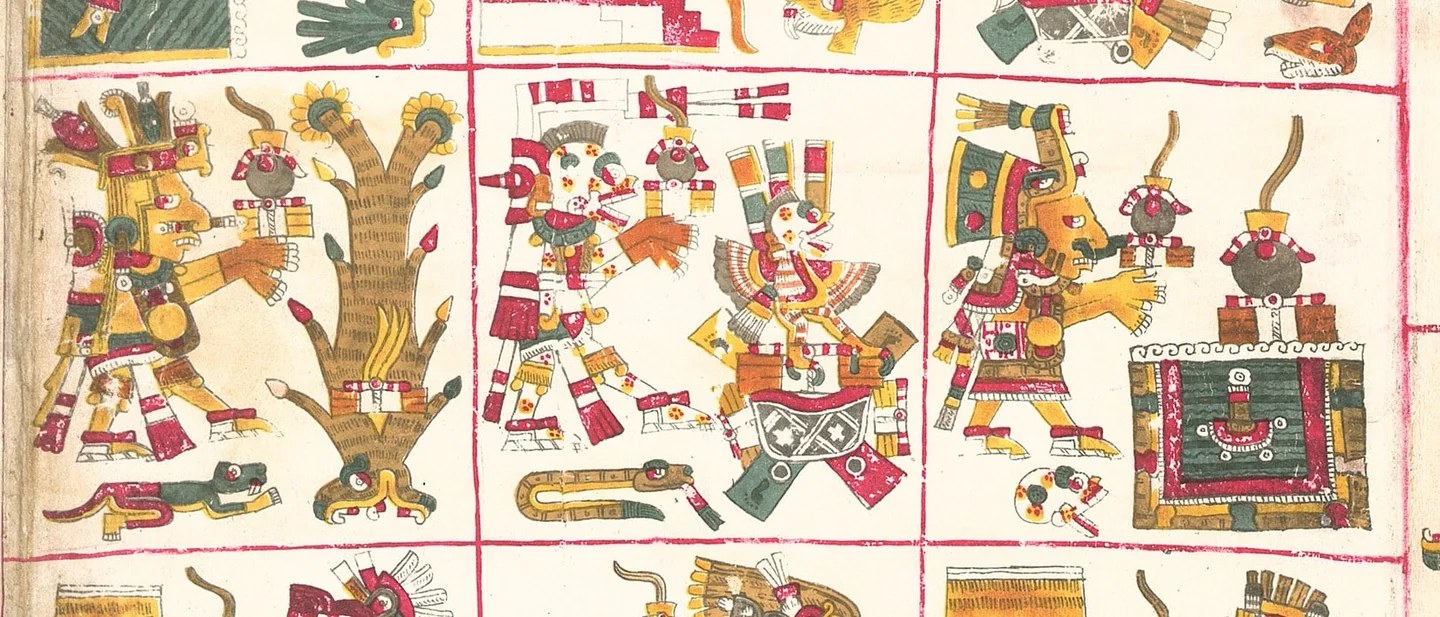
The band at the head of this page is page 14 of the Codex Borgia, one of the handful of painted books of central Mexico that came through the conquest 10. Its seventy-six pages are calendrical and ritual, painted on folded animal skin, and page 14 carries a tree in bloom among its figures 11. The book was probably written near Cholula or Huejotzingo, and its language is listed as Nahuatl, the language of the song above.
Reflection
The singer in this song knows exactly what he wants, has no idea where it grows, and sets out anyway, asking the birds for directions. Think of something you are trying to make at the moment: where do you go to look for it, and whom do you ask?
References
- 1Wikipedia: Cantares Mexicanos
en.wikipedia.org
- 2Wikipedia: Classical Nahuatl
en.wikipedia.org
- 3Wikipedia: Daniel Garrison Brinton
en.wikipedia.org
- 4
- 5
- 6Wikipedia: Elegant trogon
en.wikipedia.org
- 7Wikipedia: Roseate spoonbill
en.wikipedia.org
- 8Wikipedia: Difrasismo
en.wikipedia.org
- 9Wikipedia: Nahuatl
en.wikipedia.org
- 10Wikipedia: Codex Borgia
en.wikipedia.org
- 11Wikimedia Commons: Codex Borgia, page 14
commons.wikimedia.org
This story was produced automatically by a channel. One sentence is all it takes for Neodrop to keep producing for you.