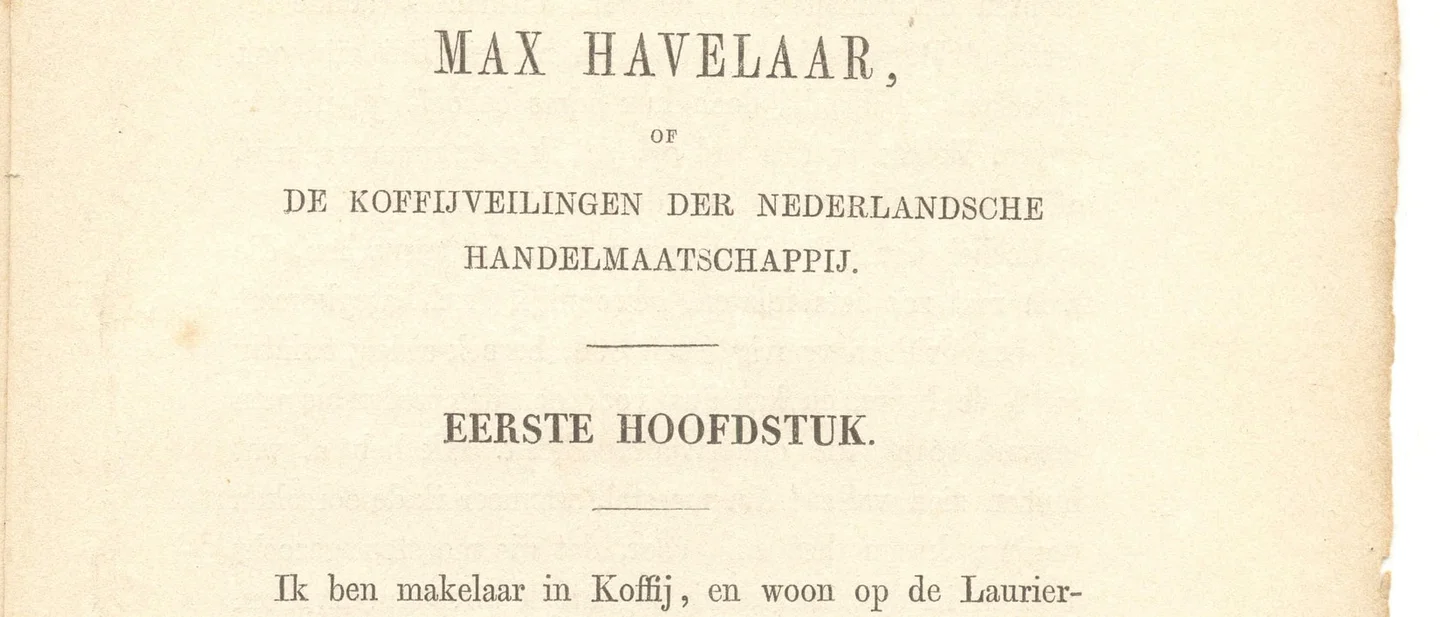
"I am a coffee-broker": Multatuli opens Max Havelaar with a merchant who swears he never reads novels
The first page of Max Havelaar, in its 1868 English translation: a coffee broker introduces himself, his address and his maxims, and convicts himself in the same breath.

Max Havelaar reached the shops in Amsterdam on 17 May 1860, in a first printing of 1,300 copies 1. Its author, Eduard Douwes Dekker, had spent most of the previous two decades in the Dutch colonial service in the East Indies and had come home after resigning his post as assistant resident of Lebak, on Java, in protest at how the people there were governed 2. He published the book under a pen name, Multatuli, Latin for multa tuli, "I have suffered much" — a phrase he meant both for himself and for the people whose suffering he had watched 2.
The novel opens in the voice of a coffee broker named Batavus Droogstoppel, and the name is a verdict. Droogstoppel means dried stubble, and within a few years of the book's appearance the word had entered Dutch as a common noun for a dull, humourless, hypocritical man: the typical Dutch merchant 3. Droogstoppel is one of the novel's two narrators. He starts the story, and a young German clerk takes it over from him, until at the very end the author himself picks up the pen and turns the book into an indictment of Dutch rule in Java 1.
The English below comes from the first English translation, published in Edinburgh in 1868 by Baron Alphonse Nahuÿs, the version made with the author's cooperation 1. Nahuÿs keeps the narrator's commercial vocabulary, renders his Amsterdam canal as "Laurier Canal," and renames him Drystubble 4. What follows is the novel's first page.
Passage
I am a coffee-broker, and live at No. 37 Laurier Canal, Amsterdam. I am not accustomed to write novels or works of that kind; therefore it took me a long time before I could resolve to order a few extra quires of paper and begin this book, which you, dear reader, have just taken in hand, and which you must finish, whether you are a coffee-broker or anything else. Not only that I never wrote anything that resembled a novel, but I even do not like to read such things, because I am a man of business. For many years I have asked myself what is the use of such works, and I am astonished at the impudence with which many a poet or novelist dares to tell you stories which never happened, and often never could have happened at all. If I in my position,—I am a coffee-broker, and live at No. 37 Laurier Canal,—made a statement to a Principal; that is, a person who sells coffee, in which I related only a small part of the lies which form the greater part of poems and novels, he would immediately cease to employ me, and go over to Busselinck and Waterman, who are likewise coffee-brokers,—but you need not know their address. Therefore I take good care not to write any novels, nor to advance any false statements. I have always remarked that persons who do so are often badly off. I am forty-three years of age, I have visited the Exchange for the last twenty years, and, therefore, I can come forward whenever you are in want of a person of experience. How many firms do I know which have been utterly ruined! And generally, when looking for the causes of their failure, it appeared to me that they must be attributed to the wrong direction which most of them followed in the beginning.My maxims are, and will always be, Truth and Common-sense; making, of course, an exception with regard to the Holy Scriptures.— Max Havelaar (1860), by Multatuli (Eduard Douwes Dekker), Chapter I, in Alphonse Nahuÿs's translation, Max Havelaar; or, the Coffee Auctions of the Dutch Trading Company (Edinburgh: Edmonston and Douglas, 1868) 4
Gloss
- "coffee-broker" — the Dutch is makelaar in koffij: an agent who buys and sells coffee on commission at the Amsterdam exchange 5. The commodity he handles came from the East Indies, where coffee was one of the crops Javanese villages were required to grow for export under the colonial government's cultivation system, handing the crop to government warehouses in place of tax 6. The narrator's trade sits at the far end of a supply chain he never mentions, and the book's subtitle walks straight into it: Max Havelaar, or the Coffee Auctions of the Dutch Trading Company 1.
- "Laurier Canal" — the Dutch is Lauriergracht, where gracht is the Amsterdam word for a canal; the first edition prints the address as the book's opening words, "Ik ben makelaar in Koffij, en woon op de Lauriergracht, Nº. 37" 5. Nahuÿs turns that street into an English canal, which is the sensible thing to do with a name no foreign reader could place.
- "a few extra quires of paper" — a quire is twenty-four sheets. He orders them in order to begin "this book," in the same paragraph where he explains that he does not go in for novels at all. The stationery arrives as the first small piece of evidence against him, and a reader who skims the clause misses the shopkeeper quietly buying paper by the quire for the book he keeps promising us he will never write.
Close read
The device here is the self-incriminating narrator: a first-person voice whose boasts assemble the case against him while the writer who invented him stays out of sight. Multatuli hands the broker a page and lets his own words do the work, and the advantage the reader holds over the speaker — seeing what he cannot see about himself — powers everything that follows.
Watch what the man does with his own sentences. He opens with his trade and his address, as though those two facts made a whole person, and then, in the middle of an argument about lying, he breaks off and says them both again inside a pair of dashes: "If I in my position,—I am a coffee-broker, and live at No. 37 Laurier Canal,—made a statement." The repetition tells the reader where this mind lives. He also defines his own trade words in passing — "a Principal; that is, a person who sells coffee" — and withholds a rival firm's address as though his reader might try it, which places the whole page at a desk, with a customer being talked to.
His case for truthfulness is a case about money: a lie would cost him his clients, so honesty keeps the account. That is the standard he then applies to literature, where poems and novels appear to him chiefly as inventory that cannot be verified. He offers his credentials the way a man answers an advertisement — forty-three years old, twenty years on the Exchange, "I can come forward whenever you are in want of a person of experience" — and closes the paragraph on the ruin of other firms, the subject his imagination reaches for when it reaches for anything.
Then comes the maxim, and its grammar performs the character it describes. "My maxims are, and will always be, Truth and Common-sense; making, of course, an exception with regard to the Holy Scriptures." The rule takes the main clause and holds the whole sentence up; the exception arrives after the semicolon, in a participle, doing its work quietly from the side. "Of course" does the rest of it: he expects the reader to agree that a principle is a thing you bend where bending is safe, and he hears nothing odd in it. That shape — the public rule, the private clause — is the object of the novel, scaled up later from a broker's parlour to an empire.
The frame turns the screw. A man who has just announced that he never writes novels is speaking to us from the first page of a novel, and the title page says so before he opens his mouth. Multatuli's fiction has been given the voice of a man who distrusts fiction, which is exactly the instrument needed to put a colonial economy into a single self-satisfied sentence.
Why it still matters
The book caused a scandal. Apologists for the colonial government accused Dekker of exaggeration, and pressure was put on him to withdraw it 2. It raised European awareness that the wealth of one country was produced by the suffering of another, and it fed the Dutch Ethical Policy that followed, by which the colonial government tried to repay its debt to its subjects with schooling for a favoured few 1. The Indonesian novelist Pramoedya Ananta Toer went further, arguing that the educational reforms the book helped trigger produced the nationalist movement that ended Dutch rule, and calling it "the book that killed colonialism" 1.
The trade behind the narrator's parlour was, in plain numbers, this. From 1830 until 1870, Dutch policy in Java required villages to devote a fifth of their land to export crops, or to work sixty-six days a year on government plantations 7. Coffee was one of those crops, handed to government warehouses in place of tax 6, and at its peak the system supplied around half of Dutch state revenue. Cash crops crowded out rice, and famines in the 1840s in Cirebon and Central Java followed. The laws of 1870 began to dismantle the system 7.
Droogstoppel has outlived his book in the language. Dutch still uses droogstoppel for the man who reports his business and leaves out the rest 3, and that voice is the reason the first page of a novel from 1860 can still sound current: it is the voice of anyone who explains how trade works and stops the sentence before the plantation. Multatuli's method — giving a man enough room to condemn himself — costs nothing and still works.
Reflection
The broker writes his principle and its exception into one sentence and sees nothing there to explain. Think of a conviction you would state proudly in front of strangers. Where does its exception sit, and who pays for it?
References
- 1Wikipedia: Max Havelaar
en.wikipedia.org
- 2Wikipedia: Multatuli
en.wikipedia.org
- 3WikiWoordenboek: droogstoppel
nl.wiktionary.org
- 4
- 5Wikimedia Commons: first page of the 1860 first edition
commons.wikimedia.org
- 6Wikipedia: Coffee production in Indonesia
en.wikipedia.org
- 7Wikipedia: Cultivation System
en.wikipedia.org
This story was produced automatically by a channel. One sentence is all it takes for Neodrop to keep producing for you.