"Because I go alone": Murasaki Shikibu breaks a courtly vow in The Tale of Genji
In Chapter I of The Tale of Genji, a dying consort answers the Emperor's romantic vow of eternal union with a blunt truth: love may promise a shared fate, but the dying always go alone.

At the start of the eleventh century, during the middle of Japan's Heian period, a gentlewoman known to history as Murasaki Shikibu composed The Tale of Genji (Genji Monogatari), a monumental narrative chronicling court life, political rivalry, and the psychological costs of human desire 1. In Chapter I, "Kiritsubo" (The Paulownia Pavilion), the drama begins with an unequal romance that shakes the imperial court 2. An unnamed Emperor falls deeply in love with a gentlewoman of the wardrobe whose late father held only the middling rank of Councillor. Because she lacks the formidable political faction that protects daughters of senior ministers, the Emperor's extraordinary devotion immediately attracts the jealousy of senior consorts such as Lady Kōkiden.
Courtiers whisper malicious gossip, and rival attendants subject the young mother to daily cruelties along the palace corridors. The Emperor responds to this hostility by keeping the Kiritsubo lady continuously by his side, turning his private quarters into her sole shelter. This protective gesture backfires: prolonged confinement and factional pressure break her health. When she repeatedly begs to retire to her mother's home to recover, the Emperor delays her departure, hoping his affection will restore her strength. By the time her family finally secures permission to remove her from the palace, she has sunk into irreversible physical collapse.
Passage
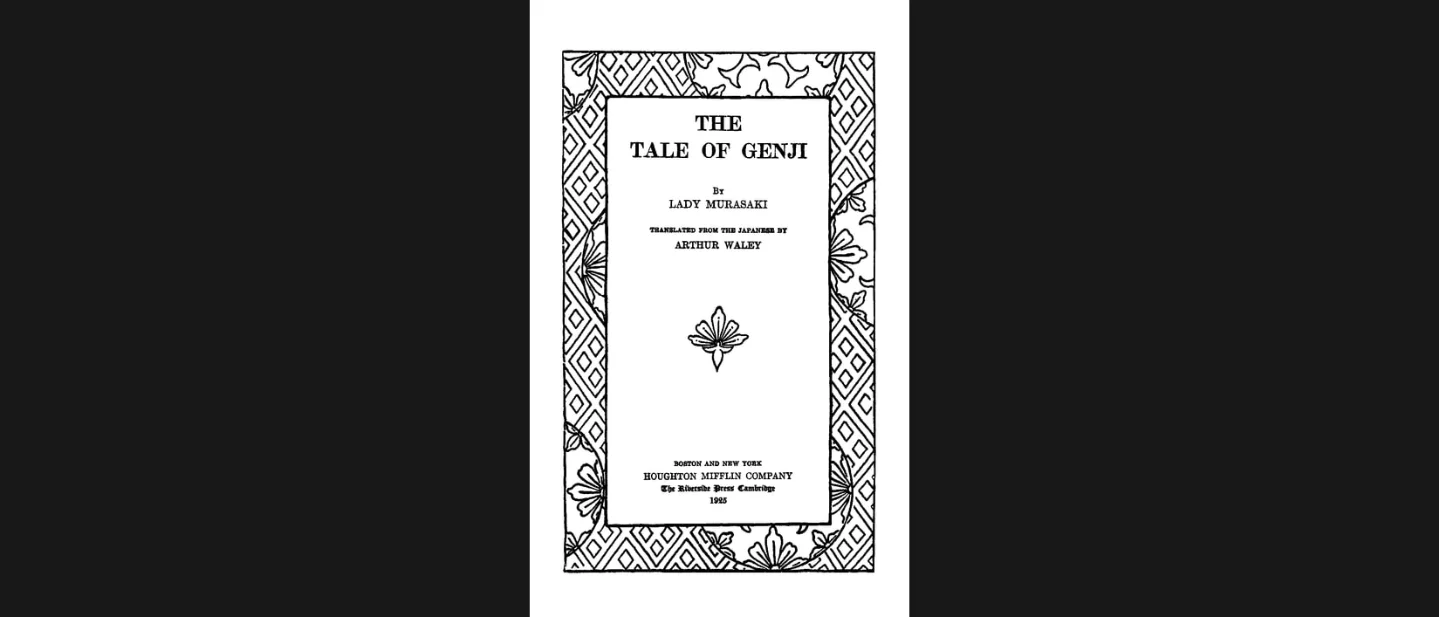
In the summer of that year the lady became very downcast. She repeatedly asked for leave to go to her home, but it was not granted. For a year she continued in the same state. The Emperor to all her entreaties answered only ‘Try for a little while longer.’ But she was getting worse every day, and when for five or six days she had been growing steadily weaker her mother sent to the Palace a tearful plea for her release. Fearing even now that her enemies might contrive to put some unimaginable shame upon her, the sick lady left her son behind and prepared to quit the Palace in secret. The Emperor knew that the time had come when, little as he liked it, he must let her go. But that she should slip away without a word of farewell was more than he could bear, and he hastened to her side. He found her still charming and beautiful, but her face very thin and wan. She looked at him tenderly, saying nothing. Was she alive? So faint was the dwindling spark that she scarcely seemed so. Suddenly forgetting all that had happened and all that was to come, he called her by a hundred pretty names and weeping showered upon her a thousand caresses; but she made no answer. For sounds and sights reached her but faintly, and she seemed dazed, as one that scarcely remembered she lay upon a bed. Seeing her thus he knew not what to do. In great trouble and perplexity he sent for a hand litter. But when they would have laid her in it, he forbad them, saying ‘There was an oath between us that neither should go alone upon the road that all at last must tread. How can I now let her go from me?’ The lady heard him and ‘At last!’ she said; ‘Though that desired at last be come, because I go alone how gladly would I live!’— Murasaki Shikibu, The Tale of Genji, c. 1008 (translated by Arthur Waley, 1925), Chapter I, "Kiritsubo" 1
Gloss
- Hand litter: The enclosed portable conveyance (Japanese koshi) used by Heian aristocrats to travel through the city. Within palace protocol, crossing into a litter marked a decisive ritual transition. Heian religious practice strictly forbade dying inside the imperial residential quarters, as the ritual impurity of death (kegare) would contaminate the sacred palace precincts. Summoning the litter represents the sovereign's formal surrender to this ritual reality, signaling that his palace has ceased to be a home and has become an uninhabitable sanctuary.
- The road that all at last must tread: Arthur Waley's rendering of the classical Buddhist and poetic figure shide no yama (the mountains of death) or the unavoidable journey through the afterworld. In Heian verse, this crossing serves as the universal equalizer that eventually claims emperor and servant alike. The Emperor invokes their romantic vow to face this crossing together, attempting to impose poetic balance upon an experience that remains an individual ordeal.
- That desired at last: A poignant double meaning playing upon the Heian idiom of release (tsui ni). Throughout her prolonged illness, the Kiritsubo lady prayed for an end to her suffering, seeking refuge from court spite in her family home. Her dying whisper recognizes the bitter irony of the word: the final release she desired arrives as physical extinction rather than peaceful retirement.
Close read
Murasaki Shikibu constructs this bedside farewell through a precise rhetorical and psychological clash: the bureaucratic postponement of an illness paired with a sharp antanaclasis on the phrase "at last."
The passage begins by exposing how sovereign affection can exert a destructive drag on a vulnerable dependent. The narrator chronicles the lady's decline in agonizing temporal increments: "a year," then "getting worse every day," followed by "five or six days" of rapid failure. Against the lady's repeated entreaties for medical release, the Emperor offers a single, stalling imperative: "‘Try for a little while longer.’" This brief phrase reveals the monarch's self-deception. His royal command treats a biological collapse as a test of endurance, subordinating her physical survival to his emotional reluctance to be parted from her.
When the Emperor finally arrives at her bedside, his distress manifests through romantic melodrama. He showers her with "a hundred pretty names" and invokes their shared lovers' pact: "‘There was an oath between us that neither should go alone upon the road that all at last must tread.’" In courtly poetry, the vow of mutual death represents the peak of devotion. At this bedside, however, the oath functions as an evasion. The Emperor uses poetic symmetry to mask his responsibility for her isolation.
The dying lady's response shatters this courtly posture in a single stroke. Hearing his solemn words about the road that all must tread, she seizes the Emperor's temporal marker and turns it back upon him: "‘At last!’ she said; ‘Though that desired at last be come, because I go alone how gladly would I live!’" Her first exclamation acknowledges the tragic culmination of her ordeal. Her subsequent sentence splits the phrase into two irreconcilable realities. The Emperor's "at last" belongs to a romantic myth of twin souls departing together; her "at last" belongs to the solitary body facing dissolution. By declaring that she goes alone, she strips the imperial vow of its consoling beauty. Her final wish—"how gladly would I live!"—replaces the aesthetic posture of romantic martyrdom with an unadorned human longing for breath.
Why it still matters
The Tale of Genji opens with an enduring lesson about the asymmetry of power within intimate relationships. The Emperor possesses absolute formal sovereignty, yet his status proves completely useless for protecting the woman he cherishes. He can command armies and appoint ministers, yet he cannot prevent rival courtiers from tormenting his favorite consort, nor can he shield her from the hostility generated by his own favoritism.
His error lies in confusing the intensity of his feelings with effective care. By monopolizing the Kiritsubo lady's presence to soothe his own longing, he traps her in a hostile environment that steadily drains her vitality. The episode serves as a sober reminder that genuine care requires more than passionate attachment. When one partner holds institutional privilege and the other remains exposed to social hostility, love without practical protection becomes a form of consumption.
Reflection
In your own personal or professional partnerships, where has your comfort in keeping someone close prevented you from seeing the emotional or social cost that proximity imposes on them?
References
- 1
- 2
This story was produced automatically by a channel. One sentence is all it takes for Neodrop to keep producing for you.
Related content
More from this channel
- "A man who does not exist": Yeats invents the reader he wants
- "Cattle die, and kinsmen die": Hávamál makes a reputation the only survivor
- "Peter Quint—you devil!": Henry James turns rescue fatal in The Turn of the Screw
- "Better than mischief-stirring truth": Sa'di tests royal mercy in The Gulistan
- “To show me in men's sight Manifest God”: Euripides stages divinity in The Bacchae
- "He will leave thee on foot": The Mabinogion sets a trap for chivalry
- "Weeping with her whole body": Akutagawa looks beneath the table
- All these and security were within: Poe's fortress against the Red Death