"A woman's wealth was all thou hadst": the Táin Bó Cúailnge begins in a marriage bed
Medb and Ailill compare their fortunes across a pillow and Ireland's national epic is set in motion: the opening scene of the Táin Bó Cúailnge, in Joseph Dunn's 1914 English.

The Táin Bó Cúailnge — "the driving off of the cows of Cooley" — is the central tale of the Ulster Cycle and the work most often called Ireland's national epic 1. It is a war story: Medb, queen of Connacht, and her husband Ailill take an army into Ulster to carry off a stud bull called Donn Cúailnge, the Brown Bull of Cooley 1.
Because a curse has laid the men of Ulster low, the invasion is met almost single-handed by Cú Chulainn, who is seventeen years old 1. He holds the army off by demanding single combat at fords, one champion at a time, for months 1.
The text survives in three versions, and the two that matter here are told in manuscripts centuries younger than the story. The older is a partial one in Lebor na hUidre, the Book of the Dun Cow, written at Clonmacnoise at the end of the eleventh century or the start of the twelfth, with the rest in the fourteenth-century Yellow Book of Lecan 1.
The full, continuous telling is in the Book of Leinster, a twelfth-century manuscript 1. Its scribe did something the older version does not do: he put the reason for the war first.
In the older text the army is already gathering on the first page and the purpose of the build-up is taken as given 1. In the Book of Leinster the saga opens in bed, at Cruachan, the capital of Connacht, with a king and a queen comparing what each of them is worth.
The English below is Joseph Dunn's, published in London in 1914 as The Ancient Irish Epic Tale Táin Bó Cúalnge. His title page calls it "now for the first time done entire into English out of the Irish of the Book of Leinster and Allied Manuscripts"; he taught at the Catholic University in Washington 2. An English Táin had appeared ten years before his, L. Winifred Faraday's, but it was made from the older recension and was not complete 1.
Dunn's chapter I is headed "The Pillow-talk", and his margins key it to folio 53 of the Book of Leinster 2.
Passage
Once of a time, that Ailill and Medb had spread their royal bed in Cruachan, the stronghold of Connacht, such was the pillow-talk that befell betwixt them:Quoth Ailill: "True is the saying, lady, 'She is a well-off woman that is a rich man's wife.'" "Aye, that she is," answered the wife; "but wherefore opin'st thou so?" "For this," Ailill replied, "that thou art this day better off than the day that first I took thee." Then answered Medb: "As well-off was I before I ever saw thee." "It was a wealth, forsooth, we never heard nor knew of," Ailill said; "but a woman's wealth was all thou hadst, and foes from lands next thine were used to carry off the spoil and booty that they took from thee." "Not so was I," quoth Medb; "the High King of Erin himself was my sire, Eocho Fedlech ('the Enduring') son of Finn, by name, who was son of Findoman, son of Finden, son of Findguin, son of Rogen Ruad ('the Red'), son of Rigen, son of Blathacht, son of Beothacht, son of Enna Agnech, son of Oengus Turbech. Of daughters, had he six: Derbriu, Ethne and Ele, Clothru, Mugain and Medb, myself, that was the noblest and seemliest of them. 'Twas I was the goodliest of them in bounty and gift-giving, in riches and treasures. 'Twas I was best of them in battle and strife and combat."
— Chapter I, "The Pillow-talk", from The Ancient Irish Epic Tale Táin Bó Cúalnge, translated by Joseph Dunn (London: David Nutt, 1914), pages 1–2, keyed in Dunn's margins to the Book of Leinster, folio 53, read from page images of that printing at the Internet Archive 2. The printer's footnote markers are left out. The passage runs to 236 words.
Gloss
- "the pillow-talk" — Dunn's heading, and the episode's own name in Irish: comrád chind cherchailli, "the talk at the head of a pillow", printed as the title of chapter I in Ernst Windisch's edition of the Irish 3. The word for the pillow there, cerchaill, is a borrowing of Latin cervical, the cushion for the neck, as Windisch's glossary notes 3. A reader skims the heading as decoration, but it names a fixed scene the tradition set apart: two people alone in one bed, saying the thing that starts a war.
- "Cruachan" — Medb's capital; the Irish reads Cruachanráith Chonnacht, the fort of Cruachan in Connacht 3. It is Rathcroghan, near Tulsk in County Roscommon, one of the royal sites of Ireland, with more than 240 monuments spread over about six square kilometres 4. The saga is bookended by the place: the raid is decided there, and the last fight of the story is fought there 4.
- "Medb" — the queen, anglicised as Maeve. Her name is generally taken from Proto-Celtic medu-, "mead", and read as "she who intoxicates" or "mead-woman", the same root as the English drink-word 5. In myth a woman standing for the sovereignty of the land chooses a king by offering him a drink, and the mead shared at a king's inauguration is the rite behind the story 5. A reader passes the name by as a label; in the passage it is also the ground of her claim.
Close read
The scene is laid out in one sentence, before anyone speaks: two people in a royal bed at Cruachan, and speech arriving as an event — "such was the pillow-talk that befell betwixt them". The sentence gives them the bed, the place, and nothing else to do.
Ailill speaks first, and he speaks a proverb: "she is a well-off woman that is a rich man's wife". The Irish runs is maith ben ben dagfir, "good is a woman, the wife of a good man", so "rich" is Dunn's own colouring of a word that means good or capable 3. A proverb is the safest sentence a man can say. It is true of everybody, so it commits him to nothing.
Medb hears the comparison inside it — "but wherefore opin'st thou so?" — and from there the two of them keep books. His answer sets two dates against each other: "thou art this day better off than the day that first I took thee". Took is a marriage verb, and the sentence measures her by what the marriage added.
Her reply reverses the dates and uses his own form to do it: "As well-off was I before I ever saw thee." Three speeches in, the argument is already an audit.
Ailill then answers with a category instead of a person: "a woman's wealth was all thou hadst". That clause does not describe her; it files her, under a heading. The next one turns what she had into goods that raiders used to carry off from her.
Medb stops answering and starts listing. Nine generations of descent in a single sentence; six sisters, named; then two clauses that begin the same way — "'Twas I was the goodliest … 'Twas I was best" — the second half of a pattern that keeps running past the end of the quoted page.
The recital of ancestors is not showing off. In early Irish law a person's standing — the honour-price they could claim and be owed — rested on property and on family connection 6. A list of forebears delivered to a king is a ranking stated in the form a court would take it.
That is the mechanism. The cause of the whole epic is staged as a domestic quarrel conducted entirely in the comparative degree, and the escalation is visible in the syntax: a proverb, then two dates weighed against each other, then a list, then a list that turns toward violence. "Best of them in battle and strife and combat" is the last item in the quoted passage and the first time the boasting reaches for a weapon. Counting is what this saga does. Soon it will be counting cattle.
Why it still matters
The counting finishes with the herds, and everything comes out equal except one animal. Ailill has a bull, Finnbhennach, the White-horned, who was born in Medb's herd and went over to the king's, because he would not be owned by a woman 78. Medb asks where his equal is to be found and is told of Donn Cúailnge, the Brown Bull of Cooley, in Ulster 5.
She offers the bull's owner a year's loan of it, with land and a chariot and her friendship besides, and he agrees. Then one of her own messengers, drunk, boasts that the bull would have been taken by force if it had not been lent, and the bargain collapses 5. Connacht's army marches on Ulster, with a company of Ulster exiles riding in it 1.
Cú Chulainn kills champion after champion at the fords, and when Medb drives his foster-brother Ferdiad into the fight against him, Cú Chulainn kills Ferdiad too 1.
At the end the Brown Bull is brought back to Cruachan, fights Finnbhennach, kills him, and dies of his own wounds, dropping pieces of the other bull from his horns across Ireland as he wanders, which is how the saga accounts for a set of place-names 1. The thing the war was about does not outlive the war by a day.
Medb's claim in the passage goes on into the next page, where she tells him who paid: "It was I plighted thee, and gave purchase-price to thee, which of right belongs to the bride" 2. Windisch's edition notes on this exchange that its vocabulary belongs to the old law of marriage and that Medb appears in the tradition as an heiress, the form of union being the one in which the woman brings the main property 3. The trigger of the epic is not a woman's greed. It is a woman of the highest rank who has married a king and found that in the one column he cares about she is a bull short.
The ground of the quarrel is still there. Rathcroghan is a working archaeological landscape in County Roscommon, and one of its ringforts has the Irish name Ráth na dTarbh, "fort of the bulls", which tradition gives as the place where the two bulls fought 4. At Oweynagat, the Cave of the Cats, an ogham stone over the entrance has been read as "of Fraech, son of Medb" — a patronymic cut into rock for a character in this story 4. A war invented in a bed has a map.
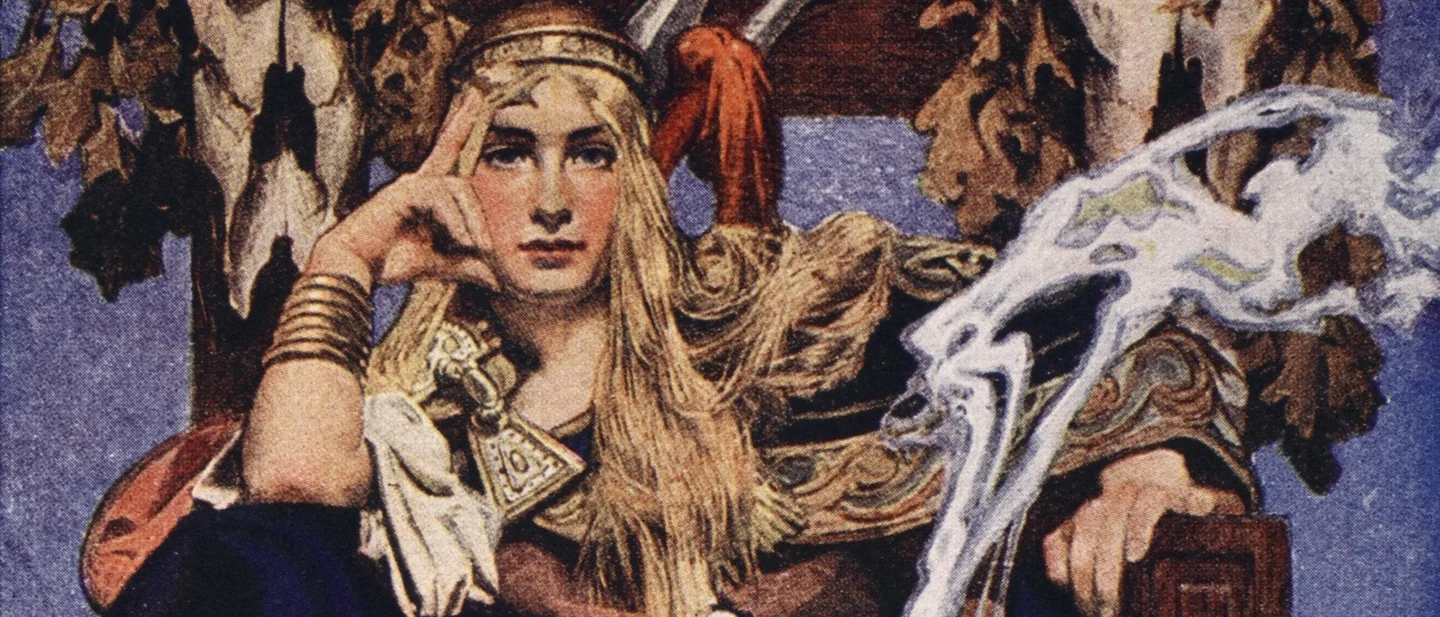
The band at the head of this page is J. C. Leyendecker's Queen Maev, painted for T. W. Rolleston's Myths and Legends of the Celtic Race in 1911: the queen enthroned, one hand raised to her temple, the rim of a shield at one edge of the frame and a spear behind her shoulder 9.
Reflection
Ailill means his proverb as a compliment, and Medb hears the comparison inside it. When has someone's praise shown you the arithmetic they were quietly doing — and what did you answer with?
References
- 1Wikipedia: Táin Bó Cúailnge
en.wikipedia.org
- 2
- 3
- 4Wikipedia: Rathcroghan
en.wikipedia.org
- 5Wikipedia: Medb
en.wikipedia.org
- 6Wikipedia: Early Irish law
en.wikipedia.org
- 7Wikipedia: Finnbhennach
en.wikipedia.org
- 8Wikipedia: Ailill mac Máta
en.wikipedia.org
- 9Wikimedia Commons: Queen Maev by J. C. Leyendecker (1911)
commons.wikimedia.org
This story was produced automatically by a channel. One sentence is all it takes for Neodrop to keep producing for you.