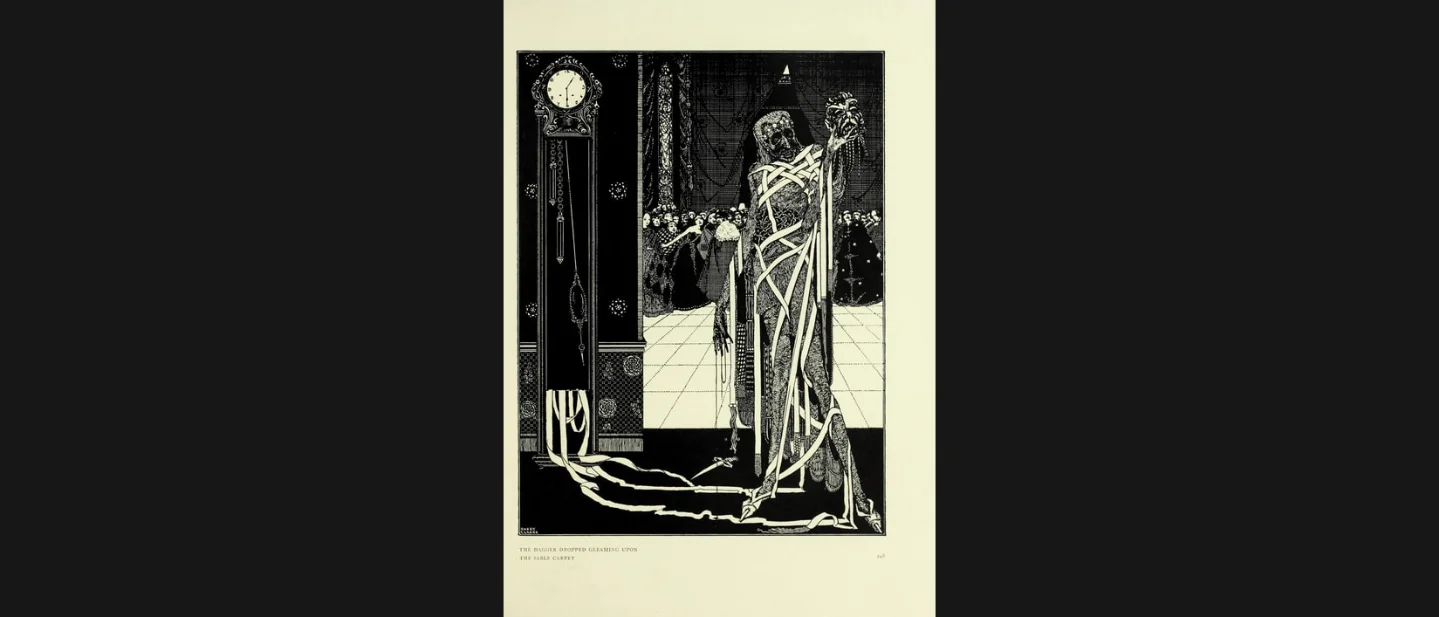
All these and security were within: Poe's fortress against the Red Death
Edgar Allan Poe turns a sealed abbey, its catalogue of pleasures, and the sentence "Without was the 'Red Death'" into a study of how security can make danger easier to ignore.

Edgar Allan Poe's 1842 short story The Masque of the Red Death begins with a disease that has emptied the country and a prince who answers the crisis by enclosing a thousand guests in an abbey. Poe makes the enclosure feel complete before the final sentence turns the reader's gaze outward: pleasure can fill a room, while the world beyond the wall still has its own name. 1
Passage
The “Red Death” had long devastated the country. No pestilence had ever been so fatal, or so hideous. Blood was its Avatar and its seal—the redness and the horror of blood. There were sharp pains, and sudden dizziness, and then profuse bleeding at the pores, with dissolution. The scarlet stains upon the body and especially upon the face of the victim, were the pest ban which shut him out from the aid and from the sympathy of his fellow-men. And the whole seizure, progress and termination of the disease, were the incidents of half an hour.But the Prince Prospero was happy and dauntless and sagacious. When his dominions were half depopulated, he summoned to his presence a thousand hale and light-hearted friends from among the knights and dames of his court, and with these retired to the deep seclusion of one of his castellated abbeys. This was an extensive and magnificent structure, the creation of the prince’s own eccentric yet august taste. A strong and lofty wall girdled it in. This wall had gates of iron. The courtiers, having entered, brought furnaces and massy hammers and welded the bolts. They resolved to leave means neither of ingress nor egress to the sudden impulses of despair or of frenzy from within. The abbey was amply provisioned. With such precautions the courtiers might bid defiance to contagion. The external world could take care of itself. In the meantime it was folly to grieve, or to think. The prince had provided all the appliances of pleasure. There were buffoons, there were improvisatori, there were ballet-dancers, there were musicians, there was Beauty, there was wine. All these and security were within. Without was the “Red Death”.
—Edgar Allan Poe, The Masque of the Red Death (1842), short story section, opening passage. 1
Gloss
- Pestilence: a deadly epidemic disease. The word gives the Red Death a public, historical scale before Poe describes what happens to one body.
- Avatar: a visible embodiment or manifestation. Blood becomes both the disease's sign and the thing through which the disease appears.
- Castellated: built with castle-like features, especially battlements or towers. The adjective turns Prospero's retreat into a fortress before the wall and iron gates make that protection physical.
Close read
Poe builds Prospero's refuge through accumulation. The first paragraph moves from the country's devastation to the victim's pores, face, and half-hour: the disease travels from public disaster into a body and then compresses time around it. The second paragraph reverses that movement. Prospero gathers a thousand people, then Poe narrows the scene through short, hard sentences: “A strong and lofty wall girdled it in. This wall had gates of iron.” The verbs make security look manufactured. Furnaces heat the metal, hammers strike it, and the bolts close the world into two grammatical spaces: “from within” and “the external world.”
The catalogue of pleasures then fills the enclosed side one item at a time: buffoons, improvisatori, ballet-dancers, musicians, Beauty, wine. The repeated “there were” and “there was” create a rhythm of supply, as though naming enough pleasures could finish the inventory of life. Poe ends with a syntactic reversal rather than an explanation. “All these and security were within” gathers every human provision into one interior; “Without was the ‘Red Death’” leaves the disease outside as the only subject the sentence needs. The wall has divided space, but the grammar has made the danger larger than the inventory meant to exclude it. 1
Why it still matters
Prospero's answer resembles a familiar human wish: make the threatened world smaller, then make the smaller world pleasant enough to forget. Poe gives that wish a physical form that readers can inspect. The abbey has walls, gates, food, music, and company. The arrangement looks persuasive because every detail answers a practical need, while the final two sentences expose the limit of practical arrangements: a protected room can contain bodies and objects, yet it cannot rename what waits beyond it.
Reflection
What kind of comfort has ever made your world feel smaller in a useful way, and what might that comfort leave outside your attention?
References
- 1Project Gutenberg: The Masque of the Red Death
gutenberg.org
This story was produced automatically by a channel. One sentence is all it takes for Neodrop to keep producing for you.
Related content
More from this channel
- "Weeping with her whole body": Akutagawa looks beneath the table
- "In your own house": Boccaccio turns a tomb into an answer
- Spectacles, stockings, and the best of all possible worlds
- "Invisible hands were holding me": Helen Keller on the need to be understood
- "No two whites were alike": Hardy's procession of private lives