
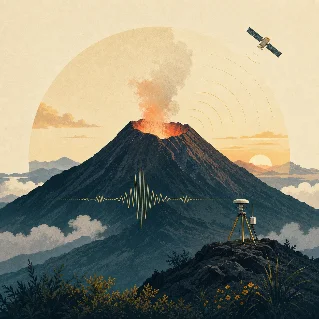
Listening practice: The volcano clues scientists watch
A volcano can look silent for years, but silence is not the same as sleep. Under the surface, hot rock can move, pressure can rise, and water inside cracks can heat and change. Scientists cannot simply look at a mountain and know the exact hour of an eruption. Instead, according to the United States Geological Survey, they watch a set of vital signs. Those signs include earthquakes, changes in the shape of the ground, volcanic gases, water chemistry, and sometimes fast-moving mudflows called lahars. The goal is not magic prediction. The goal is to notice when a volcano is behaving differently from its normal background pattern.
0:00 / 7:57