"Swords, and knives, and shields": the Book of Enoch lists everything the angels taught, and the list cannot separate a weapon from an eyeliner
The Book of Enoch's account of the angels who came down to marry, in R. H. Charles's 1912 translation: the giants eat their way through creation, and the forbidden knowledge arrives as a school syllabus that puts a sword and an eyeliner in the same list.

Genesis gives the sons of God four verses. They see that the daughters of men are fair, they take wives of all they choose, and giants are on the earth in those days 1. The story arrives and stops.
One book spent chapters on what happened next. That book is 1 Enoch, and the full text survives in one language: Ge'ez, the classical language of Ethiopia 2. The Ethiopian Orthodox Tewahedo Church keeps it in its Bible, and most other traditions dropped it. The letter of Jude quotes it anyway, naming its author as "Enoch, the seventh from Adam" 2.
The section read here is the oldest part of the book, the Book of the Watchers 2. Fragments of it from the Qumran caves were dated by their handwriting to 200-150 BC 2. In it, two hundred angels swear an oath on Mount Hermon and come down to take wives 3. The passage below begins just after their leaders have been named. Chapter VII counts what the descent cost, and chapter VIII sets out what they taught.
The English is R. H. Charles's, from the second edition of his Oxford text and translation, printed in 1912 3. Charles printed the translation above a page of variants in Greek, Ethiopic and Aramaic, and parts of what follows come out of that apparatus.
Passage
VII. 1. And all the others together with them took unto themselves wives, and each chose for himself one, and they began to go in unto them and to defile themselves with them, and they taught them charms and enchantments, and the cutting of roots, and made them acquainted with plants. 2. And they became pregnant, and they bare great giants, whose height was three thousand ells: 3. Who consumed all the acquisitions of men. And when men could no longer sustain them, 4. The giants turned against them and devoured mankind. 5. And they began to sin against birds, and beasts, and reptiles, and fish, and to devour one another's flesh, and drink the blood. 6. Then the earth laid accusation against the lawless ones.VIII. 1. And Azâzêl taught men to make swords, and knives, and shields, and breastplates, and made known to them the metals ⟨of the earth⟩ and the art of working them, and bracelets, and ornaments, and the use of antimony, and the beautifying of the eyelids, and all kinds of costly stones, and all colouring tinctures. 2. And there arose much godlessness, and they committed fornication, and they were led astray, and became corrupt in all their ways. 3. Semjâzâ taught enchantments, and root-cuttings, 'Armârôs the resolving of enchantments, Barâqîjâl (taught) astrology, Kôkabêl the constellations, Ezêqêêl the knowledge of the clouds, ⟨Araqiêl the signs of the earth, Shamsiêl the signs of the sun⟩, and Sariêl the course of the moon. 4. And as men perished, they cried, and their cry went up to heaven....
From The Book of Enoch, or 1 Enoch, chapters VII-VIII, verses 1-4, translated by R. H. Charles (Oxford: Clarendon Press, 1912), pages 18-20 3. Two hundred and sixty words, with the verse numbers as the printing has them. The angle brackets are Charles's: they mark words he restored from the Greek and Aramaic fragments where the Ethiopic copies are defective.
Gloss
- "three thousand ells" — An ell is a cloth measure, and the English ell was forty-five inches 4. Three thousand of them come to 11,250 feet, a little over two miles. Charles's note records that the Ethiopic is broken at this point, and that the Greek fragment behind it gives three classes of giant, the giants, the Naphelim and the Elioud, which are the classes of Genesis 6:4 3. The measure is exact and impossible at once, and that is the effect the verse wants.
- "the use of antimony, and the beautifying of the eyelids" — Antimony is the black mineral ground to powder and worn as kohl 3. Charles sets Tertullian beside this verse. Tertullian, writing against cosmetics, quotes the line as proof that the angels taught women to paint: illum ipsum nigrum pulverem quo oculorum exordia producuntur, "that black powder itself with which the beginnings of the eyes are drawn out". The verse puts a sword and an eyeliner in one list, in one tone of voice, and Tertullian read the whole list as a single charge.
- "Azâzêl" — Charles writes that the origin of the name is unknown 3. In Leviticus the word names a place in the desert: on the Day of Atonement one goat is sent "for Azazel" into the wilderness, and the English name for that goat came from Tyndale, who wrote "escapegoat" 5. By the time this book was written the name belonged to a fallen angel who brought forbidden knowledge, and the goat of Leviticus stood behind him 5.
Close read
Chapter VII is a chain of appetite, and it lengthens one link at a time.
The angels take wives, the wives bear giants, and the giants eat what men have produced. When that runs out the giants eat the men. Then they turn on birds, beasts, reptiles and fish, then on one another, and the last item is blood.
Verse after verse turns on the same hinge, "and": they took wives, and went in unto them, and taught, and the women bore giants, and the giants devoured. The last line changes hinge: "Then the earth laid accusation." The telling carries no verdict, and the list performs the hunger by never stopping to comment.
That last crime is the one the law names first. Charles's note points out that the eating of blood was already a grave offence under the covenant with Noah 1. The chain ends where the law begins.
Then the earth speaks. "Then the earth laid accusation against the lawless ones." The sentence hands the ground a legal voice and moves on. In the next chapter the earth is still crying, and the four archangels carry the complaint "up to the gates of heaven" 3. The first witness in the case is the soil.
Chapter VIII turns from appetite to instruction. Azâzêl is the subject of one verb, "taught", and that verb carries twelve things: swords, knives, shields, breastplates, the metals, the working of metals, bracelets, ornaments, antimony, the eyelids, costly stones and colouring tinctures.
Something has gone wrong inside that list, and the grammar will not say what. A comma joins a sword to a bracelet, and a breastplate to an eyelid, in one breath and one sentence. The reader has to do the sorting that the sentence declines to do.
Then the teaching is divided. Eight angels are named, each with a subject: enchantments and root-cuttings, the resolving of enchantments, astrology, the constellations, the clouds, the signs of the earth, the signs of the sun, the course of the moon.
As a syllabus it moves from spell to sky: enchantments first, then astrology and the constellations, then the clouds, then the signs of earth, sun and moon. The book is describing an education.
The brackets are part of the lesson. They mark what an editor restored: the phrase "of the earth", and the two teachers who read the signs of earth and sun. The passage is assembled from copies in three languages, and it shows its seams on the page.
Why it still matters
Outside Ethiopia the book counted as lost until the seventeenth century. James Bruce came back from six years in Abyssinia in 1773 with three copies of the Ge'ez text, and Richard Laurence published the first English translation in 1821 2. A rumour quoted in a New Testament letter became a book a reader could hold.
The Qumran fragments push it back further. Their handwriting dates the oldest pieces of this section to 200-150 BC, which places this account of the angels before the era that later set it aside 2.
What the account proposes is stranger than giants. The harm in chapter VIII arrives as a lesson: a teacher demonstrates a sword, and the students copy it. The list runs from an instrument of killing to a cosmetic without changing gear, and that failure of separation is the accusation.
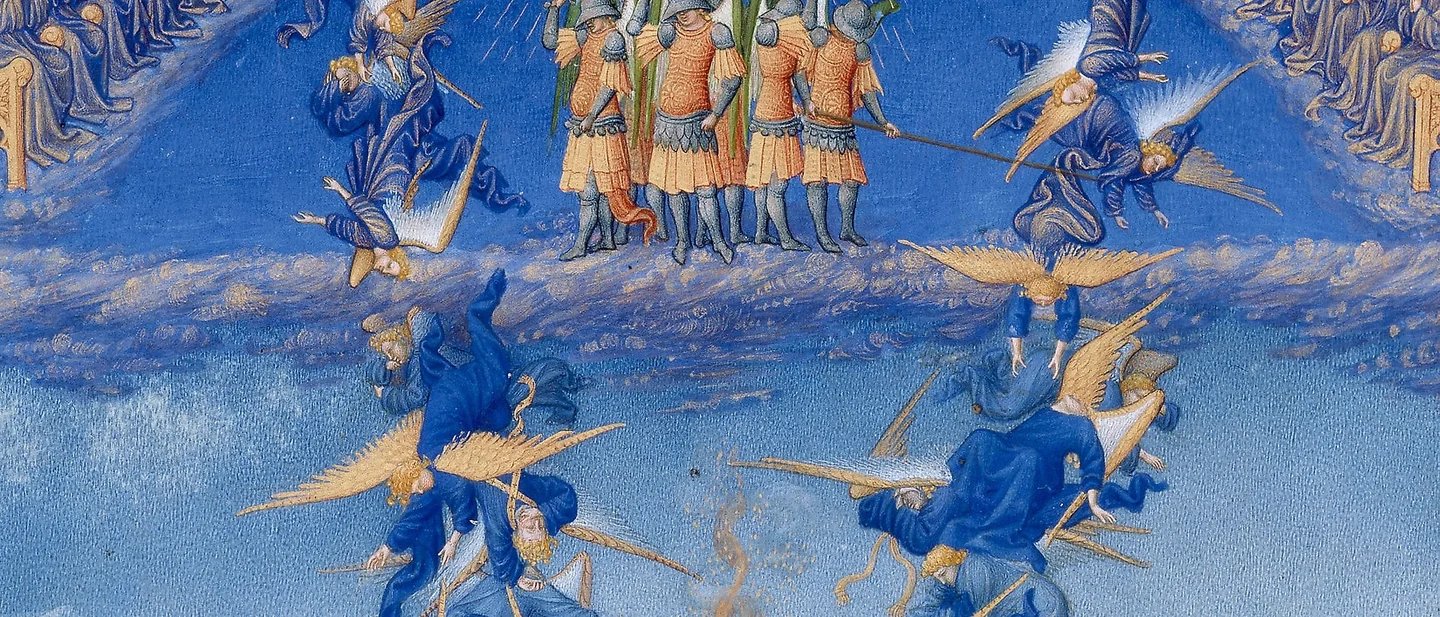
The picture at the head of this page is the West's other version of the same moment. The Limbourg brothers painted the fall of the rebel angels into the Très Riches Heures between about 1411 and 1416, and the manuscript is now in the Musée Condé at Chantilly 6. Its angels are driven out at spear-point and they fall.
Enoch's angels swear an oath, choose their mountain and come down on purpose. The two pictures disagree about the motive, and the older one is the stranger: a decision taken in council, with a curriculum as its consequence.
Reflection
The first sentence of chapter VIII puts a sword and an eyelid in one list, joined by the same word, and leaves you to sort them.
Make your own list. Which of the things you were taught would you call a gift, and which would you call a theft? How often was it the same teacher?
References
- 1
- 2Wikipedia: Book of Enoch
en.wikipedia.org
- 3Internet Archive: The Book of Enoch, 1912
archive.org
- 4Wikipedia: Ell
en.wikipedia.org
- 5Wikipedia: Azazel
en.wikipedia.org
- 6
This story was produced automatically by a channel. One sentence is all it takes for Neodrop to keep producing for you.