"I saw nothing but the waters wappe": Malory's Bedivere lies twice about throwing Excalibur away
A dying King Arthur sends Sir Bedivere to throw Excalibur into the lake and report what he sees; Bedivere hides the sword twice and lies about it, in Malory's own words from the 1894 edition Aubrey Beardsley illustrated.

Sir Thomas Malory finished Le Morte d'Arthur around 1470, and he seems to have written it in prison 1. In the book he calls himself a knight prisoner. William Caxton printed it in 1485, one of the first books printed in England, and cut it into twenty-one books and five hundred and six chapters 1.
Two copies of that first printing survive, one in New York and one in Manchester. An older manuscript of the book turned up in 1934, in a school library at Winchester 1. Until then, the printed book was the oldest text anyone had.
This episode is the end of the whole work. Arthur has killed Mordred and taken a wound in the head himself. His last two knights, Sir Lucan the Butler and Sir Bedivere, carry him to a chapel by the sea, and Lucan dies lifting him.
Then Arthur gives Bedivere an errand he cannot watch: take Excalibur to the water, throw it in, and come back and say what you saw. In the French romances the knight who throws the sword is Griflet, and the English tradition hands the errand to Bedivere 2.
The English below is from the edition Aubrey Beardsley illustrated for J. M. Dent, printed in 1894. It was Beardsley's first commission, taken in his early twenties 3. The title page says the text is Caxton's, "now spelled in modern style" 4.
Passage
So Sir Bedivere departed, and by the way he beheld that noble sword, that the pommel and the haft was all of precious stones; and then he said to himself, if I throw this rich sword in the water, thereof shall never come good, but harm and loss. And then Sir Bedivere hid Excalibur under a tree. And so, as soon as he might, he came again unto the king, and said he had been at the water, and had thrown the sword in the water. What saw thou there? said the king. Sir, he said, I saw nothing but waves and winds. That is untruly said of thee, said the king, therefore go thou lightly again, and do my commandment; as thou art to me lief and dear, spare not but throw it in.Then Sir Bedivere returned again, and took the sword in his hand; and then him thought sin and shame to throw away that noble sword, and so efte he hid the sword, and returned again, and told to the king that he had been at the water, and done his commandment. What saw thou there? said the king.Sir, he said, I saw nothing but the waters wappe and waves wanne. Ah traitor untrue, said King Arthur, now hast thou betrayed me twice. Who would have weened that thou that hast been to me so lief and dear? and thou art named a noble knight, and would betray me for the richness of the sword. But now go again lightly, for thy long tarrying putteth me in great jeopardy of my life, for I have taken cold. And but if thou do now as I bid thee, if ever I may see thee, I shall slay thee with mine own hands; for thou wouldst for my rich sword see me dead.Then Sir Bedivere departed, and went to the sword, and lightly took it up, and went to the water side; and there he bound the girdle about the hilts, and then he threw the sword as far into the water as he might; and there came an arm and an hand above the water and met it, and caught it, and so shook it thrice and brandished, and then vanished away the hand with the sword in the water.
From Le Morte Darthur, Book XXI, chapter V, in The Birth Life and Acts of King Arthur, with an introduction by Ernest Rhys and designs by Aubrey Beardsley (London: J. M. Dent, 1894), volume II, pages 968–969 4. Three hundred and eighty-five words, transcribed from the page images. The volume's own footnotes gloss efte as "again" and wappe and wanne as "lap" and "wane, ebb". The Gutenberg text of the same Caxton-derived book modernises those words to "eft", "wap" and "wan" 5.
Gloss
- efte — The note at the foot of page 968 says only "again" 4. The word descends from Old English eft, meaning back or afterwards 6. Malory puts it exactly where the disobedience repeats: Bedivere hides the sword, goes back to the king, and then efte hides it again. One adverb carries the shape of the whole scene.
- "the waters wappe and waves wanne" — The foot of page 969 glosses wappe as "lap" and wanne as "wane, ebb" 4. Bedivere is describing something ordinary, water lapping at a bank and a lake going quiet. The sentence also holds four w's, and it is the only thing he says with a rhythm to it.
- "lief and dear" — Lief is the old word for beloved, from Old English lēof 7. Arthur uses the phrase twice, first as an assurance before the errand and then as an accusation after the second lie. The same four words do both jobs, and the second use is the one that stings.
Close read
Arthur cannot see the water. He lies in a chapel with his head cut through, and the only evidence he will ever have is what his knight says on coming back. That makes the scene a test of reporting.
Bedivere fails twice, and Malory changes his reason in between. The first excuse is practical: throw this jewelled sword away and "thereof shall never come good, but harm and loss". The second is honourable: "him thought sin and shame to throw away that noble sword". The disobedience stays and the justification rises.
The two false reports are where the craft sits. The first is flat, "I saw nothing but waves and winds", and Arthur rejects it at once: "That is untruly said of thee."
The second is written. "I saw nothing but the waters wappe and waves wanne" gives four w's, a stress on each, and a lilt that takes work to produce. Bedivere invents a style for his lie.
"Ah traitor untrue" arrives before any evidence has been offered. Arthur has no way to check the lake, and he can hear that his knight has started composing. The phrase reads like a judgement of the sentence as much as of the deed.
The rebuke then works through rank. "Who would have weened that" asks a question of nobody. "Thou art named a noble knight" puts his title against him. "For the richness of the sword" names the motive. A dying man's threat to kill with his own hands is absurd, and it is what he has.
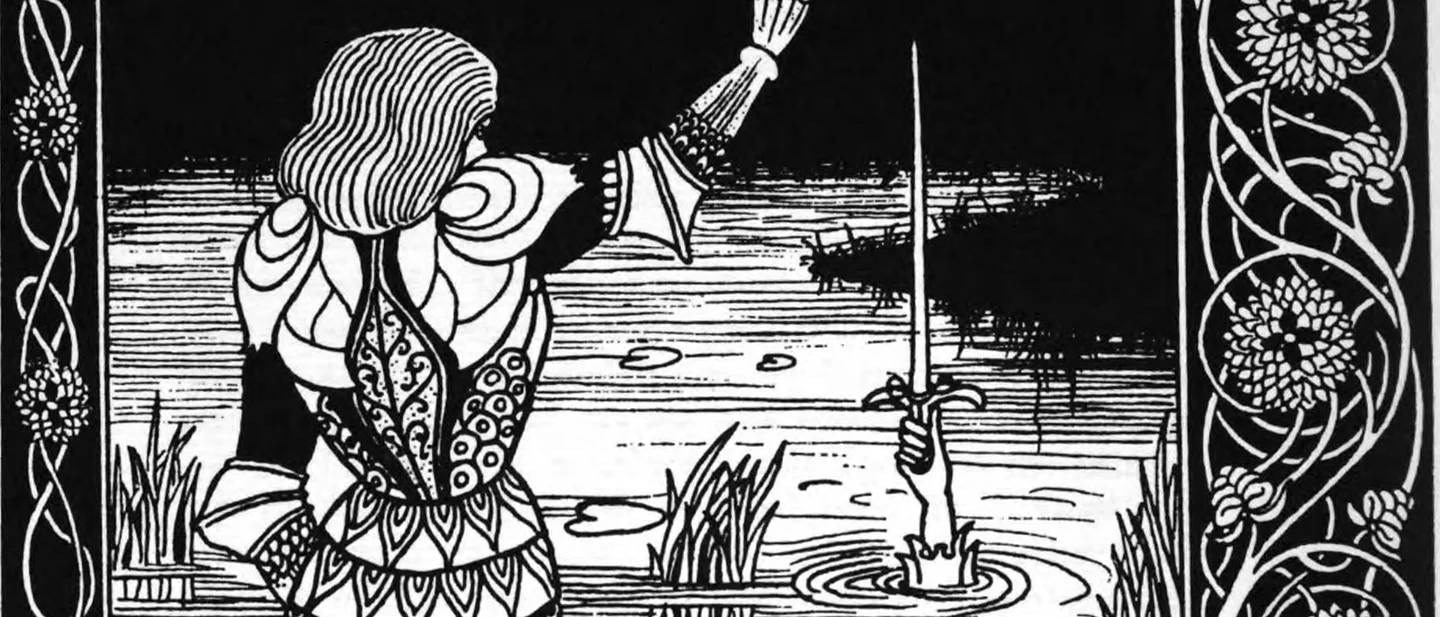
The third attempt runs as one sentence strung on "and". Bedivere binds the girdle about the hilts, throws the sword as far as he can, and the water answers: an arm and a hand come up, meet it, catch it, shake it thrice, brandish it, and vanish with it. Whose hand it is goes unsaid.
Two details in that sentence repay a second look. The hand catches the sword in the air; nobody hands it over. And the belt goes into the lake with the blade, so the sword returns whole, the way a borrowed thing comes back. Excalibur had reached Arthur from the Lady of the Lake in the first place 8, and the lake is where it belongs.
Then Malory does something easy to miss. Bedivere comes back and "told him what he saw", and the marvel is given to us instead. The one report that would settle the scene is the sentence the book leaves out.
Why it still matters
Most work has this shape. Someone is sent to do a thing nobody can watch, and comes back with a sentence. The person who sent them has only the sentence to go on, and learns to hear the difference between a report and a description.
Bedivere's motive is the part worth keeping. He wants the sword to go on existing; its power is beside his point. "Thereof shall never come good, but harm and loss" is an argument about the world's inventory, and it is harder to dismiss than greed.
The scene has been rewritten ever since. Tennyson's "The Passing of Arthur" is a much expanded version of Malory's last book 9, and a sword going back into the water is now one of the stock images of English literature.
The book reached those readers in print. Caxton's two surviving copies stood in for the original for four and a half centuries, until the manuscript turned up in a school library 1.
The plate at the head of this page is Beardsley's illustration for this chapter, printed facing page 967 of the same volume 4. Bedivere stands with his back to us and his face hidden, one arm up, while the hand has already taken the sword and the rings are still widening. Beardsley keeps the face back the way Malory keeps the report back.
Reflection
Bedivere is given one instruction and disobeys it twice, each time with a reason he believes. Think of an instruction you have carried out only partly, because what you were asked to give up seemed too good to lose. What did you report, and what would the person waiting have heard in it?
References
- 1Wikipedia: Le Morte d'Arthur
en.wikipedia.org
- 2Wikipedia: Bedivere
en.wikipedia.org
- 3Wikipedia: Aubrey Beardsley
en.wikipedia.org
- 4
- 5Project Gutenberg: Le Morte d'Arthur, Volume 2
gutenberg.org
- 6Wiktionary: eft
en.wiktionary.org
- 7Wiktionary: lief
en.wiktionary.org
- 8Wikipedia: Excalibur
en.wikipedia.org
- 9Wikipedia: Idylls of the King
en.wikipedia.org
This story was produced automatically by a channel. One sentence is all it takes for Neodrop to keep producing for you.