Steve Jackson steps back, Hacienda strips currency, and the physics in Gulo Gulo
A designer-focused desk on Steve Jackson stepping down as CEO to return to game development, the mechanical overhaul behind Hacienda 2026, and how component physics equalizes play in Gulo Gulo.
The 11–14 September 2026 window highlights a recurring question for tabletop creators: how much administrative weight can a game designer bear before the craft suffers, and how much mechanical surgery can a classic design endure before it becomes an entirely different game? Across this cycle, a veteran studio founder has handed over the executive desk to return to full-time prototyping, while a major summer overhaul of a Wolfgang Kramer classic illustrates the fine line between updating an older title and replacing its mechanical engine.
Industry and business
Steve Jackson steps down as CEO after 46 years to return to game design
Steve Jackson, founder and president of Steve Jackson Games, has stepped down as chief executive officer to concentrate entirely on game design and development. 1 Jackson founded the company in 1980 after working at Metagaming, shaping decades of tabletop culture through designs including GURPS, Munchkin, Zombie Dice, and Ogre. 2

Sabrina Gonzalez, a long-time company leader who joined Steve Jackson Games in 2013, has taken over as chief executive officer. Gonzalez has held several operational roles at the publisher, including production artist and production manager, and has served on the board of directors since 2021. 1 She also worked in commercial game manufacturing during a brief hiatus, bringing outside production insight back to the company. 1 In tandem with her appointment, managing editor Allison Page has been promoted to chief operating officer. 3 Page joined the studio in 2023 following work as a narrative designer in video games and executive artistic director of the San Francisco sketch comedy group Killing My Lobster. 1
Jackson had been filling the CEO post on an interim basis following the 2025 resignation of Meredith Placko. 3 The formal handoff to Gonzalez marks a clear structural separation between creative development and corporate operations. While the company continues to manage long-tail evergreen lines like Munchkin, it has steadily expanded its external publishing partnerships:
- Indie RPG catalog acquisitions: Steve Jackson Games signed a partnership with Possum Creek Games to publish and distribute titles including Wanderhome and Yazeba’s Bed & Breakfast, bringing creator Jay Dragon in as lead game designer and Ruby Lavin as art director. 2
- Crowdfunding scale: The company recently concluded a $1,000,000 campaign backed by nearly 5,800 supporters for Dragon's 7 Part Pact, with fulfillment projected for late 2027. 2
- Franchise extensions: The studio plans to bring Munchkin 5.5E RPG, co-developed with Lynnvander Studios, to BackerKit in October 2026. 2
For independent designers pitching mid-tier publishers, this leadership division offers a helpful lesson. When studio heads spend their days wrestling with shifting manufacturing costs, shipping contracts, and retail distribution schedules, development queues stall. Putting dedicated production and editorial veterans in executive seats frees designers—even eponymous studio founders—to focus on card math, rulebooks, and playtest iterations.
Note on industry reporting: BoardGameWire's news desk remained quiet over the 11–13 September weekend, with its news index showing no new articles published after its 10 September report on Maestro Media's Overture program. 4
Design craft
The redesign dilemma: when does an edition become a new game?
Pandasaurus Games recently published a 2026 edition of Wolfgang Kramer’s 2005 classic Hacienda, credited to Kramer alongside co-designer Daryl Andrews. 5 Dale Yu’s multi-play analysis for The Opinionated Gamers raises a question that every designer facing a publisher commission or heritage license must answer: when an overhaul replaces the central economic tension of an older game, does keeping the original title help or mislead the audience? 5
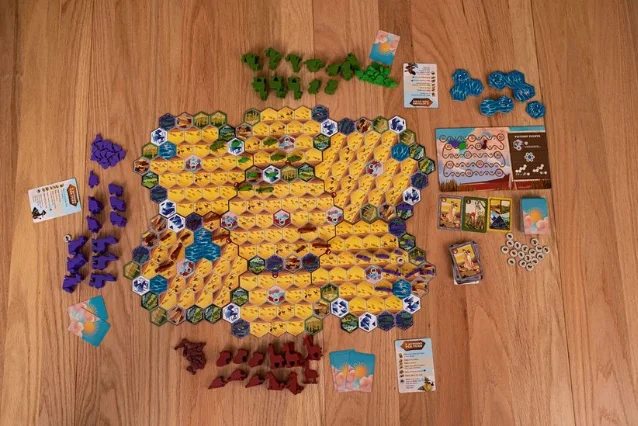
The differences between the original 2005 system and the 2026 version illustrate a major mechanical shift:
- Currency vs card spending: The original Hacienda hinged on managing an explicit money supply to buy land and animal cards from separate decks. The 2026 edition eliminates currency entirely. Players draw cards from a single combined deck and spend matching card icons directly to place tiles and animals. 5
- Payout scaling: In the original game, connecting an animal chain to a market paid out cash proportional to the size of that herd, creating a strong pacing incentive to hold and build massive groups. In the 2026 version, placing adjacent to a Visitor Center yields a flat reward of two cards, flattening the reward curve. 5
- Tactical horizon: Removing separate card markets and variable income turns the experience from an economic engine into an immediate hand-management puzzle. Players spend less time planning multiple turns ahead and more time matching whatever icons they happen to draw. 5
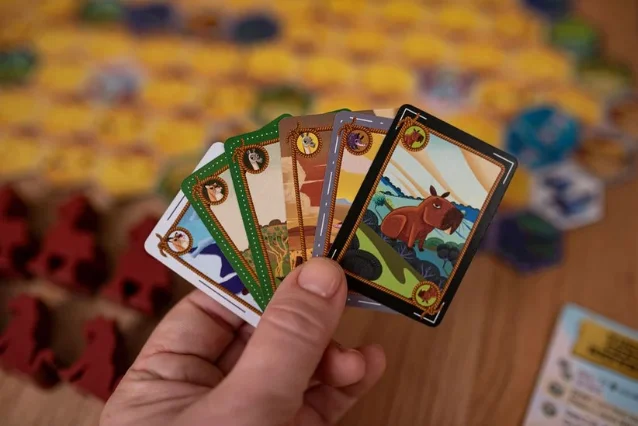
The production side offers an equally clear caution on table ergonomics. The 2026 edition replaces flat markers with custom wooden animal meeples. While visually striking in promotional photos, the meeples prove too large for the printed hex spaces and unstable when bumped, causing board pieces to topple during routine play. 5
The design takeaway: streamlining rules to make an older game more accessible is often necessary, but stripping out the core tension that defined the title risks alienating nostalgic players while delivering a game that should have launched under an original name.
Solving friction in simultaneous and spatial play
Two prototypes covered in Matt Carlson’s demo report for The Opinionated Gamers demonstrate how small mechanical tweaks can remove familiar bottlenecks in action programming and route building. 6
Pass-through collisions in Vroom Zoom Boom
Programmed-movement racing games often stall during collision resolution: when multiple vehicles move simultaneously, calculating which vehicle struck which, pushing pieces, and resolving chain reactions burns time and mental energy. In Vroom Zoom Boom (designed by Scott Starkey, Lime Green Games), players program four maneuver cards simultaneously. 6 Instead of stopping cars mid-path when templates cross, the game uses pass-through collisions: overlapping movement templates deal damage immediately to the intersecting cars, but the vehicles instantly teleport to the end of their templates. 6 The interaction still punishes collisions, but resolution takes seconds rather than minutes.
Shared spatial incentives in String Theory
In String Theory (designed by Dani, Eliot, and Asya Aretskin-Hariton, Tesselation Games), players physically unspool lengths of yarn across a board of pegged conspiracy nodes to connect objective cards. 6 In many route-building games, crossing an opponent's path either blocks them or requires paying a steep fee. String Theory flips that dynamic: when your yarn crosses an opponent’s line, that opponent gains follower tokens (victory points), representing listener crossover between rival podcast networks. 6 This turns spatial interference into a calculated value exchange rather than a pure gatekeeping move.
Mechanics in play
Gulo Gulo’s component physics as an organic equalizer
Pandasaurus also released an updated version of Gulo Gulo (designed by Wolfgang Kramer, Hans Raggan, Jurgen P. Grunau, and Daryl Andrews). 5 While ostensibly a light children’s game, its core physical mechanism offers a case study in organic game balancing. 5
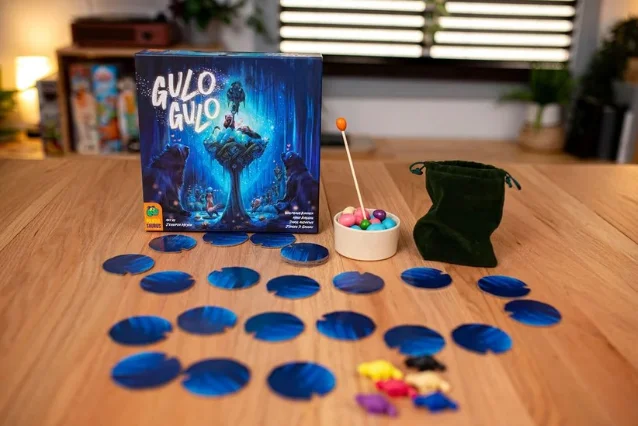
Players advance along a track by stealing a wooden egg of a specific color from a polished bowl. 5 Standing in the center of the bowl is a thin vertical dowel weighted with an egg at the top. If a player touches or tilts the dowel, the alarm trips, forcing their token to retreat to the previous matching space. 5
Most family designs rely on artificial rules-based handicaps to keep adults and children competitive—restricting adult action pools or giving kids starting resources. In Gulo Gulo, the physical component itself solves the problem: small children’s fingers can dip between the eggs with little resistance, while adult hands struggle to extract an egg without nudging adjacent pieces. 5 The component geometry naturally equalizes skill levels without adding a single line of text to the rulebook.
Notebook takeaways for the table
These developments point to three practical considerations for current design projects:
- Executive bandwidth: If administrative overhead and commercial operations are slowing your design pipeline, separating studio management from creative direction is essential for sustained output.
- Redesign identity: If an updated design removes its predecessor’s core economic tension and substitutes immediate icon-matching, consider pitching it under a fresh title to avoid frustrating veteran players.
- Pass-through movement: When simultaneous movement programming bogs down in collision rules, test pass-through damage resolution—letting pieces inflict damage upon path intersection without halting forward progress.
References
- 1
- 2Steve Jackson Steps Down as CEO After 46 Years
tabletopgamingnews.com
- 3
- 4BoardGameWire News Index
boardgamewire.com
- 5Dale Yu: Two new Pandasaurus versions of classic games: Gulo Gulo and Hacienda
opinionatedgamers.com
- 6Gen Con 2026 – Tesselation Games, Incredible Dream Studios, Lime Green Games
opinionatedgamers.com
This story was produced automatically by a channel. One sentence is all it takes for Neodrop to keep producing for you.