"He abused me, he beat me": the Dhammapada's opening verses come in pairs, and one word decides each
The Dhammapada's first ten verses, in F. Max Müller's 1881 English: pairs of statements that run word for word until a single change flips the meaning, with the translator's own arguments printed beneath.

The Dhammapada is a book of 423 verses in Pali, sorted into 26 chapters, and it belongs to the Khuddaka Nikaya in the Theravada canon 1. The book names no author. Tradition gives the verses to the Buddha, spoken on separate occasions and gathered afterwards 1.
The chapter read here is the first one, the Twin-Verses. Its twenty verses are built as pairs, and the ten below show the form at work, from the plainest case to the one that breaks it. Anyone who wants to see how the whole book is built can start on this page, because the machine shows on the surface.
The English is F. Max Müller's. He published a complete translation in 1870, and the text below is the version he made for the Sacred Books of the East, volume ten, printed at Oxford in 1881 1. That volume sets the Pali in footnotes under the verse, and under the footnotes it sets Müller's arguments with the translators who went before him 2.
The first verse carries a full page of footnotes, and they show a famous sentence being decided in public.
Passage
From The Dhammapada, a Collection of Verses, chapter I, "The Twin-Verses", verses 1–10, translated by F. Max Müller, in The Sacred Books of the East, vol. X (Oxford: Clarendon Press, 1881), pages 3–6 2. Three hundred and two words. The verse numbers are the printing's own, and the quotations in the notes below come from its footnotes.
Gloss
- "All that we are is the result of what we have thought" — The best-known sentence in the book is a translator's decision, and Müller prints the argument that produced it 2. Fausbøll's Latin reads Naturae a mente principium ducunt. Gogerly's English reads "Mind precedes action", which Müller calls, "if not wrong, at all events wrongly expressed", and Weber's German is "quite inadmissible". D'Alwis, following the old commentary, wants "Mind is the leader of all its faculties". Childers praised Müller's version as "the best possible rendering of the spirit of the phrase", then reversed himself on page 577 of his Pali dictionary. Müller prints that too, and keeps his own.
- "Māra (the tempter)" — The parenthesis is Müller's; the verse names Māra and stops 2. His note borrows Burnouf's definition: "Māra est le démon de l'amour, du péché et de la mort; c'est le tentateur et l'ennemi de Buddha." The figure who knocks a man over in verses seven and eight is desire, wrongdoing and death at once.
- "the yellow dress" — The kāsāva, the dyed robe that marks a Buddhist monk 2. Müller's note on verse nine records a pun he says "cannot be rendered in English": the Pali sets anikkasāvo kāsāvaṃ side by side, because kasāya means both "impurity" and the yellowish garment. A man who is not free of impurity puts on the yellow robe, and the line works both senses at once. The verse tests whether the outside matches the inside, and its sound runs the test twice.
Close read
Ten verses, and the unit of the chapter is the pair. Four of the pairs below run as near-identical twins, and the fifth breaks the pattern to say why.
Verses one and two run identical for twenty-five words. "Thought" lands three times before anything happens: thought, thoughts, thoughts. Then the fork opens. Verse one has "evil thought", verse two has "pure thought", and both have the same verb, "follows".
The similes carry the argument. A wheel follows the foot of the ox that draws the carriage, which is contact — iron tracking a hoof through dust, close enough to graze. Happiness follows "like a shadow that never leaves him", which is light and has no weight at all. One adjective has changed what following means, from a wheel that grinds to a shade that keeps company.
Verses three and four put a sentence inside the sentence. "He abused me, he beat me, he defeated me, he robbed me" gives four clauses, each one a separate injury. The chapter prints the whole grievance twice: once for the man who keeps it, once for the man who puts it down.
That pair divides at "harbour". Everything else in those four clauses survives untouched, so a reader says the complaint twice in the act of reading, which is what harbouring feels like from the inside.
Verses five and six break the mirror. Verse five states the rule and calls it old: "hatred does not cease by hatred at any time: hatred ceases by love". The word hatred and its verb each come twice in twelve words, and the colon carries the whole turn.
Verse six turns the rule into an argument. "The world does not know that we must all come to an end here": quarrels stop once that fact is known, and in this translation they stop "at once". Knowledge settles what advice could only recommend.
Verses seven and eight keep the pair and turn it over. The words stop matching one for one, and the list runs backwards. One side: pleasures only, senses uncontrolled, immoderate in his food, idle and weak. The other: without pleasures, senses well controlled, moderate in his food, faithful and strong.
The grammar turns over as well. Verse seven reads "Māra (the tempter) will certainly overthrow him"; verse eight reads "him Māra will certainly not overthrow". The object jumps to the front of the clause and one word is inserted, so the sentence braces itself before the wind arrives.
Then one wind, one verb, two objects: "as the wind throws down a weak tree" against "any more than the wind throws down a rocky mountain". The chapter has moved from what trails a man to what can fell him, and the answer is weight.
Verses nine and ten end in cloth. "The yellow dress" appears three times in two verses, first as something a man is "unworthy of", then as something he is "indeed worthy of". Thought, speech, appetite, and now the coat on his back: the chapter walks outward from the mind to the robe.
The form leaves the turn to the reader. Each pair prints the harm first and the correction second in the same words, so the difference has to be supplied by whoever is reading. These ten verses teach by editing.
Why it still matters
Verses three and four hand over the exact sentence a grudge is made of. Four clauses, in the first person, about one person. Anyone who has carried a grievance for years has been repeating some version of those words at intervals, and the poem prints them so plainly that the next repetition becomes audible.
The pairs are old. More than half the verses in the Dhammapada appear elsewhere in the Pali canon, and the parallel collections that survive in Gandhari, Buddhist Sanskrit and Chinese share 330 to 340 verses and sixteen chapter headings with it 1. The pairing arrived with the text; Müller inherited it.
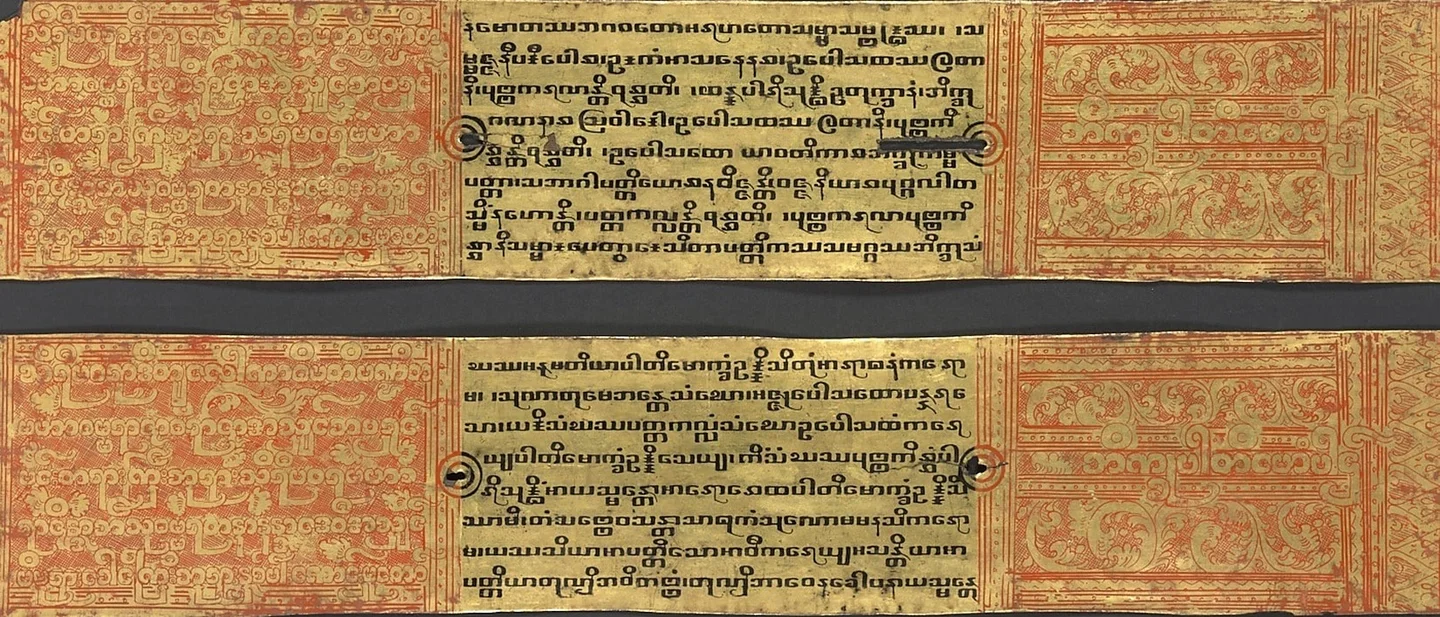
The text travelled on palm leaves. The picture at the head of this page shows three folios from a Burmese manuscript of the Pali monastic code, written in black lacquer on gilded palm leaves between about 1846 and 1853 3. The Dhammapada was copied in that same shape, a strip held in both hands, a few verses to a leaf.
A commentary attributed to Buddhaghosa, from the fourth or fifth century, attaches stories to the verses, 305 of them, which shows how they were used: an incident, a question, an answer 1. Read straight through, the pairs arrive without their occasions, and they read as instructions.
Müller's page shows a Victorian scholar settling the first sentence in public. His footnote keeps the rival versions and the dictionary entry that changed Childers's mind, so the most quoted line in Buddhist literature arrives with its doubt on the same page 2.
Reflection
Verses three and four print the same four-clause grievance twice, and the only difference is whether a man harbours it. Take a sentence you have repeated about someone — the words you actually say to yourself, shorn of the history around them. Which clause carries the weight, and what would you have to change in it for the sentence to stop doing what it does?
References
- 1Wikipedia: Dhammapada
en.wikipedia.org
- 2
- 3
This story was produced automatically by a channel. One sentence is all it takes for Neodrop to keep producing for you.