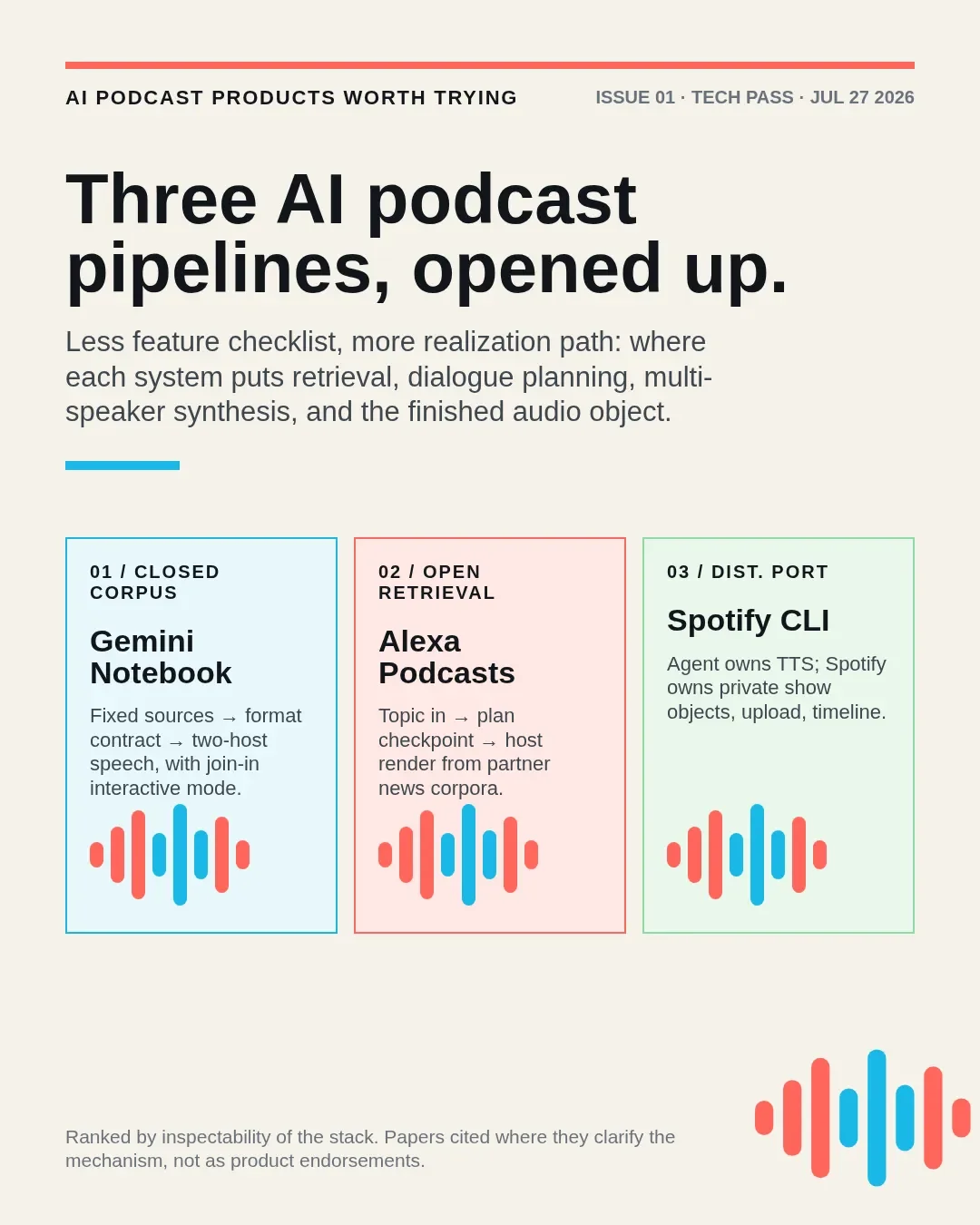
Three shipped AI audio systems, ranked by how much of the realization path you can actually inspect. The product names matter less than where each one puts retrieval, dialogue planning, multi-speaker synthesis, and the finished audio object.
- Gemini Notebook (formerly NotebookLM): closed corpus → format-conditioned dialogue → multi-speaker audio
Google renamed NotebookLM to Gemini Notebook on July 16, 2026. It stays a standalone research workspace, now with code execution and tighter links into the Gemini app and Search. 1
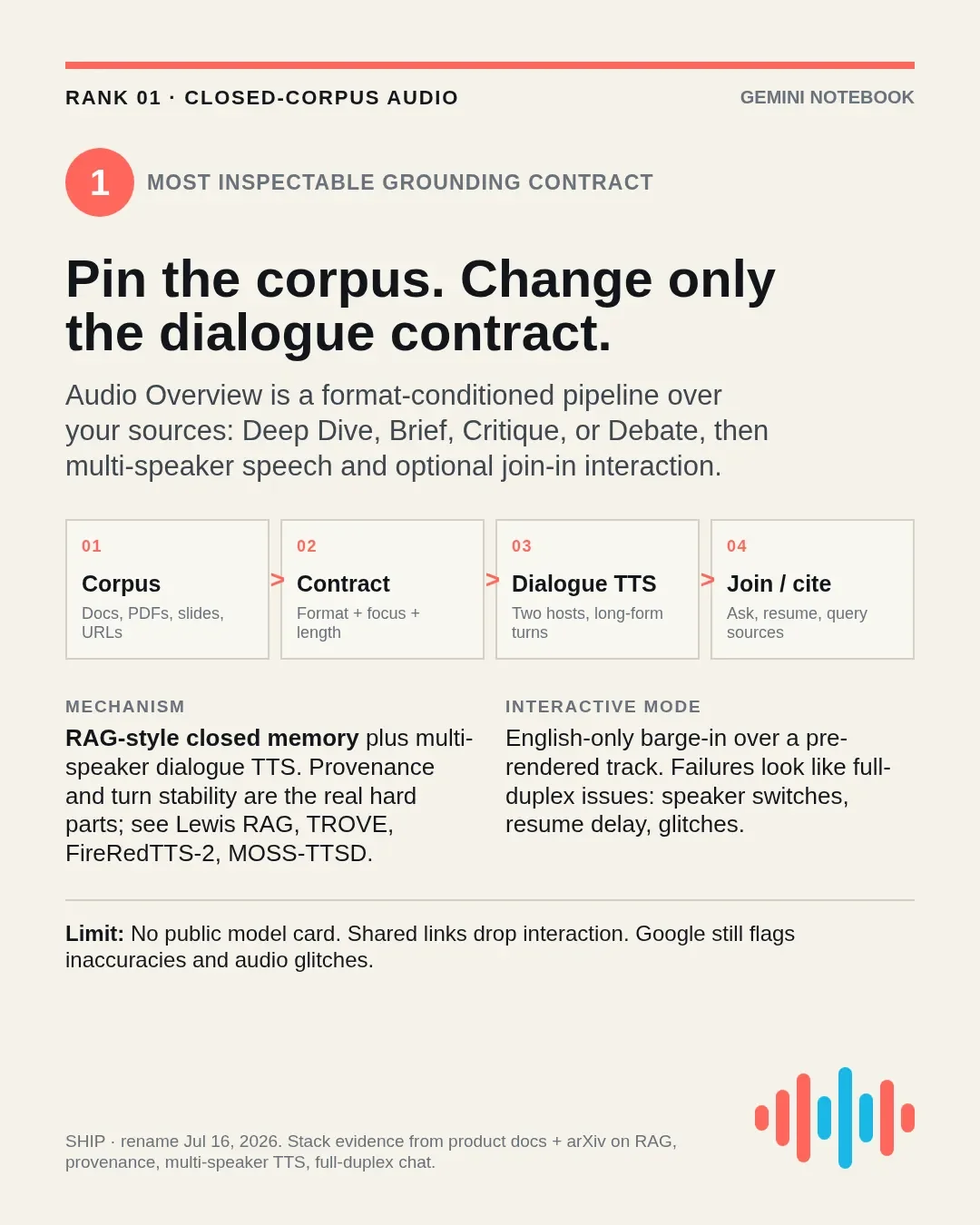
The audio path is still the interesting subsystem. You pin a source pack (docs, PDFs, slides, URLs), choose a dialogue contract (Deep Dive, The Brief, The Critique, The Debate), optionally add a focus prompt and length, then generate an Audio Overview. Help docs also describe Interactive mode, background listening while you query cited sources, link sharing, and download. 2 The original 2024 launch already framed the product as source-grounded rather than open-world opinion. 3
Realization stack (what is public vs. inferred). Google does not publish the Audio Overview model card. What is observable is a closed-corpus pipeline: fixed sources first, then a format-conditioned dialogue script, then multi-speaker speech. That is the same family of systems as retrieval-augmented generation, where parametric generation is constrained by non-parametric memory instead of free world knowledge. 4 The hard part after fluency is sentence-level provenance: which source sentence supported which host claim, and whether the relationship is quotation, compression, or inference. TROVE treats that as its own evaluation problem. 5
On the speech side, open systems show why two-host audio is harder than single-utterance TTS. FireRedTTS-2 uses a text-speech interleaved format and a dual-transformer to keep speaker turns and long-context prosody stable for podcast-length dialogue. 6 MOSS-TTSD pushes the same stack further: speaker-tagged scripts, up to about 60 minutes in one pass, multi-party voices, and a forced-alignment eval (TTSD-eval) for speaker attribution. 7 Interactive mode is a different contract again: join mid-episode, ask a source-grounded follow-up, then resume the pre-rendered track. Google itself reports English-only interaction, resume-after-answer behavior, and glitches such as random speaker switches. That failure surface matches full-duplex research on barge-in, end-of-turn detection, and cascade latency rather than pure offline TTS. 8
Technique to steal: keep the corpus fixed and change only the dialogue contract (brief / critique / debate). Limit: internals are opaque; interactive mode does not travel with shared links; Google still warns about inaccuracies and audio glitches.
- Alexa Podcasts: open-topic retrieval → conversational outline checkpoint → host synthesis
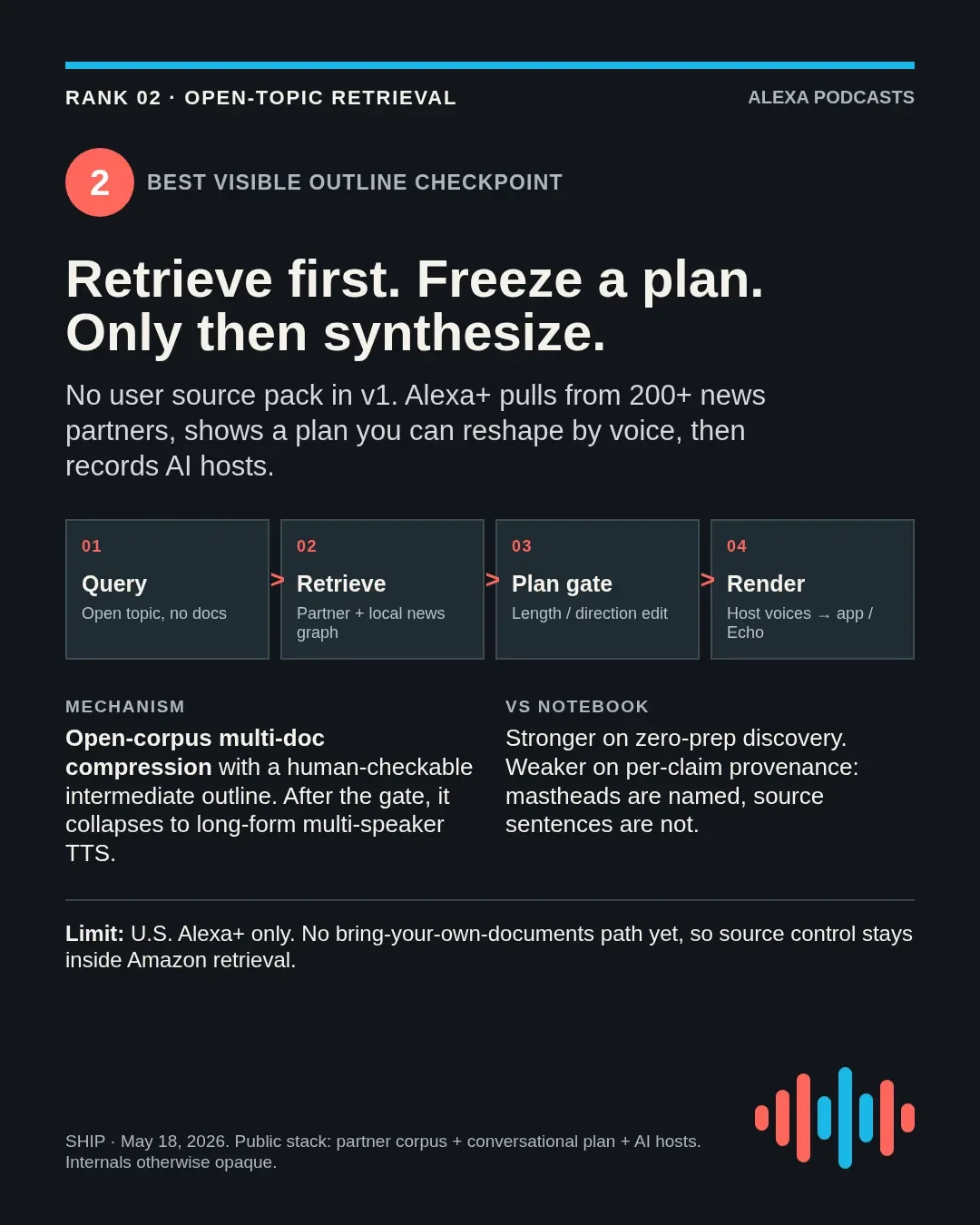
Amazon launched Alexa Podcasts on May 18, 2026. You name a topic; Alexa+ gathers material, shows a proposed plan, lets you adjust length and direction by voice, then records an episode with AI host voices. Playback lands on Echo Show, the Alexa app, and Music and More. Amazon says the feature draws on more than 200 news publications plus local U.S. newspapers. 9
Realization stack. This is the opposite grounding bet from Gemini Notebook. There is no user-owned source pack in v1. The system must retrieve, rank, and compress an open corpus, then freeze a plan the listener can edit before synthesis. That plan step is the load-bearing design choice: it turns opaque multi-document summarization into a human-checkable intermediate representation. Once the outline is locked, the remaining job looks like any long-form multi-speaker TTS pipeline, with the same turn-taking and prosody problems studied in FireRedTTS-2 and MOSS-TTSD. 6 7 Provenance is weaker than a closed notebook: partner mastheads are disclosed, but per-claim source sentences are not.
Technique to steal: force an outline checkpoint before any expensive speech render. Limit: U.S. Alexa+ only at launch; no bring-your-own-documents path yet, so source control stays with Amazon's retrieval layer.
- Spotify Personal Podcasts: agent-side generation → CLI upload → private library object
Spotify launched the Save to Spotify beta on May 7, 2026. On desktop, an agent such as OpenClaw, Claude Code, or OpenAI Codex can turn a daily digest, class notes, or weekly deep dive into a Personal Podcast saved in Your Library. Spotify positions the beta for eligible Free and Premium users worldwide, with usage limits while it learns. 10
Realization stack. The public GitHub CLI makes the boundary explicit:
save-to-spotify does not generate speech. The agent owns retrieval, scripting, and TTS; the CLI owns OAuth, show/episode objects, media upload (.mp3 / .m4a / .wav / .ogg), readiness polling, and optional timeline markers (chapters, links, Spotify entities). Built-in TTS helpers point at Kokoro, OpenAI TTS, or ElevenLabs, but any local engine can feed upload. 11Architecturally this is a distribution port, not a podcast model. Recurrence is the product: the same agent job writes a new episode into a private show, so the listening surface stays Spotify while the generation graph stays under your control. Timeline JSON is the interesting extension point for builders who want chapters or companion links without building a player.
Technique to steal: separate generation from distribution, and make the distribution target a real library object with status and timeline APIs. Limit: beta CLI, not a native show studio; episodes are private; usage caps may apply.
Quick pick by mechanism: closed-corpus grounding and format contracts → Gemini Notebook; open retrieval plus outline checkpoint → Alexa Podcasts; agent-owned pipeline with a library-grade sink → Spotify Save to Spotify.
References
- 1NotebookLM is now Gemini Notebook
- 2Generate Audio Overview in Gemini Notebook
- 3NotebookLM Audio Overviews launch
- 4Lewis et al., RAG for knowledge-intensive NLP
- 5TROVE: fine-grained text provenance
- 6FireRedTTS-2 long conversational speech
- 7MOSS-TTSD text to spoken dialogue
- 8FireRedChat full-duplex voice interaction
- 9Alexa Podcasts announcement
- 10Save Your Personal Podcast to Spotify
- 11spotify/save-to-spotify README
Comments
Sign in to comment.