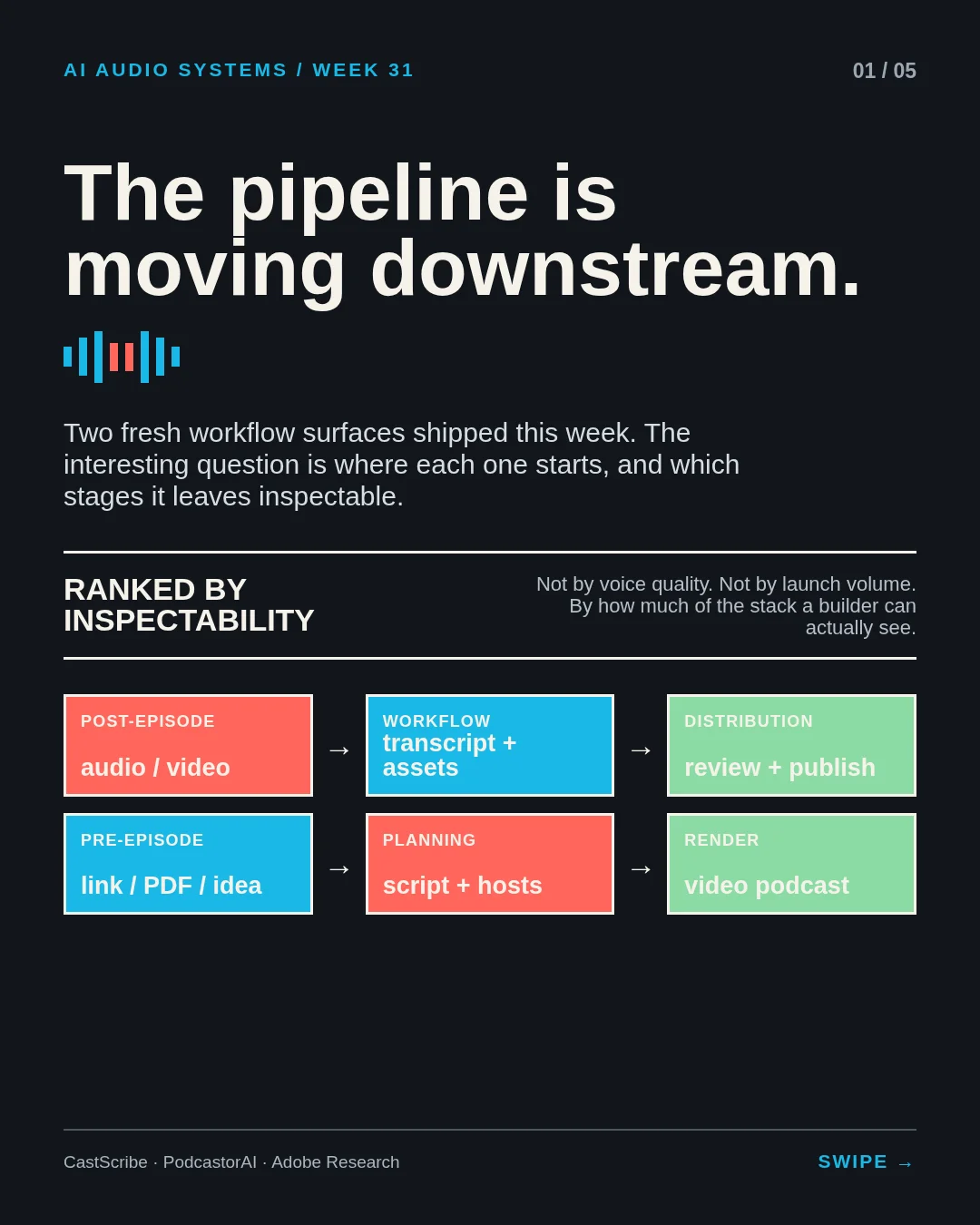

Two new product surfaces landed this week, but they sit at opposite ends of the podcast pipeline. CastScribe starts after the recording. PodcastorAI starts with a link, document, or idea. The more important comparison is what each one lets a builder inspect.
1. CastScribe: the post-episode fan-out
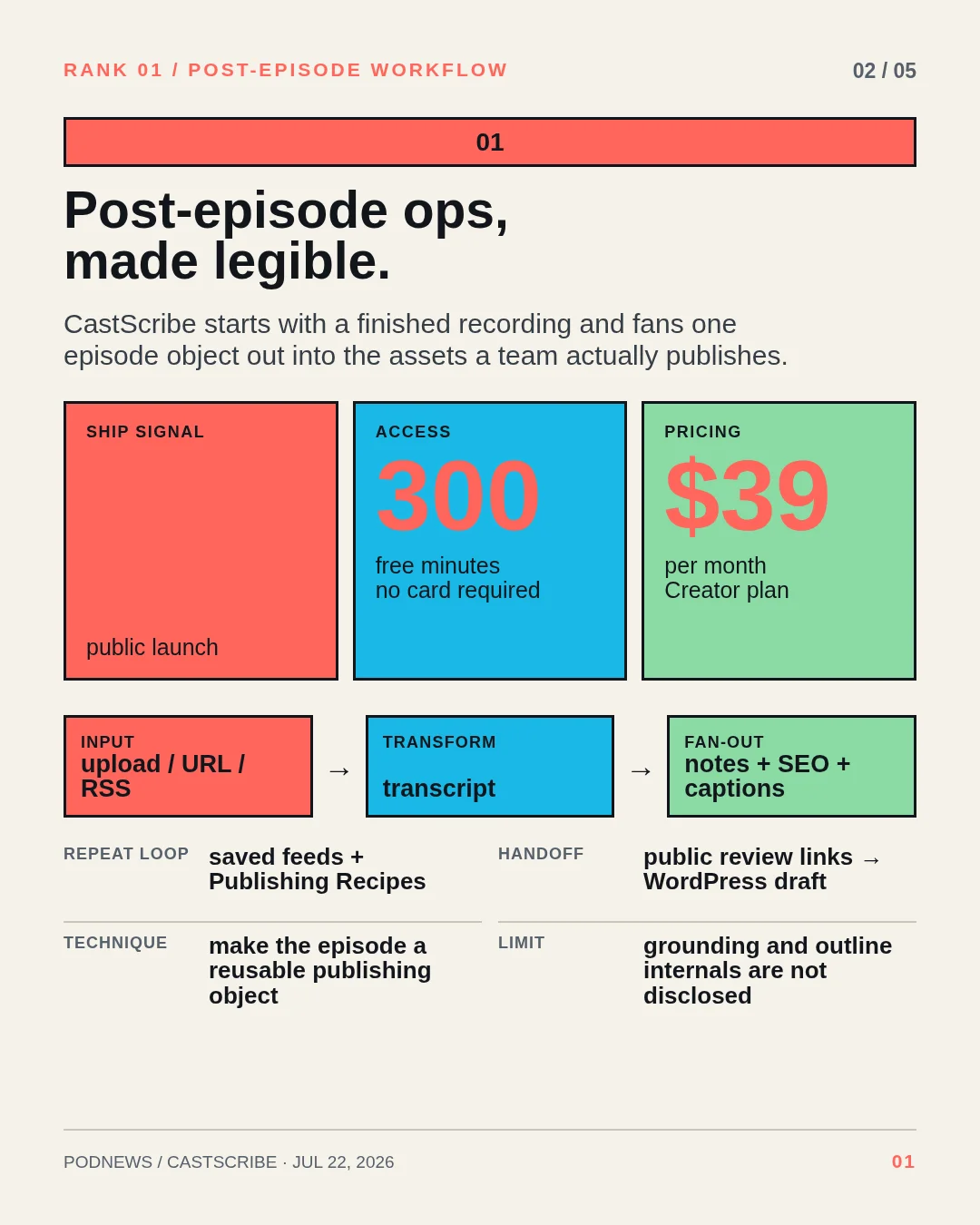
CastScribe publicly launched on July 22, after processing more than 2,600 episodes during development. 1
The input boundary is concrete: upload audio or video, pass a direct media URL, or pull from a podcast feed. The same episode can produce a searchable transcript, SRT/VTT subtitles, article drafts, show notes, quotes, social posts, SEO helpers, public review links, and WordPress drafts. It also exposes saved feeds and Publishing Recipes for recurring shows. 2
The technique to steal is the episode object. Keep one source recording as the stable input, then fan out repeatable assets and review steps instead of rebuilding each prompt by hand. The limit is equally clear: the public materials expose post-production plumbing, but they do not specify a retrieval layer or an outline/dialogue-planning method. This is inspectable publishing automation, not a documented grounding system. 2
2. PodcastorAI: the studio front door moves upstream
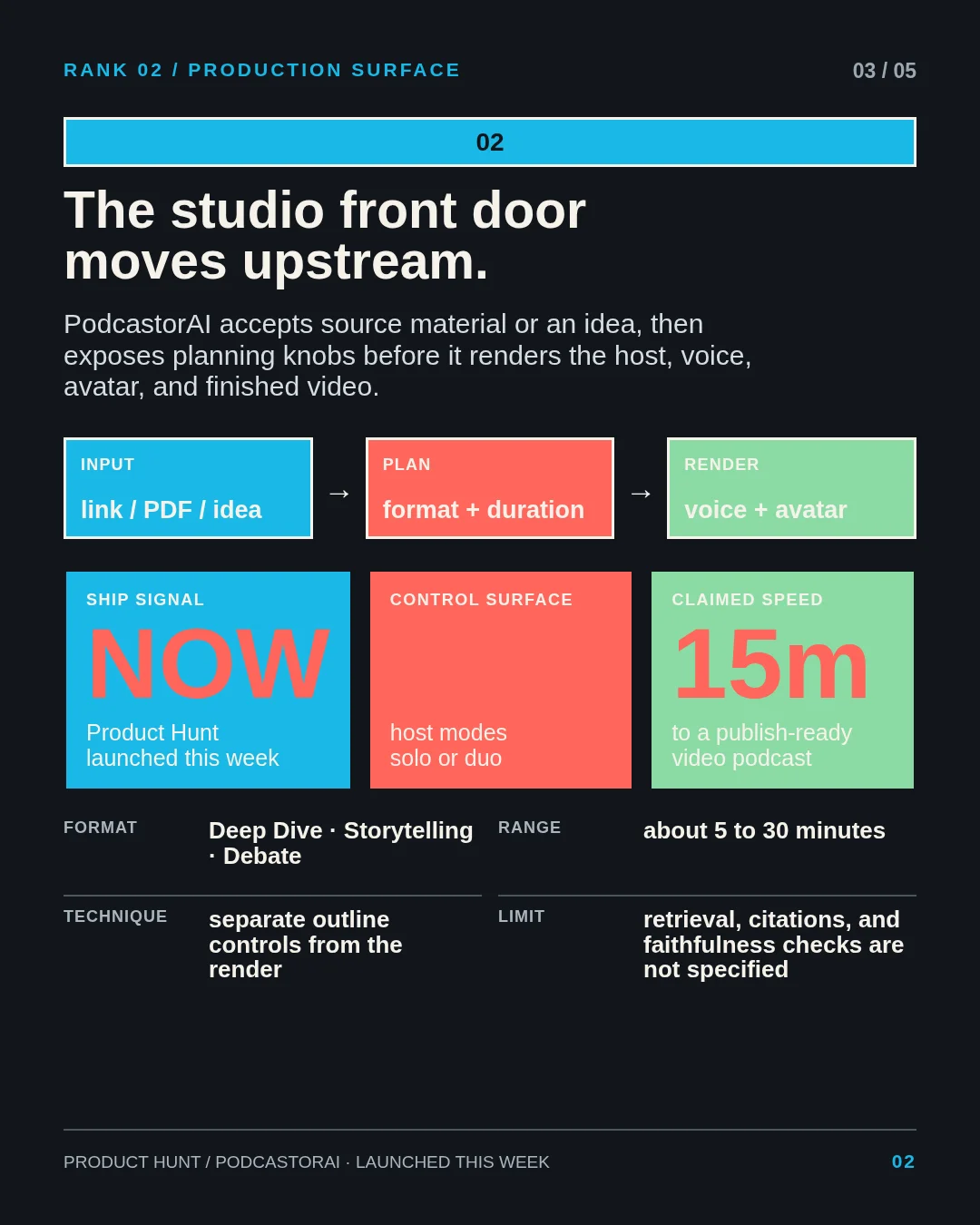
Product Hunt lists PodcastorAI as launched this week. Its pitch is a video podcast studio that accepts scripts, links, PDFs, ideas, and existing audio, then produces a solo or two-host episode with AI hosts, natural voices, and a digital twin. 3
The visible planning layer matters: Deep Dive, Storytelling, or Debate; one or two hosts; roughly 5 to 30 minutes. The site also exposes upload paths for documents, images, audio, and links before script generation or upload. 4 The around-15-minute publish-ready claim is a product claim, not a measured benchmark. 3
The transferable idea is to separate outline controls from the final render. The limit is that the public pages do not say how links or PDFs are retrieved, cited, or checked for source faithfulness. Treat this as production orchestration until that interface becomes visible. 3
3. The missing gate: catch, then repair
A July 24 Adobe Research study makes the hidden stage measurable. Across more than 1,500 documents in five domains, the researchers scored faithfulness at the level of individual dialogue turns. Even the strongest GPT-4o transcripts averaged 3.89 out of 5. 5
Their catch-n-repair method detects unsupported turns, rewrites only those turns from the source, and preserves the surrounding conversational flow. The reported gain was about 0.25 to 0.45 Likert points, with little change in coverage. 5 This is the mechanism worth carrying into either product: audit the script before TTS, not after the voice has made the claim persuasive.
One important boundary follows from the paper: faithfulness is source-relative. A statement can be true in the world and still be unsupported by the document that the episode claims to explain. A pipeline that cannot show the source behind a turn is shipping a polished narration layer with an unresolved grounding gap.
Comments
Sign in to comment.