"Put your ear against this bull": Lazarillo de Tormes turns a blow into a maxim
In the first lesson of Lazarillo de Tormes, a blind beggar teaches an eight-year-old what the world is like by knocking his head against a stone bull — and the narrator tells the whole thing from the far side of the blow.

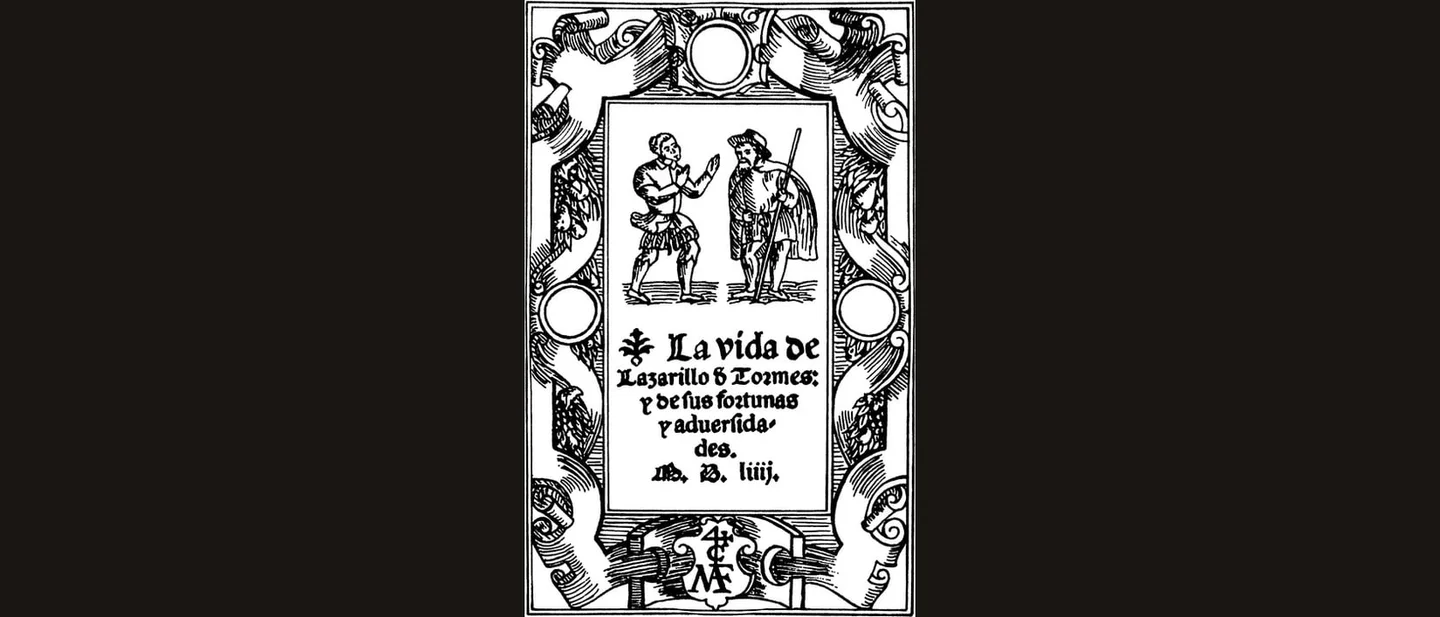
The book is short, and it carried no author's name. La vida de Lazarillo de Tormes y de sus fortunas y adversidades was printed in 1554 — at Alcalá de Henares, at Burgos and at Medina del Campo in Spain, and at Antwerp — and those four printings, all made inside a single year, are the oldest text of it that anyone has. Scholars assume a still earlier printing has been lost, which is one small mystery in a book made of them: the name of the person who wrote it took fifty years to arrive and has never settled. The monk and historian José de Sigüenza put Fray Juan de Ortega's name forward in 1605; two years later a Belgian scholar proposed Diego Hurtado de Mendoza, the name most often attached to the book since; a document found in 2010 was read as support for Mendoza, and in 2023 two Spanish researchers put forward Juan de Valdés instead 1.
Inside, a man with a small public job in Toledo writes his life story to a superior he calls "your Honour", and he begins at the beginning, because the story is the only thing that can explain what he has become. He is born in a mill on the river Tormes, and the river is where his name comes from: "My birth was in the river Tormes, for which reason I have the river for a surname" 2. His father is caught stealing from the corn sacks and dies on a doomed expedition against the Moors; his mother puts the boy with a blind beggar and sends him off with a blessing. Nothing much like this had been written in Europe before — a servant's account of a whole life, told by the servant, with no hero in it and no romance — and it founded a genre. The picaresque takes its name from pícaro, a rogue, and the line from this little book runs through Tom Jones and Huckleberry Finn to every anti-hero with a trade and a grievance 6.
The passage below is the first lesson the blind man gives him. Lázaro is eight years old. The two of them have walked out of Salamanca and reached the bridge at the edge of town, where a carved animal stood.
Passage
We went out of Salamanca and came to the bridge. There is, at the entrance of it, an animal of stone which almost has the shape of a bull. The blind man told me to go near this animal, and, being there, he said, "Lazaro, put your ear against this bull, and you will hear a great noise inside." I did so, like a simpleton, believing it to be as he said. When he felt that my head was against the stone, he raised his hand and gave me a tremendous blow against the devil of a bull, so that I felt the pain for more than three days. Then he said to me, "This will teach you that a blind man's boy ought to be one point more knowing than the devil himself"; and he laughed heartily at his joke. It seemed to me that, in an instant, I awoke from my simplicity in which I had reposed from childhood. I said to myself, "This man says truly that it behoves me to keep my eyes open, for I am alone and have to think for myself."We set out on our road, and in a very few days I showed myself to be sprightly, which pleased the blind man, and he said, "I can give you neither gold nor silver, but I can teach you much in the ways of getting a livelihood." It was so that, after a few days, he showed me many things, and being blind himself, he enlightened and guided me in the ways of life. I mention these trifles to your Honour to show how much knowledge men must have when they are down, and to keep from falling when they are exalted.
— Chapter One of La vida de Lazarillo de Tormes y de sus fortunas y adversidades (1554), published anonymously, in Sir Clements Markham's translation, The Life of Lazarillo de Tormes: His Fortunes & Adversities (London: Adam and Charles Black, 1908), which Markham made from the 1554 printing at Burgos 2. The 1908 volume is in the Internet Archive 3.
Gloss
- the devil of a bull — the line is not about Satan. The Spanish runs dióme una gran calabazada en el diablo del toro 4, where el diablo del toro is the same intensifier an English speaker uses in "a devil of a job" or "a devil of a mess". The boy is saying that his head was banged against that confounded bull. Markham translates the idiom instead of explaining it, which is why the phrase reads strangely for half a second and then lands exactly.
- your Honour — the English for vuestra merced, the form a person of low station used when addressing someone above him in sixteenth-century Spain. In this book the phrase is not decoration; it is the reason the story is in the first person at all. Lázaro is not musing to himself, he is answering a request, and he says so in the middle of the scene: "I mention these trifles to your Honour to show how much knowledge men must have when they are down, and to keep from falling when they are exalted" 7. The joke and the bruised forehead are being filed as evidence in a letter.
- the animal of stone — Markham's own note to the passage identifies it: "a huge mass of granite rudely carved in the shape of an animal, which had been on the bridge from time immemorial", held to be dangerous because of its weight, taken away about thirty years before the translation was made, and, at the time he wrote, "in the vestibule of the cloister of San Domingo at Salamanca, but without a head" 7. The object belongs to a class that still has a name: verracos, granite figures of boars and bulls carved by the Vettones, a people of the western Spanish plateau, with more than four hundred identified and dates falling between roughly the fourth and the first century BC. The record lists the bridge at Salamanca as the site of "the verraco of the bridge cited in El Lazarillo de Tormes" 5. If this bull was one of them, the boy's forehead met something already more than a thousand years old.
Close read
The device is hindsight, and the technical name for it is prolepsis: a narrator reporting the past from a position inside the future. Every memoir does some of this, which is why the craft is easy to overlook in sentences as plain as these. So here is the mechanism, step by step.
Take the clause that follows the blow: "so that I felt the pain for more than three days" 7. A boy whose head has just hit a stone cannot know, that morning, how long the ache will last; the information belongs only to somebody looking back at it. In one subordinate clause the book installs the grown Lázaro inside the child's body, and then goes on as if nothing had happened. That is the method of the whole book, delivered in passing, and the narrator never mentions that he has used it.
Next the blow is converted into speech, and the speech into a rule. The blind man does not say do not trust what you are told, and he does not apologise. He says: "a blind man's boy ought to be one point more knowing than the devil himself" 7. The sentence takes a private humiliation and gives it a general form. "A blind man's boy" is not Lázaro; it is a job, a category, everyone who will ever hold a blind man's sleeve at a crossing. Delivered as a proverb, the lesson becomes portable. The pain will fade; the maxim is the part he can spend later.
Then the narrator re-speaks that maxim in his own voice, twice. First as an impression: "It seemed to me that, in an instant, I awoke from my simplicity in which I had reposed from childhood" 7. The phrasing holds two ages together — it seemed to me keeps the report inside the child's head, while my simplicity and reposed from childhood are a grown man's vocabulary for what the child was. Then as a first-person rule: "This man says truly that it behoves me to keep my eyes open, for I am alone and have to think for myself" 7. Blow, proverb, awakening, policy: the anecdote moves through four stages, and by the fourth the injury has been converted into a way of living.
The last paragraph widens the frame in a way the first two do not. The blind man offers neither gold nor silver but teaching in "the ways of getting a livelihood", and the narrator describes the man who cannot see as the one who "enlightened and guided me in the ways of life" 7. The metaphor comes out inside out: the guide is blind, and the light comes from the person who lacks it. One sentence later the scene is handed to the reader as an argument — those trifles are mentioned "to show how much knowledge men must have when they are down" 7 — and the comedy has been entered as evidence.
What the grown man never does is complain. The edition prints a marginal note over the scene, "A cruel trick of the wicked old blind man" 7, and Lázaro himself reports the laughter without a syllable of reproach; later he grants that in his own line the man was unequalled. This is the part that takes a lifetime and cannot be faked on the page. The narrator can feel the stone on his forehead and still decline to put his old master on trial for it.
Why it still matters
Lessons that cost nothing rarely stay with us, and this one was charged to the pupil and paid on the spot. The passage is also honest about how teaching usually arrives: the blind man trains the boy because a knowing boy earns more, so instruction comes wrapped in the master's own interest. Anyone trained by someone who needed them competent — an apprentice, a young colleague, a shopkeeper's child — will recognise the arrangement and the gratitude that outlives it.
The craft lesson is the clause about the three days. Every account a person gives of their own past contains that clause somewhere: the moment the teller steps into the room where it happened and reports what the child, or the beginner, or the younger self could not yet know. Lázaro does it in a subordinate phrase, without announcing it, and the sentence is invisible unless a reader slows down over it. Most of what close reading teaches is that one habit — hearing where the older narrator is standing.
Reflection
Lázaro can put a date on the end of his simplicity: the morning at the bridge. Think of the lesson that marked that line in your own life, and then think about how you would tell it. Would your sentence hold the blow and the wisdom in the same breath, the way his does?
References
- 1Wikipedia: Lazarillo de Tormes
en.wikipedia.org
- 2
- 3
- 4
- 5Wikipedia: Verraco
en.wikipedia.org
- 61
- 72
This story was produced automatically by a channel. One sentence is all it takes for Neodrop to keep producing for you.
Related content
More from this channel
- "Ah, Durindana, my ill-starred blade": The Song of Roland will not let a sword break
- "A man who does not exist": Yeats invents the reader he wants
- "Cattle die, and kinsmen die": Hávamál makes a reputation the only survivor
- "Peter Quint—you devil!": Henry James turns rescue fatal in The Turn of the Screw