CMON's $19m rescue, Take Time's 325,000 copies, and Power Vacuum's one cable
CMON closes the full $19m share sale it needed to keep operating, Take Time passes 325,000 copies for Asmodee, Pandasaurus cuts its SPIEL Essen stand to about a third of the cost, and the designers of Power Vacuum explain the one cable that fixed their Control Board.

Three money moves lead this desk, then one designer diary worth your time and one launch. CMON has closed the share sale it warned about earlier this month, Take Time has passed 325,000 copies for Asmodee, and Pandasaurus has cut its SPIEL Essen stand back to about a third of the cost. Everything here falls inside the 22–25 September 2026 window.
CMON closes the full $19m
CMON has raised all of the $19m it went looking for. The crowdfunding publisher told investors in its half-year report that it held $368,000 in cash at the start of August, and that its directors had weighed whether the group had enough resources to continue as a going concern 1. The share sale was central to that judgment. It was offered at up to HK$150.5m, and existing shareholders bought just 7.76% of the shares available to them before the August deadline.
The placing agent, Yuen Meta, sold every remaining share to outside investors, and that is the part that matters. CMON received the full amount it asked for. Held against the company's own history, $19m is more than fifty times the cash it had in early August, and almost double the $9.9m of revenue it booked across the whole of last year. Annual revenue sat between $37m and $45m every year from 2021 to 2024.
The raise also rearranged who owns the company. Chairman and chief executive Ng Chern Ann is no longer its largest shareholder; his stake fell from about 20% to just over 5%. Investor Yip Ka Ki Cherry now holds roughly 19% personally and through her holding company Legend One. CMON added two independent non-executive directors, Chan Ka Kit and Claire Luk.
Where the money goes is set out in proportions.
- 40% for day-to-day operations over the next twelve months, including $2.28m of staff costs
- 25% for expansion in existing and new markets, with Europe named alongside Japan and the Philippines
- 20% to repay debts and other liabilities, among them $2.46m owed to a CMON director and $385,000 of unsecured advances from employees
- 15% reserved for one to three acquisitions in Asia-Pacific, valued at roughly $1.3m to $2.5m each, to build digital versions of CMON's games
CMON has not said how much of that money will reach the eight crowdfunded games it still owes, or whether it covers all of them. Together those campaigns raised $14m, with DC Super Heroes United at more than $4.4m and DCeased at more than $2.5m. The publisher has not completed fulfilment of a crowdfunding project since Zombicide: White Death in mid-2025; in the first half of this year it delivered pre-orders for Cthulhu: Dark Providence, Marvel United: Witching Hour and Dune: Desert War. Four more pre-order titles remain outstanding — Assassin's Creed Role Playing Game, The Adventurers, The Dead Keep and Super Fantasy Brawl Reborn — with the first of those slated for the third quarter.
For a designer weighing CMON as a partner, the useful reading is the split itself. Two fifths of the money is running costs, a fifth is debt, a quarter is market expansion and the rest is acquisitions. Delivery of owed games sits inside nowhere named, which is a question to put to the publisher rather than a fact to assume either way.
Take Time passes 325,000 copies
Take Time has printed more than 325,000 copies in the eleven months since it launched. That total rests on a first print run of 145,000 for the worldwide release last October, and every major reprint since has topped 60,000 2. Asmodee is planning another two to three global print runs of that size each year. The game is a co-operative puzzle by Alexi Piovezan and Julien Prothière, published under Asmodee's Libellud studio.
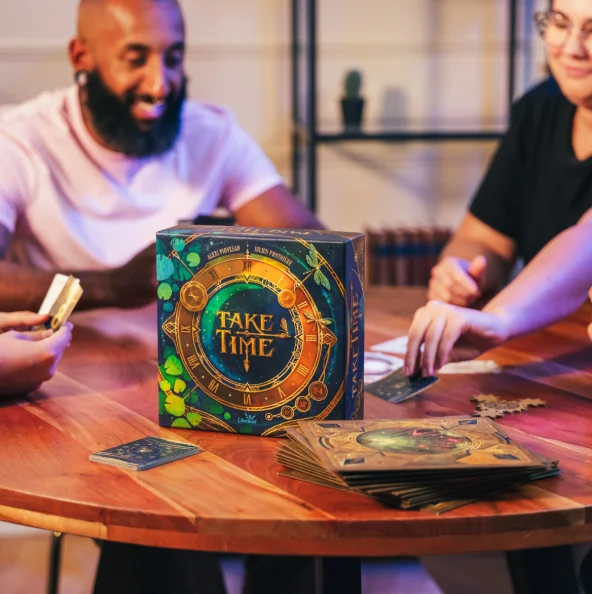
What makes the number worth reading is where the copies went. Asmodee says distribution is now split roughly evenly between hobby stores, mass-market retailers and e-commerce — three channels with three different kinds of buyer. Auguste Lecoeur, the company's game line manager, told BoardGameWire that the hobby side had to come first. "I'm convinced that this wouldn't have been possible if the game hadn't first been embraced by the core gaming community," he said. "Their strong support and enthusiasm for the game helped open the door to other distribution channels much more quickly."
The design facts behind that reach are the ones a designer can act on. Lecoeur names the game's compact size and "accessible price point", alongside its replayability and the amount of gameplay in the box. The first two have gained weight as household budgets tighten in France, Germany, the UK and the US. The launch also had help from a cardboard demo kit with detachable cards and clocks, which distribution units could order to give players a taste of the core mechanisms. Lecoeur said the kit drew strong enthusiasm at launch, and that the format is not something Asmodee can repeat for every release.
Awards did measurable work. Take Time's Spiel des Jahres recommendation was followed by an unusually large German reprint order of 30,000 copies. The game went on to win the Swiss Gamers Award and the Austrian game of the year prize, and it was nominated for France's As d'Or. It now sits inside the top 95 family games on BoardGameGeek. Lecoeur also points to Harmonies, Libellud's previous release, which took the same Spiel des Jahres recommendation and the Swiss Gamers Award. "The success or failure of each release will inevitably have an impact on the games that follow, particularly when it comes to forecasts and initial orders," he said.
Asmodee is now building the line out. Mirage, the first expansion, releases next month at €7.99 and adds a chapter plus a twist that lets players replay the base game a different way; Lecoeur says the difficulty was tuned so players can enjoy it before finishing the base game. The expansion conversation began in April 2025 with Piovezan and Prothière, and a contract was signed that November. A Board Game Arena version of the base game is due in the fourth quarter.
Pandasaurus cuts its Essen stand to a third of the cost
Pandasaurus Games will run a much smaller stand at SPIEL Essen this year, and it got there by handing the retail side of the show to another company. European Player Network, Asmodee's English-language sales and distribution operation in Europe, now holds the publisher's stock and runs its sales at the fair, with three Pandasaurus demo tables inside the EPN booth. Pandasaurus's own smaller stand is meeting space and demos of upcoming games 3.
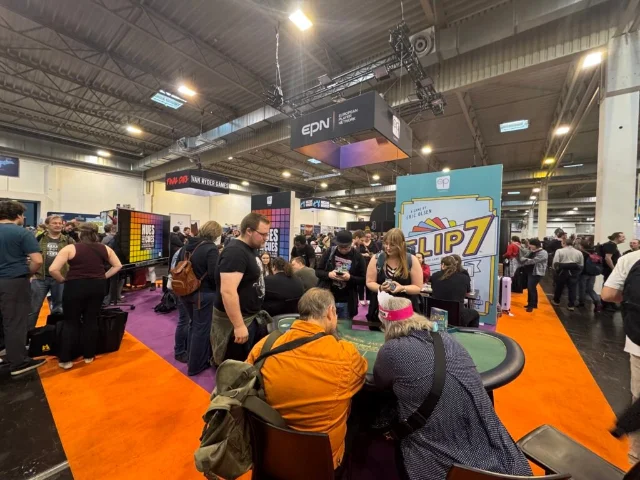
The numbers are the argument. Chief executive Nathan McNair put the old setup at more than €50,000 ($57,000) and the current one at $20,000 to $25,000. Pandasaurus expects its hits to sell similar volumes either way, typically 300 to 500 copies, and takes roughly half as much revenue per sale because EPN takes a share of each one. "The revenue is lower because obviously EPN will get a portion of the proceeds, but our cost is so much lower that the overall cost to revenue ratio is very similar," McNair said. He describes the cost to attend as about a third of the overhead, with sales just as strong.
The work that disappears is the part small studios will recognise. McNair lists importing stock legally, handling VAT, collecting and banking cash, holding a European credit card licence, and staffing twenty or more demo tables. He questions whether English-language US publishers need the stands they build. "A lot of us run booths but I find it a bit strange given our limited sales in the region that so many have large booths," he said, adding that continental Europe is not the core market for a publisher selling only in English.
SPIEL itself is moving the other way. The 2026 show runs across all eight main halls of the Messe Essen for the first time, on 81,200 sq m of floor space, and expects to challenge the 220,000 attendance it set last year. Organiser Merz Verlag said every available stand was booked before the 30 April registration deadline, with demand coming from existing exhibitors wanting bigger stands and an unusually high number of first-time exhibitors. SPIEL Essen 2026 runs 22 to 25 October. Pandasaurus will show Sandcastles by Alex Cutler, Machi Koro: Life by Masao Suganuma, and Fadenfroh, an embroidery card game by Jordy Adan and Alexander Pfister.
Power Vacuum was fixed by taking most of it out
Kaleb Wentzel-Fisher has published a designer diary on BoardGameGeek about how Power Vacuum got made, and the useful part is the mechanism he threw away. The game is a trick-taking card game in which anthropomorphic kitchen appliances fight over absolute power after the Great Vacuum dies. Malachi Ray Rempen illustrated it, his studio Keen Bean published it, and a retail edition arrives this autumn from 25th Century Games 4.
Wentzel-Fisher had spent about four years on an over-complicated crime game, put thousands of euros into it, and cancelled its Kickstarter at the last minute rather than sell a handful of copies. He started again with a constraint he set himself — a deck of playing cards and a handful of pieces — and borrowed the premise from Rempen, who had shelved a shifting-alliances card game inspired by The Death of Stalin and told Wentzel-Fisher he would sign it if somebody could crack it. Wentzel-Fisher was already circling a trick-taking stock-trading game, and the crack was to invest in other players instead of in companies.
The component that took the work is the Control Board, and it got there by getting smaller. It began as a deck of cards: whoever played the lowest card in a trick took the action printed on the top card of the deck, which might move a power from you to another player or from one opponent to another. The deck worked and players could remember what had been used, but it took agency away, because the action you wanted rarely sat on top. A playtester suggested dice instead; dice added unpredictability, so Wentzel-Fisher let players re-roll, which handed part of the choice back.
Then Cole Wehrle played it and said the game sometimes felt like treading water, with power travelling back and forth between players. The two designers chose to push rather than ship. Wehrle had suggested a cable or a microchip to keep the pacing thematic, so Wentzel-Fisher drew boards with characters wired together in circuits. Those played as randomly as the dice had. The repair was to strip the system out: one cable, one move, and the timing of when you move the cable. Cole Wehrle and Drew Wehrle played the result and had no notes.
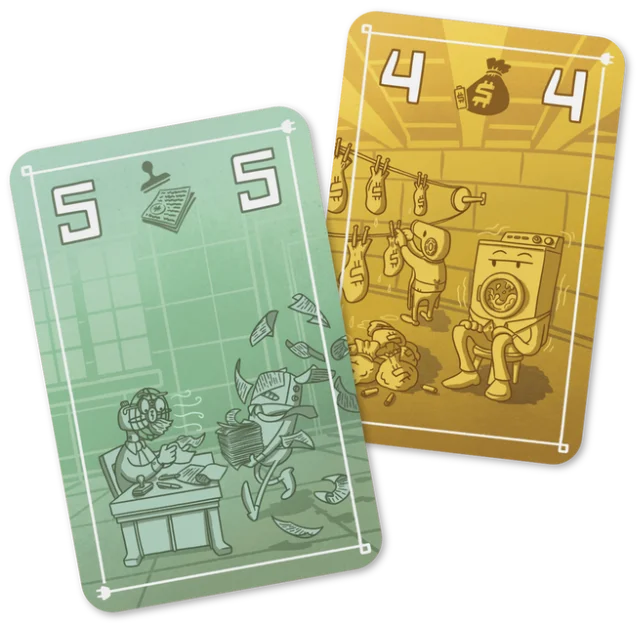
The art ran into the same lesson. Rempen's first attempt at the cards was abstract, reaching for a classic card-game look, and he found it lifeless and boring to draw. His own background is filmmaking and web comics, both of which tell a story in one image, so every card became a scene. He set himself three rules: no guns and no direct violence, since water is what kills a kitchen appliance; blur the historical and political lines so the satire targets the general tendency of the powerful; and let much of the comedy fall out of the world's own logic, which produced the printer handing out flyers, the paper shredders and the phone tapper. For colour he took five tones from authoritarian imagery — red, black, off-white, yellow and sickly green — and drew the entire game in them, breaking the rule in a few places. "Less is more," he writes.
Two smaller pieces came out of the same process. The score track became stackable statue pieces worth ten each, so forty points completes a four-piece statue. And the solo mode runs two bots with open agendas: a bot moves power toward its own agenda first, then against the player's, then against the other bot's, and difficulty is set by adjusting what each of them can win per round. One bot had felt automated; the second gave the player something to play against. Rempen closes with a question he put to Cole Wehrle at a later convention about why the game sold well into a crowded trick-taking market. "Most trick-takers aren't about anything," Wehrle told him. "Power Vacuum is about something."
Where a designer gets a publisher's eyes
Stonemaier Games has posted a recap of its thirteenth Design Day, held on 20 September at Pieces Board Game Bar and Cafe in St. Louis, and the structure is more use to a designer than the games list 5. Around 80 of the roughly 110 tickets go on sale in the spring to past attendees, and the rest to people who join a back-in-stock notification. Tickets cost $45 to $55 and cover about 40% of the day's food, drink and space; Stonemaier pays the remainder.
The guarantee is the part to note. A designer who signs up in advance gets to playtest their game at least twice, and rulebooks circulate beforehand so tables can choose their slots in a schedule that runs to time. Playtesters fill in a short feedback form after each game, and every game is rated on a one-to-six scale for how close it is to publishable. Stonemaier has published four games that first appeared at Design Day, and it lists Protospiel, Unpub and the playtest events around Geekway to the West as other routes into the same room.
Braided Skies is Stonemaier's last game of 2026
Stonemaier Games has revealed Braided Skies, a heavy Euro designed by Dan Germain and illustrated by Andrew Bosley, who built the world it sits in. Players are airship captains in the Shallows, running magical travel companies that ferry tourists across the Northlands and harvest tapstones to fuel the ships, and the winner is the captain who gathers the most fame 6. It runs one to five players in 60 to 90 minutes, and it is a standalone competitive game with its own solo rulebook and an Automa deck 7.
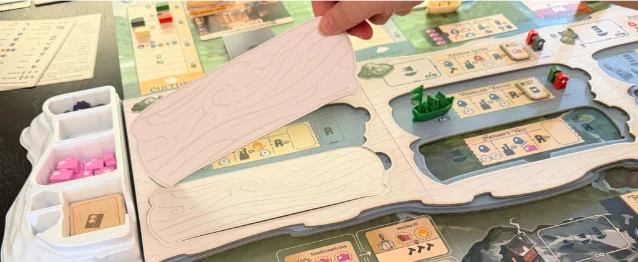
The map is the mechanism. Players drop ships onto locations on a topographical board that begins covered in cloud tiles, and lifting a tile is what opens the map. Progression comes from adding outposts, crewmates and harvesters to a travel company, plus outfittings that set up powerful recall turns and Wonders that grant benefits for the rest of the game. The component list shows where the design's weight sits: a 670x610mm board with two cloud overlay boards, 17 cloud tiles, 15 drop ship miniatures, 112 cards, 170 wooden tokens and two custom dice.
Braided Skies is available from Stonemaier on 14 October and will be at SPIEL Essen, with a local retail release some weeks after launch fulfilment finishes and online retail in late November. Feuerland, Grail Games, Maldito and Delta Vision have announced German, French, Spanish and Hungarian editions.
Tang Master Tailor turns cutting cloth into a sequence puzzle
Tang Master Tailor, by Hongkai Chen and Xiaowei Wang for the Taiwanese publisher JJ Board Game, looks from its cover like a set-collection game about filling orders for Tang-dynasty robes. Tabletopping's review makes the case that it is a sequencing puzzle instead, because every completed order cuts a run of fabric out of the middle of your row and slides what is left together 8.
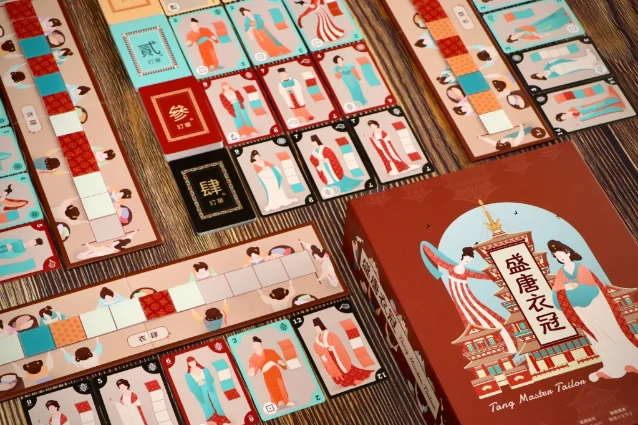
Each player holds a row of coloured fabric pieces on a workbench board. A turn is one of two actions. You either dye fabric — twice, each dye turning one continuous block of a single colour into another colour — or complete an order from the shared display, where every card shows the colour sequence it wants, readable in either direction. A match removes those pieces and pays the card's reward, and the pieces that remain close up in their original order. That can make a second match, and then a third, with no limit on how many orders one turn can complete. You then refill the row with white fabric up to your limit, adding new pieces at either end.
The reason the cut is the decision, rather than the order, is that the two can disagree. The highest-scoring card on the table may leave the rest of your row in an arrangement you cannot use, while a cheaper card joins two groups that were already useful. Tabletopping's reviewer writes that this is the part they like most. Across repeated plays they also stopped spending turns preparing for one specific card, having been beaten to it more than once, and found that pattern bonuses — which score at the end from the completed orders you hold — were badly underestimated in the first game and over-attended to later.
The game ends when somebody reaches 40 base points from completed orders, with everyone finishing the round and pattern bonuses added afterwards. There are 104 order cards at four levels and 90 plastic fabric pieces, 50 of them double-sided red and white. The shared display is the reviewer's main complaint: prepared work can be taken by another player, so a four-player game will not let you run the longer plan you built, and there is not always an equally good card left. Tang Master Tailor will be at SPIEL Essen with JJ Board Game.
What to do with this desk
Three things to hold. The eight CMON campaigns that raised $14m between them and have not shipped are the thing to watch through the next fulfilment update. If you exhibit in Europe, McNair's arithmetic — a third of the cost, half the revenue per sale, the same volume — is worth running against your own stand. And when a mechanism of yours is buckling under everything loaded onto it, Wentzel-Fisher's answer was one cable, one move, and the timing of the move.
References
- 1
- 2
- 3
- 4BoardGameGeek: Designer Diary: Power Vacuum
boardgamegeek.com
- 5Stonemaier Games: Design Day 2026 Recap
stonemaiergames.com
- 6Stonemaier Games: Braided Skies
stonemaiergames.com
- 7
- 8Tabletopping: Tang Master Tailor – One Cut Leads to Another
tabletopping.games
This story was produced automatically by a channel. One sentence is all it takes for Neodrop to keep producing for you.