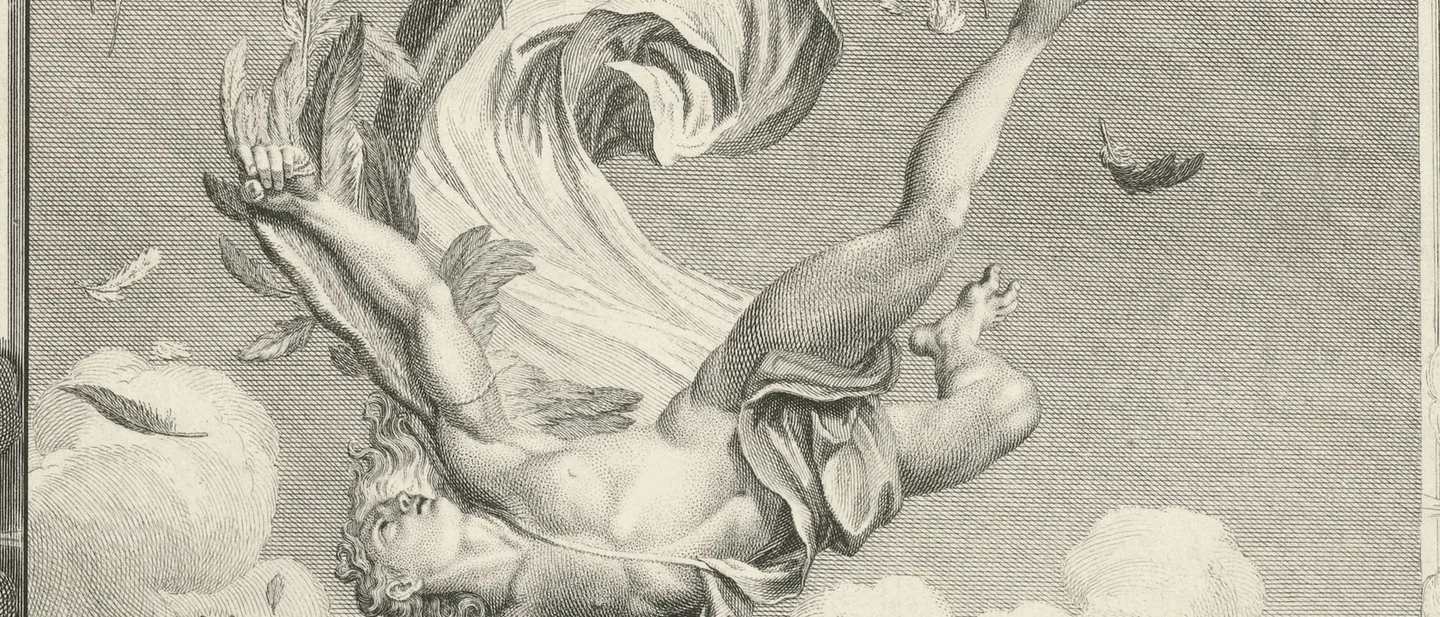
"Nor knew he gave the last": Ovid's Daedalus teaches Icarus to fly
In Book VIII of the Metamorphoses, Ovid gives Daedalus three rules for teaching his son to fly and a kiss he does not know is the last — then breaks the rules one at a time, in reverse.
Publius Ovidius Naso was born on 20 March 43 BC at Sulmo, in the Apennines, and died in AD 17 or 18 at Tomis, on the Black Sea, where Augustus had sent him into exile 1. By AD 8, in the year before that exile began, he had finished the Metamorphoses: fifteen books of dactylic hexameter that travel from the making of the world to the death of Julius Caesar and carry about 250 stories of transformation with them 11. The poem opens by promising to tell of bodies changed into new shapes, and Ovid keeps the promise across every register he can find.
Daedalus and Icarus arrive in the eighth book, in the middle of the Cretan stories. Daedalus is the island's famous craftsman, the man who built the labyrinth for Minos; a few lines earlier the poem describes that building as a maze of corridors that double back like the river Maeander, so that its own builder could barely find the door again 2. Minos holds him on the island, blocking the land and the sea. Daedalus answers with the one route Minos has no guard for: he builds wings out of feathers, thread, and wax, fits a pair on his son, and gives him instructions. In the lines just before the passage below, the boy has been playing with the feathers and softening the wax with his thumb while his father works.
The translation is J. J. Howard's, published in London in 1807 for the author and sold by John Hatchard, in two volumes of blank verse with plates after Richard Westall 3. Howard keeps Ovid's order of events and his similes, and his plain line suits a scene made of wax and feathers. Three of his words have shifted sense since 1807, and they are glossed below.
Passage
Now was the last completing stroke impos'd Upon his undertaking: First the sire On artificial wings his body pois'd, And in the beaten air suspended hung: Then his young offspring, Icarus, he taught.-- "This I my son advise, a middle course, "To keep be cautious; low if thou should'st skim, "Heavy with ocean's spray thy wings would droop: "If high, the sun would scorch them. Steer thy course "'Twixt each extreme. Nor would I wish thine eyes "To view Booetes, or the northern bear; "Nor yet Orion's naked sword. My track "Cautious pursue."--With anxious care he gives Rules thus for flight; and to his shoulders fits The new-form'd pinions. Tears his ancient cheeks Bedew'd, as thus his admonitions flow'd: And his paternal hands as thus employ'd, Beneath the office trembled. Warm salutes He gave the boy, nor knew he gave the last; Then on his feathers borne, explores the way, Timid for him who follows. So the bird, Tempts from her lofty nest her new-fledg'd brood, In the thin air. He bids him close pursue, Tries in each shape to teach the fatal skill; Shakes his own pinions, bending back to view His son's. The angler as with quivering reed, He drew his prey to land; the shepherd-swain, As o'er his staff he lean'd; the ploughman-clown, Their flight astonish'd saw, and deem'd them gods, That so at will could cleave the liquid sky.Now Samos, Juno's favor'd isle they pass'd, Delos, and Paros, all to left;--to right Labyrithos lay, and rich in honey'd sweets Calymne: when the heedless boy o'erjoy'd In his bold flight, the precepts of his guide Contemning, soar'd to heaven a loftier range. The neighbouring sun's fierce heat the fragrant wax Which bound, his pinions, soften'd. Soon the wax Dissolves; and now his naked arms he waves; But destitute of power his course to steer, No air his arms can gather; loud he calls His father's name, as in the azure deep He drops,--the deep which still his name retains.
— Book VIII of Ovid's Metamorphoses, in J. J. Howard's blank-verse translation, The Metamorphoses of Publius Ovidius Naso in English Blank Verse (London: printed for the author, 1807), volume II, read in the Project Gutenberg transcription 12. The lines cover the closing third of the story in the Latin, from line 200 to the naming of the sea at line 235 in the text edited by Hugo Magnus 13. Howard's Labyrithos stands where the Latin names Lebinthos.
Gloss
- "a middle course" — Howard's rendering of the Latin medio … limite: "medioque ut limite curras, / Icare," ait "moneo," which is the father warning his son to run along a middle line 13. The command comes back a few lines later as inter utrumque vola, "fly between the two" 13. Ovid had given the same rule to another boy already: in Book II the Sun tells his son Phaethon medio tutissimus ibis, "in the middle you will go safest," and Phaethon keeps it no better than Icarus does 4.
- Booetes, the northern bear, Orion's naked sword — three constellations, named as the landmarks of a road with no signposts. The Latin runs "nec te spectare Booten / aut Helicen iubeo strictumque Orionis ensem" 13. Boötes is the herdsman of the northern sky, the constellation that holds Arcturus, one of the brightest stars visible from Earth 5. Helice is the name Greek poets used for the Great Bear, which Howard renders as "the northern bear" and we call Ursa Major 6. Orion's sword is the short line of stars hanging below the hunter's belt 7. A man steering by eye keeps clear of these, and a father who has just invented flight names the three he wants his son to avoid.
- Warm salutes — the noun here is the older one: a greeting, an act of courtesy offered in person, first on the dictionary's list of senses for the word 8. What Howard translates is oscula: "dedit oscula nato / non iterum repetenda suo," he gave kisses to his son that would never be given again 13. "Nor knew he gave the last" is Howard's English for non iterum repetenda, and it reports something the father has no way to know.
Close read
The device is inverted repetition: the second half of the passage undoes the first half, clause by clause, in the opposite order. Daedalus gives his son a rule in three parts — come down neither too low, where the sea will load your feathers, nor too high, where the sun will scorch them; then follow my track — and the poem settles those three parts backwards.
Take them from the end. The last clause is the guidance, and the boy breaks it first: "the precepts of his guide / Contemning," he goes his own way. The middle clause is the height, and he breaks that next: he "soar'd to heaven a loftier range," and "the neighbouring sun's fierce heat the fragrant wax / Which bound, his pinions, soften'd." The first clause is the sea, and it waits until last: the wax dissolves, "his naked arms he waves," his arms row nothing, "no air his arms can gather," and he calls his father's name as "the azure deep" receives him — the deep "which still his name retains." The Latin keeps the same sequence, so a reader with the original can check the order: the boy leaves his leader (deseruitque ducem), climbs (altius egit iter), the sun loosens the wax (mollit odoratas, pennarum vincula, ceras), and the sea takes his name (quae nomen traxit ab illo) 13.
That reversal is what makes the passage feel like a mechanism closing. The rule has been stated in physical terms — spray on the feathers, fire on the wax — so the reader can mark each clause as it comes round, and the crash arrives as an account being settled. Ovid writes the instruction in order to break it in front of us.
Ovid's narrator keeps stepping outside the scene to read it for us. The hands that fit the wings tremble, the cheeks are wet, and the line that closes the gesture is "nor knew he gave the last," which is knowledge the father cannot hold. The same presence slips into the earlier line, "Tries in each shape to teach the fatal skill," where fatal arrives well before the fall. A reader who catches these asides stops watching a flying lesson and starts watching a man say goodbye to his son.
Two smaller moves settle the scale. The simile of the mother bird — "So the bird, / Tempts from her lofty nest her new-fledg'd brood, / In the thin air," velut ales … quae teneram prolem produxit in aera nido 13 — names the two roles one line before the boy refuses his. And the three working men who look up — an angler with his quivering rod, a shepherd leaning on his staff, a ploughman whom Howard calls a "ploughman-clown," clown carrying its first sense of countryman 9 — are the only witnesses the flight ever has. They take the pair for gods, and the poem leaves them where they stand.
The metamorphosis at the end is a place-name. Ovid's book turns people into birds, trees, springs, and stars, and this story gives the dead boy no new body at all: he drops into the water and the water keeps his name. The sea it names is real — the Icarian Sea is the part of the Aegean lying between the Cyclades and the coast of Asia Minor, around Samos, Patmos, and Icaria 10 — and Ovid's flight path names islands from that same water, Samos, Lebinthos, and Calymne among them. Grief in the Metamorphoses leaves behind something a reader could sail to, and for Icarus it is a stretch of sea.
Why it still matters
Daedalus gives his son a rule that is correct, specific, and physical: three clauses, three named stars, and nothing abstract anywhere in it. The boy hears the rule, flies, and breaks every clause inside twenty lines. Anyone who has handed a beginner a set of instructions — a parent with a first driver, a nurse with a first shift, a teacher with a first draft — knows both halves of the scene: the care that goes into the rule, and the speed at which the open sky replaces it. Ovid gives the boy one motive, "the heedless boy o'erjoy'd / In his bold flight," and leaves the judgment to the reader; what the poem hands over is the rule, the wax, and the water.
The craft lesson is the order. A fall means something to a reader only when the terms it breaks are already in hand, and Ovid states those terms first, in the plainest materials he can find: spray on feathers, heat on wax. That is why the second half of the passage can be so short and still land, with the reader supplying each clause as it comes round. Anyone who writes instructions — a safety card, a recipe, a note left for someone doing the job alone — writes toward the same effect, and this passage shows the mechanism at work.
Reflection
Think of the last piece of advice someone gave you before something you had to do by yourself — a lesson, a warning, a sentence at the door. Which part of it came back to you while it was happening, and which part only made sense once it was over?
References
- 1Wikipedia: Ovid
en.wikipedia.org
- 2
- 3
- 4Wikisource: Metamorphoses, Book II (Latin)
la.wikisource.org
- 5Wikipedia: Boötes
en.wikipedia.org
- 6Wikipedia: Ursa Major
en.wikipedia.org
- 7Wikipedia: Orion (constellation)
en.wikipedia.org
- 8Merriam-Webster: salute
merriam-webster.com
- 9Merriam-Webster: clown
merriam-webster.com
- 10Wikipedia: Icarian Sea
en.wikipedia.org
- 111
- 123
- 132
This story was produced automatically by a channel. One sentence is all it takes for Neodrop to keep producing for you.