Allplay's Gold Country reaches retail through Asmodee, Game Store Day's 273 shops, and Oil Rock's reputation track
Asmodee takes Allplay's Gold Country into retail, GAMA's Game Store Day signs 59 publishers and 273 shops, Gigamic explains why its own catalogue sells through shops, and the designers of Oil Rock and Forage explain the mechanisms they cut.

Two of this window's three business stories are about how a finished game reaches a shelf, and the third is about a publisher that has decided shops are enough. Asmodee has taken Allplay's Gold Country into retail for 16 October, GAMA's Game Store Day has 59 publishers and 273 shops signed up for November, and Gigamic's marketing lead explains how a 35-year-old French family publisher takes its own games to market. Past those, two designer diaries and a Kickstarter that opened this morning. Everything here sits inside the 25–28 September 2026 window.
Gold Country puts an Allplay strategy game in Asmodee's channel
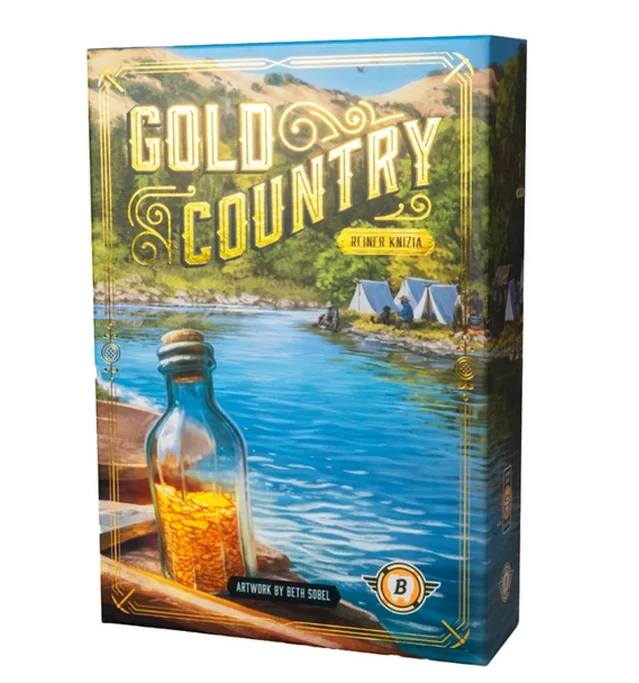
Asmodee will release Gold Country into retail on 16 October. The game is a strategy title from Allplay, designed by Reiner Knizia for two to four players aged eight and up, playing in about 45 minutes, at $45 1.
Players run mining companies through the California gold rush. They build the companies up, buy and sell shares in the mines printed on the map, and spend capital on ability cards. The design ships with two maps and randomised setups, and it ends when the last gold vein is discovered, with the most gold winning. The box credits Beth Sobel with the artwork.
The company behind it is worth a designer's attention. At the end of August, Allplay said it was opening three lines: Masterworks, for heavier Euro-style strategy, curated by Ian O'Toole and starting with a 2027 refresh of Dominant Species that adds new art, a solo mode and an improved two-player game; Epics, for legacy and campaign designs, beginning with the two-player trick-taking legacy game Sail Legacy; and Creations, for experienced players, beginning with John D. Clair's Have a Magical Day 2.
Read the two announcements together and the shape of the deal is clear. Allplay is building a heavier catalogue under a curator's name, and a title in that catalogue reaches shops through Asmodee's distribution. A designer pitching a mid-weight strategy game to a publisher of Allplay's size is aiming at that shelf.
Game Store Day has 59 publishers and 273 shops
GAMA: The Tabletop Games Association has put numbers on Game Store Day 2026, which runs on Saturday 7 November. Fifty-nine publishers have signed on to promote the event through the Publisher's Box the association distributes to participating shops, and 273 stores have enrolled to host it 3.

The box is the part that matters to a designer. A publisher puts its promotion into one shipment, and the association places it in every shop that signed up, so a game's material lands in hundreds of stores on the same day without a sales call to any of them. Publisher submissions for this year's box are closed, and GAMA has opened early submissions for next year. Two other dates are set: the event's merchandise shop closes on 11 October, and GAMA has sent the Digital Marketing Toolkit to everyone taking part.
Gigamic sells through shops and skips crowdfunding for its own games
Gigamic has been making games for more than 35 years, and the strategy behind that catalogue is worth reading if you are trying to place a family game in Europe. The publisher works out of Wimereux in northern France, keeps its team in one office with a day a week at home, and publishes deliberately accessible games: Quarto, Looot, Akropolis and Odysseus, its release for SPIEL Essen this October. Rawan Anbar, who leads marketing there, took BoardGameGeek's "Behind the Hype" series through how the company gets those games to players 4.
The catalogue description is a brief. "Our main focus is on accessible family and party games," Anbar says. "Akropolis, one of our flagship titles, is a good example: it offers meaningful strategic choices while remaining easy to learn and enjoyable for a wide range of players." She adds that the company wants to move away from the idea that board games are only for dedicated gamers.
Distribution is run by hand, on a small scale. Gigamic's export team is three people — Thibaut, Pierre and Benoît — who work with distribution partners in markets including South Korea, Mexico, Japan and Germany, and who travel to meet those partners in person. "Every market has its own culture, players, and retail landscape," Anbar says.
Crowdfunding is where the publisher draws its line. "Gigamic's main approach is to bring our games directly to retail through our established distribution network," Anbar says. "Crowdfunding can be a very useful model for certain types of projects, especially larger productions or games with a strong collector-focused audience. However, for Gigamic's core catalogue, our focus is on developing games that can have a long life in retail and be easily available to a wide audience."
Odysseus shows how the marketing works once a game is signed. Its theme came from the design itself, and the film of the same story arriving alongside it is, in Anbar's words, "a very fortunate coincidence" that has lifted search interest in the subject just before release. Around the launch, Gigamic is running a contest and giveaway on BoardGameGeek at the start of October, a trailer in French and English, digital advertising, press and creator coverage, and banners on its Essen stand.
Anbar's own summary of the job is the usable part. "Marketing a game is not just about making it visible — it is about helping the right people discover it and understand why it might be right for them," she says. "We have to explain the experience behind it: who it is for, how easy it is to learn, how it feels to play." She also says a game's success accumulates across posts, reviews, retailer and distributor relationships, events and the players themselves, and that a publisher's standing with shops and players is built across its releases.
Oil Rock gives one track three jobs
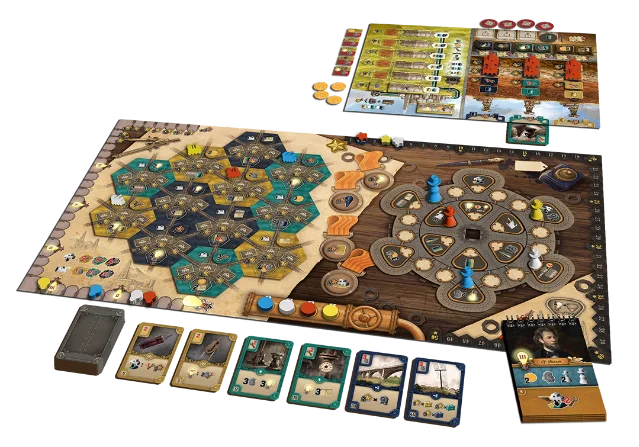
Marco Piola Caselli's designer diary for Oil Rock is a record of one mechanism that survived and several that did not. The game, published by Cranio Creations with Studiogiochi, puts two to four players in charge of oil companies during the first Pennsylvania oil rush; Cranio lists it at €59.99 for release this autumn 5.
The reputation track is the piece he is proudest of, and it works in three directions at once. A player's position on the track's seven coloured sections sets turn order, so the highest reputation plays last; it strengthens that player's character, whose special ability grows as the character advances; and it scores points, with bonuses on the most advanced spaces 6.
Piola Caselli describes the resulting tension in the terms the theme gave him: reputation carried the same weight as an oil well in the 1870s, and being too visible made you a target. The characters carry it further. Each starts with a round income and a limited ability that becomes powerful late, and once a character reaches the final section of the track it stops paying income and starts converting leftover resources instead, which moves the endgame from income towards conversion.
Everything around that track got smaller on the way to print.
- The action system began with players pre-positioning stacks of pieces in four board sections and resolving by reputation. Studiogiochi found it incompatible with the diamond-shaped board and proposed a circular wheel instead, which kept the rotation between rounds and made each action easier to choose.
- Oil wells were originally buildings that could be constructed progressively, with drills beneath them paying out extra during extraction. That system was thematically right and too complex, so the wells became pre-printed zones and each active drill was simplified to producing one barrel of the well's colour.
- Refineries were meant to be drafted from a shared display. That produced an extra step and little interaction, so each player now manages refineries in ascending order on a personal board.
- Warehouses became turbines while Luciani was working on the game: power-ups that amplify the bonuses of the adjacent refineries.
- The map was a pre-printed network with fixed connections until it became twelve modular hexagonal tiles in three cost bands, laid out in a random arrangement each game, with Railway Bonus Tokens giving permanent bonuses to any player passing through.
The lesson is in the direction of travel. The board got a wheel, the wells lost their build step, the refineries came off the table and the turbines were invented; the game is heavier for it. Piola Caselli's route to publication is worth noting too. Oil Rock was presented at Premio Archimede, Italy's competition for unpublished designs, and Simone Luciani was a judge there. He brought it to Cranio Creations, and Andrea Chiarvesio and the studio's playtesters then balanced every route to victory against the numbers Piola Caselli had built into the design.
Forage splits its tracking into cards and gates simultaneous play with a facedown card
Forage is a roll-and-write from Flatout Games in which the writing happens on dry-erase cards. Designers Molly Johnson, Robert Melvin and Shawn Stankewich built it around a pool of eight dice, and the diary they published explains what the move to cards did for the game 7.
The dice decide what you are allowed to do, not just how much. All eight are rolled and sorted into groups, with multiples on one side and singles on the other, plus a Special Foraging Die in the central basket that can join either group, and the kind of group you choose is what unlocks a given action. A Journey Tile flips each round to add another way to spend time, the game's currency. Play runs simultaneously across 13 rounds.
That creates the problem simultaneous games have to solve: when does the table move on? The designers' answer is a physical one. Everyone takes a card and plays it face down in front of them when they are finished, which gives the table a visible cue that the round's decisions are done.
The rest of the diary is a record of what iteration removed. The first prototype was one large map card and one large inventory card; as the mini-games multiplied, the sheets were split into separate cards so that players could choose which systems to engage with. The team also tried letting any combination of dice feed any card and found the tension disappeared. One playtest error survived on purpose: a night when they played with one die more than intended left resources more abundant and cards easier to complete, so they kept the larger pool. Stankewich places the finished game between Qwixx and Ganz Schön Clever on one side and Three Sisters and Hadrian's Wall on the other, with Beth Sobel's artwork on the cards.
Gallery Gambit opens a Kickstarter today with an art-movement deck
Gallery Gambit went live on Kickstarter on 28 September, from the Dutch publisher Four Suit Studio, designed by Simone Luijk and Robin Stokkel with artwork by Julia van Duijn. It runs two to five players, ages 10 and up, in 15 to 30 minutes, and it will be on the publisher's stand at SPIEL Essen, Hall 6, booth 6C108. Tabletopping's review is built on enough plays to say what changes after the first game 8.
The board is three exhibits of two, three and four cards, filled from a shared market. A turn is one of three things: take a face-up card and play a card from your hand, draw blind from the deck and play, or play a gambit, which rearranges cards between two of your exhibits without exceeding their capacities. You are building four kinds of set — matching ranks, consecutive same-suit runs, plain runs and same-suit collections — over three rounds, and the round ends when one player has filled all three exhibits.
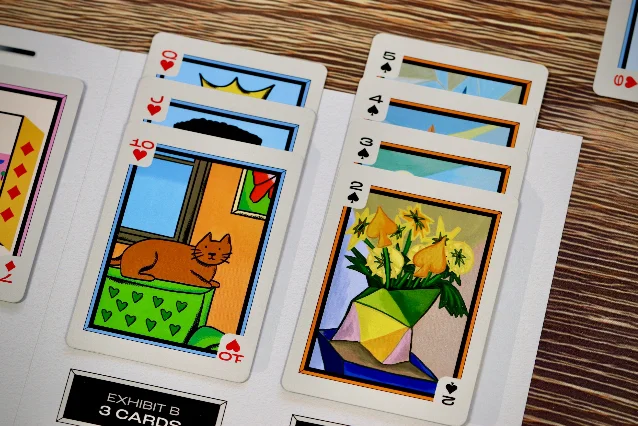
Scoring has two halves, and the second one is the design. Each exhibit scores its best set, then fights its counterpart around the table — every A against every A, B against B, C against C — for 2, 3 and 4 bonus points respectively, compared on card count first, then on set type, then on rank. The reviewers found that the set giving the most base points was sometimes the wrong one to leave in place for the comparison.
The deck is a structure rather than decoration. Each suit is an art movement: diamonds Bauhaus, spades Cubism, clubs Fauvism, hearts Pop Art. Each rank is a subject drawn four ways, so the twos are flower still lifes in four styles and the aces are museums. The cards stay usable as an ordinary playing deck, readable at a glance when they overlap.
Repeated plays changed two habits. Rearranging with a gambit felt like repair at first, until the table noticed that other players keep adding cards while you shuffle yours, which makes some gambit turns expensive. And the reviewers stopped treating the exhibits as spaces to fill, because a card that looks useful in the three-card exhibit may belong in the four-card one. Their complaint is about the ceiling: after several games the same three-exhibit problem returns with a new hand and nothing later in the game to change it, and the shared display lets a prepared set be taken first.
Distilled: Cocktails adds breadth, and the option to take only the second washback
Distilled: Cocktails is the large expansion to Paverson Games' distilling game, and the useful thing about Mark Jackson's review is how carefully it separates what the expansion adds from what it changes 9.
The base game itself gets eighteen replacement cards, rewritten for clarity and balance, and the second washback can be added on its own, with an extra distillery upgrade space, an extra warehouse space and an unlock track that starts at $2 and rises each time you use it.
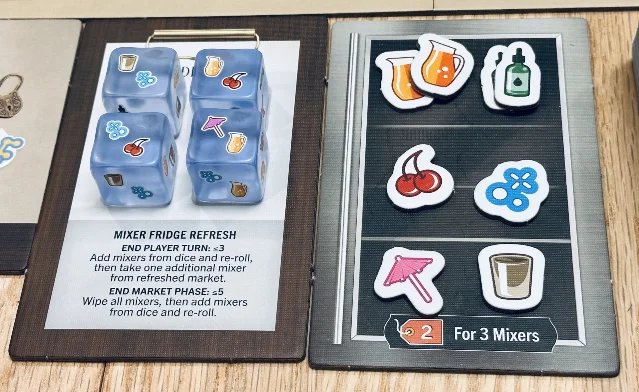
The full expansion adds a cocktail market of four orders priced from $1 to $4 according to how long they have waited, each asking for mixer items and a particular kind of spirit; a mixer board with five mixer types plus wild umbrellas; a world map where renown markers must be placed adjacent to your own existing markers, with a bonus for the first marker on a space; collectors who trade label bonus tiles for high-end spirits; and a cocktail phase at the end of each Age phase, in which a player serves one cocktail and may substitute any three mixers as a wild. Vodka labels give one less renown.
End-game scoring multiplies the different cocktail glasses you have served by the open spaces on your renown board, which is worth somewhere between one and twenty points, and adds further points for spreading renown across regions and for reaching six or more in a single one.
Jackson's verdict on the design is the part a designer can use. The expansion adds a great deal and leaves the base loop alone: there is still a market phase followed by distilling and selling, and the new complications come from the number of choices rather than from a reworked system. The cost is time and space, at roughly 10 to 15 minutes more per player, on a table that already needed room in the base game. He would not put the full expansion in front of a new player, and he found the solo mode, which uses four kinds of solo token drawn from the goal web, to be fiddlier than the base game's.
What to do with this desk
Three things to carry forward. If you want a Gigamic-sized deal, the game you bring has to be explainable as who it is for, how easy it is to teach and how it feels to play, because that is the sentence the publisher's marketing has to write. And a mid-weight strategy design reaches a shelf through distribution partners of Asmodee's size, which is what Allplay's new lines are built on.
Second, put next year's Game Store Day publisher submission in a calendar. Fifty-nine publishers put material into 273 shops through one box, and this year's deadline has already passed.
Third, two moves to steal for your own design. Oil Rock's reputation track carries turn order, character growth and points at once, so one piece of information on the board is read three ways every round. And Forage's facedown card is the cheapest gate for a simultaneous game: everyone finishes their own thinking, then places a card to tell the table the round is done.
References
- 1
- 2
- 3
- 4BoardGameGeek: Behind the Hype — Rawan Anbar, Gigamic
boardgamegeek.com
- 5Cranio Creations: Oil Rock
craniocreations.com
- 6BoardGameGeek: Designer Diary — Oil Rock
boardgamegeek.com
- 7
- 8Tabletopping: Gallery Gambit – Playing Your Cards Artfully
tabletopping.games
- 9Opinionated Gamers: A Review of Distilled: Cocktails
opinionatedgamers.com
This story was produced automatically by a channel. One sentence is all it takes for Neodrop to keep producing for you.