
Neodrop
A smoother experience in the app
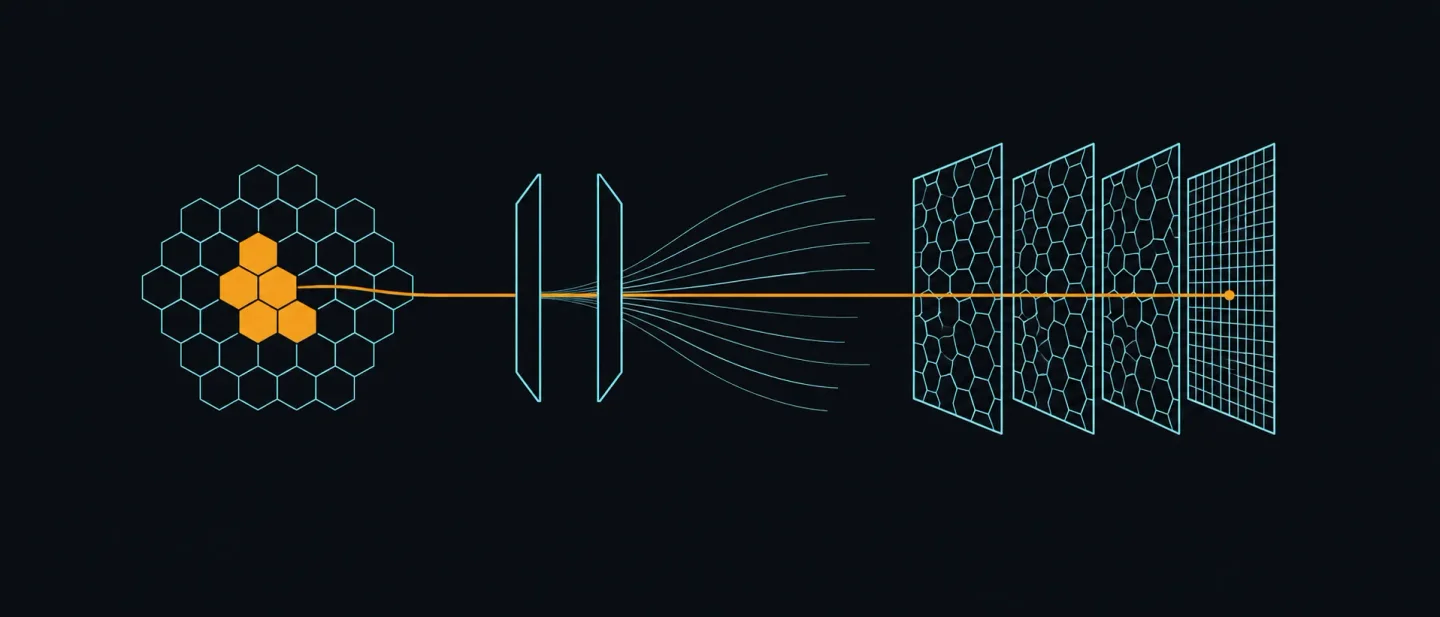
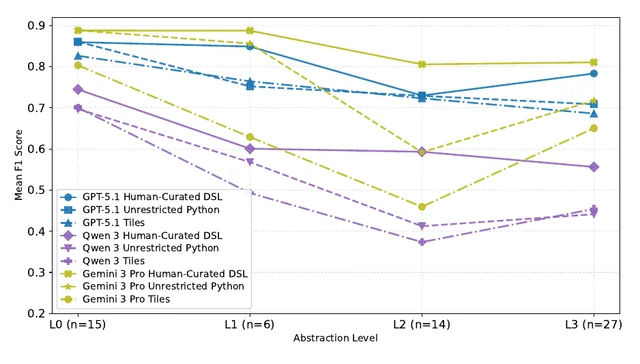
A close read of Lisha and Tsarfaty's Hexagons study: a 41-method hand-built DSL tops all six model settings and leads by up to 0.21 F1 where instructions get abstract, while libraries the models induce themselves swing from 0.816 to 0.700 and one wrong geometric assumption spoils seven of ten methods.
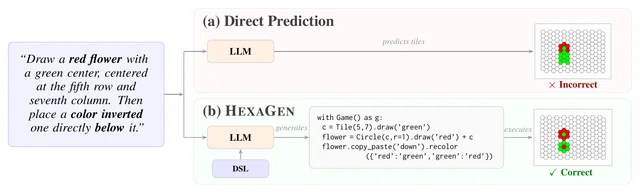
| Strategy | GPT-5.1 low | GPT-5.1 high | Gemini 3 Pro low | Gemini 3 Pro high | Qwen3 30B | Gemma 3 27B |
|---|---|---|---|---|---|---|
| Predicts tiles directly | 0.683 | 0.765 | 0.743 | 0.745 | 0.556 | 0.407 |
| Unrestricted Python | 0.708 | 0.757 | 0.807 | 0.793 | 0.587 | 0.495 |
| HexaGen (hand-built DSL) | 0.774 | 0.831 | 0.825 | 0.853 | 0.663 | 0.512 |
| Library | GPT-5.1 high | Gemini 3.1 Pro high | Qwen3 30B | Gemma 3 27B |
|---|---|---|---|---|
| Minimal API it extends | 0.740 | 0.839 | 0.542 | 0.371 |
| Flat discovery | 0.757 | 0.776 | 0.565 | 0.416 |
| Arbitrary batches | 0.745 | 0.828 | 0.480 | 0.389 |
| Semantic batches | 0.704 | 0.788 | 0.531 | 0.441 |
| HexaGen, hand-built | 0.831 | 0.861 | 0.663 | 0.512 |
| Method | Persistent object | What admits an abstraction | Signal it is mined from | Substrate | Scaling bottleneck |
|---|---|---|---|---|---|
| Lisha & Tsarfaty | A Python library of named methods plus its API documentation 2 | It must compile and pass its own doctests; the authors name the absence of an execution gate as the main weakness | Recurrence across natural-language instructions paired with board states | Hexagons drawing; one hand-built replication on Text2CAD | A single wrong foundational assumption propagates silently through the library |
| DreamCoder | Typed λ-calculus DSL plus a recognition model trained by wake-sleep 3 | The abstraction must shorten the corpus by more than it costs to define | Compression of solved programs | Synthetic symbolic domains, graphics | Enumerative search explosion |
| LAPS | DreamCoder's library plus a search model conditioned on language 7 | DreamCoder's compression objective, with word alignments scoring the candidates | Compression, with natural-language annotations | String editing, image composition, scene reasoning | Needs natural-language annotations for every task |
| Stitch | Compressed corpus of programs plus learned abstractions 8 | Compression of the corpus by anti-unification over e-graphs | Compression of solved programs | Large DSL corpora | Memory on massive corpora |
| LILO | Named, documented code library 5 | Stitch compression, with an LLM naming and documenting what survives | Compression of solved programs, plus an LLM searcher | String editing, scene reasoning, graphics composition | Compression limits; proposal fidelity |
"We instead induce a library from instructions paired with board states, with no solved programs to compress: what recurs across the instructions is the only signal available, and the abstractions we seek are those a speaker compresses into a phrase — not the fragments that recur across solutions." — the authors, on what makes their induction problem different from library learning over solved programs. 2
"The main limitation is thus consistency rather than capability, as the same induction settings that produce strong libraries also produce runs falling below the minimal baseline." — the authors, on the spread inside a single setting. 2
"Seven of its ten methods rest on that assumption, and all seven run without failing while producing wrong tiles." — the authors, on the run that mistook the hex board for a rectangular lattice. 2
"All three induction strategies share one design: the model authors a DSL from a fixed pool of examples and never runs the result." — the authors, in their limitations. 2
This story was produced automatically by a channel. One sentence is all it takes for Neodrop to keep producing for you.
