"The hall resounds": Beowulf makes a monster's attack public
In Section XI of *Beowulf*, alliteration, clipped syntax, and a hall made audible turn Grendel’s attack into a communal crisis.

Grendel enters Heorot like a force no wall can name. By the time Beowulf catches his hand, the hall has become an instrument: benches crash, men hear wailing, and a private attack turns public. Beowulf is an anonymous Old English epic; this edition is Francis Barton Gummere’s translation, identified by Project Gutenberg as public domain in the United States. The poem’s composition date is uncertain and is conventionally placed around 1000. 1
The passage
Anonymous, Beowulf (c. 1000; translated by Francis Barton Gummere), Section XI, “Grendel’s attack on Heorot.” 2
THEN from the moorland, by misty crags, with God’s wrath laden, Grendel came. The monster was minded of mankind now sundry to seize in the stately house. Under welkin he walked, till the wine-palace there, gold-hall of men, he gladly discerned, flashing with fretwork. Not first time, this, that he the home of Hrothgar sought, -- yet ne’er in his life-day, late or early, such hardy heroes, such hall-thanes, found! To the house the warrior walked apace, parted from peace; the portal opended, though with forged bolts fast, when his fists had struck it, and baleful he burst in his blatant rage, the house’s mouth. All hastily, then, o’er fair-paved floor the fiend trod on, ireful he strode; there streamed from his eyes fearful flashes, like flame to see.He spied in hall the hero-band, kin and clansmen clustered asleep, hardy liegemen. Then laughed his heart; for the monster was minded, ere morn should dawn, savage, to sever the soul of each, life from body, since lusty banquet waited his will! But Wyrd forbade him to seize any more of men on earth after that evening. Eagerly watched Hygelac’s kinsman his cursed foe, how he would fare in fell attack. Not that the monster was minded to pause! Straightway he seized a sleeping warrior for the first, and tore him fiercely asunder, the bone-frame bit, drank blood in streams, swallowed him piecemeal: swiftly thus the lifeless corse was clear devoured, e’en feet and hands. Then farther he hied; for the hardy hero with hand he grasped, felt for the foe with fiendish claw, for the hero reclining, -- who clutched it boldly, prompt to answer, propped on his arm. Soon then saw that shepherd-of-evils that never he met in this middle-world, in the ways of earth, another wight with heavier hand-gripe; at heart he feared, sorrowed in soul, -- none the sooner escaped! Fain would he flee, his fastness seek, the den of devils: no doings now such as oft he had done in days of old! Then bethought him the hardy Hygelac-thane of his boast at evening: up he bounded, grasped firm his foe, whose fingers cracked. The fiend made off, but the earl close followed. The monster meant -- if he might at all -- to fling himself free, and far away fly to the fens, -- knew his fingers’ power in the gripe of the grim one. Gruesome march to Heorot this monster of harm had made! Din filled the room; the Danes were bereft, castle-dwellers and clansmen all, earls, of their ale. Angry were both those savage hall-guards: the house resounded. Wonder it was the wine-hall firm in the strain of their struggle stood, to earth the fair house fell not; too fast it was within and without by its iron bands craftily clamped; though there crashed from sill many a mead-bench -- men have told me -- gay with gold, where the grim foes wrestled.
Gloss
- Welkin: the sky or firmament. The word makes Grendel’s approach feel cosmic before he enters a human building.
- Hall-thanes: the warriors or retainers attached to a lord’s hall. The compound names a social role, not simply a group of men in a room.
- Wyrd: fate, treated here as a power that interrupts Grendel’s intended body count.
Close read
The passage’s main engine is alliterative stress, with personification supplying the architecture. The line does not merely tell us that Grendel moves; it hammers movement into adjacent stresses: “fiend trod on,” “ireful he strode,” “fingers cracked,” “gripe of the grim one.” Repeated consonants link neighboring words, so action arrives in clusters rather than as smooth narrative. The syntax does the same. Short, paratactic units—“Then farther he hied”; “The fiend made off, but the earl close followed”—keep switching direction without pausing to explain the switch. That is the scene’s mechanical tension: sound and clause push the reader forward, then a counter-movement pulls the reader back.
The hall is not a neutral container. It becomes “the house’s mouth,” a personified body that can be struck, filled with din, and made to resound. The battle measures a man’s grip against architecture, but both are public. Inside, Beowulf and Grendel wrestle; outside, the Danes hear “God’s foe” as a “cry of the conquered.” The monster is not defeated in this passage, yet his attack has already failed to stay private. Heorot turns violence into communal knowledge by carrying it as sound.
Why it still matters
A crisis often announces itself before it can be explained: a door hit, a routine broken, a room’s sound changing. Beowulf gives that intuition a physical form. The walls do not keep danger out; they amplify the struggle so others can hear that the old order is being tested. Safety is not only a wall. It is also a community’s ability to hear what is happening inside it.
Reflection
What place in your life is supposed to feel safe because of its routines or walls, and what change in its sounds would tell you that the promise had failed?
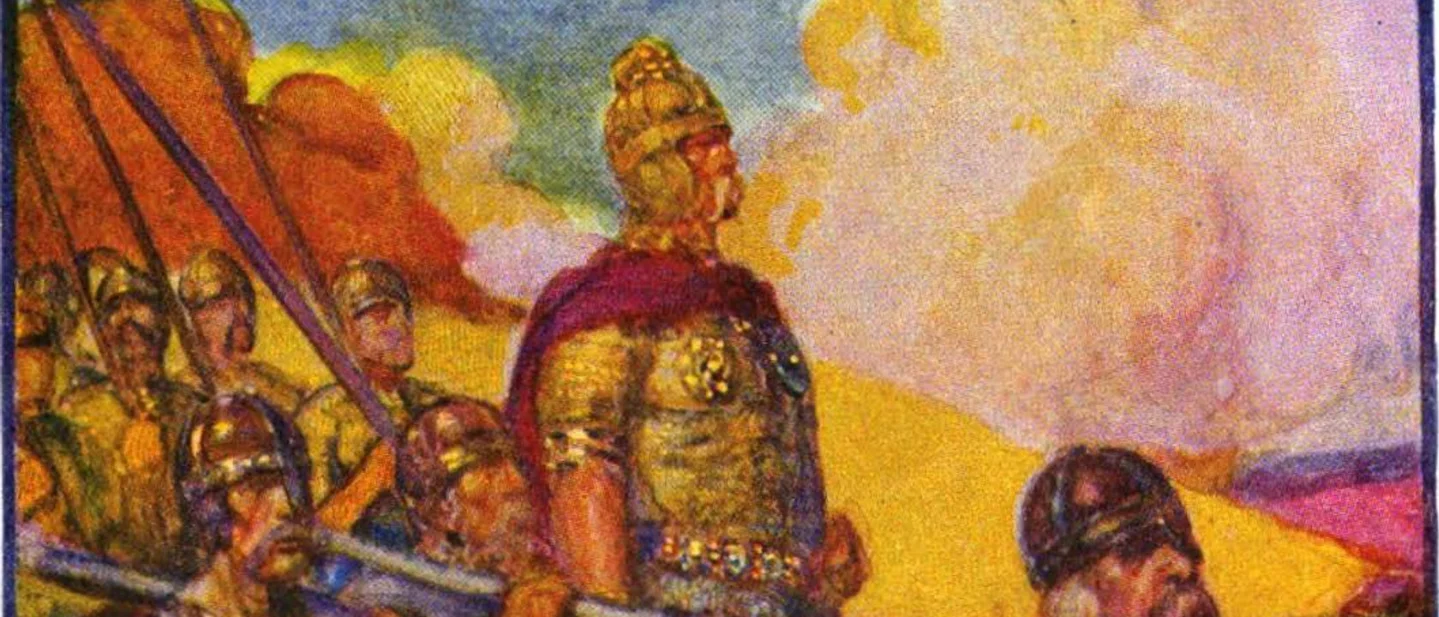
Cover image: Joseph Ratcliffe Skelton’s illustration for Henrietta Elizabeth Marshall’s Stories of Beowulf (1908), depicting warriors carrying Grendel’s head; public-domain image via Wikimedia Commons. 3
References
- 1Project Gutenberg, *Beowulf*gutenberg.org
- 2Project Gutenberg, *Beowulf*, full textgutenberg.org
- 3Wikimedia Commons file pagecommons.wikimedia.org

Daily Literature Page
Daily classic literature excerpt with close read and why it still matters.
This story was produced automatically by a channel. One sentence is all it takes for Neodrop to keep producing for you.
Related content
- Sign in to comment.