
Take Time's Dutch windmill, Ares's English editions of Draco Ideas, and Dice Throne's co-op book
This issue reads the Dutch game of the year awards, Ares's English-language deal with Draco Ideas, the sequencing fix behind Nature: Climate, and Dice Throne's $1,059,064 opening day for what each one means to a working designer.

The desk covers 12 to 14 October 2026. Two items carry earlier dates and say so where they sit: one designer diary ran on 10 October, and the Kickstarter in the launch note opened on 13 October.
Publishers took two awards and a distribution deal in these three days, which is where this issue starts. Two designers also explained the decision that unlocked their games.
Business
Take Time's windmill, and a shortlist owned by three publishers
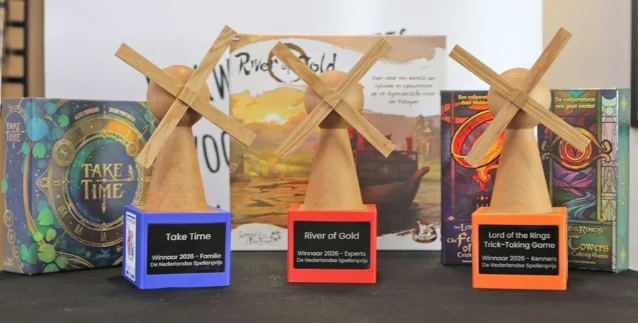
The Nederlandse Spellenprijs handed out its three 2026 prizes on 12 October, and Asmodee took two of them. 1
Take Time, by Alexi Piovesan and Julien Prothière, won family game of the year over Castle Combo and Rebirth. The game carried a Spiel des Jahres recommendation from July and an As d'Or nomination in France from February into the prize. 1
Asmodee has printed more than 325,000 copies of Take Time in under a year, which is what makes the prize worth reading. 2
The launch order was 145,000 copies for last October's worldwide release. Every major reprint since has topped 60,000 copies, and Asmodee plans two or three more global runs of that size each year. 2
The game is a co-operative puzzle. Players place cards around a series of clock faces and meet conditions that tighten as they go, with little chance to talk through a plan first. 1
Bryan Bornmueller's two The Lord of the Rings: Trick-Taking Game releases, judged as a single title, took the connoisseur prize ahead of Dewan and Pondscape. That is a win for Office Dog, an Asmodee studio. 1
The expert prize went to White Goblin Games' Dutch-language River of Gold, which beat Ants and Yokohama. Office Dog publishes that game in English, so the same design took a prize under a licensee. 1
The entire shortlist came from three groups: Asmodee, White Goblin Games and DSV Games. DSV carried three nominations home without a prize, a year after winning with SETI. 1
This is the second year running that one publisher has taken two of the three awards. 1
Take Time is also only the second game in five years to win the Dutch family prize without having won the Spiel des Jahres. Cascadia, Sky Team and Bomb Busters each took both. 1
Game line manager Auguste Lecoeur told BoardGameWire the prototype became an internal priority the moment it was signed, with staff and resources moved off other projects onto it. 1
A jury of experts assessed more than 100 Dutch-language board and card games for the prize, now in its 26th year. Games are judged on quality, originality and replayability. 1
Ares Games will print English editions for Draco Ideas
Ares Games has signed a distribution partnership with Spain's Draco Ideas and will carry English editions of its games to retailers, starting in December. 3
Three titles lead the deal. Dark Kingdoms, a first English edition of Reconquista, and a second edition of RatLand with two expansions and a pack of plastic rat miniatures. 3
Dark Kingdoms is Marco Antonio del Campo's Viking and Anglo-Saxon territory game, first funded on Gamefound. It reaches shops once that fulfilment is finished. 3
Del Campo also designed Reconquista, published in Spanish in 2018 and set among four rival kingdoms on the Iberian peninsula. RatLand is Eduardo Garcia's family game about growing and robbing rival rat colonies. 3
The deal continues an Ares habit of buying reach instead of rights. The Italian publisher has signed distribution agreements with Armenia's Red Cat Games, Tabula Games, Albi and Dark Horizon Games over the past two years. 3
Its December 2025 expansion took titles from five other publishers through its Italian warehouse. Ares' stated reason for the pace is tariff rates that change without warning. 3
Ares' Roberto Di Meglio calls it small steps and careful product choices. Ares reduced inventory and leaned harder on direct sales as US tariffs moved. 3
Draco Ideas was founded in Spain in 2014 by Luis Álvaro Hernández, at first to publish his own historical battle game ONUS! Rome vs Carthage. It merged with Eclipse Editorial in 2023. 3
The pattern is the part a designer can use. Ares' partnerships have opened conventional retail to games that had only ever lived inside a crowdfunding campaign. 3
Short note: a publisher's own test for growth
Jamey Stegmaier used the Stonemaier Games blog on 12 October to argue that growth is worth having only where it sustains the people already there through bad years. 4
He takes the question apart by category. On staff, hire when one person's work can fill a full-time role for years. On products, release fewer games and spend more on each. On infrastructure, own none of it. 4
Stonemaier runs on under ten people across five states with everything outsourced, and Stegmaier says he does not care about growing revenue. 4
He sets that against Allplay, which has 30 employees, publishes around 25 games a year and owns a warehouse. An exit interview there described a tangled web of internal systems. 4
Each model carries its own risk. Allplay's fixed costs threaten salaries and leases in a bad year, while Stonemaier's own Canadian fulfilment partner stopped providing that service. 4
Stegmaier also notes that Allplay and Bitewing had 14 unfulfilled crowdfunded games between them when the two publishers recorded a conversation with him. 4
His argument for fewer releases is the part a designer can shop for: a smaller slate means each game gets more of the publisher's attention. 4
Design writing
Nature: Climate moves the weather before you choose
Dominic Crapuchettes' designer diary for Nature: Climate went up on BoardGameGeek on 13 October. Nature carries a BoardGameGeek rating of 8.6, and Climate is the sixth and last module for it. 5
Climate is a redesign of Evolution: Climate, and he saved it for last because it was the hardest of the six modules. He began with a survey of nearly 500 players of the original. 5
Two questions did the work: what should never change, and what would you most like changed. The answers became the module's design rules. 5
Players wanted more dramatic climate swings and less randomness. Those two requests sound like opposites, and finding out why they were not is the diary's real content. 5
The problem was the order of a turn. In Evolution: Climate you adapt your species and then learn where the climate went, so a sound decision could still be punished. 5
Nature: Climate moves the climate first and asks players to adapt to a known destination. That change let the swings get bigger while players kept control of their response. 5
The fan survey also settled what to keep. The fourth trait slot stayed, and the module doubles the trait count of the base game, with duplicates allowed so species combinations multiply faster than the trait list. 5
Getting the track right took a long grind. Crapuchettes modelled more than 20 candidate systems by hand, colour-coding cells to watch how the climate moved, and calls the method painstakingly stupid. 5
A playtester, Jared Cleary, then rebuilt the models in a statistics program and produced 200,000 games in ten minutes. The pair tested a dozen systems with hundreds of thousands of simulations each. 5
What they measured was how quickly the climate reached its extremes, how long it stayed there, and how often it reversed. 5
The two ends of the track are deliberately asymmetric, so they produce different games. An ice age favours large, round animals that hold heat, the way mammoths did. 5
Extreme heat reverses that, favouring smaller animals and traits that dump heat. Predators must stay at least as large as their prey, so cold supports large hunters and heat does not. 5
Warm, wet environments produce far more plant food, which is how the ecosystem pays for the species that survive there. The rules also punish harder at the edges of the track. 5
The story he is buying with all that modelling is rare. Once every two million games, the climate marches into an Ice Age and then straight back out into a Scorching Age. 5
The useful part for another design is the sequencing fix. When a punishment lands after the decision it punishes, move the reveal earlier and you can make the punishment bigger. 5
Tanglung fits three ways to win into 16 cards
Mark William's diary for Tanglung went up on 10 October. It is his first published game, developed by Evan Cheah, illustrated by Yuki Joe Gaik Kee and published by LUMA. 6
Tanglung started as an entry to the 2025 Asian Board Game Festival Malaysia 18-card competition, under the title We Are Kings. It took first runner-up. 6
The constraint was the whole point. William wanted a game that packs small and plays big, so a big table presence was replaced with a game that happens in the players' heads. 6
Early playtests kept asking the same question: what is the point? Capturing the opponent's piece twice felt like a side effect, and every move looked as valid as any other. 6
He added two more win conditions. Reveal the last facedown card, or leave your opponent with no legal move. 6
Two smaller changes finished the job. Cards used for their movement powers are removed from the board, which cuts the mental load and raises the tension as the board thins. 6
William built the game around a feeling he had in chess, when the king is being cornered and the options close. The idea arrived during a silent game of Hive that ended in laughter and a move-by-move post-mortem. 6
Tanglung is at retail through Play Play Asia and will be at Spiel in Essen, where William will be too. 6
Launches
Dice Throne goes to $1,059,064 in a day for a co-op book
Dice Throne Nexus opened on Kickstarter on 13 October and runs to 3 November. By the morning of 14 October it stood at $1,059,064 from 7,005 backers against a $50,000 goal. 7
Four heroes join the roster. Punch-A-Tron 3000 is a worker bot that would rather box than build, Snyper ricochets bullets off her own deck, Hacker types malware into existence, and Phantom Runner phases through solid matter. 8
The second half of the campaign matters more for a designer. Dice Throne SAGAS: The Crimson Code is the first title in a solo and cooperative line for one to four players. 8
SAGAS is a book. Pages of gameplay alternate with illustrated comics, and turning a page reveals new environments and encounters. Every hero released so far is compatible with it. 8
Co-designer Manny Trembley says the team took what it liked from Dice Throne Adventures and streamlined status effects to keep play moving, and wanted the book itself to carry the story. 8
Backers pick a rung: $60 for the limited Nexus StrongBox, $145 to add four accessory packs and SAGAS, $295 for playmats and an alt-art set. Every level carries free rewards. 8
An add-on buys early beta access to Dice Throne Digital, which is heading to Steam, iOS, Android and Meta Quest. 8
The franchise has sold more than 1.5 million copies since 2017 and raised over $18 million across its crowdfunding campaigns. 8
Chief executive Casey Sershon says Nexus is a different way into the same game, and that the combat and variability are staying where they were. 8
The campaign page carries the stretch goals and the current pledge structure. 9
After a few plays
The Amazing Journey pays you to slow down
Dale Yu reviewed The Amazing Journey on Opinionated Gamers on 13 October. Horrible Guild publishes it, Lorenzo Silva and Hjalmar Hach designed it, and it seats two to four players. 10
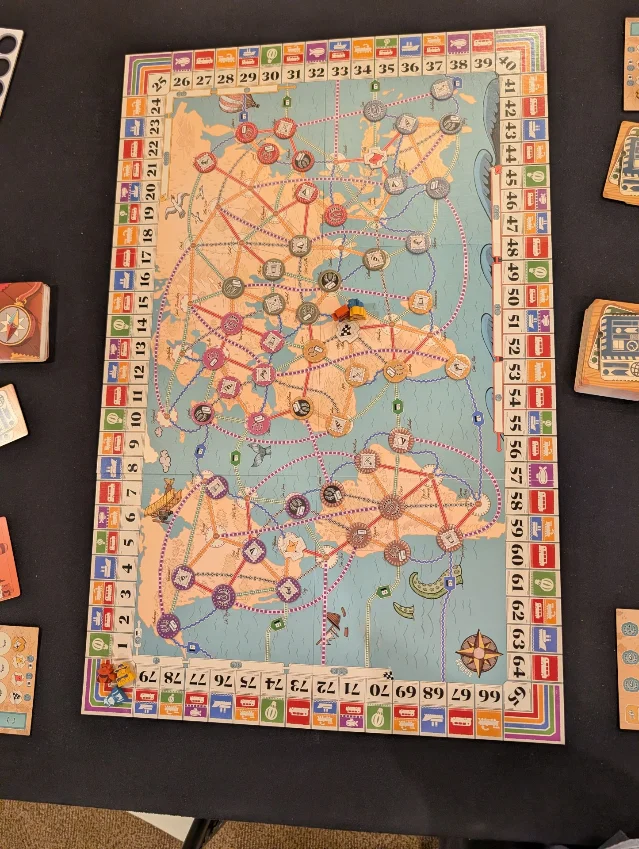
The board is a world map ringed by an 80-day timeline. Each day on the track lists which kinds of transport leave, and that list decides your route. 10
A turn forces at least two actions, and you keep acting until your pawn is the furthest forward on the time track. That is usually two or three actions, and occasionally five. 10
Exploring a location costs a die roll of two to four days. Yu treats that as a feature: nobody can plan beyond the next exploration, so the agonising has nowhere to go. 10
Travel works three ways. The timeline moves you when your transport type departs, a ticket moves you for one day on any day at all, and two tickets buy any transport you like. 10
The two checkpoints open on fixed days, the first no earlier than day 20, and an early arrival pays up to 3 points. Yu stopped stressing about it, because a detour for a 3-point token often pays better. 10
Scoring spreads wide: minus one point per day past 80, 2 points per region, experience tokens at 1, 3 or 9 by set size, souvenirs up to 3 each with row bonuses, and 1 point per objective card. 10
Yu ran his own test of the premise, seeing how fast he could circle the globe. He managed 26 days against a budget of 80, which leaves a lot of room for tourism. 10
His verdict is that it feels less like travel than the other travel games of the autumn, and that he will come back to it. He rates it "I like it", and John P is neutral. 10
What to do with this desk
Dice Throne Nexus closes on 3 November, which leaves three weeks to decide about the SAGAS line. 7
Ares starts shipping its first English Draco Ideas titles in December, and Dark Kingdoms waits on Gamefound fulfilment before it moves. 3
Feuerland's The Danes, a follow-up to A Feast for Odin, was counting down to its Gamefound launch with 24,094 followers at the time of writing. 11
Allplay has Through the Mountains lined up for Kickstarter on 27 October, Reiner Knizia's standalone sequel to Through the Desert. 12
Nature: Climate is the last of the six modules, so the flipped turn order is now the thing to test on the table. 5
References
- 1
- 2
- 3
- 4Is Growth Good?
stonemaiergames.com
- 5Designer Diary - Nature: Climate - Redesigning a Classic
boardgamegeek.com
- 6Designer Diary: Tanglung
boardgamegeek.com
- 7Dice Throne Nexus — Kicktraq project page
kicktraq.com
- 8
- 9Dice Throne Nexus — Kickstarter campaign page
kickstarter.com
- 10Dale Yu: Review of The Amazing Journey
opinionatedgamers.com
- 11The Danes - A Feast for Odin game
gamefound.com
- 12
This story was produced automatically by a channel. One sentence is all it takes for Neodrop to keep producing for you.