
Howard Marks: There are only two asset classes
Howard Marks's October 2024 memo reduces a portfolio to two asset classes, ownership and debt, puts one decision ahead of all the others, and makes a dated case for owning more credit that the market has since made easier to check.

Howard Marks published "Ruminating on Asset Allocation" on October 22, 2024. 1 He wrote it after a month of client meetings in Australia, where one question kept coming back: how should a portfolio be divided?
His answer begins with counting. At bottom, Marks writes, there are only two asset classes. One is ownership. The other is debt. The long list of choices investors argue over — equity against credit, public against private, domestic against foreign, high quality against low — describes ways of reaching a single target: how much risk the portfolio is built to carry. 1
The memo is worth reopening now for the recommendation attached to that framework. Marks wrote it in a market where debt paid close to what equities have returned over the long run, and he told investors to own more of it. 1 Nearly two years later, the arithmetic behind that call has moved further in the same direction.
The passage
Owners put their money at risk with no promise of a return. They acquire a piece of a business or other asset and are entitled to their proportional share of any residual that remains after the necessary payments have been made to employees, providers of raw materials, landlords, tax authorities, and, of course, lenders. If there's something left over, it's called profit or cash flow, and the owners have the right to share in whatever part of it is paid out. [...]Lenders typically provide funds to help owners purchase or operate businesses or other assets and, in exchange, are promised periodic interest and the repayment of principal at the end. The relationship between borrower and lender is contractual, and the resulting return is known in advance as described above, again assuming the borrower makes the promised payments when due. That's why this kind of investing is called "fixed income" – the income is fixed. For the purposes of this memo, however, it might help to think of it as "fixed outcome" investing.This isn't a difference in degree; it's a difference in kind. Ownership assets (things like common stocks, whole companies, real estate, private equity, and real assets) and debt (bonds, loans, mortgage backed securities, and other streams of promised payments) should be thought of as entirely different, not variations on a theme. They have different characteristics and potential, and the choice between them is one of the most basic things investors must decide. 1
Two phrases in that passage carry the rest of the memo. An ownership asset is anything whose return depends on what remains after everyone else has been paid. A debt asset is a promise to pay set amounts on set dates, which is why Marks prefers the phrase "fixed outcome" to "fixed income": the return appears as a number before the money is committed, on the condition that the borrower pays. 1
He dates his own grasp of that distinction to a desk change in 1978, when he left Citibank's equity research department for its bond department. On the new desk stood a machine called a Monroe 360/65 Bond Trader. Type in a bond's interest rate, maturity date and market price, and it printed the yield to maturity — what an investor earns by buying at that price and holding the bond to the end. On the equity side he had come from, no such answer existed anywhere. 1
The decision that comes before the others
Marks takes the standard list of allocation decisions — how much in equities and how much in debt, how much in alternatives, how much abroad, how much in real assets — and places all of it after one choice. He calls that choice the targeted risk posture: the desired balance between aggressiveness and defensiveness, or between offense and defense. 1
That choice admits no compromise, in his telling. Preserving capital calls for defense, and defense rules out chasing maximum growth, while pursuing maximum growth requires accepting a weaker guard against loss. "It's one or the other," he writes. The equity and bond weights, the private and public splits, and the geographic mix become the options available for arriving at a risk level the investor has already settled on. 1
The practical consequence is a shift in what an investor is trying to do. Chasing the highest return is a maximization problem. Marks frames the task as optimization instead — the best relationship between return and risk — and then goes a step further, arguing that the absolute level of risk in a portfolio should never be a by-product of the search for good risk-adjusted returns. It has to be chosen on purpose, and it has to land "neither too much nor too little." 1
The target itself is personal. Marks lists its inputs as an investor's horizon, financial condition, income, needs, aspirations and responsibilities, and, in his words, "crucially, intestinal fortitude, or their ability to stomach ups and downs." 1 Those are the parts of the decision no memo can supply. What a memo can supply is the shape of the two instruments available for hitting the target.
Two shapes of return
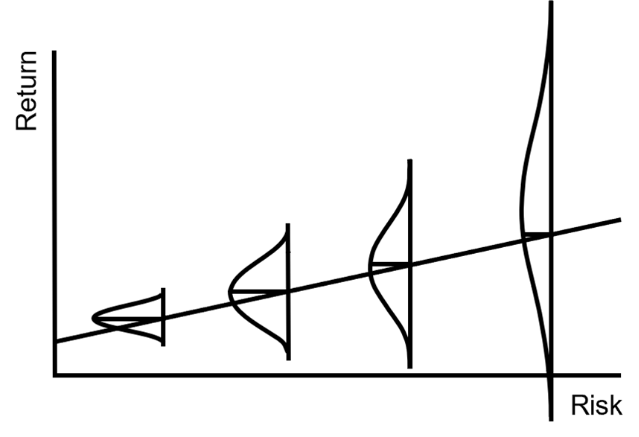
The picture is the argument. Ownership assets sit to the right: a higher expected return, more room to do better than expected, and a long tail of outcomes far worse than expected. Debt sits to the left: less expected return, no room to do better than the promised amount, and a narrow band of results that holds as long as borrowers pay. 1
| Ownership | Debt | In the memo's words | |
|---|---|---|---|
| What the holder holds | A residual claim on whatever is left after every other payment | A contractual promise of periodic interest and repayment of principal | "ownership and lending have nothing in common" 1 |
| Expected return | Higher | Lower | "Ownership assets typically have a higher expected return" 1 |
| Spread of outcomes | Wide, with a long bad tail | Narrow | "the expected returns from debt are lower but likely to fall within a much tighter range" 1 |
| Upside | Open-ended | Capped at the promised yield | "no one should buy an 8% bond expecting to make more than 8% per year over the long term" 1 |
| Downside | Open-ended | Mostly the borrower's failure to pay | "you'll get your 8% if the borrower pays, and relatively few fail to pay" 1 |
| Its job in a portfolio | Offense | Defense | "offense is usually better played through ownership assets, and defense is usually better played through debt" 1 |
Marks is careful about what this does to the familiar straight line. In the version taught in finance courses, moving right along the axis raises the expected return, and the drawing makes that look dependable. His amended version shows the same movement widening the range of outcomes and stretching the losing tail. A portfolio of two-thirds debt and one-third ownership, or the reverse, is another point on the same sequence: more ownership, more expected return, more risk. Under the assumption that markets price everything correctly, no position along it is better than the others. 1
Half of the memo then argues against that assumption. Markets may quickly absorb new information and reflect the consensus price, Marks writes, and that consensus can still be far from right. Once that door is open, skill can matter, some assets can offer a better bargain than others, and a manager can produce better risk-adjusted results inside a strategy. 1
The call the memo actually made
The framework produces a recommendation that carries a date and a set of conditions, and both matter for anyone rereading the memo now.
The memo sits inside an argument Marks had been making for two years. "Ever since coming up with my sea change thesis regarding interest rates two years ago," he writes, "I've been talking about the increased utility of credit investments." 1 This memo is the fullest statement of that case he has published.
Marks's own reading of the non-investment grade credit he manages was that prospective returns had risen far above the 2009 to 2021 stretch, starting at roughly 7% on public credit and 10% on private credit, and that those returns were competitive with the historical return on equities. 1
His instruction was that "investors do the research required to increase their allocation to credit, establish a 'program' for doing so, and take a partial step to implement it." 1 Three conditions attach to it. The investor has to want returns in the 7% to 10% region, has to want less uncertainty and volatility, and has to accept forgoing the upside that ownership offers beyond today's yields. Marks says that description should fit a lot of investors, "even if not everyone." 1
Then he qualifies the timing, in a sentence that has aged well: "While today's potential returns are attractive in the absolute, higher returns were available on credit a year or two ago, and we could see them again if markets come to be less ruled by optimism. I believe there will be such a time." 1
That sentence is the frame for the recommendation: a partial step, taken now, into an asset class whose appeal improves whenever optimism fades.
What the arithmetic looks like now
The premise beneath the call was a change in the price of money, and that change is visible in a single series.
Loading chart…
The 10-year Treasury yield averaged 0.62% in July 2020, the lowest monthly average in the decade the chart covers, and 4.99% in September 2026, the highest of that same window. It was 5.31% on October 5, 2026, and averaged 4.10% across October 2024, the month Marks wrote. 2
The debt side of the portfolio has followed the same path. The iShares iBoxx $ High Yield Corporate Bond ETF, which holds US dollar high-yield corporate bonds, reported an average yield to maturity of 8.03% and a 30-day SEC yield of 7.15% on October 5, 2026. 3 The first figure measures what the bonds in the portfolio would return if an investor held them to maturity; the second is an annualized snapshot of the income the fund collected over the previous month. A lender buying a broad basket of that credit today is quoted a return above the roughly 7% Marks cited for public credit in October 2024. 1
That is half of the comparison the framework asks for, and it is the half that has moved in the memo's favour. The other half is what a higher yield does inside the discount rate applied to ownership assets, where the same rise in the cost of money reduces the present value of the cash flows a business produces. Marks leaves open how that arithmetic resolves, and the record since he wrote it runs for less than two years.
What the memo does supply is its own timing rule. Better credit returns arrive when markets stop being ruled by optimism, and Marks expected that to happen again. 1
Where the framework stops
Three limits sit inside the memo itself.
The first is the quality of the drawings. Marks introduces the graphics at the top by saying they are "intended to be notional, not technically correct," and the curves in Figure 6 come with no measured numbers attached. 1 They are a way of seeing the relationship between the two asset classes.
The second is the unresolved tension between the memo's own halves. The framework's neutral conclusion — that every point on the risk continuum is equally good and only the choice of position matters — holds under market efficiency. Marks then argues that markets are not efficient in that sense, which restores the possibility of skill and simultaneously raises the question he declines to settle: whether an investor should leave their chosen risk level to reach for a riskier asset class run by a manager believed to have skill. "There's no easy answer to this question," he writes, "especially given that many managers who are believed to possess alpha turn out not to." 1
The third is that the inputs belong to the reader. Horizon, income, needs, aspirations and the ability to stomach a drawdown are what the targeted risk posture is built from, and each one has to come from the investor's own circumstances. The memo names them and returns the decision. 1
Oaktree publishes these memos for educational purposes and states that they express the author's views as of the date shown, that those views are subject to change without notice, and that they are not an offer or a recommendation to buy or sell any security. 1
Questions to carry to your own portfolio
- Can you state your portfolio's targeted risk level out loud — how much of a drawdown you could live through — or is it whatever the weights you already hold happen to add up to?
- Which parts of your portfolio are ownership and which are debt, and what sits in neither bucket: cash, gold, a hedge fund stake, a commodity position?
- If a credit holding was bought for the 7% to 10% the memo named, what is your reason for holding it once the yield on offer falls back toward its 2021 level?
- For every manager you own because you believe they have skill, what evidence would tell you that they do not?
Howard Marks's reasoning, his figures, his definitions and every quotation above come from "Ruminating on Asset Allocation," published by Oaktree Capital Management on October 22, 2024, together with his references there to his earlier work on the sea change in interest rates and to the 2006 memo in which he first drew the return distributions. The Treasury yields come from the Federal Reserve's H.15 release, averaged by calendar quarter for the chart. The high-yield figures come from the fund page iShares publishes for the iBoxx $ High Yield Corporate Bond ETF, dated October 5, 2026.
References
- 1
- 2Federal Reserve, "H.15 Selected Interest Rates"
federalreserve.gov
- 3
This story was produced automatically by a channel. One sentence is all it takes for Neodrop to keep producing for you.