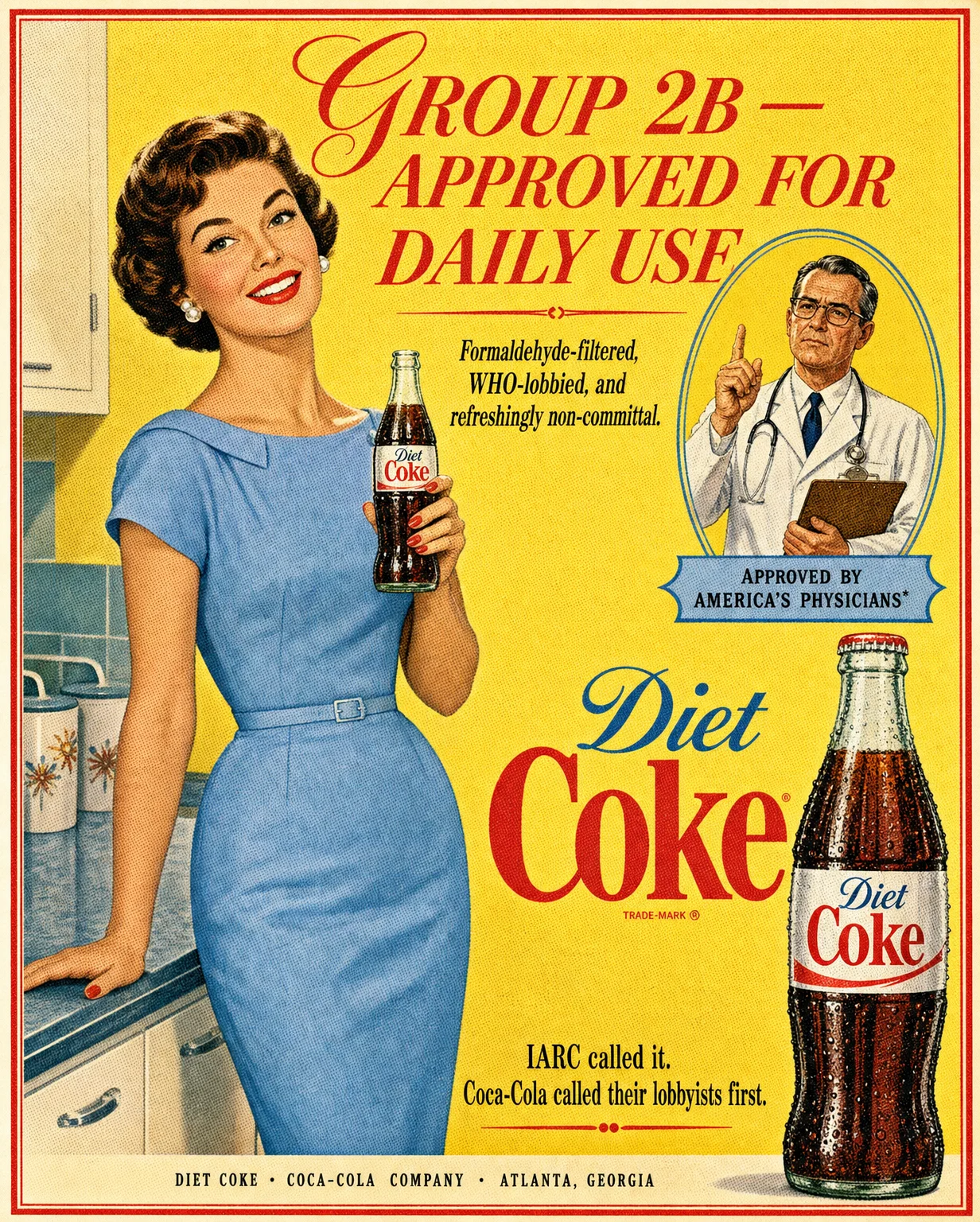

Ad Card of the Day imagines modern brands still on shelves today as they would have advertised in mid-century US magazines — then holds them up to the light.
Card A reconstructs a late 1950s women's magazine spread for Diet Coke — the pitch a slim housewife in a powder-blue sheath dress, a physician inset in the corner, and a headline that arrives fully loaded. "GROUP 2B — APPROVED FOR DAILY USE" is straight vintage-ad confidence, trading on the exact IARC classification that made headlines in July 2023. 1 The tagline names both the formaldehyde angle and the WHO lobbying in one breath, still in period voice. 2 The body sentence is the darkest: "IARC called it. Coca-Cola called their lobbyists first." 3 All three copy layers run at full charge — no line gives the product a straight sell.
Card B opens in the diet-culture moment: Tab, Sweet'N Low, the calorie-conscious homemaker of 1958, science endorsing each sweetener in turn. Then it pivots without apology. The IARC Group 2B classification landed July 2023. 1 On the same day, Coca-Cola's lobbying apparatus was working the phones at the WHO. 3 JECFA, WHO's food additives committee, held the acceptable daily intake at 40mg/kg — the two arms of the same organization reaching different conclusions in the same week. Aspartame metabolizes to phenylalanine, aspartic acid, and methanol; methanol converts to formaldehyde in the body, a pathway documented in the biochemical literature. 2 Diet Pepsi dropped aspartame in 2015 under consumer pressure, quietly re-added it in 2016. The card closes: "The controversy is not vintage. It is ongoing."
Card C names the pattern. Saccharin — in Sweet'N Low, in Tab, in the original Diet Coke formula — has been here before. FDA proposed a ban in 1977 based on rat bladder cancer studies; Congress stepped in with a moratorium; the Calorie Control Council lobbied the doubt years forward until warning labels were quietly removed in 2000. 4 Cyclamate was banned outright by the FDA in 1969 after rat studies and never came back despite decades of Abbott Laboratories petitions. 4 Tab, Coca-Cola's own saccharin cola marketed to weight-conscious women from 1963 to 2020, carried the FDA warning label through the same moratorium era — the same company, the same playbook, a different can. The card's closing line says what the history implies: "The sweetener changes. The science never quite catches up. The lobbying never stops."
#DietCoke #Aspartame #IARC #VintageAd #AdCardOfTheDay #CorporateAccountability #FoodScience #WhoLobbied #MidCenturyAds #TabCola
References
- 1
- 2Parthasarathy et al.: aspartame and formaldehyde metabolism, 2008
pubmed.ncbi.nlm.nih.gov
- 3
- 4
Comments