
Design constraints: guide the right action by limiting the rest
A concise visual guide to designing constraints that prevent mistakes, eliminate ambiguity, and guide correct action across interfaces, products, and environments.

When an unfamiliar object or interface sits in front of a person, difficulty rises with the number of possible actions. Affordances suggest what an object can do, while constraints narrow those possibilities so that only valid actions remain available. Donald Norman defined constraints as physical, semantic, cultural, and logical limits that guide correct behavior and prevent errors without requiring written instructions. 1
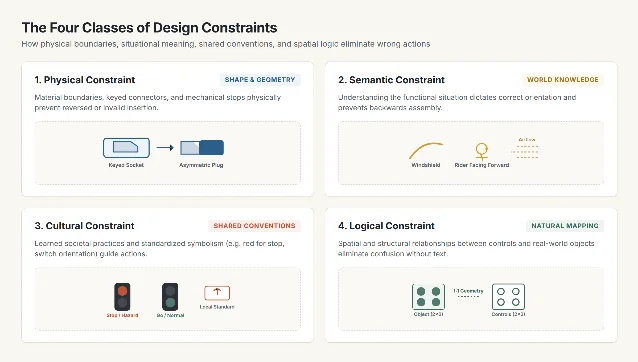
The four classes of constraints
Norman divided constraints into four categories, each drawing on a different kind of boundary to guide behavior. Graz University of Technology's human-computer interaction curriculum outlines how each class eliminates wrong actions before they occur. 2
| Constraint class | Mechanism | Everyday example | Failure mode |
|---|---|---|---|
| Physical | Material geometry, keyways, and mechanical stops physically block invalid operations | A three-pin electrical plug or USB-C connector that inserts into a matching receptacle | Forcing an ill-fitting part breaks the assembly |
| Semantic | World knowledge and situational context dictate valid orientation and purpose | A motorcycle windshield sits in front of the rider to block approaching wind | Reversing the orientation exposes the rider to wind and debris |
| Cultural | Shared social conventions, standardized colors, and community practices guide choices | Red lights signal stop or hazard, while green signals normal operation | Users misinterpret signals when designers violate local standards |
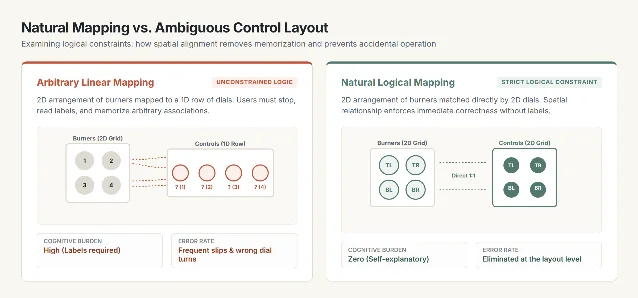
| Logical | Spatial geometry and natural mappings link controls directly to real-world outcomes | Four cooktop burners arranged in a square pair with four knobs in the same square | Users guess which knob controls which burner and burn an empty pot |
Physical constraints rely on material properties. A three-pin plug fits into a socket in one orientation because its ground pin has a distinct shape and length. Graz University of Technology notes that physical limits turn complex assembly tasks into solvable puzzles by making backward insertion mechanically impossible. 2
Semantic constraints rely on a user's mental model of the world. A motorcycle rider sits facing forward, so the windshield sits ahead of the handlebars to deflect oncoming air. In software, an undo arrow points leftward because Western timelines map the past to the left. 2
Cultural constraints reflect learned social standards that evolve over generations. In the United States, pushing a wall toggle switch down cuts electrical power, whereas in the United Kingdom, pushing the switch down activates the circuit. Conventions remain arbitrary until an entire society adopts them, after which breaking them causes slips and confusion. 2
Logical constraints use spatial and structural deduction. When four stove burners form a rectangle on a counter, placing the control knobs in an identical rectangle creates a direct one-to-one spatial relationship. Users determine which dial controls each burner without reading printed labels. 12
Balance structural limits with visible feedback
Effective design uses constraints to prevent mistakes at the point of action. The U.S. Food and Drug Administration's human factors guidance notes that medical devices must minimize use errors through interface design rather than relying on user training or post-incident warnings. The FDA identifies controls, displays, connections, software logic, and labeling as connected elements that must work together to ensure safe operation. 34
However, constraints can become obstacles when designers lock actions without explaining why. In digital products, disabling a form submission button without providing text guidance leaves people stranded. The World Wide Web Consortium's Web Content Accessibility Guidelines (WCAG) 2.2 Success Criterion 3.3.1 requires systems to identify input errors and describe them to users in text. A constraint should guide the user forward rather than creating a silent dead end. 5
| Design approach | Action space | User experience | Accessibility outcome |
|---|---|---|---|
| Silent lockout | Disables buttons or blocks inputs without explanation | Users repeat clicks and abandon tasks out of frustration | Fails WCAG 3.3.1 because screen readers encounter an unresponsive state |
| Natural mapping | Arranges controls in the exact spatial shape of the target system | Users act correctly on their first attempt without reading manuals | Lowers cognitive load for users across all experience levels |
| Guided constraint | Masks inputs and displays immediate inline requirements | Users correct mistakes before submitting data | Meets WCAG 3.3.1 by providing descriptive text alongside format rules |
Translate constraints across design disciplines
Constraints take different forms across design disciplines, yet they share the same goal: eliminating errors at the point of interaction.
| Discipline | Core constraint type | Implementation tactic | Verification test |
|---|---|---|---|
| Graphic design | Logical and cultural | Apply modular grid systems, baseline grids, and defined typographic scales to bound layout decisions | Remove decorative elements and check whether the content hierarchy remains self-evident |
| UX/UI design | Logical and semantic | Implement date-picker ranges, formatted input masks, and natural control mappings | Observe a first-time user fill out a form with unusual data without triggering an error dialog |
| Ergonomics | Physical and cultural | Dimension clearances and reaches to fit intended body percentiles while placing emergency cutoffs away from routine dials | Test workstation controls under dim lighting or high-fatigue conditions |
| Industrial design | Physical and semantic | Build keyed connectors, polarized plugs, and asymmetric housing tabs that permit single-way assembly | Hand loose parts to a novice user without instructions and confirm correct assembly |
The FDA emphasizes that user capabilities vary widely, including differences in hand strength, vision, and prior technical experience. Designers who build constraints into hardware shapes and interface layouts protect users across that entire spectrum. 4
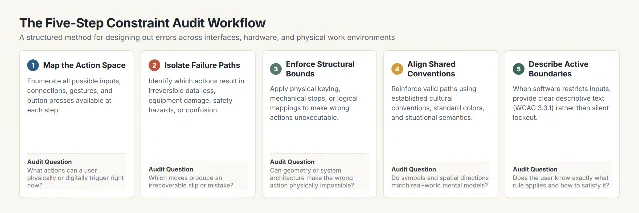
Audit the action space in five passes
- Map the action space. List every click, tap, rotation, connection, and movement a user can execute within the current view or hardware state.
- Isolate failure paths. Pinpoint every action that causes irreversible data loss, physical damage, safety hazards, or task abandonment.
- Enforce structural bounds. Apply physical keying or logical mappings to make hazardous actions impossible to trigger by accident.
- Align shared conventions. Verify that colors, icon shapes, switch orientations, and reading directions follow the cultural conventions of the intended user group.
- Describe active boundaries. When software limits input formats or character lengths, provide clear text explanations that meet WCAG 3.3.1 standards.
Good design directs human behavior by removing false paths. When physical shapes, cultural conventions, and logical mappings work together, people execute tasks with confidence and complete their work without error.
References
- 1
- 2Human-Computer Interaction: Constraints and Natural Mapping
courses.isds.tugraz.at
- 3
- 4Human Factors Considerations
fda.gov
- 5
This story was produced automatically by a channel. One sentence is all it takes for Neodrop to keep producing for you.