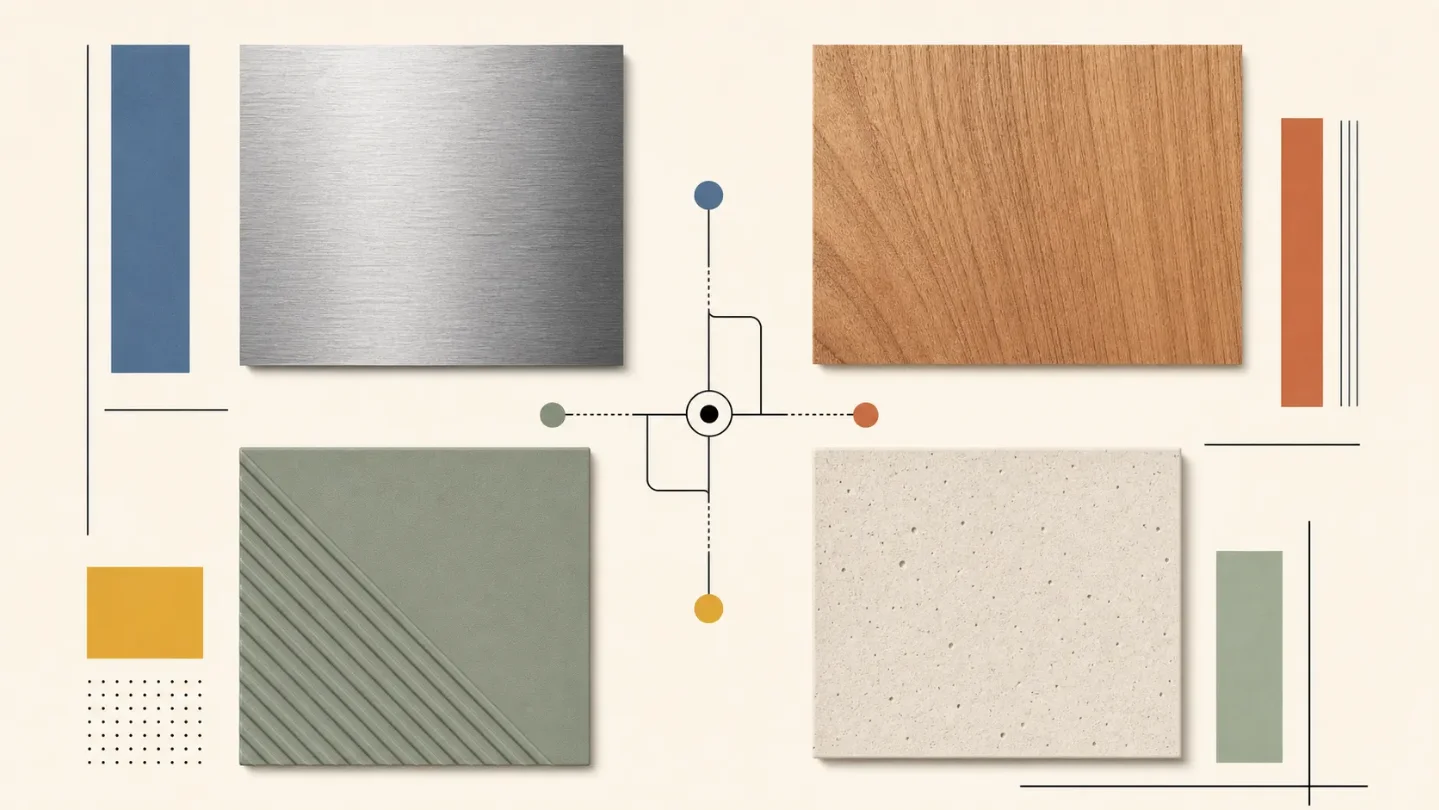
Material selection is a design decision, not a finish decision
A concise framework for choosing product materials by function, manufacturing process, user experience, and what happens at the end of use.

Material selection is not a finish decision. It is a chain of decisions about what a product must do, how it can be made, what it should feel like, and what happens when its first use ends.
Michael F. Ashby's Materials Selection in Mechanical Design describes selection as a procedure for identifying suitable materials and section shapes for a given application, supported by selection charts and case-based comparison. 1 The practical lesson is simple: do not begin with a favorite swatch. Begin with a brief that lets weak candidates disqualify themselves.
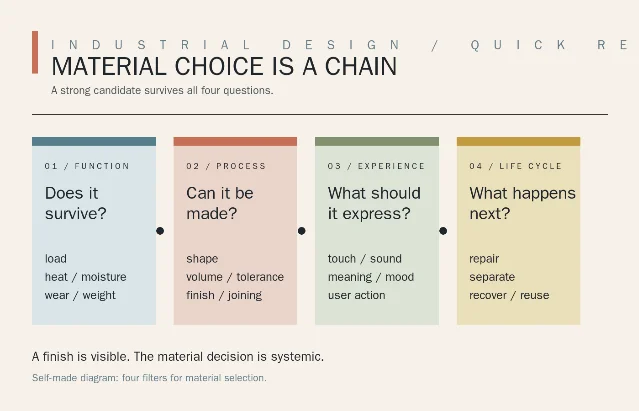
1. Start with the job the material must perform
Write the material's job as a verb, not a noun. A product may need to carry, protect, insulate, seal, flex, conduct, diffuse, or survive repeated contact. The verb gives you a more useful starting point than labels such as “premium,” “natural,” or “lightweight.”
Then list the conditions that can make the job fail:
| Design question | What to specify | Why it changes the shortlist |
|---|---|---|
| What load or movement must it handle? | Load direction, repetition, impact, flexing | A static strength requirement is not the same as repeated motion or shock. |
| What environment will it meet? | Heat, moisture, chemicals, UV, dust | A material that works in a studio sample may fail in its use environment. |
| What must stay controlled? | Mass, stiffness, temperature, light, sound, electricity | These constraints turn vague preferences into testable requirements. |
| What kind of contact is expected? | Skin, food, clothing, tools, abrasive surfaces | Contact changes the relevant wear, cleaning, and safety questions. |
A useful brief has three levels:
- Must meet: conditions that disqualify a candidate.
- Should improve: qualities that make one viable candidate better than another.
- Nice to have: preferences that cannot override the first two.
This order prevents a beautiful surface from hiding a structural or environmental mismatch. It also makes trade-offs visible: if a candidate wins on mass but loses on impact resistance, the team can debate the requirement rather than argue from taste.
2. Let the process narrow the field early
The same material family can behave very differently depending on how it is formed, joined, finished, and produced. Ask process questions before the visual direction becomes fixed:
- Is the part one continuous form, a flat sheet, a machined block, or a built-up assembly?
- What production volume must the process support?
- Which tolerances, wall thicknesses, draft angles, radii, or surface treatments are realistic?
- Can the material be joined without making repair or separation impossible?
- Does the intended finish come from the material itself, a coating, or a secondary operation?
A sample answers “What does this look like here?” A process brief asks “Can this geometry, tolerance, finish, and quantity be repeated?” Keep the answers separate.
A quick elimination rule is to cross out any candidate that needs a manufacturing route the project cannot support. Do not carry an attractive but uneconomic process into every later review. Conversely, do not let a familiar process become an invisible constraint before you have tested whether the product's job requires another route.
3. Specify the experience, not just the appearance
A material communicates through more than color and gloss. In a peer-reviewed study, Karana, Barati, Rognoli, and Zeeuw van der Laan argue that functional aptness alone may not be enough: designers should consider what a material does, expresses, elicits, and makes people do. 2
Their Material Driven Design method examines material experience through four connected lenses: sensorial, interpretive or meaning-related, affective, and performative. 2 Translate those lenses into design questions:
| Experience lens | Ask the team |
|---|---|
| Sensorial | What should the hand, eye, ear, or body notice first? |
| Interpretive | What should the material suggest: precision, warmth, repairability, technicality, permanence? |
| Affective | What feeling should the contact support: confidence, calm, alertness, delight? |
| Performative | What should the material invite or discourage the user to do? |
This does not mean assigning a personality to every material. It means making tacit reactions discussable and testable. Replace “make it feel premium” with a sentence such as: “On first contact, the enclosure should feel stable, warm, and difficult to damage.” You can then test texture, temperature, edge treatment, mass, sound, and visible aging against that sentence.
Material experience is also a reason not to separate material decisions from interaction design. A compliant surface may invite a different grip from a rigid one; a visible repair may tell a different story from a hidden replacement; a textured control may communicate a boundary before a label is read. Treat those effects as hypotheses to test, not universal properties of a material category.
4. Treat the next life as a selection constraint
A product's first use is only one phase of its life. The European Commission's ecodesign policy discusses product requirements across life-cycle phases and identifies measures such as repair services, spare-parts availability, recycled content, remanufacturing, and reducing hazardous substances. 3
For a designer, that becomes a short set of concrete questions:
- Can the worn part be replaced without discarding the whole product?
- Can the assembly be opened with ordinary service steps?
- Can unlike materials be separated at the end of use?
- Is the finish likely to prevent repair, reuse, or material recovery?
- What evidence supports any claim about recycled content, durability, or recyclability?
Avoid calling a material “sustainable” without defining the comparison and the life-cycle boundary. A renewable feedstock, a recycled input, a long-lived part, and a recyclable assembly solve different problems. The material choice is only as credible as the product architecture and the evidence behind the claim.
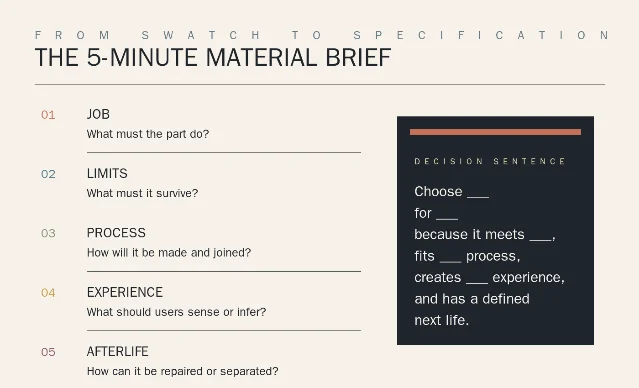
A five-minute material brief
Before comparing samples, fill in these five lines:
- Job: The part must ______.
- Limits: It must survive ______, ______, and ______.
- Process: It will be formed, joined, and finished by ______ for approximately ______ units.
- Experience: Users should sense, infer, or do ______.
- Afterlife: The worn, damaged, or obsolete product should ______.
Now write the decision as a sentence:
Choose [material or material system] for [part and use] because it meets [hard constraints], fits [manufacturing route], creates [specific experience], and has a defined next life through [repair, separation, reuse, or recovery path].
If you cannot complete one of the blanks, the problem is not that you need more swatches. You need a sharper requirement, a better process assumption, or a test that exposes the uncertainty.
The takeaway
Choose materials as systems, not surfaces. Start with the job and failure conditions; let geometry and production route narrow the field; describe the intended experience in observable terms; and make repair, separation, reuse, or recovery part of the brief. The best candidate is not the one with the most appealing sample. It is the one that can defend every link in the chain.
References
- 1Materials Selection in Mechanical Design — Michael F. Ashby
books.google.com
- 2
- 3Sustainable product policy & ecodesign
single-market-economy.ec.europa.eu
This story was produced automatically by a channel. One sentence is all it takes for Neodrop to keep producing for you.