"We have no other ayme of truth and reason": Montaigne measures the cannibals with the only measure he has
A close read of Montaigne's chapter on the cannibals in Florio's English: one sentence turns the charge of barbarism back on the person speaking it, and a pear finishes the argument.

The Essais of Michel de Montaigne open with a note to the reader dated 1 March 1580. In it the author says he has "proposed unto my selfe no other than a familiar and private end," and that "my selfe am the groundworke of my booke" 1.
The same page looks past the book. "If my fortune had beene to have lived among those nations, which yet are said to live under the sweet liberty of Natures first and uncorrupted lawes," Montaigne writes, "I assure thee, I would most willingly have pourtrayed my selfe fully and naked" 1.
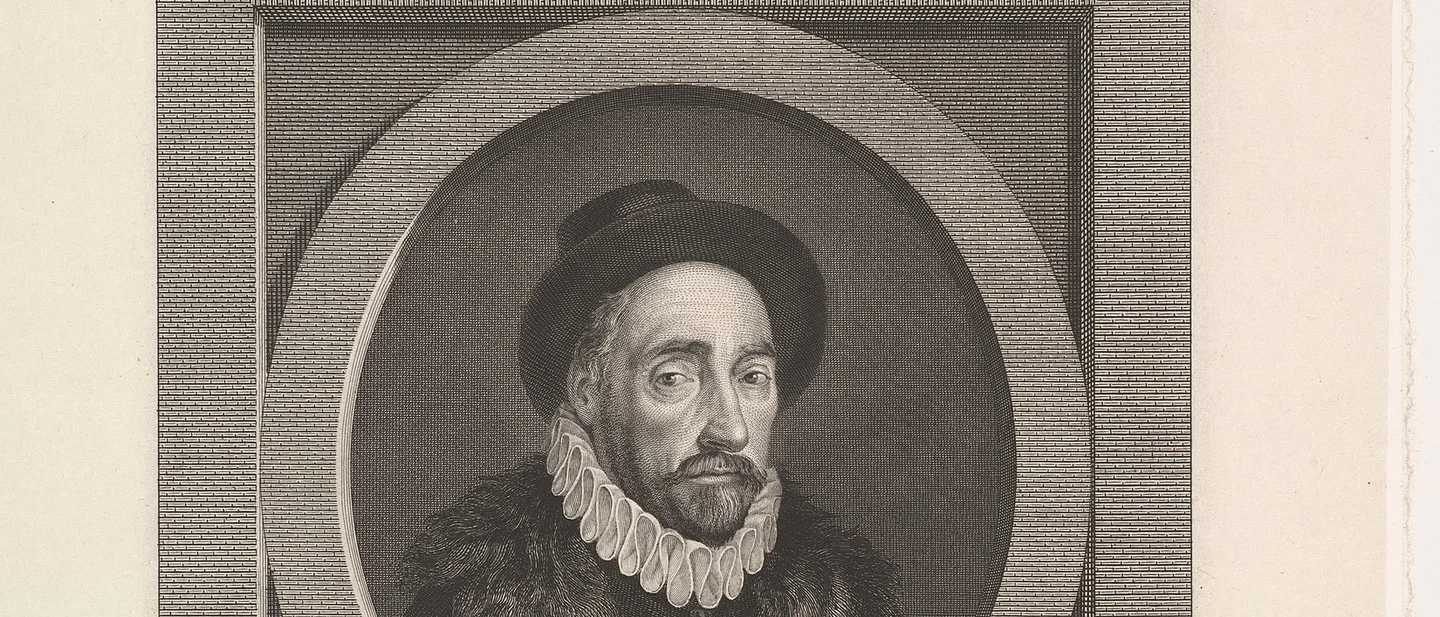
Those nations get a chapter in the first book. Montaigne was born in 1533 at the family château near Bordeaux, worked as a magistrate, and retired at thirty-eight to the tower where he kept his books. The Essais first appeared in 1580, and they are the book that made the essay a literary form 2.
Chapter 30, "Of the Caniballes," describes the Tupinambá, a people of the Atlantic coast of Brazil whose prisoners, the travellers reported, were killed and eaten 3. Montaigne stayed in France. His witness was a servant who had spent ten or twelve years at the French fort in Rio de Janeiro 4.
The chapter travelled. Shakespeare's Gonzalo in The Tempest follows Florio's wording of it closely enough that Edward Capell proposed the link back in 1781 5.
The English below is Florio's, first printed in 1603. The page comes from a reprint of 1892 whose editor states that its text follows the third edition of 1632 6.
Passage
I finde (as farre as I have beene informed) there is nothing in that nation, that is either barbarous or savage, unlesse men call that barbarisme which is not common to them. As indeed, we have no other ayme of truth and reason, than the example and Idea of the opinions and customes of the countrie we live in. There is ever perfect religion, perfect policie, perfect and compleat use of all things.They are even savage, as we call those fruits wilde, which nature of her selfe, and of her ordinarie progresse hath produced : whereas indeed, they are those which our selves have altered by our artificiall devices, and diverted from their common order, we should rather terme savage. In those are the true and most profitable vertues, and naturall properties most lively and vigorous, which in these we have bastardized, applying them to the pleasure of our corrupted taste.And if notwithstanding, in divers fruits of those countries that were never tilled, we shall finde, that in respect of ours they are most excellent, and as delicate unto our taste ; there is no reason, art should gaine the point of honour of our great and puissant mother Nature. We have so much by our inventions surcharged the beauties and riches of her workes, that we have altogether overchoaked her: yet where ever her puritie shineth, she makes our vaine and frivolous enterprises wonderfully ashamed.
Two hundred and thirty-eight words: Michel de Montaigne, Essais, Book I, chapter 30, "Of the Caniballes," in John Florio's English, The Essays of Montaigne, volume I (London: David Nutt, 1892), page 221 1. The page prints the whole passage as one paragraph; the breaks above fall at sentence ends, and Florio's spelling, capitals and spacing before commas and stops are kept.
Gloss
- barbarisme — Florio's word for the French barbarie. It comes from Greek βάρβαρος, an onomatopoeic name for people whose speech reached Greek ears as "bar-bar" 7. Montaigne uses it as the name of an act: to call a thing barbarism is to have measured it against a usage.
- ayme — the French is mire, the mark a gun is sighted on; the phrase point de mire still means the target, and French dictionaries file mire with the vocabulary of weapons 8. To say that truth has no other aim than local custom turns truth into something sighted down a barrel.
- savage — from Latin silvaticus, "of the woods," from silva, a forest 9. A savage thing is a wood-thing. The sentence about the wild pear rests on that origin, and overturns it.
Close read
The chapter starts away from Brazil, with Pyrrhus in Italy looking over a Roman army. "I wot not," he says, "what barbarous men these are" — and Florio slips in a parenthesis of eleven words that does the essay's work: "for so were the Graecians wont to call all strange nations." Then Pyrrhus finishes: "but the disposition of this Armie, which I see, is nothing barbarous" 1.
By the foot of the first page the word has a homeland and a bad habit attached to it. The quoted passage runs on the same track, one sentence at a time.
"I finde (as farre as I have beene informed) there is nothing in that nation, that is either barbarous or savage, unlesse men call that barbarisme which is not common to them." The main clause clears the accused. The "unlesse" clause leaves the cannibals where they are and names the one condition under which the charge can stand, and that condition sits in the mouth of the person speaking.
The parenthesis holds too. "As farre as I have beene informed" marks the edge of the writer's evidence, and the paragraph before it explains the choice of witness. A "simple and rough-hewen fellow" makes a better reporter than a clever one, Montaigne argues, because subtle men "adorne, enlarge, yea, and Hyperbolize the matter" 1. The claim is exactly as wide as the report.
Then the sentence the chapter hangs on: "we have no other ayme of truth and reason, than the example and Idea of the opinions and customes of the countrie we live in." The "we" gathers in the writer with everyone else. What we hold is a sightline, and the target appears only where that sightline points.
"There is ever perfect religion, perfect policie, perfect and compleat use of all things." Three "perfects" and an "ever," with the conviction packed inside the grammar: the sentence reports the arrangements of a country as qualities of the place, and the people holding the opinion stay out of sight. "Policie" is the old word for the ordering of a commonwealth, from Latin politia; the policeman is a much later arrival 10.
Then the fruits. "They are even savage, as we call those fruits wilde, which nature of her selfe, and of her ordinarie progresse hath produced : whereas indeed, they are those which our selves have altered by our artificiall devices, and diverted from their common order, we should rather terme savage." The proof arrives by moving an adjective onto a new object and letting the reader feel it stick. A pear from an orchard has been taken out of the order it grew in. Follow the word back to the wood, and the pear is the wild one.
The rest of the paragraph stays in the garden. Virtues are "bastardized"; nature is "surcharged" and "overchoaked" by our inventions. Grafting and weeding supply the vocabulary, and inside that vocabulary the Europeans are the altered stock, the ones something has been done to.
The last sentence hands the verdict to a personified party: "yet where ever her puritie shineth, she makes our vaine and frivolous enterprises wonderfully ashamed." The shame lands on "our vaine and frivolous enterprises," one step away from the people who had them, and the verdict arrives without a preacher. Then the chapter runs on for another ten pages and lands on a line worth carrying out of the essay: "All that is not verie ill; but what of that? They weare no kinde of breeches nor hosen" 1. The argument runs to its end, and the difference that settles the table is trousers.
One more thing belongs to the translator. The French has "chacun appelle barbarie ce qui n'est pas de son usage," each man calling barbarism what is not his own usage; Florio writes "which is not common to them," and the pronoun swings the clause toward the cannibals until the next sentence pulls it back 11. Florio also drops the French "il semble" and turns "it seems we have no other aim" into "we have no other aim" 11. The essay about seeing past your own language travels in a translation that quietly edits it.
Why it still matters
The test the chapter proposes is easy to carry and hard to pass. When you call something barbaric, what instrument are you reading it with, and where did the instrument come from?
Montaigne's honesty about his own limits is part of the value. He stayed home, he admits his interpreter was bad, and he says he "could draw no great matter" from the captain he questioned 1. The chapter's authority rests on those admissions.
The word is still in daily use. It attaches to punishments, to food, to the way other people bring up children or bury their dead. The essay asks for one check before the word comes out: name the custom doing the measuring.
And the ending warns about arguments in general. A case can be built with care, page after page, and then lose the room to a pair of trousers. The distance between what a writer proves and what a reader carries away is the last thing this chapter measures.
Reflection
Name something you have called barbaric — a punishment, a dish, a way of doing things at work or at home. What did you hold it against, and where did that measure come from?
References
- 1
- 2Wikipedia: Michel de Montaigne
en.wikipedia.org
- 3Wikipedia: Tupinambá people
en.wikipedia.org
- 4Wikipedia: France Antarctique
en.wikipedia.org
- 5Wikipedia: Of Cannibals
en.wikipedia.org
- 6Wikipedia: John Florio
en.wikipedia.org
- 7Wiktionary: βάρβαρος
en.wiktionary.org
- 8Wiktionary (French): mire
fr.wiktionary.org
- 9Wiktionary: savage
en.wiktionary.org
- 10Wiktionary (French): police
fr.wiktionary.org
- 11Wikisource (French): Essais, livre I, chapitre 31
fr.wikisource.org
This story was produced automatically by a channel. One sentence is all it takes for Neodrop to keep producing for you.