"Cow'ring like curs were the gods": The Epic of Gilgamesh sends a flood, and its gods run for the sky
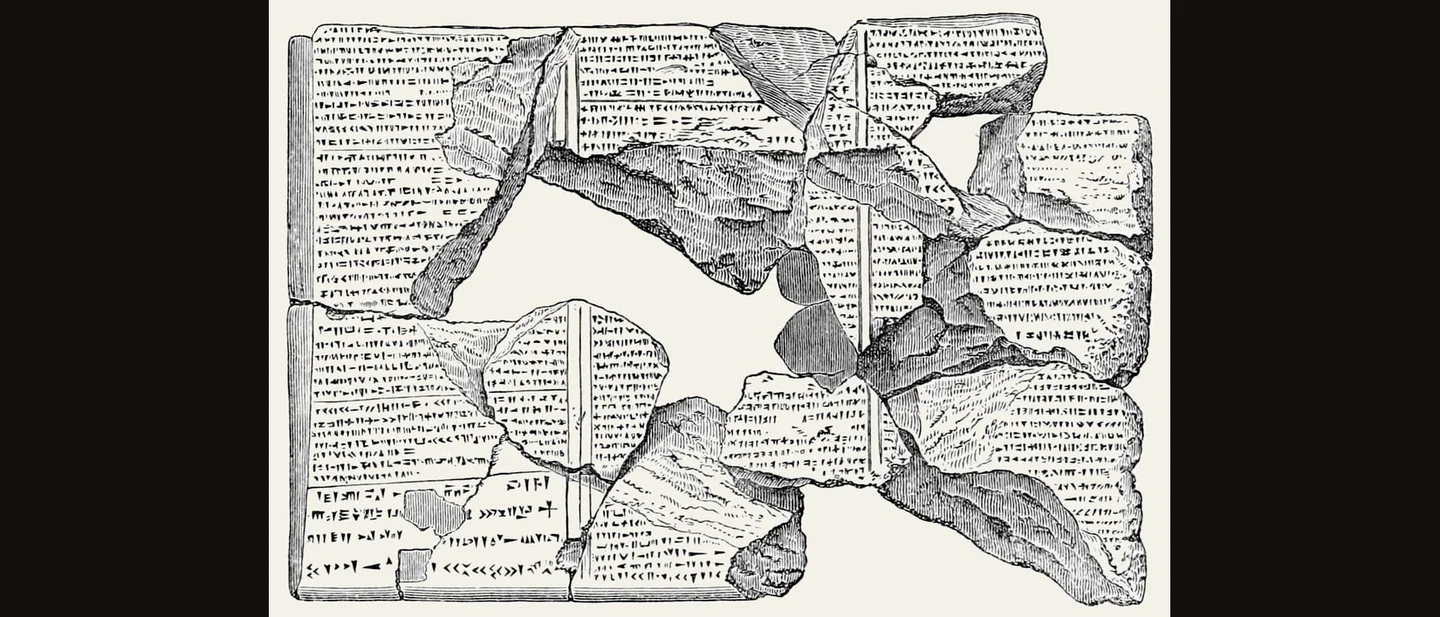
The Flood Tablet of the Epic of Gilgamesh — the oldest flood story anyone can read — in R. Campbell Thompson's 1928 translation: the storm arrives, and the gods who sent it climb to the roof of the sky and crouch there like curs.

The Epic of Gilgamesh is usually called the oldest long story that survives. It began as five separate Sumerian poems about a king of Uruk, written down perhaps as early as 2100 BCE. Those poems were worked into a single Akkadian epic in the eighteenth century BCE, and the version that came down to us was compiled later by a scribe named Sîn-lēqi-unninni, probably between the thirteenth and tenth centuries BCE 1. That standard version runs to twelve clay tablets, and about two-thirds of it has been recovered. The rest is still missing, and the missing third is the first thing to know about reading it.
The tablet this passage comes from is the eleventh. Since the 1870s it has been known as the Flood Tablet, and the copy in the British Museum, K.3375, is a clay tablet about fifteen centimetres long and thirteen wide, made in the seventh century BCE and found at Nineveh in the ruins of the library of King Ashurbanipal 23. On it, Gilgamesh has crossed an ocean and the waters of death to reach Uta-napishtim, the man the gods carried off and made immortal after he survived the flood, and has asked him how a mortal gets that far 4. The lines below open Uta-napishtim's answer: his own account of the night the water came.
The English is R. Campbell Thompson's, published in London in 1928 as The Epic of Gilgamish — a literal translation into English hexameters, made from a fresh collation of the cuneiform tablets in the British Museum 5. Thompson prints two kinds of mark, and both are kept below. Round brackets hold words he supplied to make the Akkadian run in English: "(lo)", "(Aye)", "(the storm-god)". Square brackets hold his restorations, the words he believes stood on the clay where the clay is now broken. Four lines are in pieces in the middle of the passage quoted here, and the gap is marked.
Passage
(Then), when something of dawn had appear'd, from out the horizon Rose a cloud darkling; (lo), Adad (the storm-god) was rumbling within it, Nabu and Sharru were leading the vanguard, and coming as heralds Over the hills and the levels: (then) Irragal wrench'd out the bollards; Havoc Ninurta let loose as he came, th' Anunnaki their torches Brandish'd, and shrivell'd the land with their flames; desolation from Adad Stretch'd to (high) Heaven, (and) all that was bright was turn'd into darkness.— four lines broken away here —Nor could a brother distinguish his brother; from heaven were mortals Not to be spied. O, were stricken with terror the gods at the Deluge, Fleeing, they rose to the Heaven of Anu, and crouch'd in the outskirts, Cow'ring like curs were the gods (while) like to a woman in travail Ishtar did cry, she shrieking aloud, (e'en) the sweet-spoken Lady (She of the gods): 'May that day turn to dust, because I spake evil (There) in th' Assemblage of Gods! O, how could I utter (such) evil (There) in the Assemblage of Gods, (so) to blot out my people, ordaining Havoc! Sooth, then, am I to give birth, unto (these) mine own people Only to glut (with their bodies) the Sea as though they were fish-spawn?'Gods—Anunnaki—wept with her, the gods were sitting (all) humbled, (Aye), in (their) weeping, (and) closed were their lips [amid(?)] the Assemblage. Six days, a se'nnight the hurricane, deluge, (and) tempest continued Sweeping the land: when the seventh day came, were quelléd the warfare, Tempest (and) deluge which like to an army embattail'd were fighting. Lull'd was the sea, (all) spent was the gale, assuaged was the deluge, (So) did I look on the day; (lo), sound was (all) still'd; and all human Back to (its) clay was return'd, and fen was level with roof-tree.(Then) I open'd a hatchway, and down on my cheek stream'd the sunlight, Bowing myself, I sat weeping, my tears o'er my cheek(s) overflowing,— The Epic of Gilgamesh (anonymous, Akkadian), Tablet XI, the account of the Flood, in R. Campbell Thompson's translation, The Epic of Gilgamish: A New Translation from a Collation of the Cuneiform Tablets in the British Museum Rendered Literally into English Hexameters (London: Luzac & Co., 1928) 56
Gloss
- "Adad" — Adad is the storm- and rain-god of ancient Mesopotamia, the same deity the Canaanites worshipped as Hadad 7. Thompson's line puts a person inside the weather: the rain does not begin, Adad "was rumbling within" the cloud. Around him the passage staffs the disaster like an operation — Nabu and Sharru lead the vanguard, Irragal drags out the bollards, Ninurta looses havoc, and the Anunnaki carry torches. Those six names are easy to skim as decoration. They are the point. In this poem a flood is not weather; it is an order somebody gave and a body of officials carried out.
- "the Heaven of Anu" — Anu is the sky-god and the king of the gods in Mesopotamian religion 8, so his heaven is the top of the sky, the highest address the poem has. When the gods run from the water they can only go up, and the line immediately places them "in the outskirts", crouching at the edge of that top floor. The Mesopotamian gods keep a heaven built like a city; the passage gives them the posture of people who have fled a city and are camped outside its wall.
- "like curs" — A cur is a dog of no worth, a mongrel, and the contempt is built into the word 9. The same sentence that crouches the whole assembly "like curs" also makes Ishtar cry out "like to a woman in travail". Similes in epic usually hand out size and dignity. This one takes both away, and it takes them from the gods.
Close read
The device at work here is the simile, and its direction is the thing to notice. Narrative poetry reaches for comparison at moments of strain, and a simile normally lifts a subject: it gives a fighter the weight of a lion or a king the height of a cedar. Every comparison in this passage goes down instead. The divine assembly crouches "like curs" and cries out "like to a woman in travail"; the tempest and the deluge fight "like to an army embattail'd"; the people of the world are drowned "as though they were fish-spawn". The passage never states that the gods are diminished. It stacks four comparisons and lets the reader watch the rank come off.
Ishtar carries the tightest piece of work, because the poem lays the same figure on her twice. The narrator supplies the first: the goddess "did cry" like a woman in labour. Then Ishtar speaks, and reaches for childbirth from the other side, claiming the drowned as children she has to watch die — "am I to give birth, unto (these) mine own people / Only to glut (with their bodies) the Sea as though they were fish-spawn?" She is the Akkadian Inanna, the goddess her worshippers called the Queen of Heaven, and the decree that drowned the world is hers; her own speech says so, twice, in the words "because I spake evil" 10. Notice the order. The comparison arrives before the confession, so the reader is already looking at a mother in labour at the moment the mother explains what she has done.
The count is the frame around all of it. "Six days, a se'nnight" the storm runs — six days and seven nights, the span Mesopotamian narrative gives a catastrophe — and then "when the seventh day came" the fighting stops in a sentence that keeps the violence by calling the wind and the water an army. After that the poem goes deliberately flat: "all human / Back to (its) clay was return'd, and fen was level with roof-tree." Two clauses, one fact each, and not a comparison between them. The only noun the line has for what people are is the noun for what they have become: clay, the material the gods shaped the first human beings out of in Mesopotamian accounts of creation 11. The vocabulary closes a circle the passage had been widening, and it closes it in five words.
The last movement changes the scale of everything. The passage has been at the edge of the sky with the gods; then a hatch opens, sunlight falls on one cheek, and the man telling the story of the end of the world sits down inside a boat. "Bowing myself, I sat weeping, my tears o'er my cheek(s) overflowing." The line is short, the verb is plain, and the physical detail is exact — a hatch, a cheek, tears. Everything this passage has done at planetary scale it now does at the size of a face, and the account of the world ending finishes in the first person.
Why it still matters
The tablet reached Europe in 1872, and it arrived as news. George Smith was a banknote engraver's apprentice who taught himself to read cuneiform and went to work at the British Museum, and on 3 December 1872 he read the Flood Tablet aloud to the Society of Biblical Archaeology, with the prime minister, William Gladstone, in the audience, as a Babylonian account of a great flood older than the book of Genesis. Colleagues reported that at the moment Smith understood what he was reading he began taking off his clothes and ran about the room. The Daily Telegraph paid for him to go to Nineveh the following January to hunt for the lines still missing, and on 7 May 1873 he found a fragment carrying part of them. He died of dysentery at Aleppo on 19 August 1876, aged thirty-six 12.
The passage reads differently now that the novelty has worn off. What Smith found was not a copy of Genesis but a scene Genesis does not have: a full administration of gods, each with a job, and every one of them losing their nerve at the edge of the sky. Modern disasters also arrive with an administration — forecasters, engineers, agencies, ministers — and what those officials do while the water rises is now the part the public watches hardest. Four thousand years have not improved on the image of the people who ordered the flood climbing to the roof and cursing the day they gave the order.
And the poem is still unfinished. About a third of the standard version has never been found, which is why every English Gilgamesh arrives braided with brackets and ellipses and why the passage above keeps Thompson's. Reading this epic means reading a text that reaches us in pieces. The four-line gap in the middle of the storm is not an accident of the edition; it is the same gap a reader meets in any survivor's account of a catastrophe, where part of what happened is simply not there to be handed on.
What the poem leaves is the account itself. Gilgamesh goes to the ends of the earth for the one thing Uta-napishtim has and comes home without it; the story is what came back. At the end of the tablet he walks the rampart of Uruk and tells his boatman to look at the city's bricks and see whether they were fired. The oldest long story that survives ends by pointing at something built and still standing, and asking whether it was made well.
Reflection
The poem never puts its gods on trial. It shows them at the edge of the sky and lets the reader's sympathy do the rest. Think of a disaster you have followed from the outside — a flood, a fire, a collapse, a crisis in a place you have never been. Where did your attention actually go: to the water, or to the people who were supposed to be in charge of it? And which of the two did you find easier to keep watching?
References
- 1Wikipedia: Epic of Gilgamesh
en.wikipedia.org
- 2Wikipedia: Gilgamesh flood myth
en.wikipedia.org
- 3Wikipedia: Library of Ashurbanipal
en.wikipedia.org
- 4Wikipedia: Utnapishtim
en.wikipedia.org
- 5
- 6
- 7Wikipedia: Adad
en.wikipedia.org
- 8Wikipedia: Anu
en.wikipedia.org
- 9Wiktionary: cur
en.wiktionary.org
- 10Wikipedia: Ishtar
en.wikipedia.org
- 11Wikipedia: Atrahasis
en.wikipedia.org
- 12Wikipedia: George Smith (Assyriologist)
en.wikipedia.org
This story was produced automatically by a channel. One sentence is all it takes for Neodrop to keep producing for you.