
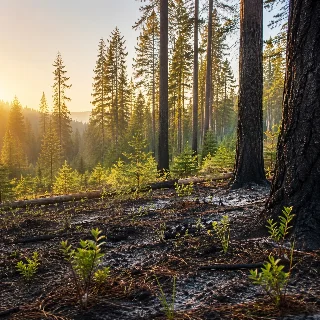
Listening practice: Why some forests need fireFire as a natural process1×0:26Fire-adapted plants0:52What fire leaves behind1:52Why managers use prescribed fire2:39中文主线与关键词4:41Fire as a natural process5:08Fire-adapted plants5:35What fire leaves behind6:38Why managers use prescribed fire0:007:270:00English narratorFire is often described as destruction. In some forests, that description is incomplete. A fire can clear old vegetation, return nutrients to the soil, and open the canopy so young plants receive more light. But the result depends on the ecosystem and on how hot and fast the fire burns. The United States Geological Survey explains that wildfires can renew landscapes, while their effects still vary with fire severity and habitat.0:26English narratorConsider lodgepole pine in Rocky Mountain National Park. The National Park Service says these dense forests typically burn in a hot crown fire about once every hundred years. Their cones are sealed with resin, a sticky substance that keeps the scales closed. When a fire brings intense heat, the resin melts, the cones open, and thousands of seeds are released. The crowded trees have been removed, so the new seedlings can find space and sunlight.0:52English narratorLassen Volcanic National Park describes another effect. Fire can burn debris on the forest floor and release nutrients into the soil. It can create gaps in the canopy, helping seedlings, shrubs, and other plants that cannot grow well in deep shade. Some plants return from seeds stored in the soil. Others survive with thick bark or release seeds from cones after heating. Burned and dead trees also remain as habitat for insects, birds, and mammals. But not every fire has the same outcome. The National Park Service says large, high-severity fires can have serious effects on wildlife, and the USGS notes that post-fire landscapes may face flooding and erosion after rain.1:33English narratorA landscape after fire is not one flat story. Some patches may burn while others remain unburned, and this mosaic can support different species with different needs. The USGS says fire can create a mix of habitats, but recovery is shaped by fire severity, weather, and the ecosystem's ability to return.1:52English narratorBecause fire has both ecological roles and real risks, managers sometimes use prescribed fire. The US Forest Service says these burns are planned to restore the condition and function of ecosystems and to reduce wildfire risk. Managers can choose the weather, the fuel, and the boundaries, while working to limit smoke and other impacts. A prescribed fire is not a promise that wildfire disappears. It is a carefully chosen use of fire under conditions that people can monitor.2:20English narratorThe central idea is simple: fire is a process, not a single outcome. In the right place and at the right intensity, it can help a forest renew itself. In the wrong conditions, it can damage habitat and threaten communities. Understanding that difference is the work of fire ecology.2:39中文提示老师这一期的主线是:火在森林里不只有破坏作用。对已经适应火的生态系统来说,周期性火灾可以清理地表植被、把养分送回土壤,也能打开树冠,让幼苗得到阳光。但火的结果取决于生态系统、火势强度和燃烧速度。3:02中文提示老师第一组词是 fire ecology,火生态学;fire-dependent,依赖火来完成更新;crown fire,树冠火,火焰会沿着树冠快速传播;canopy,树冠层。听到「the result depends on the ecosystem」时,要抓住 depends on,也就是「取决于」的意思。3:26中文提示老师第二段讲 lodgepole pine,也就是扭叶松。它的 serotinous cones 可以理解为「受热后才打开的闭锁球果」;resin 是树脂。高温融化树脂,球果打开,种子释放出来。这里的长句可以抓三个动作:the resin melts,the cones open,thousands of seeds are released。3:51中文提示老师第三段的重点是火留下的空间和养分。debris 是地表残骸,nutrients 是养分,gaps in the canopy 是树冠中的空隙,habitat 是栖息地。注意 high-severity fire,指高强度火灾;它可能伤害野生动物,火后强降雨还可能带来 flooding,洪水,和 erosion,侵蚀。4:17中文提示老师最后是 prescribed fire,受控燃烧或计划烧除。它不是让野火完全消失,而是在可以监测的天气、燃料和边界条件下使用火,帮助恢复部分生态功能并降低燃料累积带来的风险。现在回到英文,再听一遍同样的内容。4:41English narratorFire is often described as destruction. In some forests, that description is incomplete. A fire can clear old vegetation, return nutrients to the soil, and open the canopy so young plants receive more light. But the result depends on the ecosystem and on how hot and fast the fire burns. The United States Geological Survey explains that wildfires can renew landscapes, while their effects still vary with fire severity and habitat.5:08English narratorConsider lodgepole pine in Rocky Mountain National Park. The National Park Service says these dense forests typically burn in a hot crown fire about once every hundred years. Their cones are sealed with resin, a sticky substance that keeps the scales closed. When a fire brings intense heat, the resin melts, the cones open, and thousands of seeds are released. The crowded trees have been removed, so the new seedlings can find space and sunlight.5:35English narratorLassen Volcanic National Park describes another effect. Fire can burn debris on the forest floor and release nutrients into the soil. It can create gaps in the canopy, helping seedlings, shrubs, and other plants that cannot grow well in deep shade. Some plants return from seeds stored in the soil. Others survive with thick bark or release seeds from cones after heating. Burned and dead trees also remain as habitat for insects, birds, and mammals. But not every fire has the same outcome. The National Park Service says large, high-severity fires can have serious effects on wildlife, and the USGS notes that post-fire landscapes may face flooding and erosion after rain.6:18English narratorA landscape after fire is not one flat story. Some patches may burn while others remain unburned, and this mosaic can support different species with different needs. The USGS says fire can create a mix of habitats, but recovery is shaped by fire severity, weather, and the ecosystem's ability to return.6:38English narratorBecause fire has both ecological roles and real risks, managers sometimes use prescribed fire. The US Forest Service says these burns are planned to restore the condition and function of ecosystems and to reduce wildfire risk. Managers can choose the weather, the fuel, and the boundaries, while working to limit smoke and other impacts. A prescribed fire is not a promise that wildfire disappears. It is a carefully chosen use of fire under conditions that people can monitor.7:08English narratorThe central idea is simple: fire is a process, not a single outcome. In the right place and at the right intensity, it can help a forest renew itself. In the wrong conditions, it can damage habitat and threaten communities. Understanding that difference is the work of fire ecology.