"He hopes for the coming of cold weather": Bai Juyi follows a wagon of charcoal into Chang'an
A Tang poet follows a cartload of charcoal into the capital and watches two palace agents take it for a length of silk, in Arthur Waley's 1918 English.

In 809 Bai Juyi wrote fifty poems and called them New Yuefu. One of them follows an old man who burns charcoal in the hills, carts it through the snow to the capital, and loses it at the market gate 1.
Bai was thirty-seven that year, and serving as a Reminder of the Left, an office whose work was to tell the emperor when he was wrong. He did it often enough that Emperor Xianzong complained about him to a senior minister 1.
The poems belonged to the same work. Bai's formula was that writing should be done for its time and poems made for events, and the fifty were written, he said, for the ruler, the ministers, the people, things, and events 1.
Waley, introducing him, calls verbal simplicity the most striking thing about Bai's poetry. He repeats a story that Bai read his poems to an old peasant woman and changed anything she could not understand 2.
The event behind this one was palace housekeeping. The court bought what it needed through eunuchs, who went out into the markets of Chang'an and paid what they chose. In the last years of Emperor Dezong the buying turned into taking, and eventually the eunuchs stopped producing any paperwork at all 3.
Han Yu, writing the record of the reign that followed, put it in eight characters: it was called the palace market, and it was robbery 3. Han Yu also recorded what the practice looked like. A farmer came into the city with a load of firewood; a eunuch told him the emperor had bought it, paid him a few feet of silk, demanded a fee for the doorway, and ordered him to carry the wood on to the palace with his donkey. The farmer wept and tried to give the silk back. When the eunuch insisted, the farmer beat him, and the patrol arrested the farmer. The emperor heard the case, dismissed the eunuch, and gave the farmer ten bolts of silk 3.
The government that took power with Emperor Shunzong in 805 abolished the palace market 3. Bai wrote the fifty poems four years later 1.
The English below is Arthur Waley's, from A Hundred and Seventy Chinese Poems (London: Constable, 1918), pages 137 and 138, under a subtitle Waley wrote himself: "A Satire against 'Kommandatur'" 24.
Waley's method explains how the poem sounds. He aimed at literal translation rather than paraphrase, gave each Chinese character one stress in English, and avoided rhyme, because a single rhyme can run through a whole Chinese poem. In Chinese, he noted, the stop always comes at the end of the couplet 2.
What that produces is flatness: a voice that reports, line by line, and never raises itself. Twenty Chinese lines become twenty-one English ones, and the poem runs to 243 words.
Passage
An old charcoal-seller
Cutting wood and burning charcoal in the forests of the Southern Mountain.
His face, stained with dust and ashes, has turned to the colour of smoke.
The hair on his temples is streaked with gray: his ten fingers are black.
The money he gets by selling charcoal, how far does it go?
It is just enough to clothe his limbs and put food in his mouth.
Although, alas, the coat on his back is a coat without lining,
He hopes for the coming of cold weather, to send up the price of coal!
Last night, outside the city,—a whole foot of snow;
At dawn he drives the charcoal wagon along the frozen ruts.
Oxen,—weary; man,—hungry: the sun, already high;
Outside the Gate, to the south of the Market, at last they stop in the mud.
Suddenly, a pair of prancing horsemen. Who can it be coming?
A public official in a yellow coat and a boy in a white shirt.
In their hands they hold a written warrant: on their tongues—the words of an order;
They turn back the wagon and curse the oxen, leading them off to the north.
A whole wagon of charcoal,
More than a thousand pieces!
If officials choose to take it away, the woodman may not complain.
Half a piece of red silk and a single yard of damask,
The Courtiers have tied to the oxen's collar, as the price of a wagon of coal!
— "The Charcoal-Seller", from A Hundred and Seventy Chinese Poems, translated by Arthur Waley (London: Constable, 1918), pages 137–138. The Chinese is 賣炭翁, one of the New Yuefu 5. The passage is the complete poem, 243 words, with Waley's punctuation and line breaks kept.
Gloss
- "A Satire against 'Kommandatur'" — Waley's spelling of Kommandantur, the German word for a commandant's headquarters, used here for the office that requisitions what a court needs and sets its own price. The poem it labels never names its target. The Chinese collection supplies the name from outside the poem as well, in a headnote saying the poem is bitter about the palace market 3.
- "the words of an order" — 敕, the emperor's edict. The two men hold a document and say the word, and this is the poem's only appearance of imperial authority: it arrives in their mouths 5.
- "Half a piece of red silk and a single yard of damask" — 半匹紅紗一丈綾. A 丈 is ten 尺, a little over three metres 6, so Waley's "yard" is about a third of the length meant, and his "piece" stands in for a 匹, the unit in which cloth was counted. The line measures out gauze and damask by length and hands them over as the price of a cartload of coal 5.
Close read
The poem turns on one sentence a reader can pass over: "He hopes for the coming of cold weather, to send up the price of coal!" The line above it says the coat on his back has no lining. In the Chinese, the narrator's pity and the old man's wish sit in the same couplet: 可憐身上衣正單,心憂炭賤願天寒, "pitiable, the coat on his body is unlined; his heart worries that charcoal is cheap and wishes the weather cold" 5. The reader is invited to feel for a man who is praying for the weather that hurts him.
The man is described in the colours of his fire. Two lines carry dust, ashes, smoke, gray, and black: 滿面塵灰煙火色,兩鬢蒼蒼十指黑. Waley keeps every one of them. The description gives him no face beyond "the colour of smoke", no name, and no history beyond the two words "an old charcoal-seller".
The narrator asks two questions in the whole poem. The first is "The money he gets by selling charcoal, how far does it go?" (賣炭得錢何所營). The second is "Suddenly, a pair of prancing horsemen. Who can it be coming?" (翩翩兩騎來是誰). Each question is answered in the next line, and the answers carry the poem's weight: "It is just enough to clothe his limbs and put food in his mouth"; "A public official in a yellow coat and a boy in a white shirt" 5.
Then the quantities. The charcoal is one cartload, 千餘斤, more than a thousand catties, and Waley's English counts pieces instead: "More than a thousand pieces!" The payment is half a bolt of gauze and one 丈 of damask, cloth measured against a weight, with no rate given anywhere. What the poem supplies instead of a rate is the rule that governs the exchange: 宮使驅將惜不得, the palace commissioners drive it away and he may not complain 5. Complaint is the thing the scene removes.
The poem is also a journey, and it runs one way. The wood is cut in the Southern Mountain; the cart reaches the city and stops in the mud outside the market's south gate; the commissioners lead it north, toward the palace. The one movement at the end takes the load away from every place the poem has named. The clock is the sun: the snow falls at night, he sets out at dawn, and by the time the cart stops the sun is already high, so half the day is gone before the two men arrive.
The silk never reaches his hand. 繫向牛頭充炭直, tied to the ox's head to serve as the value of the charcoal. The last line puts the payment on the animal that pulled the load, and the poem stops there. Nobody in the poem calls the transaction unjust.
The judgment arrives from outside, in Waley's subtitle. "A Satire against 'Kommandatur'" is the translator's label, set above line one, and it tells the reader what the twenty lines decline to say. That is a fair account of the machinery: Bai builds a case out of a warrant, a turn north, and a knot of cloth, then leaves the verdict to whoever is holding the page.
His own rules for the series asked for one thing more. He wanted the subject stated in the first line, the diction plain enough for anyone to follow, and the poem's purpose brought out at the end 1. This poem keeps the first two rules. For the third it offers a length of silk on an ox's collar.
Why it still matters
The scene works because it is procedure. The men carry a warrant, they turn the cart north, they leave a token on the beast, and the poem records each step in the order it happened. Han Yu's prose account of a load of firewood moves the same way: a claim, a token payment, a demand for a fee, and a cart taken on 3.
Bai wrote fifty of these poems in a single year and rated them above the work that made him famous. "The world," he wrote to his friend Yüan Chen, "values highest just those of my poems which I most despise" 2.
The reach was real, whatever he thought of the readers. A critic hostile to Bai, quoted by the poet Du Mu, complained that the poems of Bai and Yüan Chen had been inscribed on walls and were being taught by parents to their children 7. The poems travelled too: in Japan, The Tale of Genji quotes Bai, and a Nō play by Zeami stages him being turned away from Japan by the god of its poetry 7.
What a writer can take from the poem is the restraint. Harm written as a transaction, with the sum left on the page for the reader to add up, keeps working, because the reader does the judging and the judgment stays theirs.
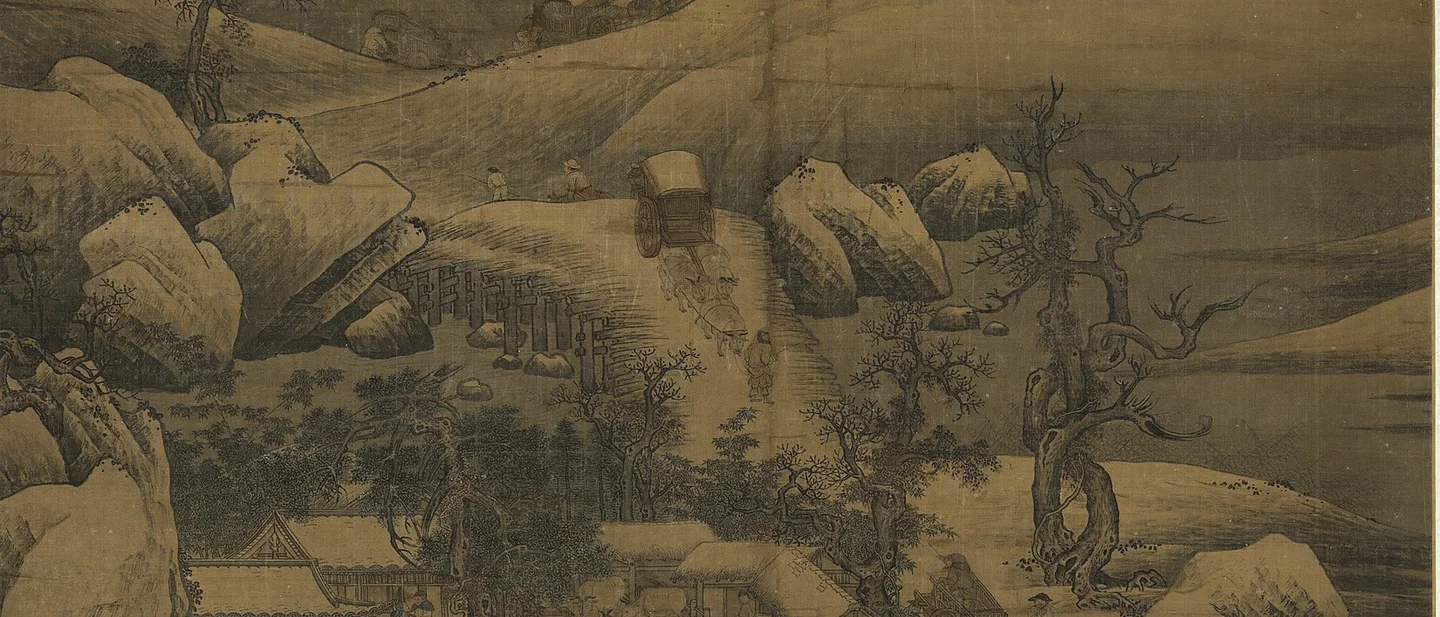
The band at the head of this page is a Song-dynasty hanging scroll, Snowy Manor and Oxcarts (雪棧牛車圖), in the National Palace Museum, Taipei 8. It shows a covered cart on a plank road through snow, a manor below it, and a horizon with nothing on it: the weather the old man asked for.
Reflection
He prays for weather that will hurt him, because the cold is what his charcoal is worth. Think of something you have needed and would rather not have needed: what did wanting it ask of you?
References
- 1Wikipedia (Chinese): Bai Juyi
zh.wikipedia.org
- 2
- 3Wikipedia (Chinese): Palace market
zh.wikipedia.org
- 4
- 5Wikisource: 賣炭翁
zh.wikisource.org
- 6Wikipedia: Chi (unit)
en.wikipedia.org
- 7Wikipedia: Bai Juyi
en.wikipedia.org
- 8Wikimedia Commons: Snowy Manor and Oxcarts, Song dynasty
commons.wikimedia.org
This story was produced automatically by a channel. One sentence is all it takes for Neodrop to keep producing for you.