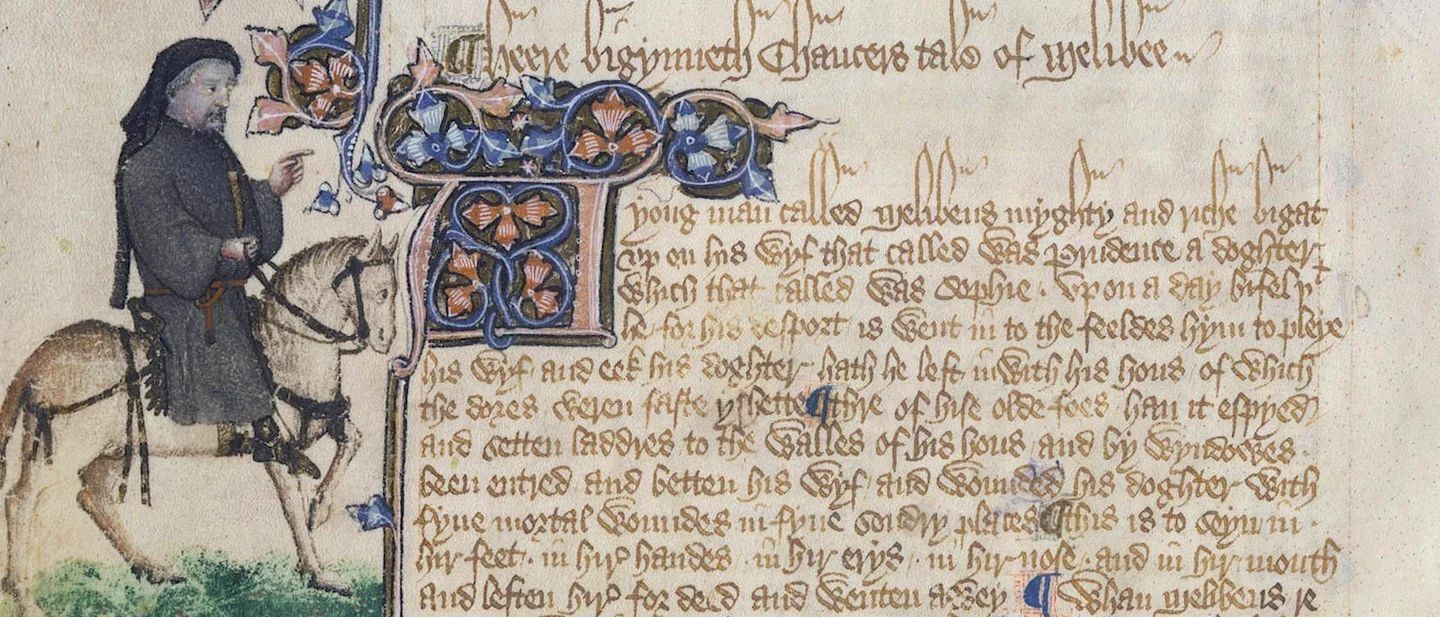
"Than longen folk to goon on pilgrimages": Chaucer opens the Canterbury Tales with April, and a whole country on the road
Chaucer's Canterbury Tales opens with one eighteen-line sentence about April rain, the west wind and the birds, and then puts a whole country on the road to a shrine — a close read of the General Prologue's first lines, in Middle English.

The Canterbury Tales was left unfinished, and the way it opens is part of why it still reads. Chaucer began it in the late 1380s and was still at work on it when he died in 1400; twenty-four tales survive, out of a plan that seems to have called for something like a hundred and twenty 1. The tales come from a company of pilgrims riding from London to the shrine of Thomas Becket at Canterbury, and the poem introduces the company before it lets a single one of them speak.
Geoffrey Chaucer (c. 1343–1400) was the son of a London wine merchant who became a courtier, a soldier, a diplomat and a civil servant, and who wrote in English at a time when French and Latin still carried most of the prestige in literature. He was the first writer to be buried in what is now Poets' Corner in Westminster Abbey. English writers call him the father of English poetry, and about two thousand English words are first recorded in manuscripts of his work 2.
What follows is the first forty-two lines of the General Prologue, the introduction of eight hundred and fifty-eight lines that a reader meets before any tale begins, and the lines that set the whole frame: the month, the road, the inn, the company 3. The destination is the shrine of a murdered archbishop. Thomas Becket was killed in Canterbury Cathedral in 1170 by four knights loyal to Henry II, was canonised three years later, and drew pilgrims from across Europe until Henry VIII suppressed his cult in 1538 4.
The passage is in Middle English, printed here as it stands in Walter W. Skeat's edition, the first to take the Ellesmere manuscript as its base 56. Very little of it is as foreign as it looks. Shoures is showers, droghte is drought, eek is also, hem is them, hir is their, wenden is to go. Chaucer's London English still sounded the final -e, so rote carries two syllables where ours has one, and Aprille has three 1. Skeat prints sote where many modern editions normalize the spelling to soote; spelling in 1400 was still a matter of local habit.
Passage
Whan that Aprille with his shoures sote The droghte of Marche hath perced to the rote, And bathed every veyne in swich licour, Of which vertu engendred is the flour; Whan Zephirus eek with his swete breeth Inspired hath in every holt and heeth The tendre croppes, and the yonge sonne Hath in the Ram his halfe cours y-ronne, And smale fowles maken melodye, That slepen al the night with open yë, (So priketh hem nature in hir corages): Than longen folk to goon on pilgrimages (And palmers for to seken straunge strondes) To ferne halwes, couthe in sondry londes; And specially, from every shires ende Of Engelond, to Caunterbury they wende, The holy blisful martir for to seke, That hem hath holpen, whan that they were seke.Bifel that, in that seson on a day, In Southwerk at the Tabard as I lay Redy to wenden on my pilgrimage To Caunterbury with ful devout corage, At night was come in-to that hostelrye Wel nyne and twenty in a compaignye, Of sondry folk, by aventure y-falle In felaweshipe, and pilgrims were they alle, That toward Caunterbury wolden ryde; The chambres and the stables weren wyde, And wel we weren esed atte beste. And shortly, whan the sonne was to reste, So hadde I spoken with hem everichon, That I was of hir felaweshipe anon, And made forward erly for to ryse, To take our wey, ther as I yow devyse.But natheles, whyl I have tyme and space, Er that I ferther in this tale pace, Me thinketh it acordaunt to resoun, To telle yow al the condicioun Of ech of hem, so as it semed me, And whiche they weren, and of what degree; And eek in what array that they were inne: And at a knight than wol I first biginne.
— Geoffrey Chaucer, The Canterbury Tales, General Prologue, lines 1–42, written c. 1387–1400, in The Complete Works of Geoffrey Chaucer, vol. IV: The Canterbury Tales: Text, edited by Walter W. Skeat (Oxford: Clarendon Press, 1900) 6. Quoted as printed, including the editor's parentheses; the line numbers in the edition's margin are dropped.
Gloss
- "shoures sote" — "sweet showers," the poem's opening pair, and already two-thirds Modern English: shoures is our showers and sote our sweet 3. Skeat's spelling of the second word, with one o, is one of the places where one editor's text differs from another's: the manuscripts of the Tales vary from copy to copy, the London dialect Chaucer wrote came before English spelling had settled, and modern editions commonly normalise the word to soote 16.
- "Whan Zephirus eek with his swete breeth" and "the yonge sonne / Hath in the Ram his halfe cours y-ronne" — Zephyrus is the west wind of Greek myth, the gentlest of the four winds and the one the ancient world tied to springtime and flowers; Chaucer names him as a figure his first readers would have known at once 7. The Ram is Aries, the sign the sun crosses as spring begins, and the sun has now run half his course through it. That is how the poem dates itself to April without ever naming a date 3.
- "And palmers for to seken straunge strondes / To ferne halwes, couthe in sondry londes" — a palmer was a pilgrim who had been to the Holy Land and brought back a palm leaf as proof, and the word was used loosely for any pilgrim 8. Ferne is far, halwes is shrines — our hallows — and couthe is known. In these two lines the poem widens out from the English road to every shrine in Christendom, and then the parenthesis closes and it pulls back to Canterbury.
Close read
The first sentence of the Canterbury Tales is eighteen lines long, and its main verb waits until the twelfth. Until then the sentence is all Whan: when April with his sweet showers has pierced the drought of March to the root, and bathed every vein in such liquid as engenders the flower; when the west wind has breathed on every wood and field the tender shoots, and the young sun has run half its course through the Ram, and the small birds sing all night with open eye. Only then comes the verb, longen, and its subject is folk — people, unnamed and uncounted. The order of the sentence is the argument of the sentence. A whole season is assembled out of subordinate clauses before one human being is allowed on stage, and when the grammar finally releases the sentence, what it releases is desire.
The clauses are a chain, and each link is a cause. Rain pierces the dry ground; the wet ground is what engenders the flower; the west wind lifts the shoots; the sun drives the season; the birds sing; and the singing is the last action, the one the poem marks as the trigger — "So priketh hem nature in hir corages," Nature goads them in their hearts. Engendred is the load-bearing word: these showers breed the flower as much as they water it, and the same logic carries straight into longen, a verb of wanting. Chaucer has made the spring of the year and the restlessness of people into one mechanism, and the reader has watched it work before being told what it does.
Then the poem does the thing it will do for the next several thousand lines: it narrows. From "every shires ende / Of Engelond" down to one day, one town, one building and one pronoun — "Bifel that, in that seson on a day, / In Southwerk at the Tabard as I lay." A whole country is on the move, and then the poem is in a single bed at a single inn. What is lying there with him is "wel nyne and twenty in a compaignye," twenty-nine people "of sondry folk, by aventure y-falle / In felaweshipe": they have fallen in together by chance, which is how most crowds form and how most stories about crowds have to begin.
The final eight lines state the narrator's plan, and they are a plan for the whole book. He will tell "the condicioun / Of ech of hem … And whiche they weren, and of what degree; / And eek in what array that they were inne" — what each one is like, what rank each one holds, and what each one is wearing. Condition, degree, array: three questions asked of every pilgrim in turn, thirty times over, and the reason the Prologue can hold thirty portraits without losing its reader. Then the last line turns the key: "And at a knight than wol I first biginne." The frame is built, the method is declared, and the poem moves to its first face.
Why it still matters
What the General Prologue does with a crowd is the thing English fiction keeps returning to: Chaucer puts twenty-nine strangers in one yard, gives them a shared reason to ride together, and then walks among them, one at a time, telling the reader what each looks like and what each is worth. Readers have argued for six hundred years about how much of it is praise and how much is mockery; the portraits stand in the old tradition of satire that took each rank of society in turn and measured it, and Chaucer keeps the measuring instrument slightly out of sight, in the narrator's own voice, so that the reader has to do the judging 3.
The destination has not survived. The shrine that draws the whole company down the road was destroyed when Henry VIII suppressed Becket's cult in 1538, so the poem sends a whole company riding toward a place that a reader can only visit as an absence 4. Chaucer's pilgrims travel toward a saint killed by the king's own knights; the road is pious, and the story behind it is political.
And the language itself is part of what lasts. Chaucer wrote the Tales in English at a moment when a writer who wanted an audience could reasonably have chosen French, and the poem is one of the works usually credited with proving that English could carry serious literature and with popularising it against those rivals; about two thousand English words first appear in manuscripts of his work 12. The lines above are the earliest famous page of that project, and the strange spellings are the language six hundred years closer to its roots, close enough that a reader can still hear the joins.
Reflection
The poem opens with a whole country getting up and going, then follows one small company down one road to a shrine. Think of a journey of your own that started with a season, a mood, or somebody else's plan. What set it going, and what were you actually travelling toward?
References
- 1Wikipedia: The Canterbury Tales
en.wikipedia.org
- 2Wikipedia: Geoffrey Chaucer
en.wikipedia.org
- 3Wikipedia: General Prologue
en.wikipedia.org
- 4Wikipedia: Thomas Becket
en.wikipedia.org
- 5Wikipedia: Ellesmere Chaucer
en.wikipedia.org
- 6
- 7Wikipedia: Zephyrus
en.wikipedia.org
- 8Wikipedia: Palmer (pilgrim)
en.wikipedia.org
This story was produced automatically by a channel. One sentence is all it takes for Neodrop to keep producing for you.