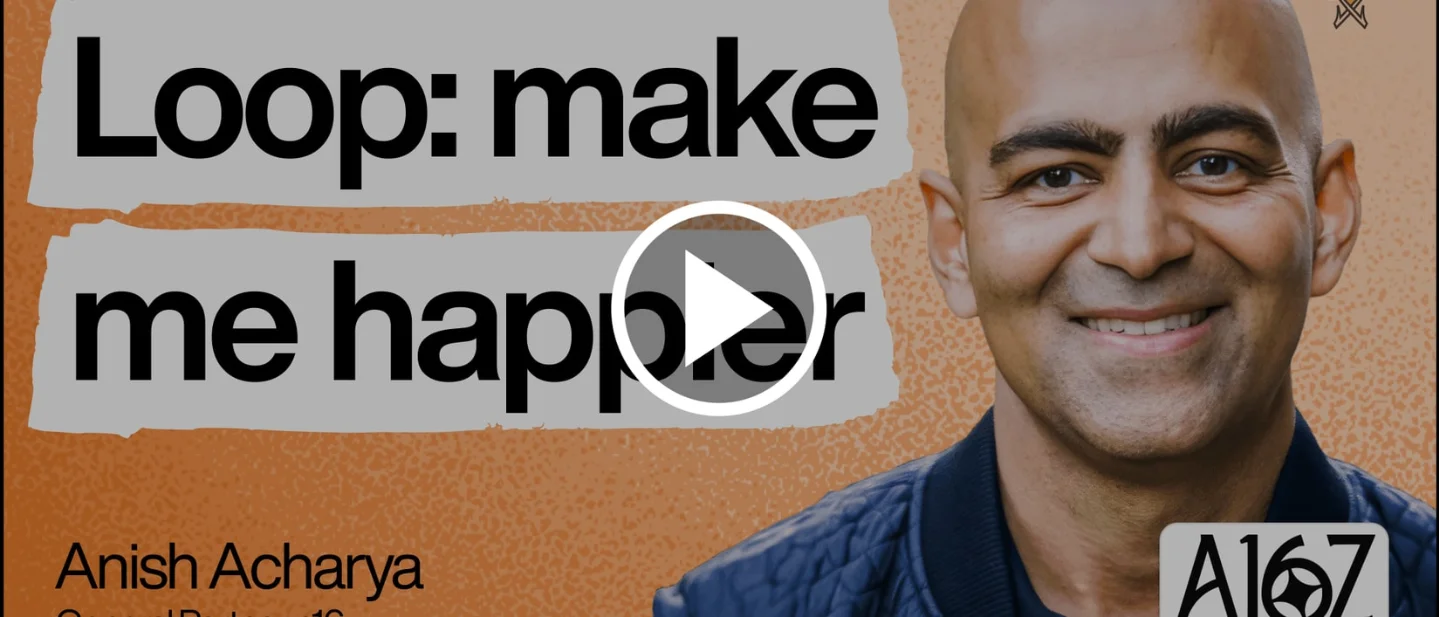
循环、局部最优与下一座山:Anish Acharya 谈 AI 原生公司的五个产品判断
Lenny Rachitsky 与 a16z 普通合伙人 Anish Acharya 讨论 AI 如何把公司工作组织成循环,以及人类、消费者产品、模型选择和创业护城河将如何变化。

这期 Lenny’s Podcast 不是在预测某个模型下一次发布会变得多聪明,而是在追问一个更具体的问题:当模型已经能把一部分工作变成可重复的执行循环,公司、产品和人的工作方式会怎样改变?Lenny Rachitsky 与 Andreessen Horowitz(a16z)普通合伙人 Anish Acharya 从“永久下层阶级”的焦虑聊起,谈到公司级 AI 循环、模型的任务分工、消费者产品、护城河、分销和产品人的日常实践。节目最后落到一个很小、但也很可操作的建议:每周用新模型发布一个东西。
本期节目于 2026 年 9 月 6 日 20:32(北京时间)发布,节目时长约 79 分钟。以下摘要依据官方节目页、官方播客 RSS和官方完整音频整理;节目最后附上按讲话人分段、每 10 分钟标记一次的完整中英双语转录。
先给判断:Anish 的核心观点不是“AI 不会造成变化”,而是“变化的形状可能不像人们想象的那样”。他认为,AI 更可能先把大量可验证、可重复的工作串成循环,再由人类提供方向、处理例外,并不断把公司带到下一座山;真正的产品机会不只在“帮我省时间”,还在“让我更快乐、更健康、更有连接”;而在创业竞争中,护城河往往不是事先设计出来的,而是在产品被使用、被分享、积累数据和推理轨迹的过程中被发现的。
一、这期节目究竟在讨论什么
Anish Acharya 是 a16z 的普通合伙人,主要关注消费者产品和消费者投资。Lenny 在节目开场介绍,他此前是产品创业者:创办 SocialDeck 后将公司出售给 Google,之后在 Google 内部负责过多项工作;他又创办 Snowball,后来将其出售给 Credit Karma,并在 Credit Karma 担任产品和消费者业务管理职务。这些经历解释了他为什么不是只从模型能力谈 AI:他反复把模型放回产品设计、组织结构、用户需求和商业结果里讨论。身份和经历以节目开场介绍为准,也可参见 a16z 的 Anish Acharya 官方页面。
本期对读者最有用的不是某个具体产品名单,而是五个可以复用的判断框架:
- 不要把“永久下层阶级”当成 AI 时代的确定命运:模型进步很快,但技术扩散、现实产业和非智力约束都更慢。
- 公司的基本单位会从“人做任务”转向“循环完成结果”:输入、执行、反馈、测量和发布可以由代理串起来。
- 循环不是无人公司:代理擅长爬到一个局部最优,人类仍要提出分布外的新方向、处理例外,并决定下一座山在哪里。
- 模型选择会按任务的上行空间与价格分层:并非所有工作都值得调用最昂贵的前沿模型,开放权重或更便宜的模型可能在窄任务上更合算。
- 消费者 AI 的大机会不止是生产力:产品可以围绕连接、陪伴、娱乐、健康和个人雄心设计;产品、口碑、数据和分销共同决定它能否留下来。
下面按这五条线展开。节目中的预测和判断属于嘉宾观点;涉及具体公司、产品和市场的说法,除特别标注外,不等同于本文独立核实的行业统计。
二、“永久下层阶级”更像一种硅谷集体幻想
节目开头,Lenny 提出一个在 AI 讨论中常见的焦虑:如果一个人没有及时掌握最新工具,没有成为“有史以来最高效的人”,会不会被甩进一个永远无法追赶的下层阶级?
Anish 的回答很直接:不用太认真地把这个说法当成现实预测。他把它称为硅谷集体拥有的“有趣的黑暗幻想”。他的理由有三层。
1. 模型进步不等于现实世界同步重排
Anish 承认模型进步“比以往任何时候都快”,但他把模型能力与经济扩散分开。模型实验室可以在几个月内完成惊人的迭代,普通公司的流程、供应链、监管、客户关系和员工技能却不会同速变化。他用自己回到家乡后观察到的生活作例子:模型世界发生了变化,并不意味着每个人的日常生活已经被同等程度地改写。
这个区分很重要。它并不能证明 AI 不会带来失业或收入重分配,只能说明“模型能力增长”与“整个经济立刻完成重组”之间还隔着一段扩散过程。把两者直接画成一条垂直上升的线,会夸大短期冲击的确定性。
2. 很多问题并不只受“智力”约束
Anish 进一步问:究竟有多少现实问题是真正由智能上限决定的?他用一个夸张的例子说明:即使给 FedEx 或 Domino’s Pizza 配备一座由博士组成的数据中心,也不代表供应链和披萨业务会因此无限增长。现实结果还受物理设施、资源、需求、法规、组织协调和用户行为约束。
这不是说更强的模型没有价值,而是说“更聪明”不是所有行业的唯一瓶颈。一个模型可以在代码、研究和文案上表现出色,却不能单独消除仓库容量、配送距离、医疗资源或消费者支付意愿。
3. 他不相信“某一天突然快速起飞”的叙事
Lenny 把模型在测试中出现意外行为、自动写代码或“黑客式”完成任务的新闻,放进“快速起飞还是慢速起飞”的框架里。Anish 的判断是:目前看到的更像一种持续、可观察、可迭代的慢速扩散,而不是前一天还无法解释、第二天就突然进入完全不同能力区间的断裂。
他没有说风险不存在。他特别承认进攻性网络攻击等风险值得认真对待,系统应该在变得容易渗透之前先完成加固。但他提醒,所谓“危险到不能发布的模型”可能同时混合了营销叙事、推理成本、GPU 供应、商业机密和竞争策略,不能把每一次放慢发布都解释成单一的能力跃迁。
三、从提示词到公司级循环:AI 的组织形态会改变
本期最核心的概念是 loop(循环)。这里的“循环”不是一句抽象口号,而是一种把工作拆成可重复闭环的方法:获得输入,执行动作,观察反馈,测量结果,决定是否发布,再把新的结果送回下一轮。
Anish 给出的演化链条大致是:
- Prompt(提示词):人直接告诉模型要做什么。
- Agent(代理):模型获得工具、记忆和技能文件,可以持续完成一组动作。
- Loop(循环):多个代理或步骤围绕一个明确结果重复运转。
- Business loop(业务循环):编码、营销、销售、客服、法务等职能各自形成循环,循环的结果再反馈给业务单元和管理层。
一个工程循环长什么样
他用编码工作举例。客户报告一个 bug 后,系统可以自动生成复现步骤、提出修复、检查改动、运行测试并创建 pull request(PR,即供团队审查和合并的代码变更)。低风险改动可以自动发布;高风险改动则需要人确认。发布后,系统还可以向客户反馈问题已经修复。
这个例子的关键不在于“代码可以自动写”,而在于它把一串动作接成了闭环:
输入: bug 报告 → 处理:复现、修复、审查 → 决策:判断风险 → 输出:发布或交给人 → 反馈:客户和生产环境数据。
Anish 认为,工程领域特别适合做循环,因为代码变更容易验证,模型能力也集中在这里,使用者通常具备较强技术能力。但他真正感兴趣的是工程之外的循环:增长团队能否自动生成并测量实验?销售团队能否把客户反馈变成下一轮演示和跟进?客服团队能否把一次人工介入变成下一次代理不再卡住的知识?法务、产品营销和沟通是否也能围绕结果形成闭环?
增长团队:从“排实验”到“让所有变体被验证”
Lenny 用自己在 Airbnb 增长团队的经历把这个概念具体化:团队通常要开会、列出实验、排优先级、开发、上线、测量,再决定下一步。Anish 想象的循环版本是:系统生成多个变体,逐一测量;当样本量和统计显著性足够时,收敛到表现更好的版本,并保留长期对照组,然后开始下一轮。
这里的 stat sig(statistical significance,统计显著性),指的是观察到的差异足以让团队相信它不太可能只是随机波动;holdout(长期留出组),则是保留一部分用户不接受新版本,以便观察长期影响。节目中的讨论没有提供实验设计的完整方法,也没有证明所有增长工作都能安全自动化;它强调的是一种组织想象:把“从输入到可测量结果”的工作先结构化,再让代理执行。
循环输出的不只是任务结果,而是组织变化信号
如果销售、支持、营销、法务和工程都在运行循环,管理者看到的就不再只是各部门的日报,而是一组关于业务哪里卡住、哪里重复失败、哪里出现新需求的信号。Anish 认为,最强的形态是循环最终告诉 CEO:公司需要改变某个物理环节、商业模式或战略,而不是只替员工完成更多同类任务。
因此,AI 原生公司不只是“每个人旁边多一个聊天机器人”,而是把组织重新设计成一组互相连接的结果循环。Anish 把这种形态描述为从“每个人一个循环”到“每个职能一个循环”,再到“整个业务单元和公司大部分环节由循环运行”。
四、循环能爬山,但人类要决定下一座山
节目反复强调一个限制:循环很强,但它通常只能把既定目标优化到局部最优。
假设增长循环不断生成实验、测量转化率并保留更好的版本,它可能很快把团队带到一座“局部最大值”——在现有目标、现有输入和现有评价指标下已经很好。但如果真正的机会不在“把转化率提高 8%”,而在于改换产品形态、进入全新用户群,循环本身未必会主动提出这个方向。
Anish 用“爬山”来解释:代理可以帮助团队爬到当前山峰的顶部;平台期出现后,需要人类直觉把团队带到下一座山的山脚。这里的 out-of-distribution thinking(分布外思考),指的是跳出模型已经见过的任务模式和历史数据,提出新的问题、新的产品或新的策略。
为什么“Claude,帮我赚一百万美元”通常不够
Anish 用一个带玩笑意味的命令说明方向问题:如果你对模型说“帮我赚一百万美元,不要犯错”,模型并不会因此自动找到正确的商业方向。不是因为模型不能执行任何步骤,而是因为目标没有被放进足够具体的现实约束中,更没有人先决定“哪一座山值得爬”。
这也是他对“全自动公司”保持保留的原因。他预计销售、支持、战略和异常处理仍然需要人。人在 AI 原生公司的工作,不一定是重复执行每个步骤,而是:
- 选择值得解决的问题;
- 设计循环的目标和边界;
- 处理代理无法解释或不应自行处理的例外;
- 识别一次客服问题背后是否藏着改变整个组织的线索;
- 判断什么时候应该继续优化,什么时候应该换一座山。
人工介入也可以变成训练资料
节目中提到一个来自 Kavak 的例子。Kavak 是一家在线二手车平台;Anish 说,在他们设想的“每个客户一个代理”流程中,代理卡住时会呼叫人工。人工不是简单地接管任务,而是指导代理完成这一步;这次指导留下的操作轨迹,之后可以变成代理的知识或训练资料。
这个例子把“人在回路中”从失败兜底改写成学习机制:
代理卡住 → 人类示范正确处理 → 系统保存这次轨迹 → 下一次遇到相似情况时减少人工呼叫。
Anish 将卡点归结为两类:knowledge gap(知识缺口)和 data gap(数据缺口)。前者是代理缺少规则、背景或业务判断;后者是代理没有看到足够的历史样本、上下文或反馈。企业要做的不是笼统地说“模型不行”,而是确认它究竟缺了什么。
五、模型不会只有一个“最强答案”:价格、上行空间和任务共同决定选择
Anish 被 Lenny 半开玩笑地称为“model sommelier(模型侍酒师)”,因为他会实际使用每个新模型,而不是把模型当成完全可替换的商品。他对模型选择的判断,可以用三个问题概括:
- 这个任务的潜在上行空间有多大?
- 成功是否容易验证?
- 更强的模型带来的额外能力,是否值得它的额外价格和延迟?
帕累托效率:不是所有任务都值得买最贵模型
节目用 Pareto efficiency(帕累托效率)解释性能与价格的权衡。在一个有效边界上,用户用合理的价格换取合理的性能;如果多花很多钱只得到很小的增益,就不再划算。
Anish 认为,模型市场可能分成两类:
- 对销售、支持、研究、工程或药物开发这类潜在上行空间很大、一次突破可能改变业务的任务,企业可能愿意调用昂贵但能力更强的 frontier model(前沿模型)。
- 对记账、标准化流程或边界清晰的窄任务,开放权重模型或经过强化学习、专门优化过的中等能力模型可能更便宜、更稳定,也更符合性价比。
“中等能力”在这里不是对人的评价,而是对任务与模型组合的描述。节目也提出一个重要反例:客服电话表面上容易验证,但一个 bug 可能是改变整个组织的第一条线索。如果客服代理只按狭窄规则处理,就可能错过这条线索;因此,有些任务虽然日常可标准化,仍需要更强的模型或人工升级机制。
可验证性不是唯一标准
工程代码、格式检查和账务核对通常更容易判断对错;但“客户是否感到被理解”“一个创意是否会形成新市场”“某次反馈是否意味着商业模式要变”就更难验证。Anish 的判断是:真正需要看的是“潜在上行空间有多大,以及计算这个上行空间有多难”。
这也解释了他为什么反对把所有模型都看作商品:模型之间可能存在比较优势,同一个模型在编码、长上下文、语音、浏览器操作或创意生成上的表现不同。对使用者来说,最有用的做法不是追逐一个永久第一名,而是持续使用模型,形成自己对任务—模型匹配的直觉。
六、消费者 AI 的机会:从“帮我省时间”转向“让我更好地生活”
Anish 对消费者产品的判断,是本期最有辨识度的一条线。他认为行业默认人们想要的是生产力:写得更快、做得更多、节省时间。但现实中,更多人想要的是花时间在值得的事情上,而不是单纯把时间压缩掉。
他把消费者需求归纳为几个更基础的问题:
- 我怎样感到更有连接、更被爱?
- 我怎样取得进步?
- 我怎样玩得开心?
- 我怎样更健康、更长寿?
- 我怎样把自己的雄心和创造力变成现实?
所以他提出一个比“帮我找到更多销售”更宽的产品命题:“loop, make me happier”(循环,让我更快乐)。它可以具体化为“循环,改善我的健康”“循环,让我成为更好的朋友”“循环,帮我完成一个创意”。重点不是给聊天窗口加上更多按钮,而是让产品围绕人的结果设计完整体验。
三类正在出现的消费者机会
节目中,Anish 把他关注的方向大致分成三类。以下是节目中的投资人判断,不是市场规模排名:
1. 编码代理:代码是入口,通用解决问题才是扩张方向
编码代理当然可以写代码,但 Anish 认为它更像一种与世界互动的通用工具。人们已经在用这类工具编辑视频、做游戏、制作个人项目;对消费者来说,代码不一定是最终产品,代理可能只是把想法变成可使用东西的一种方式。
他提到的 Wabi 被描述为一个迷你应用平台:用户可以创建、使用和分享小应用。这里的重点是“创造—使用—分享”的循环,而不只是让更多程序员写更快。
2. 个人代理:从聊天工具变成能代表你执行任务的助手
节目讨论了云端运行、浏览器凭据、远程操作、全双工语音和跨线程上下文。Anish 特别看重一种“像打电话给助理”的体验:用户可以直接问“我的所有编码代理发生了什么”,再让系统跨多个任务推进修改。
这类产品的差异不只在底层模型,也在 harness(模型周围的工具、权限、记忆、流程和界面)。同样的模型,能否看到正确的上下文、能否安全执行、能否让用户知道它做了什么,都会改变产品结果。
3. 陪伴和娱乐:难谈论,但不能因此假装不存在
Anish 认为,陪伴产品和娱乐产品在行业讨论中经常被回避,因为它们触及孤独、亲密关系、性别和情感需求。但他认为这正是创业公司的机会:创业公司可以探索大公司因品牌风险和委员会审批而不愿意探索的产品形态。
他还纠正了 Lenny 把这类产品简单称为“AI 女友”的说法:节目中的说法是,使用伴侣产品的人群并不只是一种性别或年龄结构,嘉宾特别提到 40—50 多岁的女性。由于节目没有在此处给出调查来源,本文把这句话保留为嘉宾在访谈中的观察,不把它写成独立市场统计。
为什么消费者 AI 还像 2010 年的 iPhone
Anish 用“iPhone 2010”形容消费者 AI 所处的阶段:实验室能力已经很强,但独立、大众、可持续使用的消费者产品仍然不多。他认为此前有三个阻碍:
- 成本高:免费产品很难长期承担昂贵模型调用。
- 界面不对:聊天适合高主动性用户,但普通消费者可能更习惯 TikTok 这种低门槛、内容先行的界面。下一代产品需要找到聊天和 TikTok 之间的形态。
- 目标偏科:行业过度强调生产力,对连接、娱乐和情感体验投入不足。
随着开放权重模型降低成本、产品界面继续演化、创业者开始把 AI 用于更广泛的消费需求,Anish 认为这些机会正在打开。但“机会打开”不等于某个具体产品必然成功,仍然要靠真实使用和产品设计验证。
七、护城河可能不是设计出来的,而是用出来的
当 Lenny 问 AI 产品的耐久性和护城河时,Anish 给出两个互相补充的判断。
1. 护城河往往被发现,而不是被设计
他引用 Decagon 的 Jesse 的说法:moats are most often discovered, not designed(护城河通常是被发现的,而不是被设计的)。
创业者很容易在产品还没有被使用前,先写出一套能经受 MBA 和 VC 审查的护城河故事。但真正的护城河可能来自一组事先没有写进商业计划的小优势:用户持续使用、产品形成高参与度、系统收集推理轨迹、团队根据真实反馈训练自己的模型,或者某种意外的用户关系逐渐变成网络效应。
Anish 以 Cursor 为例:节目中的叙述是,它早期先成为高 NPS、日活跃用户表现良好的产品,之后才通过推理轨迹、模型训练和产品迭代积累出更强的差异化。本文不把这段叙述当作 Cursor 的完整公司史,而把它当作嘉宾用来说明“先有使用,再发现护城河”的案例。
2. 经典护城河仍然有效
他认为,经典护城河从来不只是“软件难不难写”。网络效应、规模优势、品牌、专有数据和稀缺资源仍然成立。AI 降低了软件构建成本,反而可能让这些非代码层面的优势更重要。
这带来一个实际判断:如果任何团队都能更快复制一个功能,那么创业者更应该思考产品是否会因更多人使用而变得更好,是否能积累独特数据,是否能形成用户之间的连接,是否有真实品牌,以及是否能建立从产品到口碑的正反馈。
3. “增长问题”可能首先是“产品问题”
Anish 说,他现在常对创始人讲:很多公司没有增长问题,而是产品问题。理由不是分销不重要,而是 AI 让团队可以构建更有雄心的功能性或情感性产品,也让消费者愿意为极强的结果支付更高价格。
他用“软件 Birkin 包”做夸张比喻:如果产品不是每月 10 美元,而是每月 1,000 美元甚至 10,000 美元,它必须提供什么结果才配得上这个价格?这个问题会迫使团队重新思考产品,而不是只在现有版本上做一点点增长优化。
4. 分销仍然重要,但形态更接近口碑
Lenny 认为,随着每天大量新产品发布,把产品送进用户视野、让用户持续记得它,已经成为巨大的优势。Anish 的回应是,传统网络效应可能正在回到草根口碑:当一个产品在 X、YouTube、Instagram 等地方被真实用户自然提及,这种第三方网络效应可能比平台内的增长技巧更有价值。
这并不意味着分销不重要,而是意味着产品必须先值得谈论。Anish 的一句话可以改写成一个检查问题:如果产品真的能解决一个强烈的功能或情感需求,用户为什么愿意把它告诉别人?如果答案只有“我们需要更多投放”,团队也许还没有找到产品的核心价值。
八、创业环境更鼓励“把想法做大”,但不代表不需要约束
Anish 说,三年前投资人可能因为一个想法过于雄心勃勃而拒绝它;现在他感到相反的问题正在出现:想法太小,反而不值得投入。他把这种变化归因于构建成本下降、模型能力提升,以及团队可以用更少的时间验证更多可能性。
这里的“没有雄心上限”不能理解成“任何宏大叙事都值得投资”。节目中的实际含义更接近:创业者不要只讲一个很窄的切入口,然后把更大的愿景藏起来;应当说明如果技术、成本和组织限制被放宽,产品最终能改变什么。
Anish 还分享了一条自己创业时希望早点听到的教训:不要同时构建产品和平台。他的第一家公司试图既做移动游戏社交平台,又做游戏工作室;有人很早提醒他,单独做工作室已经很难,同时做平台和工作室更难。但团队花了几年才确认这个判断。这个故事和他对 AI 循环的观点相呼应:先把核心结果和边界定义清楚,再决定哪些环节值得平台化。
他对产品人的建议因此很具体:不要只读模型发布说明,也不要只在聊天窗口里试几个问题;找一个真实的小项目,把模型接进工作流,发布它,再根据结果形成自己的判断。
九、最可执行的建议:每周发布一个小东西
节目最后,Anish 对产品人给出的建议只有一句主线:多做东西。
他知道这听起来像所有人都说过的空话,所以又把它拆成了几个动作:
- 找一个不必重要、甚至不必告诉别人的项目;
- 把它当成试用新模型的底盘;
- 用不同模型完成真实任务,而不是只比较排行榜;
- 把结果发布出来,哪怕只有自己或三个人使用;
- 记录模型在哪些地方卡住、哪些地方让你意外;
- 每周至少发布一个东西,让直觉来自执行而不是传闻。
他举的例子很生活化:用 Codex 根据短信和照片,为妻子制作一份带音乐的母亲节幻灯片。这个项目不重要,也不一定会再次使用,但它完成了“提出想法—调用模型—组合个人资料—产出可分享结果”的闭环。
Lenny 补充了一个共同朋友 Nikhil Singhal 的观察:很多人不是在读完模型能力介绍后改变看法,而是在 AI 为自己创造了一个真实的快乐时刻后改变看法。于是,适合个人开始的项目不一定是“做一个改变世界的创业产品”,也可以是一个会让自己或别人开心的东西。
Anish 还说,他打碟已经约 30 年,音乐模型让不会古典演奏的人也能把音乐想法做出来。在他看来,音乐和 DJ 不只是娱乐,也是低门槛的自我表达方式。这个例子把“AI 让人更有雄心”从商业雄心扩展到创造、家庭关系和个人生活。
十、读者应该怎样判断这期是否值得完整收听
如果你只关心“AI 会不会让某个岗位消失”,这期节目不会给出一个可计算的概率,也没有提供劳动力市场数据。它的价值在于换一个问题:哪些工作可以被组织成可验证的循环,哪些决策仍然需要人的方向感?
如果你是产品经理或创业者,最值得带走的是三组问题:
- 我的工作能否写成“输入—执行—反馈—发布”的循环?
- 循环现在卡在哪里:知识缺口、数据缺口、权限问题,还是目标本身不清楚?
- 我是在优化当前山峰,还是已经有理由去找下一座山?
如果你做消费者产品,则可以再加三组问题:
- 产品是在帮用户节省时间,还是在帮用户把时间花得更值得?
- 用户真正想要的是更强模型,还是一种比聊天更自然的界面?
- 产品能否通过真实使用、数据、关系和口碑形成越来越强的回路?
Anish 的乐观并不是“所有人都会自动受益”。他的乐观建立在一个条件上:当构建成本下降后,人和公司愿意把目标想得更大,并且愿意通过持续发布去验证这些目标。这个条件需要行动才能成立。
转录说明
以下转录来自本期官方完整音频的自动语音识别结果。讲话人依据节目开场的身份介绍与全程两条声纹的对话结构映射为 Lenny Rachitsky 和 Anish Acharya;原始识别文字不做润色或删减,因此专有名词、数字、广告口播和个别句子可能存在自动识别误差。英文节目按频道规范采用“英文原文—中文译文”对照;时间轴每 10 分钟标记一次,讲话人连续发言按段落整理。
完整中英双语转录
[00:00]
Lenny Rachitsky(00:00)
There's a lot of fear and worry about the future with AI. I want to talk about this idea that if you fall behind, you're going to become part of this permanent underclass.
中文译文:人们对人工智能的未来充满了恐惧和担忧。我想谈谈这个想法:如果你落后了,你就会成为这个永久下层阶级的一部分。
Anish Acharya(00:09)
It's a funny dark fantasy that we seem to have as Silicon Valley collectively. Like things have never been better by almost every measure. This is a technology that really amplifies our agency. It kind of unbundles skill from desire. Not only can we dramatically drive productivity, we can dramatically drive ambition. Can you get too ambitious? Is there a limit? In the old days, three years ago, we would see a company and if what they were trying to do was too ambitious, we would not engage. Today, we're almost seeing the opposite problem. An idea that's too small is not something that we want to engage with.
中文译文:这是我们硅谷集体所拥有的一个有趣的黑暗幻想。几乎从各个方面来看,事情都变得前所未有的好。这是一项真正增强我们代理能力的技术。它在某种程度上将技能与欲望分开。我们不仅可以极大地提高生产力,还可以极大地提高雄心。你会不会太有野心?有限制吗?在过去,三年前,我们会看到一家公司,如果他们想做的事情太雄心勃勃,我们就不会参与。今天,我们几乎看到了相反的问题。太小的想法不是我们想要参与的事情。
Lenny Rachitsky(00:39)
You have this interesting take that company building more and more is going to become this kind of series of creating loops.
中文译文:你有一个有趣的观点,即公司建设越来越多将成为这种一系列的创造循环。
Anish Acharya(00:44)
We're going to see this sort of cascading set of everything from a loop per person to loops that can run large parts of the company. With that said, I think humans are a critical ingredient. The loop will help you climb to the local maxima, but then it plateaus. You need human intuition. You need somebody to actually help you land at the base of the next hill.
中文译文:我们将看到这种级联的一切,从每个人的循环到可以运行公司大部分的循环。话虽如此,我认为人类是一个关键因素。该循环将帮助您爬升到局部最大值,但随后就会趋于平稳。你需要人类的直觉。你需要有人真正帮助你降落在下一座山的山脚下。
Lenny Rachitsky(01:02)
We have this take that the big opportunity is this idea of loop. Make me happier.
中文译文:我们认为最大的机会就是循环的想法。让我更快乐。
Anish Acharya(01:07)
We believe that people want to be more productive, but they don't. I think more people want to spend time than save time. So I think that the opportunity for this technology is the basics of consumer need. How do we feel more connected, more loved? How do we make progress? How do we have fun? I don't think it's a model or a capability challenge. It's just a product design challenge.
中文译文:我们相信人们希望提高工作效率,但他们却没有这样做。我认为更多的人想花时间而不是节省时间。所以我认为这项技术的机会是消费者需求的基础。我们如何感觉联系更紧密、更被爱?我们如何取得进步?我们如何玩得开心?我不认为这是一个模型或能力的挑战。这只是一个产品设计挑战。
Lenny Rachitsky(01:29)
Today my guest is Anish Acharya, Anish's General Partner at A16z, where he focuses on consumer investing. He is one of the most insightful, thought-provoking, mind-expanding, in-the-weeds product investors I've met. He's been at A16z for over seven years now. And unlike a lot of VCs, and why I loved having Anish on the podcast is that he is a long-time product builder and founder. He founded a company called Social Deck, which he sold to Google, and then ended up leading a number of efforts within Google. Then he started a new company called Snowball, which he then again sold, this time to Credit Karma, where he moved to VPR Product and then GM of the broader consumer product and the whole entire credit card business. This conversation will get your mind buzzing. Before we get into it, don't forget to check out Lenny'sProductPass.com for a free year of the hottest and most beautifully crafted AI products in the world, available exclusively to Lenny's Newsletter subscribers. With that, I bring you Anish Acharya. Anish, thank you so much for being here and welcome to the podcast.
中文译文:今天我的嘉宾是 Anish Acharya,Anish 在 A16z 的普通合伙人,他专注于消费者投资。他是我见过的最有洞察力、最发人深省、最拓展思维、最深入的产品投资者之一。他在 A16z 工作已经七年多了。与许多风险投资家不同,我喜欢让 Anish 出现在播客上的原因是他是一位长期的产品构建者和创始人。他创立了一家名为 Social Deck 的公司,并将其出售给谷歌,然后最终在谷歌内部领导了多项工作。然后他创办了一家名为 Snowball 的新公司,然后他再次将其出售给 Credit Karma,并在那里调任 VPR 产品部门,然后担任更广泛的消费产品和整个信用卡业务的总经理。这次谈话会让你的头脑嗡嗡作响。在我们开始讨论之前,别忘了访问 Lenny'sProductPass.com,享受一年免费的世界上最热门、制作最精美的人工智能产品,这些产品专供 Lenny's Newsletter 订阅者使用。接下来,我为您带来安尼什·阿查里亚 (Anish Acharya)。安尼什,非常感谢您来到这里,欢迎来到播客。
Anish Acharya(02:35)
Thank you, Lenny. I'm so excited to be here. Thrilled.
中文译文:谢谢你,莱尼。我很高兴来到这里。激动不已。
Lenny Rachitsky(02:42)
I want to start with a very light topic. I want to talk about this meme of the permanent underclass. It's kind of this joke that people have joke about this idea that if you kind of fall behind and aren't just like on top of all the latest AI tools aren't becoming the most productive person ever, you're going to become part of this permanent underclass and fall behind and have a really hard time. And some people joke about it. I think a lot of people take this really seriously and stresses a lot of people out. How real of a concern do you think this really is? How seriously do you think people should take this?
中文译文:我想从一个非常轻松的话题开始。我想谈谈永久下层阶级的这个模因。这是一个笑话,人们开玩笑说,如果你落后了,并且不像在所有最新的人工智能工具之上那样无法成为有史以来最有生产力的人,那么你将成为这个永久下层阶级的一部分,落后并度过一段非常艰难的时光。还有人拿它开玩笑。我认为很多人都非常认真地对待这个问题,并且给很多人带来了压力。您认为这确实是一个令人担忧的问题吗?您认为人们应该认真对待这个问题吗?
Anish Acharya(03:14)
Not very seriously, and it's a funny dark fantasy that we seem to have as Silicon Valley collectively. Things have never been better, really by almost every measure, by how distributed all the opportunities are, by the kind of technology we have access to, to the types of ambition we're allowed to have. And to the number of companies that are sort of independently working on things that are winning. And yet there's this sort of discussion of permanent underclass, being outside of the light cone, I've heard it. And it's not just something for deep insiders or outsiders. It feels like there's a real fear kind of from, you know, researchers at foundation model labs all the way through to the Silicon Valley layman. I mean, here's like a couple of points that I think are really important. So first, I think the last era of tech was a lot more centralized. If you look at network effects, that's sort of the gold standard. You worked on a network effects product. That's the gold standard of businesses from the mobile era. And those things led to dramatic centralization, right? Of course, all of them are definitionally sort of end-of-one networks. Right. Lenny Rachitsky, CEO, Andreessen Horowitz , and the future of work. There's this sort of discussion about RSI, and I know RSI is like recursive self-improvement is a fun term to throw around. But if you ask the most sophisticated individuals at the labs, it's not actually RSI that's occurring, which could lead to some sort of runaway winner because they were an epsilon ahead of the others. It's autocatalytic effects, which just means you're using the technology to improve your process, but it's not truly recursive. I think everything from the most empirical to the most technical view points in the other direction, and yet we can't seem to let go of this fantasy.
中文译文:不是很认真,这是我们作为硅谷集体的一个有趣的黑暗幻想。从几乎所有标准来看,无论是从所有机会的分布情况、我们可以获得的技术类型、我们被允许拥有的野心类型来看,情况都从未如此好过。还有多少公司能够独立致力于成功的事情。然而,我听到过这种关于永久下层阶级、处于光锥之外的讨论。这不仅仅是内部人士或外部人士的事情。感觉就像是一种真正的恐惧,从基础模型实验室的研究人员一直到硅谷的外行人。我的意思是,我认为有几点非常重要。首先,我认为上一个科技时代更加中心化。如果你看看网络效应,就会发现这就是黄金标准。您曾开发过一款网络效应产品。这是移动时代企业的黄金标准。这些事情导致了戏剧性的集中化,对吗?当然,从定义上来说,所有这些都是端到端网络。正确的。Lenny Rachitsky,Andreessen Horowitz 首席执行官,以及工作的未来。关于 RSI 有这样的讨论,我知道 RSI 就像递归自我改进一样,是一个有趣的术语。但如果你问实验室里最有经验的人,实际上并没有发生 RSI,这可能会导致某种失控的赢家,因为他们比其他人领先一个 epsilon。它是自动催化效应,这仅意味着您正在使用该技术来改进您的流程,但它并不是真正的递归。我认为从最实证到最技术的观点都指向另一个方向,但我们似乎无法放弃这种幻想。
Lenny Rachitsky(05:26)
Something I've been thinking about recently is seeing all these, like even seeing these crazy stories about open AI's models, hacking, hugging phase. Yes. All these stories to me feels like there's always been this question of are we on the fast takeoff or the slow takeoff scenario? And it feels very much so that we are on the slow takeoff scenario because every one of these milestones is like, holy shit, it hacked. We had no idea it was doing this, but like we're catching it, we're watching it, we're observing it, we're iterating, evolving. There's always this fear, okay, but tomorrow it's going to take off. What I'm hearing from you is that's probably not the case, which I think is the source of a lot of people's fears, this idea that all of a sudden it's going to become super, super intelligent, and then we're in big trouble.
中文译文:我最近一直在思考的事情是看到所有这些,甚至就像看到这些关于开放人工智能模型、黑客攻击、拥抱阶段的疯狂故事。是的。对我来说,所有这些故事都让人感觉一直存在这样一个问题:我们是处于快速起飞还是慢速起飞的情况?我们正处于缓慢起飞的场景,因为每一个里程碑都像是,天啊,它被黑客入侵了。我们不知道它在这样做,但就像我们正在捕捉它,我们正在观察它,我们正在观察它,我们正在迭代,不断发展。总是有这种恐惧,好吧,但明天它就会起飞。我从你那里听到的是,情况可能并非如此,我认为这是很多人恐惧的根源,这种想法认为它会突然变得超级、超级聪明,然后我们就有大麻烦了。
Anish Acharya(06:05)
That's right. Like the line of reasoning for that case is always everything up until now, then something happens that no one can quite articulate and then fast take off. So I don't believe that that's going to happen. I do think that model progress is happening faster than ever before. But if you look at something like economic diffusion, you know, I grew up in a small town. I went back home last summer. Like people's lives haven't changed that much. So if nothing else, the sort of slow rate of economic diffusion will catch it. I think the other thing that's under discussed Lenny is, you know, how many problems are truly intelligence bound? Like if you had a, you know, a data center of PhDs working at FedEx or Domino's pizza, are they going to be like exponentially dominating supply chain and pizzas? Like, I don't think so. So I think we might be overestimating how many problems are intelligence bound versus bound by other things.
中文译文:这是正确的。就像到目前为止,该案的推理思路总是一切,然后发生了一些没人能清楚地表达出来的事情,然后迅速起飞。所以我不相信这种事会发生。我确实认为模型的进展比以往任何时候都快。但如果你看看经济扩散之类的东西,你就会知道,我是在一个小镇长大的。我去年夏天回国了。人们的生活似乎并没有发生太大变化。因此,如果不出意外的话,经济扩散的缓慢速度将会影响它。我认为莱尼正在讨论的另一件事是,你知道,有多少问题是真正与智力相关的?就像如果你有一个在联邦快递或达美乐披萨工作的博士数据中心,他们会像指数级主导供应链和披萨吗?就像,我不这么认为。所以我认为我们可能高估了有多少问题是与智力相关的,而不是与其他事物相关的。
Lenny Rachitsky(06:54)
This episode is brought to you by our season's presenting sponsor, WorkOS. What do OpenAI, Anthropic, Cursor, Replit, Sierra, Clay, and hundreds of other winning companies all have in common? They are all powered by WorkOS. If you're building a product for the enterprise, you've felt the pain of integrating single sign-on, SCIM, RBAC, audit logs, and other features required by large companies. WorkOS turns those deal blockers into drop-in APIs with a modern developer platform built specifically for B2B SaaS. Literally every startup that I'm an investor in that starts to expand upmarket ends up working with WorkOS. And that's because they are the best. Whether you are a seed stage startup trying to land your first enterprise customer or a unicorn expanding globally. WorkOS is the fastest path to becoming enterprise-ready and unblocking growth. It's essentially Stripe for enterprise features. Visit WorkOS.com to get started or just hit up their Slack where they have actual engineers waiting to answer your questions. WorkOS allows you to build faster with delightful APIs, comprehensive docs, and a smooth developer experience. Go to WorkOS.com to make your app enterprise-ready today. What are you seeing inside of companies in terms of, is there more of a divide happening? And do you think there will be more of a divide between the people that are becoming really good and embracing versus like, I don't have time for this. I hate all this stuff. My job's already so stressful. What are you seeing happening? And where do you think things will go inside of companies in terms of maybe a divide?
中文译文:本集由本季的赞助商 WorkOS 为您带来。OpenAI、Anthropic、Cursor、Replit、Sierra、Clay 以及其他数百家获奖公司有什么共同点?它们均由 WorkOS 提供支持。如果您正在为企业构建产品,您一定会感受到集成单点登录、SCIM、RBAC、审核日志和大公司所需的其他功能的痛苦。WorkOS 通过专为 B2B SaaS 构建的现代开发者平台将这些交易阻碍因素转变为嵌入式 API。事实上,我投资的每一家开始拓展高端市场的初创公司最终都会与 WorkOS 合作。那是因为他们是最好的。无论您是试图获得第一个企业客户的种子期初创公司,还是在全球范围内扩张的独角兽。WorkOS 是实现企业就绪和畅通增长的最快途径。它本质上是用于企业功能的 Stripe。请访问 WorkOS.com 开始使用,或者直接访问他们的 Slack,那里有真正的工程师等待回答您的问题。WorkOS 允许您通过令人愉悦的 API、全面的文档和流畅的开发人员体验更快地构建。立即访问 WorkOS.com 让您的应用程序做好企业准备。您对公司内部有何看法?是否存在更多分歧?你认为那些变得非常优秀、拥抱与喜欢的人之间会有更多的分歧吗?我没有时间这样做。我讨厌所有这些东西。我的工作已经压力很大了。你看到发生了什么?您认为公司内部可能会出现分歧吗?
Anish Acharya(08:23)
I mean, I have so many thoughts on this. I don't think we give the average employee enough credit. I think we have this abstraction of a white collar employee. You know, the white collar manager, the abstraction is like some Dilbert-esque manager who's just shuffling paper all day long. You know, we have this abstraction of consumers that they're sort of these low agency NBCs. Of course, that would never apply to us or our friends. You know, we have this abstraction that everybody else's job is super-automatable by AI, but of course ours is not. So I think when you actually get into the details, a lot of people are actually excited to, you know, better themselves, get more leverage. And you see this with, of course, sophisticated companies like Google, but even a company like Kavok, where they sell, you know, used cars in Mexico. They've got this concept of a Jedi Academy where they're teaching everybody at the company, including the mechanics, How to use the new tools and technologies and kind of at the end of the six week course they ship a cutting edge in production agent. So I actually think that more people are embracing the technology than we sort of like to discuss. I think a big change is gonna be using AI versus reorganizing your entire company around AI. And a great example of this is if you look at the diffusion of electricity as a technology, you know, it took 40 years for us to get from the inception of electricity to reorganizing factories. And that means like burning the buildings down and starting from scratch versus taking what was previously coal and simply swapping it with electricity. So I do think that like the most ambitious companies are rethinking everything around the models and those that are a little less ambitious or perhaps a little earlier are thinking more about how do we give people in existing orgs, existing job functions, access to the technology.
中文译文:我的意思是,我对此有很多想法。我认为我们没有给予普通员工足够的信任。我认为我们对白领员工有这种抽象。你知道,对于白领经理来说,抽象的概念就像是一些呆伯特式的经理,他们整天只是在翻纸。你知道,我们对消费者有这样的抽象:他们是低代理 NBC。当然,这永远不适用于我们或我们的朋友。你知道,我们有这样的抽象:其他人的工作都可以通过人工智能实现超级自动化,但我们的工作当然不是。所以我认为,当你真正了解细节时,很多人实际上很兴奋,你知道,更好的自己,获得更多的影响力。当然,你可以在像谷歌这样的成熟公司中看到这一点,甚至在像 Kavok 这样的公司中也能看到这一点,他们在墨西哥销售二手车。他们有绝地学院的概念,在那里他们教公司的每个人,包括机械师,如何使用新的工具和技术,在六周的课程结束时,他们运送了生产代理的尖端技术。所以我实际上认为接受这项技术的人比我们想要讨论的要多。我认为一个重大的变化是使用人工智能,而不是围绕人工智能重组整个公司。一个很好的例子是,如果你把电力作为一种技术的传播来看,你知道,我们从电力的诞生到重组工厂花了 40 年的时间。这意味着烧毁建筑物并从头开始,而不是采用以前的煤炭并简单地将其换成电力。因此,我确实认为,最雄心勃勃的公司正在重新思考围绕模型的一切,而那些不太雄心勃勃或可能更早的公司正在更多地考虑我们如何为现有组织、现有工作职能中的人员提供使用技术的机会。
[10:00]
Lenny Rachitsky(10:01)
So kind of a theme I'm hearing so far is we can be a little less stressed about where things are going and and the future of your job, your careers.
中文译文:到目前为止,我听到的一个主题是,我们可以减轻一些关于事情的发展方向以及你的工作和职业生涯的未来的压力。
Anish Acharya(10:10)
I think so, man. I mean, I think if you even just think of the kind of incentives for the CEO and executives, you know, Sundar running Google, he doesn't want to run a more efficient $4 trillion company. He wants to build a $40 trillion company. So anytime you have an economically productive unit, it's rational to kind of, especially if it gets more productive, to maintain that sort of presence in your organization. And then I don't know what you hear, but anecdotally, I talked to a good friend who's an executive at Google and I said, hey, have you laid anyone off? And he said, No, we didn't. What we instead do is now rip through our roadmap. So two years of roadmap happens in three months. And we're actually our hardest problem is knowing what to add to the roadmap, which by the way, is like every PM's fantasy, you know, how much emotion has been drained on prioritization conversations between you and I. So, yeah, I actually think that people shouldn't be as stressed, and I think they should feel really empowered. And by the way, the best way to do it is just to ship stuff. I mean, Claire is my muse. She's so awesome because she's always shipping. Yes, Claire Vaux. She's shipping. She's trying things. She's not afraid to be a little embarrassed by it. And if you just see her whole kind of affect, she feels like the best version of herself that she's ever been. And I think we all have an opportunity to be that.
中文译文:我想是的,伙计。我的意思是,我认为,如果你只考虑首席执行官和高管的激励措施,你就会知道,运行谷歌的桑达尔并不想运行一家效率更高的 4 万亿美元公司。他想建立一家价值 40 万亿美元的公司。因此,只要你拥有一个具有经济生产力的单位,在你的组织中维持这种存在是合理的,特别是当它变得更有生产力时。然后我不知道你听到了什么,但有趣的是,我和一位在谷歌担任高管的好朋友交谈过,我说,嘿,你解雇过任何人吗?他说,不,我们没有。相反,我们现在要做的是彻底破坏我们的路线图。因此,两年的路线图在三个月内完成。事实上,我们最困难的问题是知道要在路线图中添加什么,顺便说一句,这就像每个 PM 的幻想,你知道,你和我之间的优先级对话消耗了多少情感。所以,是的,我实际上认为人们不应该有那么大的压力,而且我认为他们应该感到真正有权力。顺便说一句,最好的方法就是运送东西。我的意思是,克莱尔是我的缪斯。她太棒了,因为她总是在运送。是的,克莱尔·沃克斯。她正在送货。她正在尝试一些事情。她不怕因此而感到有点尴尬。如果你看到她的全部情感,你会觉得她是她有史以来最好的自己。我认为我们都有机会做到这一点。
Lenny Rachitsky(11:22)
Yeah. I love that. I want to be Clairvaux when I grow up. Totally. Kind of along those lines, you have this interesting take that company building more and more is going to become this kind of series of creating loops and creating series of loops. Talk about that.
中文译文:是的。我喜欢那个。我长大后想成为克莱尔沃。完全。沿着这些思路,你有一个有趣的观点,即公司建设越来越多将成为这种一系列创建循环和创建一系列循环的过程。谈谈那个。
Anish Acharya(11:36)
Yeah, yeah. Well, I think the broad concept and, you know, the loops concept kind of gets teased a little on X because sometimes it feels like maybe we're big braining it. I know there is a big meme around graphs, like the next stage of loops is graphs. But let me make the kind of steel man for it, which is. You know, we had prompts and then we invented agents. Agents, of course, are just models in a loop with tools and memory and skill files. And then we had sort of loops, which are, you know, sets of agents that are doing tasks. If you look at a lot of work in coding, coding is such a great domain because you have the best models and you have the most sort of technically apt customer. Plus, you have these established loops. Like bug fix or sort of bug report comes in, repro gets generated, bug fix gets created, bug fix gets reviewed. If high risk, then humans should confirm that it's okay to ship to prod. And if low risk, it just gets shipped. And maybe you even email the customer and say, "'Hey, we fixed the bug you reported. "'That happens in five minutes.'" There are many loops like that in engineering, everything from bug fixes, to customer feedback, to sales demos, to new feature development. So coding sets itself up well. So you have a coding loop and the kind of change it makes is to the code base. My question is what are the business loops, right? So if you're the GM of a business, you're looking across many job functions and you've got loops running in coding and marketing and sales and support and legal, the output of all of those loops is something that is itself a loop that you should be able to optimize for. And I think the strong form of this is that it sends a message to the CEO saying, Hey, we need to actually make a change to one of the physical aspects of the business or to our business model or to our strategy. So I think we're going to see this sort of cascading set of everything from a loop per person, loop per job function, loop across entire business units to loops that can run large parts of the company. With that said, I think humans are a critical ingredient. I just don't think that most work in the organization can be done fully autonomously. When you think of what a human will do in this like AI native company, sales, support, strategy, and exceptions. Right? And all those things are super critical. We've seen one thing Lenny, it's that the ability for models to do new thinking out of distribution thinking is still really limited. And I don't actually take the point that some of the new thinking in math is actually representative of new thinking in domains like business. So you're still going to need a person to say, Hey, here's the thing I think we should make and have them be right about it.
中文译文:是啊是啊。嗯,我认为广泛的概念,你知道,循环概念在 X 上有点被嘲笑,因为有时感觉我们可能在思考它。我知道围绕图表有一个很大的迷因,就像循环的下一阶段是图表一样。但让我为它制作那种钢铁侠,就是这样。你知道,我们有提示,然后我们发明了代理。当然,代理只是带有工具、内存和技能文件的循环模型。然后我们有一些循环,你知道,这是一组正在执行任务的代理。如果你观察编码方面的大量工作,就会发现编码是一个很棒的领域,因为你拥有最好的模型,并且拥有最适合技术的客户。另外,您还有这些已建立的循环。就像错误修复或某种错误报告一样,生成重现,创建错误修复,审查错误修复。如果风险高,那么人们应该确认可以将其运送到产品中。如果风险低,它就会被运送。也许您甚至给客户发电子邮件说:“嘿,我们修复了您报告的错误。“‘五分钟内就会发生。’”工程中有很多类似的循环,从错误修复到客户反馈,到销售演示,再到新功能开发。所以编码本身就很好。因此,您有一个编码循环,它所做的更改是对代码库的更改。我的问题是业务循环是什么,对吧?因此,如果您是一家企业的总经理,您正在查看许多工作职能,并且在编码、营销、销售、支持和法律方面运行着循环,所有这些循环的输出本身就是一个您应该能够优化的循环。我认为这种做法的重要形式是,它向首席执行官传达了一条信息:嘿,我们需要对业务的某个物理方面、我们的业务模式或我们的战略进行真正的改变。因此,我认为我们将看到这种级联的一切,从每个人的循环、每个工作职能的循环、跨整个业务部门的循环到可以运行公司大部分部门的循环。话虽如此,我认为人类是一个关键因素。我只是不认为组织中的大部分工作可以完全自主完成。当你想到人类在人工智能原生公司、销售、支持、战略和例外情况中会做什么时。正确的?所有这些事情都非常关键。莱尼,我们看到了一件事,那就是模型从分布思维中进行新思维的能力仍然非常有限。我实际上并不认为数学中的一些新思维实际上代表了商业等领域的新思维。所以你仍然需要有人说,嘿,这是我认为我们应该做的事情,并让他们对此做出正确的决定。
Lenny Rachitsky(14:05)
Let me just kind of make sure this point is really clear because it's so interesting. What you're saying here is engineering and building more and more is becoming this loop of input, feedback, support ticket, whatever, input of just like what to build. And then AI more and more is taking that, deciding here's a PR, here, is this ready, and then shipping it. And you're saying that you expect that to spread. To, like, say, go to market, legal, growth, support. So maybe describe what that loop looks like or may look like within a company.
中文译文:让我确保这一点真的很清楚,因为它非常有趣。你在这里所说的是,越来越多的工程和构建正在成为输入、反馈、支持票证等输入的循环,就像构建什么一样。然后人工智能越来越多地接受这一点,决定这是一个 PR,这里,准备好了,然后发布它。你是说你预计这种情况会蔓延。比如,进入市场、法律、增长、支持。因此,也许可以描述一下这个循环是什么样子,或者在公司内部可能是什么样子。
Anish Acharya(14:38)
I mean, a great example is a growth team. You worked at the growth team at Airbnb, right? Yeah, yeah. Supply growth. Yeah, awesome. Right.
中文译文:我的意思是,一个很好的例子就是增长团队。您曾在 Airbnb 的增长团队工作过,对吗?是啊是啊。供应增长。是啊,太棒了。正确的。
Lenny Rachitsky(14:44)
So you remember those, like, I don't know how you ran your team, but I'm guessing it was something like you got everyone together, you built a list of possible experiments, you prioritized them, you built them, you shipped them, you measured them. Brainstormings. Yeah. A lot of brainstorming, a lot of spreadsheets.
中文译文:所以你记得那些,比如,我不知道你是如何管理你的团队的,但我猜这就像你把每个人聚集在一起,你建立了一个可能的实验列表,你确定了它们的优先级,你构建了它们,你运送了它们,你测量了它们。头脑风暴。是的。大量的头脑风暴,大量的电子表格。
Anish Acharya(14:56)
So the loop version of that should be that every variant gets generated, every variant gets measured. Once you get to stat sig with a high NFP value, you converge and ship that variant. You then have a long-term holdout, and you start working on the next experiment. And then you're going to hit some local maxima, and I think this is really important. The loop will help you climb to the local maxima, but then it plateaus. And you need some sort of out-of-distribution thinking, you need human intuition, you need somebody to actually help you land at the base of the next hill.
中文译文:因此,循环版本应该是生成每个变体,测量每个变体。一旦您获得具有高 NFP 值的 stat sig,您就会聚合并发布该变体。然后你就会长期坚持下去,然后开始进行下一个实验。然后你将达到一些局部最大值,我认为这非常重要。该循环将帮助您爬升到局部最大值,但随后就会趋于平稳。你需要某种非分布思维,你需要人类的直觉,你需要有人真正帮助你降落在下一座山的山脚下。
Lenny Rachitsky(15:26)
Yeah, you have this chart. I don't know, maybe we'll show it over as we talk about this, which is such an interesting way of thinking about it. This idea that agents will help you hill climb and reach some new plateau, and then you need a human there to think about a bigger idea, kind of unlock it, and then it keeps going and going, and there's kind of this like agent to human kind of back and forth.
中文译文:是的,你有这张图表。我不知道,也许我们会在讨论这个问题时展示它,这是一种非常有趣的思考方式。这种想法是,智能体将帮助你爬山并到达新的平台,然后你需要一个人在那里思考一个更大的想法,解锁它,然后它不断前进,这有点像智能体与人类之间的来回。
Anish Acharya(15:47)
Yes. Yeah. And you know what really illustrates that? If you've ever tried to have an agent come up with a business idea for you, like, you know, hey, Claude, make me a million dollars, make no mistakes. Like, why doesn't that work? You know, and it's because you sort of need to set it in the right direction and nothing in the technology has shown us that that is not needed.
中文译文:是的。是的。你知道什么真正说明了这一点吗?如果你曾经试图让经纪人为你提出一个商业想法,就像,你知道,嘿,克劳德,给我一百万美元,别犯错误。就像,为什么这不起作用?你知道,这是因为你需要将其设置在正确的方向上,而技术中没有任何内容向我们表明这是不需要的。
Lenny Rachitsky(16:06)
Yeah, it's interesting. Like, I've been hearing more and more. I just saw a tweet that I think at OpenAI, the go-to-market team now is using Codex more. More of the go-to-market team is using Codex more often than even the engineering team.
中文译文:是的,这很有趣。就像,我听到的越来越多。我刚刚看到一条推文,我认为 OpenAI 的市场推广团队现在更多地使用 Codex。更多的上市团队甚至比工程团队更频繁地使用 Codex。
Anish Acharya(16:19)
Yes. And think about how happy that makes them. Like, what does the go-to-market team want to do? I mean, this is a caricature, but I'm going to stand behind it, which is they want to hit the gym, they want to go to steak dinners, and they want to, like, you know… Why raise the trophy up for being salesperson of the quarter of the year? So I actually think that this is a distillation of their job into the thing that they're the best in the world at that the most interested in. And all the administration that goes around doing that core work is now handled for them. So like, that's where go to market is going and it's going to be awesome.
中文译文:是的。想想这让他们多么高兴。比如,上市团队想要做什么?我的意思是,这是一幅漫画,但我会支持它,即他们想要去健身房,他们想要去吃牛排晚餐,他们想要,就像,你知道......为什么要举起年度季度销售人员的奖杯?所以我实际上认为这是他们工作的升华,成为他们最感兴趣的世界上最好的事情。现在,所有围绕核心工作进行的管理工作都由他们处理。就像,这就是进入市场的方向,而且会很棒。
Lenny Rachitsky(16:51)
This reminds me of a PM friend who has this really funny take that as a PM, you're constantly having to say no to all these ideas that are coming at you. And you have like, I'll put on the roadmap, we'll prioritize it. He's like, okay, I'm going to flip this. I'm going to say yes to everything. I'm going to build everything and then simulate every idea with like Simile or all these products that are launching where you could simulate how a user will react. And then that'll tell you should we build this. What a hilarious way to rethink PMs.
中文译文:这让我想起一位 PM 朋友,他有一个非常有趣的想法:作为 PM,你必须不断地对所有这些向你提出的想法说不。你会说,我会制定路线图,我们会优先考虑它。他说,好吧,我要翻转这个。我会对一切说“是”。我将构建所有内容,然后使用 Simile 或所有正在推出的产品来模拟每个想法,您可以在其中模拟用户的反应。然后这会告诉你我们应该建造这个。重新思考产品经理的方式真是太搞笑了。
Anish Acharya(17:21)
And you know what's so beautiful about that? Actually, there's two things. And I'll tell you maybe the one that's less obvious to me, which is I feel like every PM at every company feels like they're a true zero to one thinker, but they're held back by the kind of, you know, the heavy hand of management and executives and founders and engineering capacity. And in a world where every story gets told, every product story gets told, every feature gets tried, I think a lot of PMs are going to realize they're actually not that good at zero to one. And it's much more fulfilling to work on someone else's good idea than your own bad idea. So I think even things like that are going to lead to a lot more organizational health than we've had in the past. Not to mention the fact that the idea that ends up winning doesn't have to be the one that's came up with by the person who can sell it best to an executive. It just gets tried and the best idea wins.
中文译文:你知道那有什么美妙之处吗?事实上,有两件事。我会告诉你,也许对我来说不太明显的一点是,我觉得每家公司的每一位产品经理都觉得自己是真正的零到一的思考者,但他们受到了管理层、高管、创始人和工程能力的严厉限制。在一个每个故事都被讲述、每个产品故事都被讲述、每个功能都被尝试的世界里,我认为很多产品经理会意识到他们实际上并不擅长从零到一。为别人的好主意而努力比为自己的坏主意而努力更有成就感。因此,我认为即使是这样的事情也将导致组织比过去更加健康。更不用说最终获胜的想法不一定是最能将其推销给高管的人提出的。只要经过尝试,最好的想法就会获胜。
Lenny Rachitsky(18:09)
So coming back to this loops idea, the way I'm thinking about it is how can every function start to think of their function as setting up an agent to be able to just go from input to some kind of impact? And what this makes me think about is something actually Claire tweeted recently, this point that People always used to joke that soft skills are the least valuable and engineering skills the most important and valuable because they're so concrete. And it turns out that's what AI is the best at, the things that are verifiable and you know what success looks like. And so the question I think about now is just like, which skills can you not just turn into a loop because the output is so hard to verify?
中文译文:回到这个循环的想法,我思考的方式是每个函数如何开始将其函数视为设置一个代理,以便能够从输入到某种影响?这让我想到的是克莱尔最近在推特上发布的内容,人们总是开玩笑说,软技能是最不有价值的,而工程技能是最重要和最有价值的,因为它们是如此具体。事实证明,这就是人工智能最擅长的事情,是可验证的事情,而且你知道成功是什么样子。所以我现在思考的问题就是,哪些技能不能因为输出很难验证而直接变成循环?
Anish Acharya(18:50)
Yeah, I think that's right. And I think that those are going to be the rate limiting factors because you can only do one steak dinner a night. I guess you could do a steak lunch. But, you know, to some extent, there's going to be these rate limiting factors in every system. I think a useful way to think about it is anytime the model's making a mistake or doing something you wouldn't do, what do you know that it doesn't know? There's a really interesting example I heard from Ale at Kavok. He's probably the most sophisticated thinker on this stuff that I get to hang out with. He said anytime they have an agent per customer, they sell used cars online, and when the agent gets stuck, it actually calls a human. And the human will coach the agent through. Now, the magic of that is not only does it unblock the agent, but of course, the agent then captures all the traces and learns from it. Like, that's a really interesting mental model. It's either a knowledge gap or a data gap that you have to give the agent, and the next time it shouldn't have to call you.
中文译文:是的,我认为这是对的。我认为这些将成为限制因素,因为你每晚只能吃一顿牛排晚餐。我想你可以做一顿牛排午餐。但是,您知道,在某种程度上,每个系统中都会存在这些速率限制因素。我认为一个有用的思考方法是,每当模型犯错误或做了你不会做的事情时,你知道什么是它不知道的?我从 Kavok 的 Ale 那里听到了一个非常有趣的例子。他可能是我所见过的在这方面最老练的思想家。他说,只要每个客户有一个代理人,他们就会在网上销售二手车,当代理人陷入困境时,它实际上会打电话给人工。人类将指导代理完成整个过程。现在,它的神奇之处不仅在于它解锁了代理,当然,代理还捕获了所有痕迹并从中学习。就像,这是一个非常有趣的心理模型。您必须向代理提供知识差距或数据差距,并且下次它不应该给您打电话。
Lenny Rachitsky(19:42)
I love that example. Basically, the takeaway here is. You need to start thinking about every function as an agent loop, and the job is to figure out where it gets blocked, where it goes wrong, and give it more context, more insight, more direction, basically.
中文译文:我喜欢这个例子。基本上,这里的要点是。您需要开始将每个功能视为一个代理循环,而工作就是找出它在哪里被阻塞、哪里出错,并基本上为其提供更多背景、更多洞察力、更多方向。
Anish Acharya(19:58)
That's right. That's right. And then hopefully, a lot of your day-to-day work, you know, when you come up with a new idea that works, the kind of implications of that idea, if it's a product, you know, there's marketing work, there's sales work, there's product marketing, there's communication, there's legal, all of that should be largely handled for you. And your idea, you know, your job is to go take a hike and dream the dreams and come up with the next hill to climb.
中文译文:这是正确的。这是正确的。然后希望你的很多日常工作,你知道,当你想出一个可行的新想法时,这个想法的影响,如果它是一个产品,你知道,有营销工作,有销售工作,有产品营销,有沟通,有法律,所有这些都应该主要为你处理。你的想法,你知道,你的工作就是去徒步旅行,梦想着梦想,并找到下一座要攀登的山峰。
[20:00]
Lenny Rachitsky(20:19)
And this begs the question a bit of just what will separate the companies that win in this world where AI is kind of doing a lot of this. I imagine part of the answer is the human in this local maxima coming in with a better idea. Is there anything else that you think becomes like a differentiator in this world where AI is doing so much of the work that humans are currently doing?
中文译文:这就引出了一个问题:在这个人工智能正在做很多这样的事情的世界里,是什么让那些获胜的公司脱颖而出。我想部分答案是人类在这个局部最大值时提出了更好的想法。在这个人工智能正在做人类目前正在做的大量工作的世界里,你认为还有什么东西可以成为一个与众不同的因素吗?
Anish Acharya(20:39)
I mean, I think one thing that's under-discussed is that it's unclear that the sort of competitive equilibria that exists in a lot of industries will really change. You know, so let's say Pizza Hut and Domino's and Papa John's and Roundtable all get a data center of PhDs. And, you know, they're all going to either adopt it or have a CEO change and adopt it. So it'll be a rocky period and there'll be some, you know, relative shuffling. But I think that they're all going to embrace the new technology because most companies do. I don't know that one of them is going to have 99% of the market. So I think kind of what's under discussed is that yes, in the near term, I think there'll be winners and losers based on adoption of the technology and kind of how ambitiously you adopt it. But I do think there's a lot of industries that will sort of maintain their current competitive dynamics because they're not intelligence bound. I think the most useful question to ask yourself as a founder CEO is just, hey, if we assume these things are infinitely intelligent and astonishingly cheap, how will we reorganize the company? Because that's where we're going.
中文译文:我的意思是,我认为尚未充分讨论的一件事是,目前尚不清楚许多行业中存在的竞争均衡是否会真正改变。你知道,比方说必胜客、达美乐、棒约翰和圆桌会议都拥有一个由博士组成的数据中心。而且,你知道,他们都会要么采用它,要么更换首席执行官并采用它。所以这将是一个艰难的时期,并且会出现一些相对的洗牌。但我认为他们都会接受新技术,因为大多数公司都会这样做。我不知道其中一家会占据 99%的市场。所以我认为正在讨论的是,是的,在短期内,我认为根据技术的采用以及采用技术的雄心程度,将会有赢家和输家。但我确实认为有很多行业会保持当前的竞争动态,因为它们不受智力限制。我认为作为创始人首席执行官问自己的最有用的问题就是,嘿,如果我们假设这些东西无限智能且便宜得惊人,我们将如何重组公司?因为那就是我们要去的地方。
Lenny Rachitsky(21:42)
Kind of along those lines, you have this interesting take about this kind of split that might be coming within companies between these generalists and specialists and how AI plays into that. Talk about that.
中文译文:沿着这些思路,你对公司内部可能出现的通才和专家之间的这种分裂以及人工智能如何发挥作用有一个有趣的看法。谈谈那个。
Anish Acharya(21:51)
Yeah, well, I think that there's so many interesting things that this touches on. You know, one is the question of open weight versus frontier. So I'm sure, are you familiar with kind of Pareto efficiency? I'm sure you are.
中文译文:是的,我认为这涉及到很多有趣的事情。你知道,其中一个是开放权重与边界的问题。所以我确定,您熟悉帕累托效率吗?我确信你是。
Lenny Rachitsky(22:02)
Please explain.
中文译文:请解释一下。
Anish Acharya(22:03)
Yeah, so Pareto efficiency is just, you know, for price performance, for example, what is the kind of the efficient frontier is what's considered the optimal trade off of, you know, a unit of performance for a unit of price. And, you know, are you sort of, if you're along that curve, you're always paying the rational amount for the performance. And what's interesting is that frontier models are actually irrationally priced in that, you know, first of all, Mythos is infinite dollars a token, you can't use it. But if you look at even something like Fable 5, you know, for one IQ, conceptually one IQ of extra intelligence, you're paying 100x more. The There's perhaps only so much upside to be had in legal or finance, and for those jobs you actually do want to be very Pareto efficient and probably pay for, you know, good performance at a good price, not infinitely priced infinite potential upside performance. So I think what we're going to see is a split between job functions that demand kind of mid IQ intelligence. And those will often be open weight, sort of biased with reinforcement learning, you know, things that make the models even cheaper, more performant for a narrow job, along with, you know, incredibly, quote unquote, expensive, but performant frontier tokens. For sales, support, research, engineering. So I think you're going to end up having both architectures. And, you know, we can touch on this in a little bit, but I do think there are these sort of comparative advantages amongst model families. And then also amongst, of course, individual models that we're seeing more and more of. It's not going to be one or the other.
中文译文:是的,所以帕累托效率只是,你知道,对于性价比来说,例如,有效边界是什么被认为是单位性能与单位价格的最佳权衡。而且,你知道,如果你沿着这条曲线,你总是为性能支付合理的金额。有趣的是,前沿模型的定价实际上是不合理的,首先,Mythos 是无限美元的代币,你不能使用它。但如果你看一下《神鬼寓言 5》这样的东西,你就会知道,对于一个 IQ,概念上是一个额外智力的 IQ,你要付出 100 倍的代价。在法律或金融领域,也许只有这么多的上升空间,而对于这些工作,你实际上确实希望非常帕累托效率,并且可能会付出代价,你知道,以良好的价格获得良好的业绩,而不是无限定价无限的潜在上升业绩。因此,我认为我们将看到需要中等智商的工作职能之间的分裂。这些通常是开放权重,有点带有强化学习的偏见,你知道,这些东西使模型更便宜,对于狭窄的工作来说性能更高,同时,你知道,令人难以置信的是,引用不引用,昂贵但高性能的前沿代币。用于销售、支持、研究、工程。所以我认为你最终会拥有两种架构。而且,您知道,我们可以稍微讨论一下这一点,但我确实认为模型系列之间存在这些相对优势。当然,还有我们看到越来越多的个人模型。不会是其中之一。
Lenny Rachitsky(24:01)
Such an interesting insight. So just to make sure I understand what you're describing here, you're thinking there's going to be this split between kind of within an org of function and model where specific functions that have a lot more upside and potential leverage go for the frontier models. And you described these kind of product sales, engineering, research roles.
中文译文:如此有趣的见解。因此,为了确保我理解您在这里所描述的内容,您认为功能组织和模型之间将会存在这种分歧,其中具有更多优势和潜在影响力的特定功能适用于前沿模型。您描述了这些产品销售、工程、研究角色。
Anish Acharya(24:22)
And then for other functions, you don't need mythos. You don't need Astra, I think. Is that the latest one? Yes, Astra. Yeah, yeah, yeah. And so it's both, you're saying the AI doesn't need to be the frontier model and the people don't have to be the smartest people in the world to do really well in that world. Yeah, and I don't want to be diminutive. Like, there's extraordinary people in those job functions. I just think that they're bounded upside problems that they work on. You know, you can only kind of close the books.
中文译文:然后对于其他功能,你不需要神话。我认为你不需要阿斯特拉。这是最新的吗?是的,阿斯特拉。是啊,是啊,是啊。所以两者都是,你说人工智能不需要成为前沿模型,人们也不需要成为世界上最聪明的人才能在这个世界上做得很好。是的,我不想变得渺小。就像,在这些工作职能中都有杰出的人才。我只是认为他们所解决的问题是有限的。你知道,你只能合上书本。
Lenny Rachitsky(24:48)
I wonder if it's connected back to that discussion we had earlier about it's verifiable. If it's a lot more verifiable, you don't need the frontier model versus, I don't know, the potential upside.
中文译文:我想知道这是否与我们之前关于它是可验证的讨论有关。如果它更容易验证,那么你就不需要前沿模型,而不是我不知道的潜在优势。
Anish Acharya(25:04)
I'm not sure. I mean, I think for a... Verifiability is a good question because I think for a drug development company, you have infinite upside. It is verifiable. But closing the books is also a verifiable problem, which has limited upside. I think the question is really how much upside is there and how hard is it to calculate it? Like, here's a nuance. Customer support, a customer may call in and report a bug. That bug may actually be the first breadcrumb to a thing that changes our entire organization. And if the CEO was on that call or the smartest person, they could follow the trail. But if we actually have this quote unquote mid IQ generalist, then not. That actually makes the case for as a basket of problems always use frontier intelligence. And I can of course make the case for the mid IQ basket as well, which is simply that we've crossed an intelligence threshold for almost every economically useful problem. And anything beyond that threshold is simply waste.
中文译文:我不知道。我的意思是,我认为对于一个...可验证性是一个很好的问题,因为我认为对于药物开发公司来说,你有无限的优势。这是可以验证的。但结账也是一个可验证的问题,其上行空间有限。我认为问题实际上是有多少上升空间以及计算它有多难?就像,这是一个细微差别。客户支持,客户可以打电话来报告错误。该错误实际上可能是改变我们整个组织的第一个线索。如果首席执行官或最聪明的人在场,他们就可以跟踪线索。但如果我们真的有这句话不引用中智商通才,那就不行了。这实际上证明了解决一揽子问题总是使用前沿情报的理由。当然,我也可以为中等智商篮子提供理由,这只是我们已经跨越了几乎所有经济上有用的问题的智力门槛。任何超过这个阈值的东西都只是浪费。
Lenny Rachitsky(25:57)
Yeah, and like I think people, the point people forget is that the models that are not the Frontier models, they were, like that was what the Frontier was, I don't know, six months ago, and we were so impressed and we loved it. It was like, holy shit, I can do all this. And now just because there's something better, we don't give those models as much credit.
中文译文:是的,就像我认为人们一样,人们忘记的一点是,这些模型不是 Frontier 模型,它们就像是 Frontier 模型,我不知道,六个月前,我们印象深刻,我们喜欢它。就好像,天哪,我可以做到这一切。现在,仅仅因为有更好的东西,我们就不再给予这些模型太多的信任。
Anish Acharya(26:12)
You're right, because it's sort of like, this thing is so crazy, you know, this is AGI, and then a day later it's like the old thing that you throw in the dustbin.
中文译文:你是对的,因为这有点像,这东西太疯狂了,你知道,这是 AGI,然后一天后它就像你扔进垃圾箱的旧东西一样。
Lenny Rachitsky(26:22)
So kind of along those lines, I hear people jokingly call you a model sommelier. Okay? Tell us, with your Somalia credentials, what's kind of like the current state of the model art? What is each model great at? What are models terrible at?
中文译文:因此,我听到人们开玩笑地称您为模范侍酒师。好的?请以您在索马里的资历告诉我们,模型艺术的现状如何?每个模型的优点是什么?模特最擅长什么?
Anish Acharya(26:43)
Yes, well, as you know, the secret of every sommelier is 10,000 hours, or maybe 10,000 bottles. So I think that the secret of being a model sommelier is just using them all. Drinking a lot. I push myself really hard to ship something with every new model that comes out. And I think you learn so much. I think for people who believe the models are commodities or totally fungible, you just haven't actually used the models. And, for example, in the last few weeks, I've been obsessed with QEN 3.8 MAXX. Lenny Rachitsky Lenny Rachitsky, CEO, Andreessen Horowitzdisciplinary, and the future of work. Lenny Rachitsky Lenny Rachitsky, CEO, Anish Acharya, and the future of work.
中文译文:是的,正如你所知,每个侍酒师的秘诀就是 10,000 小时,或者可能是 10,000 瓶酒。所以我认为成为模范侍酒师的秘诀就是充分利用它们。喝了很多。我非常努力地要求自己为每一款新车型推出一些产品。我认为你学到了很多东西。我认为对于那些相信模型是商品或完全可替代的人来说,你只是没有真正使用过这些模型。例如,在过去的几周里,我一直沉迷于 QEN 3.8 MAXX。Lenny Rachitsky Lenny Rachitsky,Andreessen Horowitz 首席执行官,学科与工作的未来。Lenny Rachitsky Lenny Rachitsky,Anish Acharya 首席执行官和工作的未来。
Lenny Rachitsky(28:24)
How important is this habit, do you think, for people? Because I hear a lot that it's really important to be using these models. And kind of a secondary question is, how do you come up with what to do with these models? Because a lot of people want to try these things. They're like, okay, what do I do? I know. Any suggestions?
中文译文:您认为这个习惯对于人们来说有多重要?因为我经常听说使用这些模型非常重要。第二个问题是,你如何想出如何处理这些模型?因为很多人都想尝试这些事情。他们说,好吧,我该怎么办?我知道。有什么建议吗?
Anish Acharya(28:44)
Well, I think almost all of us have got, you know, the most insufferable thing for a long time was your app idea friend. You know, every time you went to have a beer, they're like, let me tell you my app idea. You're like, ah, here we go again. Like, we have got to be the app idea guys now. And all the silly ideas, actually, especially the silly ideas, because those are the ones that often have the most alpha, are the ones that we should all be building. So I've probably got, you know, two dozen apps that I've built. I've got one or two large apps that I iterate on. And I think that...
中文译文:好吧,我想我们几乎所有人都曾有过,你知道,长期以来最令人难以忍受的事情就是你的应用创意朋友。你知道,每次你去喝啤酒时,他们都会说,让我告诉你我的应用程序想法。你会说,啊,我们又来了。就像,我们现在必须成为应用程序创意者。实际上,所有愚蠢的想法,尤其是愚蠢的想法,因为这些想法通常具有最大的阿尔法,是我们都应该构建的想法。所以我可能已经开发了两打应用程序。我有一两个需要迭代的大型应用程序。我认为...
Lenny Rachitsky(29:28)
Lenny Rachitsky Like maybe even zooming out, I've been thinking more and more, one of the most important habits to build right now is to, whenever you're about to do something, ask yourself, how can AI do this for me? Totally. I'm visualizing this like input to response, you know, like the whole idea of there's a space between input and response and meditation helps you think more deeply before you respond. And I feel like the trick now is insert in that moment.
中文译文:Lenny Rachitsky:就像甚至缩小一样,我越来越多地思考,现在要养成的最重要的习惯之一就是,每当你要做某事时,问问自己,人工智能如何为我做这件事?完全。我将其想象为输入到响应,你知道,就像输入和响应之间有一个空间的整个想法一样,冥想可以帮助你在响应之前更深入地思考。我觉得现在的窍门就是在那一刻插入。
Anish Acharya(29:53)
How can AI help me with this?
中文译文:人工智能如何帮助我解决这个问题?
[30:00]
Anish Acharya(30:17)
Yeah, no, I think that's, I mean, I'm also a long time meditator, we should talk about that if you like. But yeah, I think that's right. I think in our day to day knowledge work, sometimes it's less obvious to me. I guess my mind is I've always been a consumer product person. I love products. So for me, it's some fun examples. You know, I posted about one a few weeks ago where I had my laptop transcribe everything that was happening in the kitchen. And then it would award or detract screen time from my son's iPad, depending on whether he was being good or bad. So it was like a fun little social experiment. It also had a fun outcome, which is that he recorded a video of himself saying, I love you, Dad, over and over and put it next to the mic. To hack the metrics. I hacked the metrics, so yes, anything becomes a measure, it's no longer useful. But it was just a cool little social experiment. I think those things are super fun.
中文译文:是的,不,我认为,我的意思是,我也是一个长期冥想者,如果你愿意的话,我们应该谈谈这个。但是,是的,我认为这是对的。我认为在我们日常的知识工作中,有时这对我来说不太明显。我想我的想法是我一直是一个消费产品人。我喜欢产品。所以对我来说,这是一些有趣的例子。你知道,几周前我发布了一篇文章,其中我让我的笔记本电脑记录了厨房里发生的一切。然后,它会奖励或减少我儿子使用 iPad 的屏幕时间,具体取决于他表现得好还是坏。所以这就像一个有趣的小社会实验。它还产生了一个有趣的结果,那就是他录制了一段自己一遍又一遍地说“我爱你,爸爸”的视频,并将其放在麦克风旁边。破解指标。我破解了指标,所以是的,任何东西都变成了衡量标准,它不再有用。但这只是一个很酷的小社会实验。我认为这些事情非常有趣。
Lenny Rachitsky(30:54)
That is hilarious. And so one of the measures was how often he said, I love you. And I was going to give him more screen time.
中文译文:太搞笑了。因此衡量标准之一是他说“我爱你”的频率。我打算给他更多的放映时间。
Anish Acharya(31:00)
Is he saying things that are positive and pro-social or negative and anti-social? And, you know, saying I love you is very pro-social.
中文译文:他所说的话是积极的、亲社会的,还是消极的、反社会的?而且,你知道,说我爱你是非常亲社会的。
Lenny Rachitsky(31:07)
That's so funny. I had a friend who built this little device that measured how often he and his kid laugh throughout the day. Oh, that's nice. Yeah. He hacked like one of those limitless pendants to do that. And then they just look at that metric every day.
中文译文:太有趣了。我有一个朋友制作了这个小设备,可以测量他和他的孩子一整天笑的频率。哦,那太好了。是的。他就像那些无限吊坠之一一样进行黑客攻击以做到这一点。然后他们每天都会查看该指标。
Anish Acharya(31:20)
Lenny Rachitsky Lenny Rachitsky, CEO, Andreessen Horowitz , is the CEO of Anish Acharya, a company that is currently working on a new product called the Anish Acharya, a company that is currently working on a new product called the Anish Acharya, a company that is currently working on a new product called the Anish Acharya, a company that is currently working on a new product called the Anish Acharya, a company that is currently working on a new product called the Anish Acharya, a company that is currently working on a new product called the Anish Acharya, a company that is currently working on a new product called the Anish Acharya, a company that is currently working on a new product called the Anish Acharya, a company that is currently working on a new product called the Anish Acharya, a company that is currently working on a new product called the Anish Acharya, a company that is currently working on a new product called the Anish Acharya, a company that is currently working on a new product called the Anish Acharya, a company that is currently working on a new product called the Anish Acharya, a company that is currently working on a new product called the Anish Acharya, a company that is currently working on a new product called the Anish Acharya, a company that is currently working on a new product called the Anish Acharya, a company that is currently working on a new product called the Anish Acharya, a company that is currently working on a new product called the The
中文译文:Lenny Rachitsky Lenny Rachitsky,Andreessen Horowitz 首席执行官,是 Anish Acharya 公司的首席执行官,该公司目前正在开发一种名为 Anish Acharya 的新产品,该公司目前正在开发一种名为 Anish Acharya 的新产品,该公司目前正在开发一种名为 Anish Acharya 的新产品,该公司目前正在开发一种名为 Anish Acharya 的新产品,该公司目前正在开发一种名为 Anish Acharya 的新产品。该公司目前正在开发一种名为 Anish Acharya 的新产品 该公司目前正在开发一种名为 Anish Acharya 的新产品 该公司目前正在开发一种名为 Anish Acharya 的新产品 该公司目前正在开发一种名为 Anish Acharya 的新产品 该公司目前正在开发一种名为 Anish Acharya 的新产品 该公司目前正在开发一种名为 Anish Acharya 的新产品该公司目前正在开发一种名为 Anish Acharya 的新产品 该公司目前正在开发一种名为 Anish Acharya 的新产品 该公司目前正在开发一种名为 Anish Acharya 的新产品 该公司目前正在开发一种名为 Anish Acharya 的新产品 该公司目前正在开发一种名为 Anish Acharya 的新产品 该公司目前正在开发一种名为 Anish Acharya 的新产品该
Lenny Rachitsky(32:15)
Yeah, along these lines, I saw somewhere you have this really interesting take that like the big opportunity, maybe just in consumer, but broadly is this idea of loop make me happier.
中文译文:是的,沿着这些思路,我在某个地方看到了一个非常有趣的想法,就像巨大的机会,也许只是在消费者中,但总的来说,这种循环的想法让我更快乐。
Anish Acharya(32:16)
Yeah.
中文译文:是的。
Lenny Rachitsky(32:17)
Talk about that.
中文译文:谈谈那个。
Anish Acharya(32:23)
Oh, yeah. I mean, I think that we believe that people want to be more productive, but they don't. I think more people want to spend time than save time. There's a reason the biggest products in the world are kind of entertainment and social. So we get at the heart of how do we sort of deliver the value to the consumer? I think for most consumers, you know, sometimes I tease and I say it's like the Instagram AI user versus the XAI user. The XAI user is like, you know, fearful of being outside of the permanent underclass, is really opinionated on GLM 5.3 versus Kimmy K3. Like, they're just so pilled. And then the Instagram person is like, oh, this is like a better Google search, kind of. It's cool. You don't get what all the hype is about. So I think that a lot of the, and it's really a product design failure, we have the capabilities to radically transform people's lives. I mean, Lenny, in many ways, we spent 40 years building a technology that enables better spreadsheets, right? We built this like technology that extends our intellect, but nothing to extend our soul. And I think that we have a little bit of a spiritual hunger, especially as a lot of these cultural institutions have gone away that fulfilled that, especially in the rest of America. You know, where you don't have as many hot yoga classes and Pilates and fasting and Friendsgiving, right? So I think that the opportunity for this technology is like, hey, the basics of consumer need. How do we feel more connected, more loved? How do we make progress? How do we have fun? Like the things that we all aspire to, the basics, how do we apply this technology to those areas? That's what I want to see more of. And again, I don't think it's a model or a capability challenge.
中文译文:哦,是的。我的意思是,我认为我们相信人们希望提高工作效率,但他们却没有。我认为更多的人想花时间而不是节省时间。世界上最大的产品都是娱乐性和社交性的,这是有原因的。那么我们的核心问题是如何向消费者提供价值?我认为对于大多数消费者来说,有时我会开玩笑,我说这就像 Instagram AI 用户与 XAI 用户之间的对比。XAI 用户就像,你知道,害怕脱离永久的下层阶级,对 GLM 5.3 与 Kimmy K3 的看法非常固执。就像,它们就是这么起球。然后 Instagram 的用户会说,哦,这有点像更好的谷歌搜索。这很酷。你不明白所有的炒作是什么。所以我认为,我们有能力从根本上改变人们的生活,这实际上是产品设计的失败。我的意思是,Lenny,从很多方面来说,我们花了 40 年的时间构建了一种可以实现更好的电子表格的技术,对吧?我们构建的技术就像是扩展我们智力的技术,但没有任何东西可以扩展我们的灵魂。我认为我们有一点精神饥渴,特别是当许多满足这一需求的文化机构已经消失时,尤其是在美国其他地区。你知道,那里没有那么多的热瑜伽课程、普拉提、禁食和友谊聚会,对吧?所以我认为这项技术的机会就像,嘿,消费者需求的基础。我们如何感觉联系更紧密、更被爱?我们如何取得进步?我们如何玩得开心?就像我们都渴望的事情一样,基础知识,我们如何将这项技术应用到这些领域?这就是我想看到更多的。再说一次,我不认为这是一个模型或能力挑战。
Lenny Rachitsky(33:49)
It's just a product design challenge. I love this so much. We talked about this idea of loop, like grow my business, loop, find me more sales, loop, close support tickets. But the way you're describing here, I think you, the way you had it, I have my notes here, just like loop, improve my health or loop, make me a better friend.
中文译文:这只是一个产品设计挑战。我非常喜欢这个。我们讨论了循环的想法,比如发展我的业务,循环,为我找到更多销售,循环,关闭支持票。但是你在这里描述的方式,我想你,你的方式,我在这里有我的笔记,就像循环,改善我的健康或循环,让我成为更好的朋友。
Anish Acharya(34:10)
And there's no reason the AI can't just think deeply and hard about all those things and figure out a way to actually do this. Yeah, and also, you know, look, there's a, we have to dial this in, but I think there's a way that AI can sort of challenge you, can push you, can be disagreeable. This is also why I think startups are advantaged over incumbents. You know, the idea, there's a thousand Google committees who would, you know, roll in their graves at the idea that they're going to release a model that's disagreeable or God forbid, it should be like sexually suggestive or, but guess what? Those are all parts of human existence. Right.
中文译文:人工智能没有理由不能深入、认真地思考所有这些事情,并找到一种实际做到这一点的方法。是的,而且,你知道,你看,有一个,我们必须拨入这个,但我认为人工智能可以通过某种方式挑战你,可以推动你,也可以是令人不愉快的。这也是我认为初创企业比现有企业更具优势的原因。你知道,这个想法,有一千个谷歌委员会,你知道,他们会在坟墓里打滚,因为他们将要发布一个令人不快的模型,或者上帝禁止的模型,它应该像性暗示,或者,但你猜怎么着?这些都是人类存在的一部分。正确的。
Lenny Rachitsky(34:41)
So I think exploring the kind of uncomfortable parts of our social existence are things that startups are uniquely set up to do. And I know you spend a lot of time investing in consumer companies.
中文译文:因此,我认为探索我们社会存在中那些令人不舒服的部分是初创公司专门要做的事情。我知道你花了很多时间投资消费品公司。
Anish Acharya(34:55)
What I'm hearing here is this is a big opportunity for consumer businesses to basically build an app product that is exactly this loop around improving my connections with my friends and family. I think that's right. And you know, I think the thing that's held back consumers so far a little bit, and it may be held back, it's just strong, because if you, if we kind of put this into iPhone terms, we're in iPhone 2010, right? What is iPhone 2010? I think it's pre Airbnb, pre WhatsApp, pre Uber, pre all the important kind of consumer companies. So it is early days, but what's held us back is I think three things. One is that the models have been expensive. So if you want to do a kind of free to use product, it's that hasn't been easy. The second is that we've kind of had an interface problem. Like, chat makes sense if you're the highest agency person in the world, which is Elon and Sam. But for the average consumer, like, their ideal interface is TikTok. So we need to find something between chat and TikTok. And then the fact that the technology has been so much more focused on productivity than things like, you know, human connection and entertainment. I think all those things are kind of up for grabs. Like the open weight models mean things are way cheaper. I think that we're starting to have conversations about things like loop make me happier. And I think that founders like Eugenia, who you should have on the show, she's tremendous, are thinking really ambitiously about user interfaces. Brian Chesky from Airbnb, I think he started a foundation lab project. I think all those problems will get solved or they're at least in a better position to be solved than they were two years ago.
中文译文:我在这里听到的是,对于消费者企业来说,这是一个巨大的机会,可以基本上构建一个应用程序产品,而这正是围绕改善我与朋友和家人的联系的循环。我认为这是对的。你知道,我认为到目前为止,这对消费者来说有点阻碍,而且可能会被阻碍,它只是很强大,因为如果你,如果我们用 iPhone 的术语来说,我们就在 iPhone 2010 中,对吗?iPhone 2010 是什么?我认为它是在 Airbnb 之前、在 WhatsApp 之前、在 Uber 之前、在所有重要的消费公司之前。所以现在还为时过早,但我认为阻碍我们的是三件事。一是这些模型价格昂贵。因此,如果你想做一种免费使用的产品,那并不容易。第二个是我们遇到了接口问题。比如,如果你是世界上最高级别的机构人员,即埃隆和山姆,那么聊天就有意义。但对于普通消费者来说,他们的理想界面是 TikTok。所以我们需要在聊天和 TikTok 之间找到一些东西。事实上,这项技术更加注重生产力,而不是诸如人际关系和娱乐之类的东西。我认为所有这些东西都是可以争夺的。就像开放重量模型意味着东西要便宜得多。我认为我们开始讨论诸如循环之类的事情让我更开心。我认为像尤金妮亚这样的创始人,你应该在节目中看到她,她很棒,正在雄心勃勃地思考用户界面。来自 Airbnb 的 Brian Chesky,我认为他启动了一个基础实验室项目。我认为所有这些问题都会得到解决,或者至少比两年前能够更好地得到解决。
Lenny Rachitsky(36:19)
I want to come back to this, the whole space of consumer and AI and things like that. But I want to follow this thread a little bit more about just the optimism around where things might go. There's a lot of fear and worry about the future with AI and just generally. Marc Andreessen, when he came on the pod, had this really interesting take that AI came just in time to save us because population is declining, productivity is going down, there's all this war, climate change, and all these things, and we would be in big trouble if AI wasn't here to fill that gap. Talk about just kind of your bigger picture perspective on why you think maybe people are underestimating the positive and optimism around AI.
中文译文:我想回到这个,消费者和人工智能的整个领域以及类似的事情。但我想进一步关注这个话题,了解事情可能走向的乐观情绪。人们普遍对人工智能的未来充满恐惧和担忧。马克·安德森(Marc Andreessen)在加入该节目时提出了一个非常有趣的观点,即人工智能及时出现来拯救我们,因为人口正在减少,生产力正在下降,还有战争、气候变化以及所有这些事情,如果人工智能不来填补这一空白,我们将遇到大麻烦。谈谈你的大局观,为什么你认为人们可能低估了人工智能的积极和乐观情绪。
Anish Acharya(37:07)
One, I think it's a potential for it to be a sort of emotional, spiritual interface on which we can kind of get leverage and explore aspects of ourselves that have been really buried. If you look at the kind of effect of the Industrial Revolution, it's that there are these scale advantages which are insurmountable. And as much as obviously I'm very pro capitalism and I love the economy that we live in, I think that centralization, it sort of discourages the individual in some ways and it maybe detracts from their identity. So I think one of the really magical things is this is a technology that really amplifies our identity, our agency. It kind of unbundles skill from desire, for example. If you want to make music, you can make music now. You don't have to know how to play the piano. If you want to be a programmer and make software, you can make software now. So it really amplifies our individuality. It allows us to explore aspects of our lives that we were never able to explore before. And you know, just in terms of the nuts and bolts, like we have been in this sort of morass of 2% GDP growth. Like who said that we have to be there? Why can't we be 10 or 15 or 20%? And this is a technology with which not only can we dramatically drive productivity, we can dramatically drive ambition. Like think of the, maybe this is a caricature, but the 1950s and 1960s, we believed that we could do anything, right? We were coming out of World War II where the entire economy, the entire world mobilized in a way that we didn't think was possible. And one of my theories, Lenny, is that like when the stakes are high, we are awesome. When the stakes are low, we are at our absolute worst. And in a lot of ways, I think the world we lived in five years ago felt like a low stakes world, which is why we kind of collectively had a lot of these like side projects as a society, which weren't necessarily productive or making any of us happier. And now you've got, you know, it's not just Elon doing everything he's doing, but I think everybody feels like they're climbing the ambition ladder. You ship your bad ideas so you can discover your good ideas. And if you want to, you know, build software, great. If you want to build a bridge,
中文译文:第一,我认为它有可能成为一种情感、精神界面,我们可以利用它来探索自己真正被埋藏的方面。如果你看看工业革命的影响,就会发现这些规模优势是难以克服的。显然,我非常支持资本主义,而且我喜欢我们所生活的经济,我认为集中化在某些方面会阻碍个人,并且可能会损害他们的身份。所以我认为真正神奇的事情之一是这是一项真正增强我们的身份、我们的机构的技术。例如,它将技能与欲望分开。如果你想制作音乐,现在就可以制作音乐。您不必知道如何弹钢琴。如果你想成为一名程序员并制作软件,你现在就可以制作软件。所以它确实增强了我们的个性。它使我们能够探索生活中以前从未探索过的方面。你知道,就具体细节而言,我们就陷入了 GDP 增长 2% 的困境。就像谁说我们必须在那里一样?为什么我们不能达到 10%、15% 或 20%?这项技术不仅可以极大地提高生产力,还可以极大地提高我们的雄心。就像想想,也许这是一幅漫画,但在 20 世纪 50 年代和 1960 年代,我们相信我们可以做任何事情,对吗?我们刚从第二次世界大战中走出来,整个经济、整个世界都以一种我们认为不可能的方式动员起来。莱尼,我的理论之一是,就像赌注很高时,我们就很棒。当风险较低时,我们绝对处于最糟糕的境地。从很多方面来说,我认为五年前我们生活的世界感觉像是一个低风险的世界,这就是为什么我们作为一个社会集体有很多这样的副业项目,这些项目不一定富有成效或让我们中的任何人更快乐。现在你知道,不仅仅是埃隆在做他正在做的一切,而且我认为每个人都感觉他们正在攀登野心的阶梯。你提出你的坏想法,这样你就可以发现你的好想法。如果你想构建软件,那就太好了。如果你想建一座桥
Lenny Rachitsky(39:10)
Lenny Rachitsky, CEO, Andreessen Horowitz , But if you actually look at how things have gone so far with the rise of AI, unemployment's down, people are making a lot of money. You know, obviously, a lot of people are struggling. There's a lot of downsides. Data centers causing problems for people, things like that. A lot of issues. But it feels like as an economy and as a country, it feels like things are going well so far. Like they just almost like cured some kind of cancer the other day. So, yeah.
中文译文:Lenny Rachitsky,Andreessen Horowitz 首席执行官,但如果你真正看看随着人工智能的兴起、失业率下降,人们正在赚很多钱。你知道,显然,很多人都在挣扎。有很多缺点。数据中心给人们带来了诸如此类的问题。很多问题。但感觉作为一个经济体和一个国家,到目前为止一切进展顺利。就像他们前几天几乎治愈了某种癌症一样。所以,是的。
Anish Acharya(39:33)
Yeah, you're right. Moderna just did. I mean, the fact that Dario can write a blog post and say, what happens when we cure every disease, and then we debate it as a serious topic? Like, what world are we living in here, you know? I also think that we're collectively worried about, Lenny Rachitsky, CEO, Andreessen Horowitz , is the CEO of Anish Acharya, a company that is currently working on a series of loops with host Lenny Rachitsky and guest Anish Acharya, a general partner at Andreessen Horowitz , and the future of work.
中文译文:是的,你是对的。Moderna 刚刚做到了。我的意思是,达里奥可以写一篇博客文章说,当我们治愈每种疾病时会发生什么,然后我们将其作为一个严肃的话题进行辩论?就像,我们生活在一个什么样的世界,你知道吗?我还认为,我们共同担心安德森·霍洛维茨 (Andreessen Horowitz) 首席执行官 Lenny Rachitsky 和 Anish Acharya 的首席执行官,该公司目前正在与主持人 Lenny Rachitsky 和客座安德森·霍洛维茨 (Andreessen Horowitz) 普通合伙人安尼什·阿查亚 (Anish Acharya) 合作开展一系列循环,以及工作的未来。
[40:00]
Anish Acharya(40:16)
You know, if you ask people if they want a data center in their neighborhood, most will say no. But if you ask them if they use ChatGPT today, most people will say yes. So that's kind of the dissonance.
中文译文:你知道,如果你问人们是否想要在他们的附近建立一个数据中心,大多数人都会说不。但如果你问他们现在是否使用 ChatGPT,大多数人都会说是。这就是一种不和谐。
Lenny Rachitsky(40:26)
The obvious issue is just the PR of our NAIs not been great. There's a lot of fearmongering. Thoughts on that? What's going on there? Do you think that'll change?
中文译文:明显的问题是我们 NAI 的公关不是很好。有很多恐吓行为。对此有何想法?那里发生了什么事?你认为这会改变吗?
Anish Acharya(40:34)
The most important thing that we can do with AI to change the kind of conversation around it is make important things cheap. There's two things that are extraordinarily important in America that have only gotten more expensive, right? Healthcare and education. If you look at healthcare, 45% is administrative. So if you take a lot of that administrative burden out, you can actually see deflationary healthcare costs. Also things like curing every disease. That sounds awesome. You know, GLP-1s also obviously not an AI thing, but I think is a reason to be optimistic about deflationary health costs. And then education as well. I think education now has the strongest form of competition, sort of traditional education that it's had in 200 years. And I think it's going to be very, very good to kind of unbundle learning from institutions and also, by the way, like status from credentials, you know, like you don't need a Harvard degree, you just need to get. And that's pretty cool.
中文译文:我们可以利用人工智能改变对话方式的最重要的事情就是让重要的事情变得便宜。在美国,有两件事非常重要,但它们却变得更加昂贵,对吧?医疗保健和教育。如果你看看医疗保健,就会发现 45% 是行政性的。因此,如果你去掉很多行政负担,你实际上可以看到通货紧缩的医疗费用。还有治愈各种疾病之类的事情。听起来棒极了。你知道,GLP-1 显然也不是人工智能的东西,但我认为这是对通缩健康成本持乐观态度的一个理由。然后是教育。我认为现在的教育具有最激烈的竞争形式,有点像 200 年来的传统教育。我认为将学习与机构的学习分开是非常非常好的,顺便说一句,就像资格证书中的地位一样,你知道,就像你不需要哈佛学位一样,你只需要获得。这非常酷。
Lenny Rachitsky(41:47)
And now with Spend, you can give your team individual cards, set spending limits per person or per team, and have expense receipts automatically pulled in from Gmail or over text. You can even give your AI agents their own cards with their own limits and policies. Most founders start out the same way. One card used by everybody at the company. It works until it stops working. Someone goes over, a receipt disappears. You spend two days trying to figure out who spent what and why. Spend is expense management built directly into Mercury. All your team's cards, budgets, and reimbursements all live in the same place as your business banking. No chasing, no manual reviews, no end of month scramble. The result is a team that can move fast and a founder who is no longer the bottleneck. Learn more and get signed up at Mercury.com Mercury is a fintech company, not an FDIC-insured bank. Banking services provided to Choice Financial Group and column NA members FDIC. The I.O. card is issued by Patriot Bank, NA member FDIC, pursuant to a license from MasterCard International, Inc. I saw OpenAI recently slow down their AI development. They paused their RL kind of phase on their latest model because of what they're seeing. So that's obviously a big concern for people, just how fast and smart these models get. Any thoughts on just that? That's like a big shift now. Instead of race ahead to the fastest, best model ever, okay, we actually have to slow these things down. That feels crazy.
中文译文:现在,通过 Spend,您可以为团队提供单独的卡片,设置每人或每个团队的支出限额,并自动从 Gmail 或通过短信提取费用收据。您甚至可以为您的人工智能代理提供自己的卡,并有自己的限制和政策。大多数创始人都是以同样的方式开始的。公司每个人都使用一张卡。它会一直工作直到停止工作。有人走了过去,一张收据消失了。您花了两天时间试图弄清楚谁花了什么以及为什么。Spend 是直接内置于 Mercury 中的费用管理。您团队的所有卡、预算和报销都与您的企业银行业务位于同一位置。没有追赶,没有人工审核,没有月末争夺。结果是一支能够快速行动的团队和一个不再是瓶颈的创始人。了解更多信息并在 Mercury.com 注册 Mercury 是一家金融科技公司,而不是 FDIC 承保的银行。向 Choice Financial Group 和 NA 成员 FDIC 提供银行服务。I.O.卡由北美联邦存款保险公司成员爱国者银行根据万事达卡国际公司的许可发行。我看到 OpenAI 最近放慢了他们的人工智能开发速度。由于他们所看到的情况,他们暂停了最新模型的强化学习阶段。因此,这些模型的速度和智能程度显然是人们关心的一个大问题。对此有什么想法吗?现在这就像一个巨大的转变。好吧,我们实际上必须放慢速度,而不是争先恐后地开发有史以来最快、最好的模型。这感觉很疯狂。
Anish Acharya(43:10)
I mean, without commenting on OpenAI specifically, I think that maybe I'm a little skeptical on some of these things where I think the kind of the aura that Anthropic got from having a model that was too dangerous to release was extraordinary. And maybe they had a GPU shortage. Now, maybe it was, you know, the capabilities were more advanced than they actually wanted. You know, maybe they actually wanted to keep that proprietary model internal to extend their own lead. So I think there's a lot of sort of confounding factors that would cause you to pull back a little bit. Look, I do take the points about offensive cyber seriously, which is we should harden all of our systems before we make them trivial to penetrate. But I think the sort of concept of the model that's too dangerous to release, it kind of conflates marketing, inference capacity, and then also economic considerations, like do you want to externalize your competitive advantage or use it to make yourself better?
中文译文:我的意思是,在不具体评论 OpenAI 的情况下,我想也许我对其中一些事情有点怀疑,我认为 Anthropic 从拥有一个太危险而无法发布的模型中获得的那种光环是非凡的。也许他们的 GPU 短缺。现在,也许,你知道,这些功能比他们实际想要的更先进。你知道,也许他们实际上想将专有模型保留在内部以扩大自己的领先地位。所以我认为有很多令人困惑的因素会导致你退缩一些。听着,我确实认真对待进攻性网络的观点,那就是我们应该强化所有系统,然后再让它们变得容易渗透。但我认为这种模型的概念太危险了,无法发布,它有点将营销、推理能力以及经济考虑混为一谈,比如你想外化你的竞争优势还是用它来让自己变得更好?
Lenny Rachitsky(44:06)
Yeah, I always think about that when I have folks from Anthropic and OBN, the podcast, just like how an advantage they have when they have the best model. It's crazy, right? Just like that's a loop right there is just have the best model for longer and they can move so much faster.
中文译文:是的,当我有来自 Anthropic 和 OBN 播客的人时,我总是会想到这一点,就像他们拥有最好的模型时所拥有的优势一样。太疯狂了,对吧?就像这是一个循环一样,只要拥有更长时间的最佳模型,它们就可以移动得更快。
Anish Acharya(44:20)
It's crazy, though, you know, to take the other side for a moment, like, it felt like Anthropico is unassailable, and now OpenAI has had an amazing six months, and open weights are also ripping. So, despite the, like, the sort of scary concept of this, like, you know, supremely intelligent model that's totally proprietary to one company, so far the kind of industry trends haven't played that way at all.
中文译文:不过,你知道,暂时站在另一边是很疯狂的,就像感觉 Anthropico 是无懈可击的,现在 OpenAI 已经度过了令人惊叹的六个月,开放权重也正在撕裂。因此,尽管有这种可怕的概念,比如,你知道,完全属于一家公司的超级智能模型,但到目前为止,这种行业趋势根本没有这样发挥。
Lenny Rachitsky(44:41)
Yeah, like, Grokbot just came out of nowhere and is now, like, the most amazing AI kind of assistant tool. I'm just hooked on it.
中文译文:是的,Grokbot 突然出现,现在是最令人惊奇的人工智能辅助工具。我只是沉迷于它。
Anish Acharya(44:48)
Oh man, I mean, we should talk about the personal agent thing. Like actually the three big products that I love here, GrokBots totally nailed it. And also the model underneath it is awesome, right? They came out of your right out of left field. Um, and that's, I know a lot of the good work that cursor team did. I think ChatGPT work. It's kind of buried in the UI, but it's really, really good. It's one of the best products they've released. And then there's a startup that's really getting some buzz called Instinct, which has made some more aggressive and interesting trade-offs, but all in the same domain.
中文译文:噢,我的意思是,我们应该谈谈个人经纪人的事情。就像我在这里喜欢的三大产品一样,GrokBots 完全做到了这一点。而且它下面的模型也很棒,对吧?他们从你的右边,从左边的外野出来。嗯,我知道光标团队所做的很多出色的工作。我认为 ChatGPT 有效。它有点隐藏在用户界面中,但它真的非常非常好。这是他们发布的最好的产品之一。还有一家名为 Instinct 的初创公司确实引起了一些关注,它做出了一些更积极、更有趣的权衡,但都在同一个领域。
Lenny Rachitsky(45:17)
That's amazing. I don't know if it was a strategy for someone tweeting this vague tweet about how awesome it is and everyone's like, what the hell are you talking about? That was really effective. Is that a good job? How did I get that? Chat GPT work. The episode that will come out right before this is the PM in charge of that, Tara. Oh, really? Yeah.
中文译文:太棒了。我不知道这是否是有人发推文说它有多棒的含糊推文的策略,每个人都在说,你到底在说什么?那确实很有效。这是一份好工作吗?我是怎么得到的?聊天 GPT 工作。在此之前即将推出的剧集是负责此事的总理塔拉。哦真的吗?是的。
Anish Acharya(45:37)
Oh, man. They did such a good job on it. It's really... I don't know how much you use it, but it's really well done.
中文译文:哦,伙计。他们在这方面做得非常好。实在是……我不知道你用了多少,但它确实做得很好。
Lenny Rachitsky(45:43)
What is better than cowork there? Is it that it runs in the cloud? Is that the big differentiator?
中文译文:还有什么比那里的 cowork 更好呢?它是在云端运行的吗?这是最大的区别吗?
Anish Acharya(45:49)
It runs in the cloud. It does a good job of kind of caching browser credentials, though it's not as aggressive as Grok or Instinct. And... It also, the remote feature, it's got the full duplex voice mode. So you can actually just call it. It can see all your threads and you can just talk to it and say, hey, what's happening across all my coding agents, across this, can you change that? So just because the full duplex voice is so good, you really feel like you're calling your assistant who knows everything that's happening in your world. Whereas with Grok, it's a sort of one-way transcription, right? Or with some of the other assistants, it's a text. So the voice plus the kind of model of it can see all threads is really well done.
中文译文:它在云端运行。它在缓存浏览器凭据方面做得很好,尽管它不像 Grok 或 Instinct 那么激进。和...它还具有远程功能,具有全双工语音模式。所以你实际上可以直接调用它。它可以看到您的所有线程,您可以与它交谈并说,嘿,我所有的编码代理之间发生了什么,您能改变这一点吗?因此,正因为全双工语音非常好,您真的感觉自己正在给您的助理打电话,他知道您世界上发生的一切。而对于 Grok,它是一种单向转录,对吧?或者对于其他一些助手来说,这是一条短信。所以声音加上那种可以看到所有线程的模型确实做得很好。
Lenny Rachitsky(46:25)
Awesome. Okay. I'm going to come back to this AI system, consumer stuff, but just something I wanted to kind of close the thread on. I feel like there's, in terms of jobs and the economy as a result of AI, I see it almost as the spectrum of, there's like the Dario end of the spectrum of 50% of knowledge work will be disrupted and we're going to have massive unemployment. To like the SACS, David SACS spectrum of like, it's going to be incredible. So far, everything is pointing in the good direction, clearly you're closer to the SACS direction. Is there anything else just along the lines that you think might make people feel better about jobs in the future?
中文译文:惊人的。好的。我将回到这个人工智能系统,消费者的东西,但只是我想结束线程的东西。我觉得,就人工智能带来的就业和经济而言,我认为这几乎是一个范围,就像达里奥那样,50% 的知识工作将被扰乱,我们将出现大规模失业。喜欢 SACS、David SACS 等系列,这将是令人难以置信的。到目前为止,一切都朝着好的方向发展,显然你已经离 SACS 的方向更近了。您认为还有什么其他事情可能会让人们对未来的工作感觉更好吗?
Anish Acharya(47:04)
I mean, I think that the entire trend of human existence has been that our desires grow faster than our ability to fulfill them. If you look at the things that are expectations today, they were unimaginable luxuries 500 years ago, even 50 years ago for things like therapy, right? Or things like antibiotics 100 years ago, right? I mean, it didn't matter how rich you were, you simply didn't have access to it. So I think we're underestimating human ambition, human desire. You know, people are going to be mad that they don't have a vacation home on Mars in 20 years. Like really mad, like this really mad. They'll be seeing it on Insta and be like, come on, babe, we got to like work harder and make this happen. Every CEO is going to want to build a much bigger company. So I don't think already it feels like we're living a much larger form of sort of human existence than we could have imagined 100 years ago. And there's no reason that trend won't continue or accelerate.
中文译文:我的意思是,我认为人类存在的整个趋势是我们的欲望增长得比我们实现它们的能力更快。如果你看看今天所期待的东西,它们在 500 年前是难以想象的奢侈品,甚至在 50 年前对于治疗之类的东西也是如此,对吗?或者 100 年前的抗生素之类的东西,对吗?我的意思是,无论你多么富有,你根本无法获得它。所以我认为我们低估了人类的野心、人类的欲望。你知道,人们会因为 20 年后在火星上没有度假屋而生气。真的很生气,真的很生气。他们会在 Insta 上看到它,然后说,来吧,宝贝,我们必须更加努力地工作,才能实现这一目标。每个首席执行官都想建立一家更大的公司。所以我认为我们现在的人类生存形式并没有比我们 100 年前想象的要大得多。而且这种趋势没有理由不会继续或加速。
Lenny Rachitsky(47:53)
This idea of ambition, I'm glad you brought that word up again. It's something that's coming up a lot on this podcast, that not only is AI making it easy to be a lot more ambitious, it's almost making us have to be more ambitious because everybody else can just do all the easy stuff now. Lenny Rachitsky, CEO, Anish Acharya, and the future of work.
中文译文:这个野心的想法,我很高兴你再次提到这个词。这是这个播客中经常出现的事情,人工智能不仅让我们变得更加雄心勃勃,而且几乎让我们必须更加雄心勃勃,因为现在其他人都可以做所有简单的事情。Lenny Rachitsky,Anish Acharya 首席执行官,以及工作的未来。
Anish Acharya(48:27)
A lot of things get conflated because when you and I say ambition on this pod, I think people have a very specific idea of what that ambition is. You know, ambition to be a founder, ambitious to build a beautiful software product. Like those are types of ambition, but there are other types of ambition. Let's talk about creative ambition. You know, when you're five, nobody says, Lenny, you're good at painting, but you're bad at drawing. You know, you just have an ambition or a desire to make something and you make it. Like that's something that's very unique and can now actually be encouraged. You know, think of very local ambition. So, you know, they have the NHS in the United Kingdom. I think it's a sort of treasured institution that's not working well. Maybe the way AI shows up in their society is making like the NHS as good as the iPhone. Right, that's very specific and local to them, or simply the ambition to be more connected to our family, to be more present parents. So the ambition doesn't have to be sort of ambition in the narrow economic sense. It can be really anything that we want to do more of, and who doesn't have that in their bones?
中文译文:很多事情都会被混为一谈,因为当你和我在这个 Pod 上谈论野心时,我认为人们对这个野心是什么有一个非常具体的想法。你知道,雄心勃勃地成为一名创始人,雄心勃勃地构建一个漂亮的软件产品。这些都是野心的类型,但还有其他类型的野心。我们来谈谈创造性的野心。你知道,当你五岁的时候,没有人说,莱尼,你画得很好,但你画得不好。你知道,你只是有雄心或渴望去做某事,然后你就做到了。就像这是非常独特的事情,现在实际上可以得到鼓励。你知道,想想非常本地化的野心。所以,你知道,英国有国民医疗服务体系(NHS)。我认为这是一个运作不佳的宝贵机构。也许人工智能在他们的社会中出现的方式正在让 NHS 和 iPhone 一样好。是的,这对他们来说是非常具体和本地化的,或者只是希望与我们的家庭有更多的联系,成为更多在场的父母。因此,这种雄心壮志不一定是狭义经济意义上的雄心壮志。它实际上可以是任何我们想做更多的事情,谁骨子里没有这样的想法呢?
Lenny Rachitsky(49:23)
Yeah, that's such, like, my example is so dumb now that I think about it. Like, it feels like the thing we have to unblock in our brain is, okay, AI, solve cancer. We're not, we're not like, like that's where we can start to think now. And it's so unnatural to us, especially as product people that always have to think about the MVP and the constraints. Now we have to think big. Okay. What can, what's the big, what's the 10 X, the thousand X version of this?
中文译文:是的,就是这样,我的例子现在想想太愚蠢了。就像,感觉我们必须在大脑中解锁的东西是,好吧,人工智能,解决癌症。我们不是,我们不是,就像我们现在可以开始思考的地方。这对我们来说太不自然了,尤其是作为产品人员,他们总是必须考虑 MVP 和限制。现在我们必须往大处想。好的。什么能,什么大,什么十 X、千 X 版本的这个?
Anish Acharya(49:46)
Yes, I know. Right. In a way we have to think small because this thing that we've, our whole lives been built around how precious software and intelligence is. And now it's totally not precious. Like that probably will be a harder change for you and I.
中文译文:是的,我知道。正确的。在某种程度上,我们必须从小处着眼,因为我们的整个生活都是围绕软件和智能的宝贵而建立的。而现在却完全不值钱了。这样对你我来说可能会是一个更困难的改变。
Lenny Rachitsky(49:58)
Yeah, it's like all these new little habits. I think a lot about on the Claude Co team, they have a principle. You know what's better than me doing it? It's Claude doing it.
中文译文:是的,就像所有这些新的小习惯一样。我对克劳德公司团队思考了很多,他们有一个原则。你知道什么比我做得更好吗?这是克劳德干的。
[50:00]
Lenny Rachitsky(50:09)
And that just created this habit in everyone on the team. How do I have Claude do this thing for me? And I feel like that's a thing we all have to start to build in our head. And Grokbot's really good at that. Like, not an investor, no affiliation, but it's just like so simple and good at this stuff.
中文译文:这让团队中的每个人都养成了这种习惯。我怎样才能让克劳德为我做这件事呢?我觉得这是我们所有人都必须开始在头脑中建立的东西。Grokbot 非常擅长这一点。就像,不是投资者,没有从属关系,但它就像如此简单且擅长这些东西。
Anish Acharya(50:22)
I also think that there's so much learning that happens through doing. You know, it's funny, if you look at the number of people that are talking about vibe coding versus the number of people that are talking about their projects, People are a little embarrassed. I'm a little embarrassed to talk about a lot of my projects because they don't seem important or substantial enough. But so much of it is learning through execution or shipping or being fulfilled through execution and shipping. Like, I don't think we can underestimate that either.
中文译文:我还认为,通过实践可以学到很多东西。你知道,这很有趣,如果你看看谈论氛围编码的人数与谈论他们的项目的人数,人们会有点尴尬。我有点不好意思谈论我的很多项目,因为它们看起来不够重要或不够实质性。但其中很大一部分是通过执行或运输来学习,或者通过执行和运输来实现。就像,我认为我们也不能低估这一点。
Lenny Rachitsky(50:45)
I have a guest post coming together from someone at Google that works on a lot of their lab stuff. And I don't want to give away the goods, but just broadly her concept is that building is now the new reading. where you build to learn and infuse and experience and it's totally okay for most of it to go through and away because that's still building your muscle.
中文译文:我有一篇客座文章,来自 Google 的某个人,他负责他们的许多实验室工作。我不想放弃这些东西,但总的来说,她的概念是建筑现在是新的读物。你在那里学习、注入和体验,大部分的经历和离开是完全可以的,因为这仍然在增强你的肌肉。
Anish Acharya(51:07)
So well said. Yeah, it's building as an activity rather than an outcome. Right?
中文译文:说得好。是的,它是作为一项活动而不是结果而构建的。正确的?
Lenny Rachitsky(51:12)
Mm-hmm. Yeah. Which I think a lot of people feel bad. I shipped all these things, but no one's using it. I never use it. And I think that the key here is like that's actually okay. That's totally fine.
中文译文:嗯嗯。是的。我想很多人都感觉不好。我运送了所有这些东西,但没有人使用它们。我从来不使用它。我认为这里的关键是实际上没关系。那完全没问题。
Anish Acharya(51:21)
Oh man, I mean, and it happens in every other domain, you know, like I make a DJ set and like three people listen to it and I listen to it a hundred times. And it's like, it's very fulfilling. It doesn't matter.
中文译文:哦,天哪,我的意思是,这种情况发生在其他所有领域,你知道,就像我制作了一套 DJ 设备,三个人听它,我听了一百遍。就好像,这非常有成就感。没关系。
Lenny Rachitsky(51:31)
We're going to talk about your DJ stuff later.
中文译文:我们稍后会讨论你的 DJ 事情。
Anish Acharya(51:32)
Okay, okay.
中文译文:好吧,好吧。
Lenny Rachitsky(51:34)
Okay, let's come back to consumer stuff. So you focus on consumer at A16z. What's kind of like, what's happening in consumer these days? What's kind of like the landscape? What are you excited about?
中文译文:好吧,让我们回到消费者的话题。所以你在 A16z 专注于消费者。如今消费者正在发生什么?风景像什么?你在兴奋什么?
Anish Acharya(51:45)
So I think there's three big areas. We're very early as we kind of discussed. You know, the labs have done a good job, but there aren't as many sort of independent mass market consumer products. Coding agents are awesome, and I think a total lightning bolt. You know, I think it's easy to say most people don't want to make code, but the big change in my thinking is that coding agents are a way to interact with the world generally. And you've seen a lot of this on X. People use cloud code to edit videos, or codecs to create a game that they play with their kid on an airplane ride. It's sort of this general problem-solving tool that consumers can use in very unique ways. And probably the best example company we've invested in is Wabi, where it's sort of a platform for mini apps. People can create them, consume them, share them. So coding agents is one big area I think that's important. Personal agents, we had this, The The It's companionship products, all that. That entire area is uncomfortable to talk about, so I think it's under-discussed, but there's some huge, fast-growing products there. I think those are the three big areas that we're watching right now.
中文译文:所以我认为有三大领域。我们讨论的还很早。你知道,实验室做得很好,但独立的大众市场消费产品种类并不多。编码代理非常棒,我认为这简直就是闪电。你知道,我认为很容易说大多数人不想编写代码,但我的想法的重大变化是编码代理是与世界交互的一种方式。您在 X 上已经看到了很多这样的情况。人们使用云代码来编辑视频,或使用编解码器来创建与孩子在飞机上玩的游戏。这是一种通用的解决问题的工具,消费者可以以非常独特的方式使用它。我们投资的最好的例子公司可能是 Wabi,它是一个迷你应用程序平台。人们可以创造它们、消费它们、分享它们。因此,编码代理是我认为很重要的一大领域。个人代理,我们有这个,The It 的配套产品,等等。整个领域很难谈论,所以我认为它的讨论不足,但那里有一些巨大的、快速增长的产品。我认为这些是我们现在正在关注的三大领域。
Lenny Rachitsky(53:13)
That's really interesting, just thinking of these three buckets. Coding agents. AI assistance, kind of open-claw, but much simpler and easier and more reliable. Sounds like basically the three described there that you're excited about are Instinct, Grokbot, and ChatGPT work. That's right. And then Wabi, I guess, would fit in that first one. It's like a personal coding agent that can build whatever you want for you.
中文译文:想想这三个桶,真的很有趣。编码剂。人工智能辅助,有点张开爪子,但更简单、更容易、更可靠。听起来基本上您所兴奋的三个是 Instinct、Grokbot 和 ChatGPT 工作。这是正确的。我想,侘寂就适合第一个。它就像一个个人编码代理,可以为您构建任何您想要的东西。
Anish Acharya(53:36)
Yes, yeah, that's exactly right.
中文译文:是的,是的,完全正确。
Lenny Rachitsky(53:37)
And then entertainment is the third bucket, like AI girlfriends and that kind of stuff for it. Yeah, those companies, it's like crazy. You guys put out these market maps and like five of them are these different like...
中文译文:然后娱乐是第三个桶,比如人工智能女友之类的东西。是的,那些公司,简直太疯狂了。你们拿出这些市场地图,其中五个是不同的,就像......
Anish Acharya(53:47)
That's right. Though actually, to be accurate, it's more boyfriends and girlfriends, actually, you know? The majority of people using companion products are women that are in their 40s and 50s, actually.
中文译文:这是正确的。虽然实际上,准确地说,更多的是男女朋友,实际上,你知道吗?实际上,大多数使用伴侣产品的人都是 40 多岁和 50 多岁的女性。
Lenny Rachitsky(53:58)
Interesting. Okay, cool. So those are the three kind of areas you think the biggest opportunities will come from. And it's interesting that they connect to this idea of loop. I don't know, make me happier. Like, like they, yeah, these are kind of, there's kind of like the jobs to be done for humans. Make me happy. Make me healthier. Make me live longer. That kind of stuff. Yes.
中文译文:有趣的。好吧,酷。因此,您认为最大的机会将来自这三个领域。有趣的是,它们与循环的想法有关。我不知道,让我更快乐吧。就像,就像他们一样,是的,这些有点像人类要做的工作。让我开心。让我更健康。让我活得更长久。那种东西。是的。
Anish Acharya(54:19)
Yes, give me a channel for my ambition, a channel for my sort of fulfillment, and then a thing to do when I'm not doing everything else.
中文译文:是的,给我一个实现我的抱负的渠道,一个实现我的成就的渠道,然后当我不做其他事情时可以做一件事。
Lenny Rachitsky(54:27)
That makes sense. Okay. The other question I have for you along these lines is there are so many companies and so many startups, so many products everyone's launching. The speed at which companies and products are shipped is like a thousand xing. How do you think about durability and moats when you look at a startup? Because a lot of founders get that question. Everyone's getting that question. How am I not a rapper? What are signs that tell you this might be a durable thing?
中文译文:这是有道理的。好的。我要问你的另一个问题是,有如此多的公司和初创公司,每个人都推出了如此多的产品。企业和产品的出货速度如千兴。当你审视一家初创公司时,你如何看待耐用性和护城河?因为很多创始人都有这个问题。每个人都会有这个问题。我怎么就不是说唱歌手呢?有哪些迹象表明这可能是一件持久的事情?
Anish Acharya(54:54)
Well, I think there's two important ideas. One is something that Jesse from Decagon said, which I love, and that is that moats are most often discovered, not designed. I think it's really easy, I've done this as a founder, to get in your own head about like, hey, I need a business plan that survives scrutiny from MBAs and VCs. I've got to have some really sophisticated, you know, idea of what my moat will be. And for that team, they just started shipping and it developed over time. Another great example of this is Cursor. You know, they were criticized a lot for not having a moat, but it turned out that initially being a high-NPS DAU product was really good. And over time, they captured all the reasoning traces, they trained their own models, the composer one-two models, and you know, so on and so forth. We know how that story plays out. So moats can be discovered. They don't have to be designed is one. And I think the other is that we seem to have forgotten that the classic moats, none of the classic moats are based on how hard it is to make the software. You know, like we're not building self-driving cars. Most of us aren't. So it's network effects, it's scale advantages, it's brand effects, proprietary sort of data, what was historically called a cornered resource. Every moat from five years ago generally is still a good moat. We just need founders that have ambition in those directions. We need more multiplayer products. We need consumer social. We need products that get dramatically better the more you use them, like town, so on and so forth.
中文译文:嗯,我认为有两个重要的想法。其中之一是 Decagon 的 Jesse 所说的,我很喜欢,那就是护城河通常是被发现的,而不是设计的。我认为这真的很容易,作为创始人,我已经做到了这一点,让你自己思考,嘿,我需要一个能够经受 MBA 和 VC 审查的商业计划。我必须对我的护城河有一些非常复杂的想法。对于那个团队来说,他们刚刚开始发货,并且随着时间的推移而发展。另一个很好的例子是光标。要知道,他们因为没有护城河而受到很多批评,但事实证明,最初成为高 NPS DAU 的产品确实很好。随着时间的推移,他们捕获了所有推理痕迹,训练了自己的模型,作曲家一二模型,你知道,等等。我们知道这个故事的结局。所以可以发现护城河。它们不必被设计为一个。我认为另一个是我们似乎忘记了经典的护城河,没有一个经典的护城河是基于制作软件的难度。你知道,就像我们不是在制造自动驾驶汽车一样。我们大多数人都不是。所以它是网络效应、规模优势、品牌效应、专有数据,历史上被称为垄断资源。五年前的每一条护城河通常仍然是一条好护城河。我们只需要在这些方向上有雄心的创始人。我们需要更多多人游戏产品。我们需要消费者社交。我们需要的产品使用次数越多,性能就会显着提高,例如城镇等等。
Lenny Rachitsky(56:15)
So still read Hamilton Helmer and all that stuff still applies. Yes. Love his book. Yeah, he's been on the podcast.
中文译文:因此,仍然阅读汉密尔顿·赫尔默,所有这些内容仍然适用。是的。喜欢他的书。是的,他一直在播客上。
Anish Acharya(56:24)
Yeah, I feel like there's only five real business books in the world. Every other one is in the business of selling business books, and they're fake. And his is on my list of five.
中文译文:是的,我觉得世界上只有五本真正的商业书籍。其他的都从事销售商业书籍的业务,而且都是假的。他在我的五个名单上。
Lenny Rachitsky(56:34)
Are there any other on this list that come to mind real quick while we're on the topic?
中文译文:当我们谈论这个话题时,这个列表中还有其他的东西很快就会浮现在脑海中吗?
Anish Acharya(56:37)
The two that are so obvious are High Output Management. which is like that is as good as it ever was. And then Ben's book, you know, Hard Things is, it was the first emotionally honest book about business that was ever written. And that's why founders love it. That's why I love it. Because you read it and you're like, wow, I'm not the only one that's, you know, anxious and feels like a failure and can't tell anyone what I'm going through. Ben went through it too.
中文译文:最明显的两个是高产出管理。就像以前一样好。然后本的书,你知道,《艰难的事情》是有史以来第一本情感上诚实的关于商业的书。这就是创始人喜欢它的原因。这就是我喜欢它的原因。因为你读了它,你会想,哇,我不是唯一一个焦虑、感觉自己失败、无法告诉任何人我正在经历的事情的人。本也经历过这个过程。
Lenny Rachitsky(57:01)
Two of the most mentioned books on this podcast, turns out. I'm not surprised. So on this moat idea, so say you're a founder and you're just like, you know, you're putting a pitch together, trying to pitch you or other VCs. What's the best way to talk about a moat? Is it like, can you just say, we're going to discover it? We're not sure. Nobody really knows yet.
中文译文:事实证明,这是这个播客上最常被提及的两本书。我并不感到惊讶。因此,在这个护城河的想法上,假设你是一位创始人,你就像,你知道,你正在整理一份提案,试图向你或其他风险投资人推销。谈论护城河的最佳方式是什么?你能说我们会发现它吗?我们不确定。目前还没有人真正知道。
Anish Acharya(57:19)
Yeah, I think that we would happily take a bet on a product that doesn't have a quote unquote moat or durability story if it has, you know, a lot of momentum, a lot of craft, a lot of, you know, sort of growing engagement. It's actually a thing I've learned over the years. I used to be very worried about people stealing my idea. But I've learned that the big ideas are always supported by a dozen small ideas that are invisible. And even if somebody replicates your big idea, they never see the small ideas that make the big idea work. So I actually think that there's some just something special in the water with certain products that make them incredibly successful despite extraordinary competition. I mean, look at granola. You know, two years ago, it was really criticized. And I don't know that they have a super strong durability story today, and yet it is like beloved and dominant. So I think, you know, you sort of, I listen to like what the customers are saying more than, you know, what the business books say.
中文译文:是的,我认为我们很乐意把赌注押在一个没有护城河或耐用故事的产品上,如果它有很大的动力,很多工艺,很多,你知道,不断增长的参与度。这实际上是我多年来学到的东西。我曾经非常担心有人窃取我的想法。但我了解到,伟大的想法总是由十几个看不见的小想法支撑。即使有人复制你的大创意,他们也永远不会看到使大创意发挥作用的小创意。所以我实际上认为,某些产品在水中有一些特殊的东西,使它们在竞争激烈的情况下取得了令人难以置信的成功。我的意思是,看看格兰诺拉麦片。要知道,两年前,还真是被诟病过。我不知道他们今天有一个超强的耐用故事,但它就像受人喜爱和占主导地位。所以我认为,你知道,我更喜欢听客户所说的,而不是商业书籍所说的。
Lenny Rachitsky(58:11)
You get a free year of Granola if you become a subscriber to Lenny's newsletter. I'm going to, I should do this more often. When it's part of this product pass, Lenny'sproductpass.com, you get a free year of all these amazing products, including Granola. I just saw Ram put out a report of the fastest growing companies, according to their data, and Granola is like number two or three. It's a tremendous product. The craft is really high. Yeah, and I think about that a lot these days. Because there's so much, like there's co-work, there's chat GPT work, there's cursor, there's rock bot. And it's crazy how quickly one can switch from one to the other. And the underlying model is not that different. All it really is, most of it is the harness and slash UX of the product. And so to me, that tells you there's so much opportunity in the actual user experience being a moat, or at least giving you a lot of time to find something that is durable.
中文译文:如果您成为莱尼时事通讯的订阅者,您将获得一年的免费格兰诺拉麦片。我要去,我应该更频繁地这样做。当它成为该产品通行证 Lenny'sproductpass.com 的一部分时,您可以免费获得一年的所有这些令人惊叹的产品,包括格兰诺拉麦片。我刚刚看到拉姆根据他们的数据发布了一份增长最快的公司的报告,而格兰诺拉麦片大概排名第二或第三。这是一个很棒的产品。工艺确实很高。是的,这些天我经常思考这个问题。因为有太多的东西,比如协同工作、GPT 聊天工作、光标、摇滚机器人。一个人可以如此迅速地从一种方式切换到另一种方式,这真是太疯狂了。底层模型并没有那么不同。事实上,大部分都是产品的利用和斜杠用户体验。所以对我来说,这告诉你在实际的用户体验中有很多机会成为护城河,或者至少给你很多时间来找到耐用的东西。
Anish Acharya(59:01)
100%, and I think for the people that are at the edge, they pay for all of them because they all have their respective areas of specialization.
中文译文:100%,我认为对于那些处于边缘的人来说,他们会为所有这些人付费,因为他们都有各自的专业领域。
Lenny Rachitsky(59:08)
Yeah, I have many $200 a month plans right now. I know, I know, right? It's a little painful, but yes, me too. And I think Cursor has a $300 a month plan now.
中文译文:是的,我现在有很多每月 200 美元的计划。我知道,我知道,对吗?有点痛苦,但是,是的,我也是。我认为 Cursor 现在有每月 300 美元的计划。
Anish Acharya(59:17)
So does Grok. Oh, yeah, you're right. Yeah, that was the Grok plan. It's with Grok Heavy. RIP.
中文译文:格罗克也是如此。哦,是的,你是对的。是的,这就是 Grok 的计划。是和 Grok Heavy 一起的。安息吧。
Lenny Rachitsky(59:22)
Yeah, RIP Cursor. I think they've transitioned away from that brand. Something I've been talking a lot about is the distribution. I call it distribution this new moat, but it's like, it's always been a moat. But it feels like more and more, that is actually a massive advantage because everybody is, there's like a thousand launch videos a day. Everyone's launching, launch, launch, launch, and really... The ability to get your stuff into people's feed, get them continue to be reminded your product is good, feels like increasingly is powerful and important. Thoughts on the rising value of existing distribution being a big lever for growth and success?
中文译文:是的,RIP 光标。我认为他们已经放弃了这个品牌。我一直在谈论的一个问题是分布。我称其为分配这条新护城河,但它就像,它一直是一条护城河。但感觉越来越多,这实际上是一个巨大的优势,因为每个人都是,每天都有大约一千个发布视频。每个人都在发射、发射、发射、发射,真的……让你的东西进入人们的视野,让他们不断提醒你的产品是好的,感觉越来越强大和重要。您是否认为现有分销的价值不断上升是增长和成功的重要杠杆?
[60:00]
Anish Acharya(60:03)
This is so important. And, you know, I asked Chris Dixon about this because he sort of authored the famous come for the tools, stay for the network. I think the issue is that our entire generation of founders and CEOs were trained on the theory of networks and network building. And as a result, every network that exists today is hyper trained to ensure no one else builds a network on their network. So I actually think that the sort of network effect has gone back to this grassroots, like, true word of mouth. When somebody is getting a ton of mentions on X and on YouTube and on Instagram and all these places organically, that is probably the best form of the sort of third party network effect that you can hope for today. And actually, just like the Web 2.0 era, unlike the mobile era where you had the App Store and you had growth hacking and you had all of these sort of, you know, little cottage industries, we have to kind of build our own channels off of that word-of-mouth growth. So in a sense, it's a purer growth problem, but a harder one than we've had in a couple of product cycles.
中文译文:这非常重要。而且,你知道,我问克里斯·迪克森(Chris Dixon)这个问题,因为他是著名的“为工具而来,为网络而停留”的作者。我认为问题在于我们整代创始人和首席执行官都接受过网络和网络建设理论的培训。因此,当今存在的每个网络都经过严格训练,以确保没有其他人在其网络上构建网络。所以我实际上认为这种网络效应已经回到了草根阶层,就像真正的口碑一样。当某人在 X、YouTube、Instagram 和所有这些地方有机地获得大量提及时,这可能是您今天可以期望的第三方网络效应的最佳形式。实际上,就像 Web 2.0 时代一样,与移动时代不同,移动时代有 App Store、增长黑客以及所有这些小型家庭手工业,我们必须依靠口碑增长来建立自己的渠道。因此,从某种意义上说,这是一个更纯粹的增长问题,但比我们在几个产品周期中遇到的问题更困难。
Lenny Rachitsky(61:02)
And to get word of mouth, you need to build something. I always think about Seth Godin's line, build something remarkable, something that people, that is worth remarking about, which is basically, you know, build an amazing product that people want to talk about, which is, you know, very hard to do. And it makes sense that because there's so much happening, people are just going to pay attention to what are my friends using and saying is worth paying attention to.
中文译文:为了获得口碑,你需要建造一些东西。我一直在思考 Seth Godin 的路线,打造一些非凡的东西,一些人们值得关注的东西,基本上,你知道,打造一个人们想要谈论的令人惊叹的产品,你知道,这是很难做到的。这是有道理的,因为发生了这么多事情,人们只会关注我的朋友正在使用的东西以及说值得关注的东西。
Anish Acharya(61:24)
Well, you know, here's the one thing I would say that, here's the hopeful point, which is I always say that nobody has a growth problem these days. They have a product problem. And the reason for that is like you can build such a wildly ambitious product in any direction, you know, functional or emotional. You can charge a lot of money for it. So my challenge is like, hey, is it that you have a growth problem or is it a failure of our collective imagination? You know, if we imagined our product cost $1,000 a month, $10,000 a month, like what if our product was a software Birkin bag? What would it have to do to justify that? Okay, let's figure out how we build that.
中文译文:嗯,你知道,这是我要说的一件事,这是充满希望的一点,那就是我总是说现在没有人有成长问题。他们有产品问题。原因就好像你可以在任何方向上构建如此雄心勃勃的产品,无论是功能性的还是情感性的。你可以为此收取很多钱。所以我的挑战是,嘿,是你有成长问题还是我们集体想象力的失败?你知道,如果我们想象我们的产品每月花费 1,000 美元,每月 10,000 美元,就像我们的产品是一个软件 Birkin 包会怎么样?它必须做什么才能证明这一点是合理的?好吧,让我们弄清楚如何构建它。
Lenny Rachitsky(61:59)
And it comes back to the ambition question. Yes. And still, though, you still need some advantage to get in front of people to get it out there, at least initially, because there's like a thousand things launching every day. Imagine that's still a big opportunity and, I don't know, advantage, which to me makes me feel like incumbents have a huge advantage. They have their products. They can tell you, hey, go use Gemini. And every time you go search Google. I guess. Do you feel like that? Do you feel like it's harder for startups now because of this distribution challenge?
中文译文:这又回到了野心问题。是的。尽管如此,你仍然需要一些优势才能在人们面前将其推出,至少在最初是这样,因为每天都会有上千个产品推出。想象一下,这仍然是一个巨大的机会,而且,我不知道,优势,对我来说,这让我觉得现任者拥有巨大的优势。他们有他们的产品。他们可以告诉你,嘿,去使用双子座。每次你去谷歌搜索。我猜。你有这样的感觉吗?您是否觉得由于分销方面的挑战,初创公司现在变得更加困难?
Anish Acharya(62:28)
I think it's easier because like Jev and I, despite all the kind of heavy cross-selling Google has done, nobody would say they're winning. Startups can build in directions that incumbents are uncomfortable building in, like everything we talked around Companion, but there's many others. Prices can be pretty high. People are open to paying $200 a month or in the enterprise, they're open to signing million-dollar ACV contracts without really knowing what they're getting. So I think like the kind of the floodgates are open. It feels like Christmas 2009 where everybody got their iPhone and want to download new apps. You know, that'll change at some point. People will feel like they, you know, they're done and they're tired and they don't want to try any more apps, but the windows are open for now. I think it's easier for startups.
中文译文:我认为这更容易,因为就像杰夫和我一样,尽管谷歌做了各种大规模的交叉销售,但没有人会说他们赢了。初创公司可以朝着现有企业不舒服的方向发展,就像我们围绕 Companion 谈论的一切,但还有很多其他的方向。价格可能相当高。人们愿意每月支付 200 美元,或者在企业中,他们愿意签署价值数百万美元的 ACV 合同,但并不真正知道自己会得到什么。所以我认为闸门已经打开了。这感觉就像 2009 年圣诞节,每个人都拿到了 iPhone 并想要下载新应用程序。你知道,这种情况在某个时候会改变。人们会觉得,你知道,他们已经完成了,他们很累,他们不想再尝试任何应用程序,但窗口现在是打开的。我认为这对于初创公司来说更容易。
Lenny Rachitsky(63:09)
That's a really interesting insight. And you're lying about how it's not a distribution or growth problem. It's a product problem is such an important one. Because if your product was that good, people would talk about it and share it and use it.
中文译文:这是一个非常有趣的见解。你在撒谎说这不是分配或增长问题。这是一个非常重要的产品问题。因为如果你的产品那么好,人们就会谈论它、分享它并使用它。
Anish Acharya(63:21)
And it can be. I mean, what are the wild social experiments that we're going to see? With this technology kind of intermediating them. You know, I think a lot about actually here's a fun example from a few years ago. Have you heard of Mischief? Do you know Mischief?
中文译文:确实可以。我的意思是,我们将看到哪些疯狂的社会实验?通过这种技术来中介它们。你知道,我想了很多,实际上这是几年前的一个有趣的例子。你听说过恶作剧吗?你知道恶作剧吗?
Lenny Rachitsky(63:34)
Yeah. Yeah.
中文译文:是的。是的。
Anish Acharya(63:35)
Right. They're awesome, right? They're sort of like this creative studio that uses technology as their medium. A very web 2.0 in that way, actually. Many of the kind of, you know, the Williams, the Kevin Roses, that's who they were painters, except technology was their canvas. So they created this very funny product called Card vs. Card, where they shipped, I think, 100,000 people a debit card. And then every day they would text those people with a location that they had to spend the money at, and they would put $100 on the card. And everyone would rush out to spend the money, and one or two would be able to spend it, and everybody else would get declined. And it was just this hilarious social experiment that went hyper viral. And for me, it was always inspiring in the world of fintech because it was like, wow, why don't we build more products like that? You know, money is inherently social, and yet all the financial products we have are so dry and personal and embarrassing. I think there's a sort of similar moment happening in AI right now where we can build these wildly ambitious products that touch on many of our social nerves. We just have to do it.
中文译文:正确的。他们很棒,对吧?他们有点像这个以技术为媒介的创意工作室。实际上,这是一个非常 Web 2.0 的方式。很多人,你知道,威廉姆斯、凯文·罗斯,他们都是画家,只不过技术是他们的画布。所以他们创造了这个非常有趣的产品,名为“Card vs. Card vs.”。卡,我认为他们向 100,000 人运送了一张借记卡。然后他们每天都会给这些人发短信告知他们必须花钱的地点,然后他们会在卡上存入 100 美元。每个人都会争先恐后地花钱,只有一两个人能花,其他人都会被拒绝。正是这个搞笑的社会实验迅速走红。对我来说,金融科技的世界总是鼓舞人心,因为它就像,哇,我们为什么不开发更多这样的产品呢?你知道,金钱本质上是社会性的,但我们拥有的所有金融产品却是如此枯燥、个人化和令人尴尬。我认为现在人工智能领域正在发生类似的时刻,我们可以构建这些雄心勃勃的产品,触动我们的许多社会神经。我们只需要这样做。
Lenny Rachitsky(64:28)
So let me follow that thread. You get to see tons of companies both pitching you and also companies you're working with that you're an investor in. What are some counterintuitive lessons you've learned from watching the companies that operate well and have succeeded? Lessons that maybe go against typical wisdom, startup wisdom.
中文译文:那么让我跟随这个线索。你会看到大量的公司向你推销,还有你投资的正在合作的公司。通过观察那些运营良好并取得成功的公司,您学到了哪些违反直觉的教训?这些教训可能与典型智慧、创业智慧相悖。
Anish Acharya(64:51)
I'll tell you the biggest one. In the old days, which is three years ago, we would see a company, and if what they were doing, trying to do was too ambitious, we would not engage. Just too crazy, too complex. You know, and implied by that is, you wouldn't do a $100 million seed because it's too much money for almost any problem. It's too much money for any person to actually manage. It's too much money to build this sort of talent to absorb. Like, it doesn't make sense as an inception round. I think today we're almost seeing the opposite problem where an idea that's too small is not something that we want to engage with. And you can talk about how you put $100 billion to work in the seed productively. Now, I'm not recommending you raise $100 billion, but I think that there's this sort of no ceiling on ambition is also showing up in how we're picking companies and maybe how they're picking us as well. Because when we invest, we tell every founder, we're here to help you build the strongest form of your vision. You know, Mark told this to me when him and I were talking about coming here and he said, Anish, the way we sort of told our story when we were raising our first fund was, you know, we were going to the moon or we were going to leave a moon-sized crater in the ground and there was no other option. That's sort of how we want to work with our founders as well.
中文译文:我来告诉你最大的一个。在过去,也就是三年前,我们会看到一家公司,如果他们正在做的事情、试图做的事情太雄心勃勃,我们就不会参与。太疯狂,太复杂。你知道,这意味着你不会做 1 亿美元的种子,因为这对于几乎任何问题来说都太大了。对于任何人来说,这笔钱太多了,无法真正管理。培养这样的人才需要花费太多的钱。就像,它作为启动轮没有意义。我认为今天我们几乎看到了相反的问题,即太小的想法不是我们想要参与的事情。您可以谈论如何投入 1000 亿美元来有效地进行种子工作。现在,我并不是建议你筹集 1000 亿美元,但我认为这种没有上限的野心也体现在我们如何选择公司以及他们如何选择我们方面。因为当我们投资时,我们会告诉每位创始人,我们是来帮助您建立最强大的愿景的。你知道,当我和马克谈论来这里时,他告诉我,安尼什,当我们筹集第一笔基金时,我们讲述故事的方式是,你知道,我们要去月球,或者我们要在地上留下一个月球大小的陨石坑,没有其他选择。这也是我们希望与创始人合作的方式。
Lenny Rachitsky(66:05)
I love that point. So like, is can you get too ambitious? Is there like a limit? Obviously, you look at the team and what they're, but kind of the key lesson here is be more ambitious. It's like the opposite of what used to be of like, here's our wedge, here's where we're going to go. What you're looking for is just how big is the idea?
中文译文:我喜欢这一点。就像,你会不会太雄心勃勃?有类似限制吗?显然,你会关注团队以及他们是什么,但这里的关键教训是更加雄心勃勃。这就像以前的相反,这是我们的楔子,这是我们要去的地方。您要寻找的是这个想法有多大?
Anish Acharya(66:22)
I mean, look at Adams. How crazy is Adams, you know? I mean, what an incredible hero's journey for all of us collectively, but also what they're trying to do is something that, you know, five or seven or ten years ago would have felt insurmountable. And now it's like, okay, it's challenging. Let's see, you know?
中文译文:我的意思是,看看亚当斯。亚当斯有多疯狂,你知道吗?我的意思是,对于我们所有人来说,这是一次多么不可思议的英雄之旅,而且他们正在尝试做的事情,你知道,在五、七或十年前会让人觉得难以逾越。现在看来,好吧,这很有挑战性。让我们看看,你知道吗?
Lenny Rachitsky(66:38)
Interesting. Is there anything else that has changed or I guess you've changed your mind about around what you think it takes to build a successful company these days?
中文译文:有趣的。还有什么其他事情发生了变化吗?或者我猜您对于如今建立一家成功公司所需的要素已经改变了看法?
Anish Acharya(66:46)
I mean, I think that the kind of old wisdom around consumer products have to be free. I'm almost taking the opposite take, which is let's think about consumer products that are extraordinarily expensive. I think every part of consumer discretionary spend is up for grabs right now. And I think a really useful because price is a measure of product market fit, a really useful product exercise is what is the Birkenbeck 10,000 a month, 1,000 a month version of our product. So I think expensive consumer software is something like new and important that we wouldn't have thought about five years ago.
中文译文:我的意思是,我认为围绕消费品的古老智慧必须是免费的。我几乎采取相反的观点,那就是让我们考虑一下非常昂贵的消费品。我认为消费者可自由支配支出的每一部分现在都可供争夺。我认为非常有用,因为价格是产品市场契合度的衡量标准,真正有用的产品练习是 Birkenbeck 每月 10,000 件,我们产品的每月 1,000 件版本。所以我认为昂贵的消费者软件是一种新的、重要的东西,这是我们五年前不会想到的。
Lenny Rachitsky(67:17)
I love that framing because it just pushes you again to be more ambitious. Yeah. You mentioned Mark and you work closely with Mark Andreessen, Ben Horowitz. Yes. What's one thing you've learned from each of those guys?
中文译文:我喜欢这个框架,因为它只会再次推动你变得更加雄心勃勃。是的。您提到了马克,并且您与马克·安德森(Mark Andreessen)、本·霍洛维茨(Ben Horowitz)密切合作。是的。您从这些人身上学到了什么?
Anish Acharya(67:32)
They're such extraordinary leaders, founders. I mean, the thing that I actually feel so grateful to be a part of that they really embody to their core, I think, is a feeling of stewardship for the technology industry and for really the country and the sort of maybe the Western way of living and thinking. You know, and if you look at sort of a Ron Conway, you know, or a Brooke Byers, Tom Perkins, there was this feeling, I think, of obligation to sort of leave it better than you found it from an industry perspective. And that sort of aspiration goes way beyond just being the best investor in the world, though we want to do that too. I see them both show up that way over and over again, where they want to do hard, important things that don't directly benefit the firm, or at least not singularly, because they're just sort of important. You know, Ben has done a lot of that in the direction of the industry and Mark in sort of the direction of the country, though, of course, both work on both. Another really cool thing is just to see how I think Mark and Ben, but maybe the firm a little bit, has shaped our collective ambition as a founder community. I think if you look at five or seven or ten years ago, deep tech was deeply unpopular. You know, it wasn't a high status thing to be working on. It was very fringe. And now it's become very popular, high status, and mainstream. And I think there's a lot of firms that have, of course, pulled in that direction. But I think that someone like Mark has been very full-throated in his support of working on sort of capital I important work in the national interest. And all of Silicon Valley has changed as a result.
中文译文:他们是非常出色的领导者、创始人。我的意思是,我实际上非常感激能够成为他们真正体现的核心的一部分,我认为,是一种对技术行业、对整个国家以及可能是西方的生活方式和思维方式的管理感。你知道,如果你看看罗恩·康威(Ron Conway),或者布鲁克·拜尔斯(Brooke Byers)、汤姆·帕金斯(Tom Perkins),我认为,有一种感觉,有义务让它比你从行业角度看到的更好。这种愿望远远超出了成为世界上最好的投资者的范畴,尽管我们也想做到这一点。我看到他们都一次又一次地以这种方式出现,他们想要做困难的、重要的事情,但这些事情不会直接使公司受益,或者至少不是单一的,因为它们只是有点重要。你知道,本在行业方向上做了很多工作,而马克则在国家方向上做了很多工作,当然,两人都致力于这两方面。另一件非常酷的事情是看看我如何看待马克和本,但也许公司一点点,已经塑造了我们作为创始人社区的集体雄心。我认为如果你看看五年前、七年前或十年前,深度科技是非常不受欢迎的。你知道,这并不是一件地位很高的事情。这是非常边缘的。现在它已经变得非常流行,地位很高,并且成为主流。当然,我认为有很多公司已经朝这个方向努力了。但我认为像马克这样的人一直非常全力支持为国家利益而进行的某种资本工作。结果整个硅谷都发生了变化。
Lenny Rachitsky(69:10)
And you guys have had some big wins in the past couple of weeks, investing-wise, too. Yeah, thank you. Congrats. Final question before we get to a very exciting lightning round. Yeah. What's your advice to product people who are trying to think about what they might want to shift in how they work, how they think, how they operate to be more successful in the future in their careers and with their companies?
中文译文:在过去的几周里,你们在投资方面也取得了一些重大胜利。是的,谢谢。恭喜。在我们进入非常激动人心的闪电回合之前,最后一个问题是。是的。对于那些试图改变自己的工作方式、思维方式、运作方式以便在未来的职业生涯和公司中取得更大成功的产品人员,您有什么建议?
Anish Acharya(69:35)
Just make more things. And I know it sounds silly. I know everybody says it, but just please, like, come up with a project. You don't have to tell anyone about it. It can be totally unimportant. But use it as a chassis to use all the new models, ship things, talk about them, build your own intuition. I promise you're one sort of slightly frustrating and then very fulfilling week away from being as pilled as anyone.
中文译文:多做点东西就好了我知道这听起来很愚蠢。我知道每个人都这么说,但请想出一个项目。你不必告诉任何人这件事。这可能完全不重要。但可以将其用作使用所有新模型的底盘,运送东西,谈论它们,建立你自己的直觉。我保证你会度过一个有点令人沮丧但又非常充实的一周,远离像其他人一样的烦恼。
[70:00]
Anish Acharya(70:01)
So you just got to use the technology. And if not now, then when, right? This is all of us got in the game to build the products we saw in our mind's eye. And now we have a chance to do it. So just please, please use the models, you know, and tell me what you built. Text me, you know, tag me, like, I will reply and respond and engage with you and so will everyone else because we the magic of Silicon Valley is that it's a very positive some mindset, you know, it's sort of everybody is building on each other and vulnerability is really rewarded. So I definitely would encourage people to use the models.
中文译文:所以你只需要使用这项技术。如果不是现在,那么什么时候,对吧?这是我们所有人参与构建我们在脑海中看到的产品的过程。现在我们有机会做到这一点。所以请使用模型,你知道,并告诉我你建造了什么。给我发短信,你知道,标记我,比如,我会回复、回应并与你互动,其他人也会如此,因为我们硅谷的魔力在于,这是一种非常积极的心态,你知道,每个人都在互相帮助,脆弱性确实得到了回报。所以我绝对会鼓励人们使用这些模型。
Lenny Rachitsky(70:33)
What's like a good heuristic if you're doing this enough? Is it like build something once a month? Is it like some number of hours per day sitting, talking, building? Anything that you think might help people be like, okay, you're doing a good job.
中文译文:如果你做得足够多,那么什么是好的启发法呢?就像每月构建一次一样吗?是不是每天要花几个小时坐着、说话、建造?任何你认为可能对人们有帮助的事情都会说,好吧,你做得很好。
Anish Acharya(70:46)
I mean, just ship something once a week. And it doesn't have to be crazy. You know, I mean, for example, When I was playing around with Codex, I had it build a slide deck for Mother's Day for my wife that pulled from my text messages. It looked at my photo gallery. It set some music to it. Created like a 20 slide deck of our relationship and pulled some cool old text from when I first asked her out. It was a really nice Mother's Day. I mean, it wasn't important. It wasn't something that I might come back to, but it was shipping something. So it can be that small.
中文译文:我的意思是,每周只运送一次东西。这并不一定是疯狂的。你知道,我的意思是,例如,当我在玩 Codex 时,我让它从我的短信中为我的妻子构建了一个母亲节幻灯片。它查看了我的照片库。它为它设置了一些音乐。创建了一个关于我们关系的 20 张幻灯片,并从我第一次约她出去时摘录了一些很酷的旧文本。这真是一个美好的母亲节。我的意思是,这并不重要。这不是我可能会回来的事情,但它正在运送一些东西。所以它可以这么小。
Lenny Rachitsky(71:18)
I know that you're our mutual friend, Nikhil Singhal. You worked at Credit Karma with him. He had a really good way of thinking about this. He finds that people flip on AI and how they feel about it once they find some moment of joy that it had created for them. And this Mother's Day idea is such a good example. And so I think that's kind of a tip I always think about is just like, what's something that just will bring you joy if this works?
中文译文:我知道你是我们共同的朋友,尼基尔·辛哈尔。你和他一起在 Credit Karma 工作。他对这个问题有一个很好的思考方式。他发现,一旦人们发现人工智能为他们创造了一些欢乐时刻,他们就会对人工智能以及他们的感受产生兴趣。这个母亲节的想法就是一个很好的例子。所以我认为这是我一直在想的一个技巧,就像,如果这有效的话,什么东西会给你带来快乐?
Anish Acharya(71:43)
What's something you can do for someone else? You know, maybe that's a good starting point as well.
中文译文:你能为别人做些什么?你知道,也许这也是一个很好的起点。
Lenny Rachitsky(71:47)
I love that. Anish, before we get to our very exciting lightning round, is there anything else that you want to share? Anything else you want to double down on before we get into the lightning round? I don't think so. I've loved the conversation so far. Me too. And with that, we've reached our very exciting lightning round. I've got five questions for you. Are you ready? Okay. Here we go. What are two or three books that you find yourself recommending most to other people?
中文译文:我喜欢那个。安尼什(Anish),在我们开始激动人心的闪电回合之前,您还有什么想分享的吗?在我们进入闪电回合之前,您还想加倍下注吗?我不这么认为。到目前为止我很喜欢这次谈话。我也是。至此,我们进入了非常激动人心的闪电回合。我有五个问题要问你。你准备好了吗?好的。开始了。您发现自己最向其他人推荐的两三本书是什么?
Anish Acharya(72:12)
Yeah, so okay, Conquest and Cultures is my very favorite book. It's Thomas Sowell, and it just talks about how conquests have led to culture change in different societies around the world, sometimes positive, sometimes negative. I think to me, it's just the best historic view of sort of culture as the biggest driver of outcomes. And I've experienced a lot of that as you know, somebody who's born in Canada and moved here to America. Lenny Rachitsky, CEO, Andreessen Horowitz HARF.com You know, maybe the third is the one that Mark, I actually thought that he was maybe punking me when he sent this to me before I started. I said, Mark, are there any books that I should read? And he sent me a couple. And one was a book, a textbook called Increasing Returns to Scale. Yeah. Which I think is Brian Arthur is the author. It's an awesome book. It's a slightly dense study of why things like software have such outlier economic effects, but it really helps put things in perspective or help me in terms of like, why does our industry work in the way that it does? Why does our culture work in the way that it does, right? Why are we so positive some? I'd love to say that we're better people, but I think it may be a sort of better system and structure we work within. Favorite recent movie or TV show you have really enjoyed? That's not trashy. Yeah, that's great. I don't know. Yeah, maybe it's not highbrow. It's not important with a capital I, but it was awesome. We loved that. And then I did see Odyssey. I saw it in London. I was there for a board meeting in an IMAX theater packed with people drinking pints and having fun. Amazing. It was cool because it was just a whole—the movie was great, but it was just like a theater experience, like a weird social experience, kind of alone together. Those are two recent ones.
中文译文:是的,好吧,《征服与文化》是我最喜欢的书。这是托马斯·索威尔(Thomas Sowell),他只是谈论征服如何导致世界各地不同社会的文化变革,有时是积极的,有时是消极的。我认为对我来说,这只是文化作为结果最大驱动力的最佳历史观点。正如你所知,我经历过很多这样的事情,一个出生在加拿大并搬到美国的人。Lenny Rachitsky,Andreessen Horowitz HARF.com 首席执行官 你知道,也许第三个就是 Mark,在我开始之前,我实际上认为他可能是在愚弄我。我说,马克,有什么书我应该读吗?他给我发了几张。其中之一是一本书,一本名为规模收益递增的教科书。是的。我认为作者是布莱恩·阿瑟。这是一本很棒的书。这是对为什么软件之类的东西具有如此异常的经济影响的稍微深入的研究,但它确实有助于正确看待事物,或者帮助我了解为什么我们的行业会以这种方式运作?为什么我们的文化会以这种方式运作,对吗?为什么我们这么积极一些?我很想说我们是更好的人,但我认为这可能是我们工作的一种更好的系统和结构。您最近最喜欢的电影或电视节目是?那不是垃圾。是的,那太好了。我不知道。是的,也许这并不高调。大写的 I 并不重要,但它太棒了。我们喜欢那个。然后我确实看到了奥德赛。我在伦敦看到的。我去一家 IMAX 影院参加董事会会议,里面挤满了喝着啤酒、玩得很开心的人。惊人的。这很酷,因为它是一个整体——电影很棒,但它就像一场戏剧体验,就像一种奇怪的社交体验,有点单独在一起。这是最近的两张。
Lenny Rachitsky(74:11)
I have not been able to get tickets to the Odyssey at an IMAX. I actually have a Grokbot just watching the site constantly and finding me good seats.
中文译文:我没能买到 IMAX 电影《奥德赛》的门票。事实上,我有一个 Grokbot,它会不断地观察网站并为我找到好的座位。
Anish Acharya(74:21)
Perfect.
中文译文:完美的。
Lenny Rachitsky(74:22)
Perfect. They've got the dumb Captcha though on the AMC website that hasn't been able to get there.
中文译文:完美的。他们在 AMC 网站上找到了愚蠢的验证码,但无法到达那里。
Anish Acharya(74:27)
Really?
中文译文:真的吗?
Lenny Rachitsky(74:28)
It's like a tricky one. It's a really tricky one. Is it the like, select the fruits? Anyways. Yeah, it's like you have to click three different matching shapes, which like, come on, you can't do that. Hopefully by the time this comes out, I've seen it. I think it's a few podcasts in a row. I'm like, I haven't seen it yet. Oh, man. Okay. Favorite new AI product? I don't know. Favorite AI product recently that you've given me joy?
中文译文:这就像一个棘手的问题。这确实是一件非常棘手的事情。是不是就像,选择水果?无论如何。是的,就像你必须单击三个不同的匹配形状,就像,来吧,你不能这样做。希望当它出现时,我已经看到了。我认为这是连续几个播客。我想说,我还没见过。哦,伙计。好的。最喜欢的人工智能新产品?我不知道。最近最喜欢的给我带来快乐的人工智能产品是?
Anish Acharya(74:54)
Oh man, I've spent a lot of time with the personal agents. I think Grok's okay. I'm going to give it to GrokBots only because it's just so unhinged for it to be so ambitious about sort of caching credentials and getting work done on your behalf. Like I love it and I expect it from a startup, but they actually are doing things that I think no other sort of big company would do. It's really, really well done. It's a really thoughtful UI. It's got a really powerful foundation model. I think it also is like, okay, wait, maybe this is not a two horse race on the sort of model side. Thank you for watching. So I just think the product is like fun and ambitious and is sort of taking risks that other products like that wouldn't take. Two more questions. Do you have a favorite life motto that you often come back to in work or in life? Oh man, I've got one. It's, I learned this or I sort of, you know, this is from my founder days, but it also is something that's very true of parenting, which is, you know, don't discover things through painful experience that somebody can just tell you. So, and I unfortunately have had a bad habit of sort of discovery versus learning from somebody who's just a few steps ahead of me. And I find my children have that habit too.
中文译文:天哪,我花了很多时间和私人经纪人在一起。我觉得格罗克还行我之所以把它交给 GrokBots,只是因为它如此雄心勃勃地想要缓存凭证并代表你完成工作,这实在是太疯狂了。就像我喜欢它并且我期望初创公司能做到这一点,但他们实际上正在做我认为其他类型的大公司不会做的事情。真的做得非常非常好。这是一个非常贴心的用户界面。它有一个非常强大的基础模型。我认为这也就像,好吧,等等,也许这不是模型方面的两匹马比赛。感谢您的观看。所以我只是认为这个产品既有趣又雄心勃勃,并且承担了其他类似产品不会承担的风险。还有两个问题。您在工作或生活中是否有最喜欢的人生格言?哦,伙计,我有一个。这是,我学到了这一点,或者我有点,你知道,这是从我的创始人时代起的,但这也是养育子女的非常真实的事情,那就是,你知道,不要通过别人可以告诉你的痛苦经历来发现事情。所以,不幸的是,我有一个坏习惯,那就是发现而不是向只比我领先几步的人学习。我发现我的孩子也有这个习惯。
Lenny Rachitsky(76:02)
What's one example of something that you wish someone had told you?
中文译文:您希望有人告诉您的事情的一个例子是什么?
Anish Acharya(76:05)
I mean, for my kids, it's don't touch the hot stove.
中文译文:我的意思是,对于我的孩子来说,不要碰热炉。
Lenny Rachitsky(76:08)
For my startup, it was like...
中文译文:对于我的初创公司来说,这就像......
Anish Acharya(76:09)
Literally. For my startup, it was don't build a product and a platform at the same time. If you're going to be a platform company, build one. Our first company, we tried to build a sort of social platform for mobile games and be a gaming studio. And somebody wise told me right away, like, look, being a studio is so hard, much less being a studio and a platform. Pick one. And we did. And it was it took us years to figure out we were wrong.
中文译文:字面上地。对于我的初创公司来说,不要同时构建产品和平台。如果你想成为一家平台公司,那就建立一个。我们的第一家公司,我们试图建立一种手机游戏社交平台并成为一个游戏工作室。明智的人立即告诉我,就像,看,作为一个工作室是如此困难,更不用说作为一个工作室和一个平台了。选择一个。我们做到了。我们花了很多年才发现我们错了。
Lenny Rachitsky(76:33)
Final question. Ask Ben Horowitz what to ask you about. And he just said, ask him about his DJing. He's very good. And I went to your, I found your DJ site, I don't know if that's what you call it, on SoundCloud slash IllScience. It's very good. I'm just listening to it while I work. Any tips for somebody that wants to get into DJing? Any tools you found useful? Any, I don't know, insights that might help someone become better at this?
中文译文:最后一个问题。询问本·霍洛维茨 (Ben Horowitz) 要问您什么问题。他只是说,问问他打碟的事。他非常好。我去了你的,我找到了你的 DJ 网站,我不知道你是不是这么称呼它,在 SoundCloud 斜线 IllScience 上。非常好。我只是在工作时听。对于想从事 DJ 工作的人有什么建议吗?您发现任何有用的工具吗?我不知道有什么见解可以帮助某人在这方面做得更好吗?
Anish Acharya(76:59)
Totally. I mean, I think that this is why I love music models so much. DJing has always, I mean, I love DJing. I've been playing for 30 years now, since 95, actually 31. Wow. And it's an awesome way to kind of express yourself musically if you're not a classically trained musician. You know, you select the music, you pick the records, you mix them together, so it requires some technical skill. But now I think you can go a step further and just make music with the models. And the best part is when you can come up with music ideas and have the models do the kind of strong form of them. So I think music is just such a visceral, satisfying way to kind of, you know, experience and, you know, provide experiences in the world. So whether it's DJing or making music, I just suggest everyone do it. I hadn't thought about how DJing has changed now that you have Suno and things like in the Lovin' Labs and all these things where you could just generate the music, not have to just splice together existing music. I mean, think of the history of it. You know, you went from, okay, you know, first you could only hear music if you were there with a person playing it on an instrument. You know, recorded music on the phonograph. The big change in music actually from a medium perspective was the cassette tape. Because the cassette tape was really the first time you could create music. The album is a series of loops with music and music and
中文译文:完全。我的意思是,我认为这就是我如此喜欢音乐模型的原因。我的意思是,我一直很喜欢打碟。我从 95 年开始打球到现在已经 30 年了,实际上是 31 岁了。哇。如果您不是受过古典音乐训练的音乐家,这是一种用音乐表达自己的绝佳方式。你知道,你选择音乐,选择唱片,将它们混合在一起,所以这需要一些技术技能。但现在我认为你可以更进一步,用模型制作音乐。最好的部分是当你可以想出音乐创意并让模型将它们表现出来时。所以我认为音乐就是一种发自内心的、令人满意的方式,可以让你体验,你知道,在世界上提供体验。所以无论是打碟还是做音乐,我只是建议大家都去做。我没有想过 DJ 已经发生了怎样的变化,因为有了 Suno 和 Lovin' Labs 之类的东西,以及所有这些你可以生成音乐的东西,而不必只是将现有的音乐拼接在一起。我的意思是,想想它的历史。你知道,你从,好吧,你知道,首先,只有当你在那里有人用乐器演奏音乐时,你才能听到音乐。你知道,用留声机录制音乐。实际上从媒介的角度来看,音乐的巨大变化是盒式磁带。因为盒式磁带确实是你第一次可以创作音乐。这张专辑是一系列带有音乐和音乐的循环,
Lenny Rachitsky(78:18)
music and music and Anish, this was incredible. We covered so much ground. Final question, how can listeners be useful to you?
中文译文:音乐、音乐和安尼什,这太不可思议了。我们涵盖了很多领域。最后一个问题,听众如何对你有用?
Anish Acharya(78:34)
I mean, show me what you're building. Please don't be despondent. Build something and then tag me and I'd love to see it. If you're interested in hearing more stuff like this, please follow me on X. I try to kind of engage and follow back. And otherwise, make sure you check out all the amazing folks in Lenny's network. Claire is a star. Alina is so, so good. And there's just so much compelling content here. Mikael, which we talked about. Nikal is the best man. That guy is everything. Amazing. Anish, thank you so much for being here. Thank you, Lenny. Bye, everyone.
中文译文:我的意思是,告诉我你正在构建什么。请不要沮丧。构建一些东西然后标记我,我很想看到它。如果您有兴趣听到更多类似的内容,请在 X 上关注我。我尝试参与并跟进。否则,请务必查看莱尼网络中所有出色的人。克莱尔是个明星。阿丽娜真是太好了。这里有很多引人注目的内容。米凯尔,我们谈到过。尼卡尔是最好的人。那家伙就是一切。惊人的。安尼什,非常感谢你来到这里。谢谢你,莱尼。再见,大家。
Lenny Rachitsky(79:04)
Thank you so much for listening. If you found this valuable, you can subscribe to the show on Apple Podcasts, Spotify, or your favorite podcast app. Also, please consider giving us a rating or leaving a review as that really helps other listeners find the podcast. You can find all past episodes or learn more about the show at Lenny's Podcast.com. See you in the next episode.
中文译文:非常感谢您的聆听。如果您发现这很有价值,您可以在 Apple Podcasts、Spotify 或您最喜欢的播客应用程序上订阅该节目。另外,请考虑给我们评分或留下评论,因为这确实有助于其他听众找到播客。您可以在 Lenny's Podcast.com 上找到所有过去的剧集或了解有关该节目的更多信息。下一集见。
This story was produced automatically by a channel. One sentence is all it takes for Neodrop to keep producing for you.