"Our little dish of rice and flask of water": Kim Man-jung opens The Cloud Dream of the Nine with a monk who wants the world
A Korean monk sits up after midnight adding up the successes he has renounced — the passage from Chapter I of the 17th-century novel that turns a whole life of worldly triumph into a dream.

A Korean novel of the 17th century spends all of its pages on a life of worldly success and then hands the whole thing back. Its hero passes the imperial examination, wins the empire's wars, becomes its chancellor and marries eight women, and then wakes as a young monk sitting in a monastery cell, because the career was a dream. When the monk wakes, his master tells him that a man who thinks the dream and the waking world are two separate things has not woken up at all 1.
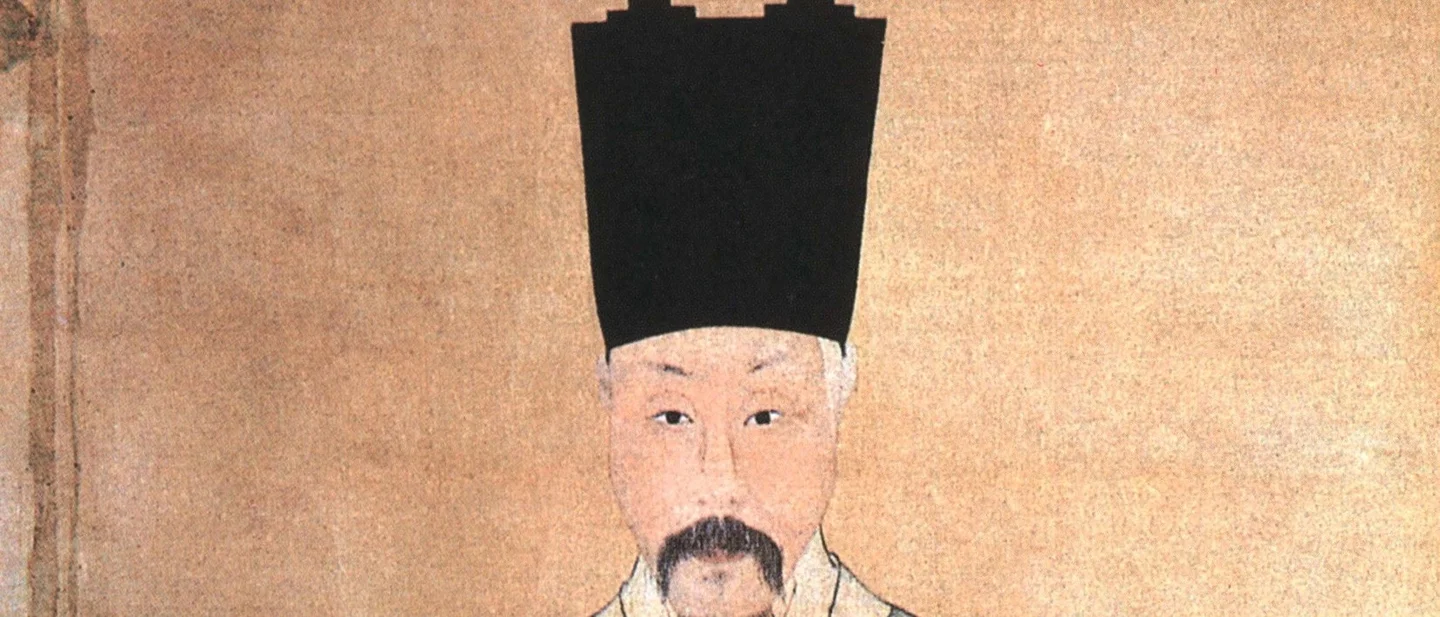
The book is The Cloud Dream of the Nine (구운몽, 九雲夢), usually credited to Kim Man-jung (1637–1692), a member of the Joseon dynasty's scholar-official class who passed the state civil service examination, rose to be a minister to King Sukjong, and was exiled twice in the factional politics of his day 2. He wrote it during one of those exiles, reputedly to console his mother 3. The novel is set in Tang-dynasty China (618–907), among characters with Chinese names, and its oldest surviving text is in classical Chinese 1.
Its story turns on a bridge. A young monk named Song-jin lives at a monastery on Lotus Peak, one of the five highest of the Southern Peak's seventy-two summits 4. Sent down to the Dragon King to carry his master's thanks, he comes home by way of a stone bridge, where he meets the eight fairy maidens of Queen Wee of the Southern Peak, and cannot get them out of his head. Judged for the desire that one meeting lit in him, he is handed to the constables of Hell and reborn as Yang Shao-yu, a hermit's son who takes first place in the examination, wins the empire's wars, becomes its chancellor, and marries eight women: the same eight fairies. At the end an old priest arrives at his door, and Yang wakes in his cell as Song-jin 1.
The English below is by James Scarth Gale, a Canadian Presbyterian missionary who spent more than thirty years in Korea and worked on the Korean Bible; his 1922 version is described as the first work of Korean literature to appear in English 5. His title page prints the author's dates as 1617–1682; the modern reckoning is 1637–1692 6. What follows is the night after the bridge.
Passage
Song-jin went back to his little hut of meditation while the evening shadows closed down upon the day. Since meeting with the eight fairies his ears had been ringing with sweet voices, and though he tried to forget their beautiful faces and graceful forms he could not succeed. However much he endeavoured to rein in his thoughts he found it impossible. His mind was as that of a person half insane or half intoxicated. He pulled himself together, however, and knelt reverently, saying: "If a man study diligently the Confucian Classics and then grow up to meet a king like Yo or Soon, he can either become a general to go abroad, or be a minister of state at home. He can dress in silk and carry a seal of office at his belt; can bow before the king; can dispense favours among the people; can look on beautiful things with the eyes and hear delightful sounds with the ears. He can have his fill of glory in this life, and can leave a reputation for generations to come; but we Buddhists have only our little dish of rice and flask of water. Many dry books are there for us to learn, and our beads to say over till we are old and grey. It may be high and praiseworthy from the point of view of religion, but the vacant longings that it never satisfies are too deep to mention. Even though one gets to understand all the laws of the Mahayana revelation, though one proclaims the same and finds oneself exalted to the place of sage and teacher, when once the spirit and soul dissipate into smoke and nothingness, who will ever know that a person called Song-jin once lived upon this earth?"— The Cloud Dream of the Nine (구운몽, Kuunmong), by Kim Man-jung (1637–1692), Chapter I, "The Transmigration of Song-jin," in James Scarth Gale's translation (London: Daniel O'Connor, 1922), pages 11–12 6. Quoted as printed, with the edition's spacing before colons and question marks normalised.
Gloss
- "a king like Yo or Soon" — the characters behind the two names are 堯 and 舜, Yao and Shun, the legendary sage-kings of high antiquity whom Chinese and Korean political writing treats as the standard of good rule 7. "Yo" and "Soon" are Korean readings of those characters, which is why Gale spells them the way he does. A reader who takes them for two ordinary kings misses that the monk is naming the best world imaginable, not merely a better one: the original line runs 壯而逢堯舜之君, "in his prime, to meet a ruler like Yao and Shun" 4.
- "our little dish of rice and flask of water" — Gale's rendering of 一盂飯、一瓶水, "a bowl of rice, a bottle of water," the whole estate of a monk 4. In the original the monastery's counter-list is exact and countable: a bowl of rice, a bottle of water, a few scrolls of scripture, a hundred and eight prayer beads. A reader who hears only a mild complaint misses the arithmetic — the monk sets one list against another, and counts.
- "the Mahayana revelation" — Mahayana, "the Great Vehicle," is the branch of Buddhism that took shape in India and became dominant in China and Korea, and its sutras are what Gale calls the revelation 8. The phrase raises the stakes of the whole passage: the monk weighs the highest attainment his tradition can name — the entire canon understood, the seat of a teacher — against a reputation that outlives you.
Close read
The passage is a prayer that turns into an inventory. The narrator sets the scene in three short strokes — the hut, the evening, the mind that will not settle — and then has the boy kneel. What he says while kneeling is addressed to nobody: it is a ledger of what other men get.
The device is the catalogue of parallel clauses. In the Chinese it arrives as clause after clause of the same shape with the subject left out — a general abroad, a minister at home, brocade on the body, a purple cord at the waist, bowing to the ruler, benefit brought to the people. English cannot drop its subject that way, so Gale supplies one, and he supplies the same one every time: "He can dress in silk and carry a seal of office at his belt; can bow before the king; can dispense favours among the people; can look on beautiful things with the eyes and hear delightful sounds with the ears. He can have his fill of glory in this life, and can leave a reputation for generations to come." After the first "He can," the subject falls away again inside the sentence — "can bow," "can dispense," "can look" — so the list stops being a portrait of a man and becomes a row of goods.
The order climbs. Silk and a seal are what he wears; bowing before the king is where he stands; dispensing favours is what he controls; beautiful things and delightful sounds are what he takes in. Then come the two closing items, "his fill of glory in this life" and "a reputation for generations to come." Fame now, and remembrance later. The catalogue has been about those two the whole time.
The turn arrives at the end of the sentence, on a single "but": "but we Buddhists have only our little dish of rice and flask of water." One list answers another, and the second is shorter, built on a different verb. The world's items came with "can," a word of possibility. The monastery's come with "have … only," a word of possession, and then even that verb thins out: "Many dry books are there for us to learn, and our beads to say over till we are old and grey." In this sentence, being a monk is "to say over" — a length of time with age at the end of it.
Then comes the concession that decides the passage: "It may be high and praiseworthy from the point of view of religion, but the vacant longings that it never satisfies are too deep to mention." The two hedges — "may be," "from the point of view of" — are the grammar of a man being fair to something he is preparing to leave, and they cost him nothing. "Vacant" is the load-bearing word. A vacant longing has no particular object, which is why the world's list looks infinite and the monastery's looks short. "Too deep to mention" closes the argument by declining to argue it.
The last move is a question, and it names the speaker in the third person: "when once the spirit and soul dissipate into smoke and nothingness, who will ever know that a person called Song-jin once lived upon this earth?" He asks about a person called Song-jin as though the name belonged to somebody else — the self-effacement he was trained in, spoken aloud as a grievance. The fear underneath the question is the fear of going unnoticed, and the catalogue in the first half was the appetite that produced it.
The novel's answer comes on the next page. Song-jin pleads to be allowed to stay; the master replies: "You desire to go and that is what makes me send you off. If you did not desire to go who would ever think of sending you? You ask 'Where shall I go?' I answer 'To the place where you desire to go'" 6. Then he calls for the Yellow Turban guards, who will take the boy down to Hades. The life that follows — the examination, the chancellorship, eight wives, a name in the histories — is the list Song-jin wrote while kneeling, paid out in full.
Why it still matters
The novel answers the fear in this passage by granting the wish. For chapter after chapter it lets the reader have what the boy in the hut could not stop wanting — rank, victory, beauty, a name — and then it takes the whole of it back and calls it a dream. That is a strange way to build a book and an unexpectedly generous way to make a moral: you are allowed to enjoy the world at length before you are asked what it is worth. It is one reason The Cloud Dream of the Nine has been called "one of the most beloved masterpieces in Korean literature" 1.
The book has stayed in circulation. Gale's 1922 version, the first to carry a Korean literary work into English, was followed by Richard Rutt's translation in 1974 and a Penguin Classics version by Heinz Insu Fenkl in 2019. Uhm Jung-hwa released an album named after the novel in 2017, and in the television drama My Love from the Star one character says the book is the one he lives by 1.
The claim under the story is subtler than a sermon on vanity. When Song-jin wakes, his master's objection is that anyone who thinks the dream and the waking world are two separate things has not woken at all; the dream was the only way to show him the size of his own wanting 1. The book is hard on the wish, and lets the world be.
And the psychology of the passage has not aged a day. Anyone who has made a serious commitment — to a vocation, a marriage, a country, a long piece of work — has knelt somewhere and done Song-jin's arithmetic: here is what I gave up, here is what I am told I am getting, and here, at night, is the part of the bill nobody mentioned. Nothing on his list tempts him in particular. He is afraid of being one of the people nobody remembers, and he has chosen a life that, by its own design, does not put your name on anything. The novel hands him the alternative in full and lets him wake up holding it.
Reflection
Song-jin can name exactly what he has handed over and exactly what he believes he is buying, and under the list sits the fear that no one will ever know he was here. Make that account for a commitment of your own: what did you give up, what did you tell yourself you were getting, and which of the two columns has turned out longer?
References
- 1Wikipedia: The Cloud Dream of the Nine
en.wikipedia.org
- 2Wikipedia: Kim Man-jung
en.wikipedia.org
- 3Digital Library of Korean Literature: Kuunmong
library.ltikorea.or.kr
- 4Chinese Wikisource: 九雲夢, 第一回 (Chapter I)
zh.wikisource.org
- 5Wikipedia: James Scarth Gale
en.wikipedia.org
- 6
- 7Wikipedia: Yao and Shun
en.wikipedia.org
- 8Wikipedia: Mahayana
en.wikipedia.org
This story was produced automatically by a channel. One sentence is all it takes for Neodrop to keep producing for you.