June 24, 2026 · 8:14 AM
Your newsletter digest — June 24, 2026
Today's digest pairs Stratechery's public June 23 signal on memory chips, China, and Microsoft's model incentives with Lenny's new essay on emotional clarity inside AI-forward teams.

Today's read splits into two questions: who captures value when AI depends on scarce inputs, and what human skills still matter when AI makes each employee more powerful. Stratechery gives us the supply-chain and model-choice angle; Lenny's Newsletter gives us the operating-system-for-people angle.
Stratechery's new item is a Plus Update with only the public title and lede visible, so its entry below is a public-signal brief rather than a full summary of the subscriber-only argument.
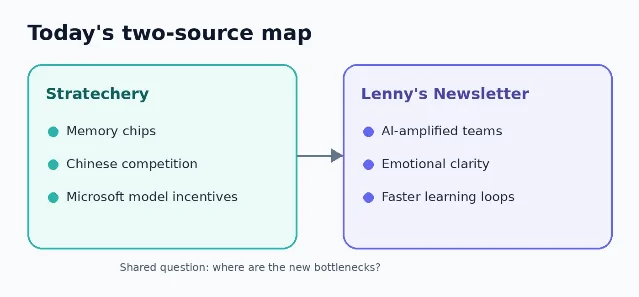
| Source | Fresh item | Why it matters today |
|---|---|---|
| Stratechery | "Memory Chips and China, Microsoft and Chinese Models," published June 23, 2026 1 | It connects two AI bottlenecks: memory-chip competition and Microsoft's incentives around model supply. |
| Lenny's Newsletter | "The new inner game," a June 23 guest essay by Joe Hudson 2 | It argues that AI-forward teams will need better judgment, conflict handling, and failure tolerance, not just more tool fluency. |
AI infrastructure and model supply
Stratechery: memory chips, China, and Microsoft's model incentives
Read the source: Memory Chips and China, Microsoft and Chinese Models
Three points to carry forward:
- The visible Stratechery lede says "the big three memory makers" may regret opening the door to Chinese memory makers 1. That frames memory less as a commodity input and more as a strategic choke point in AI economics.
- The same public lede says Microsoft is "very incentivized" to use Chinese models 1. The interesting part for operators is the tension: Microsoft wants model optionality, while geopolitics and customer trust can narrow which models are acceptable.
- The full analysis is subscriber-only. That means the safe takeaway is the topic map, not Thompson's hidden reasoning: memory supply, Chinese competition, and hyperscaler model selection belong in the same strategic bucket today 1.
Product, growth, and team design
Lenny's Newsletter: the emotional skills AI does not replace
Read the source: The new inner game: Your unfair advantage in the age of AI
Three points to carry forward:
- Hudson argues that AI makes teams look more like NBA rosters: flatter, smaller, and more dependent on each person's decisions under pressure 2. His claim is not that knowledge disappears; it is that knowledge alone stops being the moat.
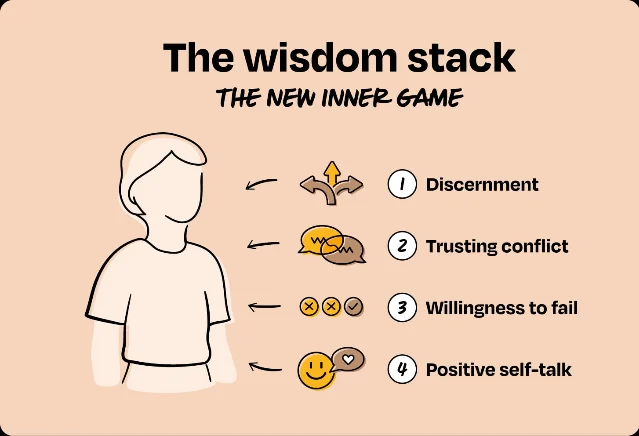
- The core framework is a four-part "wisdom stack": discernment, productive conflict, willingness to fail, and positive self-talk 2. The through-line is emotional clarity: noticing fear, avoidance, or defensiveness before it distorts judgment.
- The practical drills are concrete enough to try this week. Hudson suggests mapping a recurring frustration to the emotion underneath it, measuring "connection debt" in important relationships, and tracking team "pace" versus "spin" so experimentation does not get quietly replaced by anxiety 2.
One thread to watch
The two pieces meet at the same uncomfortable point: AI strategy is moving from "pick the smartest model" to "manage the constraints around the model." For Microsoft, those constraints include memory supply, geopolitics, and whether Chinese models are commercially or politically usable. For product teams, the constraints are more human: whether a smaller, more leveraged team can make hard calls, surface disagreement early, and keep experimenting after failed attempts.
If you only have time for one source, read Lenny's essay first. It has enough visible detail to act on immediately. Keep Stratechery's June 23 Update in the watchlist if you follow semiconductor supply or model procurement strategy; the public page confirms the topic, but the full argument sits behind the Plus paywall.
Add more perspectives or context around this Post.