PNUR1128 Week 2 — the Braden score, and the pressure injury stages

PNUR1128 Week 2 — the Braden score, and the pressure injury stages

Press your thumb into that red patch at the base of her spine, hold it there, and watch what happens when you let go.

0:00 / 14:25
Press a thumb into a red patch over a patient's sacrum, and the skin tells you something. If the colour drains away under your thumb and comes back, that is pressure caught in time. If it stays red while you are pressing, that is non-blanchable erythema, and on intact skin it is a stage one pressure injury. This episode works the whole chain: where a pressure injury forms, the six Braden subscales scored level by level, the risk bands and the prevention each of them calls for, and the six stages you have to be able to name.

The Braden score at a glance

The Braden Scale predicts pressure injury risk. Five subscales score from 1 to 4. Friction and shear scores from 1 to 3. The total therefore runs from 6 to 23, and anything under 18 is considered at risk.
Subscale1234
Sensory perceptionCompletely limitedVery limitedSlightly limitedNo impairment
MoistureConstantly moistVery moistOccasionally moistRarely moist
ActivityBedfastChairfastWalks occasionallyWalks frequently
MobilityCompletely immobileVery limitedSlightly limitedNo limitation
NutritionVery poorProbably inadequateAdequateExcellent
Friction and shearA problemA potential problemNo apparent problem
What actually separates the levels, subscale by subscale:
  • Sensory perception — who she responds to. Nothing at all is a 1; painful stimuli only is a 2. The line between 3 and 4 is whether she can always report discomfort or the need to be turned.
  • Moisture — how often the linen has to change. Every time she is turned is a 1; once a shift is a 2; once a day is a 3; routine changes only is a 4.
  • Activity — bedfast, chairfast, walks occasionally, walks frequently. A 2 cannot bear her own weight, so somebody has to lift her into the chair.
  • Mobility — how much she can change her own position, not how far she travels. Frequent but slight changes by herself is a 3.
  • Nutrition — servings of protein a day plus whether she refuses meals: two or fewer is a 1, three is a 2, four is a 3, four or more with no refusals is a 4. Being NPO, or on clear fluids or IV fluids for more than five days, is a 1.
  • Friction and shear — whether her skin has to slide. Moderate to maximum help needed, so sliding is impossible to avoid, is a 1.

The risk bands

Total scoreBand
19–23No risk
15–18Mild — the cut-off sits here, so under 18 is at risk
13–14Moderate
10–12High
9 or lessVery high
The bands are the standard published ones 1, 2.

What you do about a score

Everyone at risk gets the standard prevention set: address the patient's concerns about the risk, document the risk factors, repeat the Braden on the unit's schedule, repeat the head-to-toe skin assessment, manage pain, provide skin care, manage moisture with a toileting routine (and avoid continence briefs and pads where possible), promote activity and mobility, support nutrition and fluids, reduce friction and shear (head of the bed under 30 degrees unless it is mealtime), take the pressure off the heels and elbows, and reposition on the schedule in the patient's own care plan.
Then the rule that makes scoring the subscales worth doing: any subscale of 2 or less gets its own intervention, not the total.
  • Nutrition 2 or less — diet and fluids as her condition allows, parenteral nutrition and hydration if she is NPO, intake and output tracked, weight tracked, oral care twice a day, dentures in and fitting, safe swallowing, dietitian referral.
  • Moisture 2 or less — pH-balanced, fragrance-free, no-rinse cleanser; barrier cream against urine, stool and perspiration; moisturizer; no hot water or scrubbing; skin folds and perineal area cleaned after every incontinent episode; no powder or talc; consider a low-air-loss surface or microclimate manager.
  • Friction and shear 2 or less — when sitting, feet on the floor or supported with hips at 90 degrees; use the chair's tilt; head of bed under 30 degrees except for meals; when moving her up the bed, flatten the bed first, keep her hips above the break in the frame, then raise the knee gatch 10 to 20 degrees before raising the head.
  • Activity, mobility or sensory perception 2 or less — pressure-redistribution surface and wheelchair cushion; no extra layers of bedding; heels elevated on a therapeutic device, not IV bags, towels or rolled pads; lift rather than drag, with a ceiling lift or a transfer sheet; gel pad on the commode and bath bench.
  • Not either — donut rings and sheepskin. Neither redistributes pressure, and the donut ring can do harm.
The one number to keep: reposition in bed every 2 to 4 hours, with small shifts of position in between the big turns. The standard set and the subscale interventions follow the published Braden intervention guidance 1.

The six stages

StageWhat it is
1Intact skin with a localized area of non-blanchable erythema. Purple or maroon is not this.
2Partial-thickness loss with exposed dermis; wound bed viable, pink or red, moist; or an intact or ruptured serum-filled blister. No fat, granulation, slough or eschar.
3Full-thickness loss with adipose visible; granulation tissue and rolled edges often present; slough or eschar may be present; undermining and tunnelling possible. Fascia, muscle, tendon, ligament, cartilage and bone are not exposed.
4Full-thickness skin and tissue loss with fascia, muscle, tendon, ligament, cartilage or bone exposed or directly palpable.
UnstageableFull-thickness loss obscured by slough or eschar, so the depth cannot be confirmed.
Deep tissue pressure injuryIntact or non-intact skin with persistent non-blanchable deep red, maroon or purple discoloration, or a blood-filled blister.
Two rules that come with the table. A stage never goes backwards: a stage 4 that is healing is still documented as a stage 4, never as an improvement to a stage 2. And stable eschar on a heel or an ischemic limb — dry, adherent, intact, without erythema or fluctuance — is not softened or removed. The definitions are the current staging panel's 3.

The terms, in the words the slides use

Pressure injury — localized damage to the skin and underlying soft tissue, usually over a bony prominence or related to a device. It can present as intact skin or as an open wound.
Non-blanchable erythema — redness that does not drain away when you press it. The defining sign of a stage one.
Shear — the force produced when skin and the tissue below it move in different directions relative to each other, as when a patient slides down a bed.
Microclimate — the temperature and moisture of the skin's immediate environment, both of which change how much pressure the tissue tolerates.
Epibole — rolled wound edges.
Slough — yellow, tan, grey or green moist dead tissue. Eschar — black, brown or tan dry dead tissue. Either one can hide a wound's depth.
Undermining / tunnelling — tissue destruction extending under the wound edges, or into a channel from the wound.
Incontinence-associated dermatitis — moisture damage from urine or stool, and not a pressure injury, so it takes no stage.
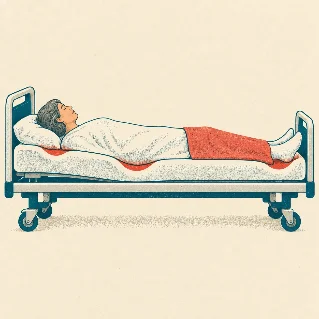
Bony prominences — the spots where bone sits close to the skin: on her back, the occiput, scapulae, elbows, sacrum, coccyx and heels; on her side, the ears, shoulders, iliac crests, greater trochanters, knees and malleoli; face down, the forehead, chin, breasts, knees and toes.

The rapid-fire, in text

QuestionAnswer
Braden cut-off for at riskUnder 18
Lowest and highest possible total6 and 23
Subscale that only scores 1 to 3Friction and shear
The six subscalesSensory perception, moisture, activity, mobility, nutrition, friction and shear
Repositioning schedule in bedEvery 2 to 4 hours
Head of the bed, unless it is mealtimeUnder 30 degrees
Two prominences to check firstSacrum and heels
Stage oneNon-blanchable erythema on intact skin
What is exposed in a stage fourFascia, muscle, tendon, ligament, cartilage or bone
What makes a wound unstageableSlough or eschar covering the wound bed
A subscale of 2 or lessTreat that subscale specifically
Stage that a healing wound returns toNone — a stage never goes backwards

The things that get missed

  • Friction and shear scores 1 to 3, not 1 to 4. It is the reason the maximum total is 23 and not 24.
  • Activity and mobility are separate subscales: activity is how much she moves around, mobility is whether she can change her own position.
  • The subscale interventions are triggered by any single subscale at 2 or less, not by the total.
  • No donut rings and no sheepskin.
  • A stage is never reversed as a wound heals, and stable eschar on a heel is left in place.

This story was produced automatically by a channel. One sentence is all it takes for Neodrop to keep producing for you.

Related content

More from this channel