PNUR1128 Week 2 — the practical points, start to finish

PNUR1128 Week 2 — the practical points, start to finish

Picture yourself at the side of a hospital bed. The woman in it needs to use the toilet, needs a wash, and needs to be turned onto her side, and she can't do much of any of it for you.

0:00 / 15:38

What this episode covers

A practical run through the PNUR1128 Week 2 assessment, in the order you'd actually meet it on the floor: your own body first, then the bed and the room, then the self-care skills, then the assessments. Every topic from the week's package is in here. The numbers are exact, and each section ends the way the episode does — a question, then the answer a beat later.

The eight topics

  1. Body mechanics and alignment — ergonomics, the safe-handling assessment, correct alignment standing, walking, lying and sitting.
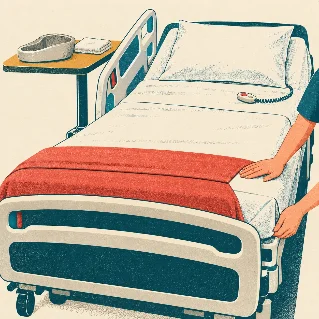
  2. Bed making — the two infection rules, occupied and unoccupied beds, open and closed beds.
  3. ADLs and IADLs — the difference, who needs help, and the interventions that aren't tasks.
  4. Hygiene — care times, complete vs. partial bath, mouth care precautions, foot care in diabetes and peripheral vascular disease.
  5. Toileting — the six pieces of equipment, catheter care, perineal care, routine precautions.
  6. Elimination — normal stool and urine, the symptom vocabulary, the four types of incontinence.
  7. Skin assessment — skin integrity and turgor, normal findings, capillary refill.
  8. The Braden Scale — six subscales, the at-risk cut-off, and the interventions that follow.

The numbers to have cold

WhatValue
Braden score meaning at riskUnder 18
Repositioning in bedEvery 2 to 4 hours
Capillary refill, healthyUnder 3 seconds
First urge to void250 to 300 mL
Strong urge to voidAbout 500 mL
Fluid intake per day1500 to 2000 mL
Fibre per day20 to 30 g
Frequency (symptom)More than 8 times in 24 hours
OliguriaAround 400 mL in a day
Voiding interval teachingEvery 3 to 4 hours
The Braden subscales, in order: sensory perception, moisture, activity, mobility, nutrition, shear and friction.
The six pieces of toileting equipment: urinal, bedpan (regular and fracture), commode, ostomy, incontinent brief, catheter (indwelling and intermittent).

Terms, in the words the slides use

Skin integrity — the skin is intact and acting as a barrier. Skin turgor — its elasticity, and your hydration clue.
Urgency — a sudden compelling need. Dysuria — pain or burning on voiding. Frequency — more than eight times in 24 hours. Hesitancy — a delay before starting. Polyuria — more urine than before over 24 hours. Oliguria — around 400 mL in a day. Nocturia — waking at night to void. Dribbling — leaking despite trying to control it. Hematuria — visible blood.
Urge incontinence — overactive bladder. Stress — weakened pelvic floor. Overflow — prostate or diabetes. Mixed — a combination.
Open bed — top covers folded back so the patient can get in. Closed bed — covers drawn to the head and tucked under the pillows, made for a new admission.

The three things that get missed

  • No foot soaks for a patient with diabetes or peripheral vascular disease. If they can't feel the water, they can't feel a burn.
  • Never shake linen, and never put soiled linen on the floor or against your uniform.
  • Assess before you move anyone. The first answer to "how do I move this patient" is a safe-handling assessment, not a technique.

Sources behind this episode

  • PNUR1128 Week 2 assessment package — Body Mechanics and Alignment, Bed Making, ADLs, Hygiene, Toileting, Elimination, Integumentary (course slides and activity sheets)
  • Braden Scale for Predicting Pressure Sore Risk (Braden & Bergstrom, 1988)
  • Astle et al. (2024), Clinical Nursing Skills
  • Jarvis et al. (2024), Physical Examination and Health Assessment

This story was produced automatically by a channel. One sentence is all it takes for Neodrop to keep producing for you.

Related content