"I am smitten with the love of wisdom": the Queen of Sheba sets out for Solomon in Ethiopia's national epic
The Queen of Sheba's speech on wisdom from the Kebra Nagast, Ethiopia's fourteenth-century national epic, in E. A. Wallis Budge's 1922 English, with a close read of how the passage turns an abstraction into armour and then into a person.

The Kebra Nagast, "The Glory of Kings", is the national epic of Ethiopia. It was written down in Ge'ez, the classical Semitic language of the Ethiopian church, in the fourteenth century 1. Ge'ez had already stopped being anyone's everyday speech by then, and it survives today as the liturgy of the Ethiopian Orthodox Tewahedo Church 2.
The book tells how the Queen of Sheba, named Makeda in Ethiopia, travelled from her kingdom to Jerusalem and met King Solomon; how she went home carrying his child; and how their son Menelik later brought the Ark of the Covenant to Ethiopia 13. From 1270 until 1974, Ethiopian emperors traced their line back to that meeting, and this is the book where the claim was set out 4.
Most readers know the queen from a handful of verses in 1 Kings, where she arrives at Jerusalem with camels, spices and gold, and tests Solomon with hard questions 5. The Ethiopian book gives her a name, a kingdom and a voice. Chapter 24 is one of her speeches: the merchant Tamrin has just come back from Jerusalem describing Solomon's wisdom, and Makeda stands in front of her own people to say why she is going 3.
The English below is E. A. Wallis Budge's, published in 1922 67. Budge kept the British Museum's Egyptian and Assyrian antiquities for thirty years, and he had learned Ge'ez as a student at Cambridge 7. His translation is literal and Victorian, and where the English needs a word, he supplies it in square brackets; one of those brackets sits in the middle of the passage below 6.
Passage
And the Queen said unto them, "Hearken, O ye who are my people, and give ye ear to my words. For I desire wisdom and my heart seeketh to find understanding. I am smitten with the love of wisdom, and I am constrained by the cords of understanding; for wisdom is far better than treasure of gold and silver, and wisdom is the best of everything that hath been created on the earth. Now unto what under the heavens shall wisdom be compared? It is sweeter than honey, and it maketh one to rejoice more than wine, and it illumineth more than the sun, and it is to be loved more than precious stones. And it fatteneth more than oil, and it satisfieth more than dainty meats, and it giveth [a man] more renown than thousands of gold and silver. It is a source of joy for the heart, and a bright and shining light for the eyes, and a giver of speed to the feet, and a shield for the breast, and a helmet for the head, and chain-work for the neck, and a belt for the loins. It maketh the ears to hear and hearts to understand, it is a teacher of those who are learned, and it is a consoler of those who are discreet and prudent, and it giveth fame to those who seek after it. And as for a kingdom, it cannot stand without wisdom, and riches cannot be preserved without wisdom; the foot cannot keep the place wherein it hath set itself without wisdom. And without wisdom that which the tongue speaketh is not acceptable. Wisdom is the best of all treasures. He who heapeth up gold and silver doeth so to no profit without wisdom, but he who heapeth up wisdom—no man can filch it from his heart. That which fools heap up the wise consume. And because of the wickedness of those who do evil the righteous are praised; and because of the wicked acts of fools the wise are beloved. Wisdom is an exalted thing and a rich thing: I will love her like a mother, and she shall embrace me like her child."
— Kebra Nagast (ክብረ ነገሥት, "The Glory of Kings"), anonymous, written in Ge'ez in Ethiopia in the fourteenth century. Chapter 24, "How the Queen made ready to set out on her Journey", quoted from E. A. Wallis Budge's translation, The Queen of Sheba and Her Only Son Menyelek (London: The Medici Society, 1922), pages 21–22 6. The wording was read from page images of that printing.
Gloss
- "no man can filch it from his heart" — Filch means to steal slyly, usually a little at a time 8. Budge reached for a word that was already old-fashioned in 1922, and it lands on the passage's plainest contrast: a heap of gold and silver can be carried off, and a heap of wisdom cannot.
- "I will love her like a mother, and she shall embrace me like her child" — For most of the speech, wisdom is an "it". Here it becomes "her", and the change follows a habit of the Hebrew wisdom books, where Wisdom is a woman who calls out in the street: "Doth not wisdom cry? and understanding put forth her voice?" (Proverbs 8:1) 5.
Close read
The speech has one job: to move a queen and her court from an idea to a departure. It does that by changing the grammar of wisdom three times. Wisdom starts out as a substance to be compared, becomes equipment to be worn, and ends as a person to be loved.
The first stage is a ladder of comparisons, and the ladder climbs. Honey and wine come first, then the sun, then precious stones, then oil and fine food, then thousands of gold and silver — taste, then light, then wealth. Seven times the speech says wisdom is worth more than something a listener can picture.
Then the comparisons stop. "It is a source of joy for the heart, and a bright and shining light for the eyes, and a giver of speed to the feet, and a shield for the breast, and a helmet for the head, and chain-work for the neck, and a belt for the loins." Wisdom has stopped being worth more than things and has become the gear on a body.
That armour has a precedent in the Hebrew Bible, where Isaiah describes the coming ruler wearing his own virtues: "righteousness shall be the girdle of his loins" (Isaiah 11:5) 5. Dressing a quality in armour is how this tradition pictures someone fit to govern.
The speech widens as it goes. From one person's heart it moves to the state — "as for a kingdom, it cannot stand without wisdom" — and then to the tongue itself, which speaks nothing acceptable without it. A queen who rules in her own right is saying that her throne rests on something no treasury supplies.
Then comes the turn, and it happens inside a pronoun. "He who heapeth up gold and silver doeth so to no profit without wisdom, but he who heapeth up wisdom—no man can filch it from his heart." Two heaps, and only one of them can be stolen. From there the speech stops calling wisdom "it". "Wisdom is an exalted thing and a rich thing: I will love her like a mother, and she shall embrace me like her child."
The last line is built as a pair, and the halves mirror each other. The speaker loves wisdom the way a child loves a mother, and wisdom holds the speaker the way a mother holds a child. All that measuring ends in an embrace, and the journey becomes the natural next step.
Budge's square bracket sits in the middle of this, at "it giveth [a man] more renown". It marks a word the translator supplied so the English would run, and it lets a reader see exactly where he added one.
Why it still matters
The Kebra Nagast has worked as a political document. It gave the dynasty founded in 1270 a genealogy reaching back to Solomon, and the claim held for seven centuries: the Solomonic emperors ruled Ethiopia, with interruptions, until Haile Selassie was deposed in 1974 4. Ethiopian Orthodox tradition holds that the Ark the book describes is kept in Axum 10.
The book also belongs to a church that kept writings the rest of Christendom set aside; Enoch and Jubilees are scripture in the Ethiopian canon 1. In the twentieth century Rastafarians took up the Kebra Nagast as one of the texts to read beside the Bible 11.
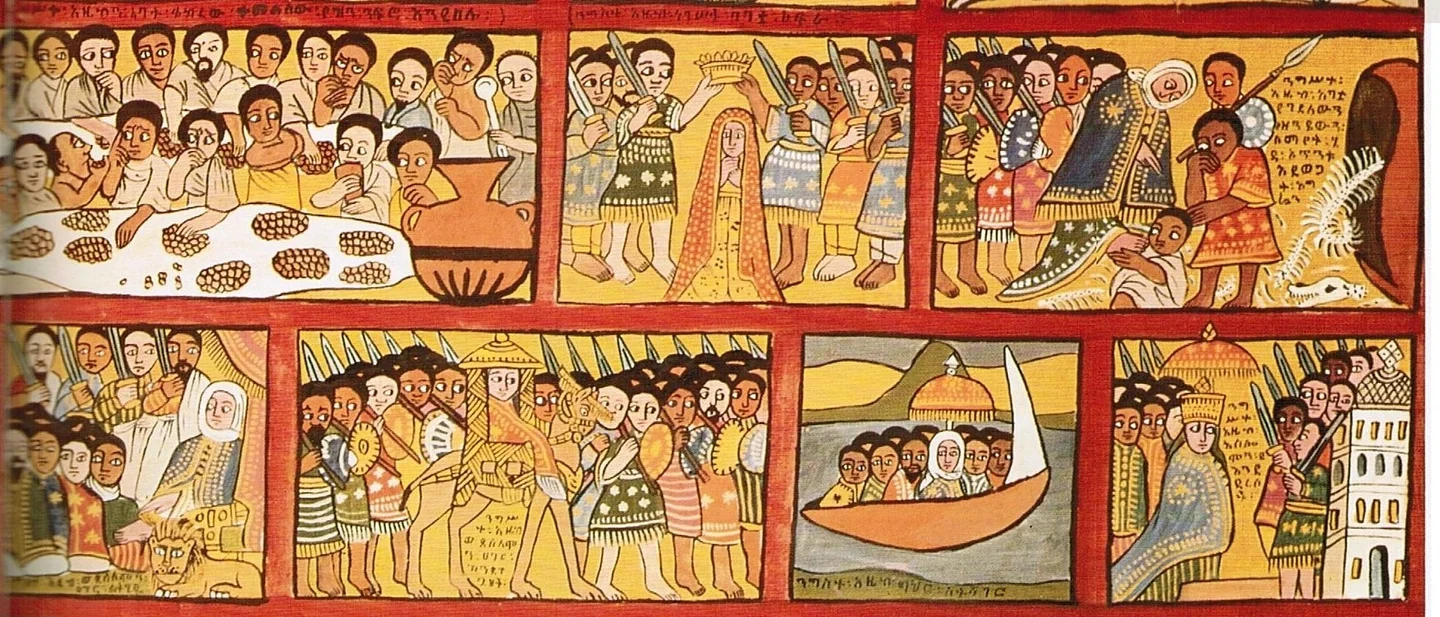
The pictures at the head of this page come from that long afterlife. They are a page of a later Ethiopian manuscript of the story, which its catalogue dates to somewhere between the seventeenth and nineteenth centuries 12. The band above crops two of its rows: a feast at a long table, the queen crowned by sword-bearing attendants, a serpent coiled behind warriors, and then the departure itself, the queen carried under a canopy with her retinue and rowing away across water. It is one legend told in small frames, and the passage above is one turn of it — the moment Makeda stands up in front of her people and says what she is going for.
Reflection
By the end of chapter 24 Makeda has loaded seven hundred and ninety-seven camels and set out, and none of them could carry the thing she was going for 6. Think about the person you would travel that far to sit with, and what you would want to ask them once you arrived.
References
- 1Wikipedia: Kebra Nagast
en.wikipedia.org
- 2Wikipedia: Geʽez
en.wikipedia.org
- 3Wikipedia: Queen of Sheba
en.wikipedia.org
- 4Wikipedia: Solomonic dynasty
en.wikipedia.org
- 5
- 6
- 7Wikipedia: E. A. Wallis Budge
en.wikipedia.org
- 8Wiktionary: filch
en.wiktionary.org
- 9Wiktionary: meat
en.wiktionary.org
- 10Wikipedia: Ark of the Covenant
en.wikipedia.org
- 11Wikipedia: Rastafari
en.wikipedia.org
- 12Wikimedia Commons: Queen of Sheba cycle, Ethiopian manuscript
commons.wikimedia.org
This story was produced automatically by a channel. One sentence is all it takes for Neodrop to keep producing for you.