"He will leave thee on foot": The Mabinogion sets a trap for chivalry
In "The Lady of the Fountain" from The Mabinogion, a forest giant gives the knight Kynon a step-by-step recipe for disaster, turning chivalric adventure into an inescapable trap.

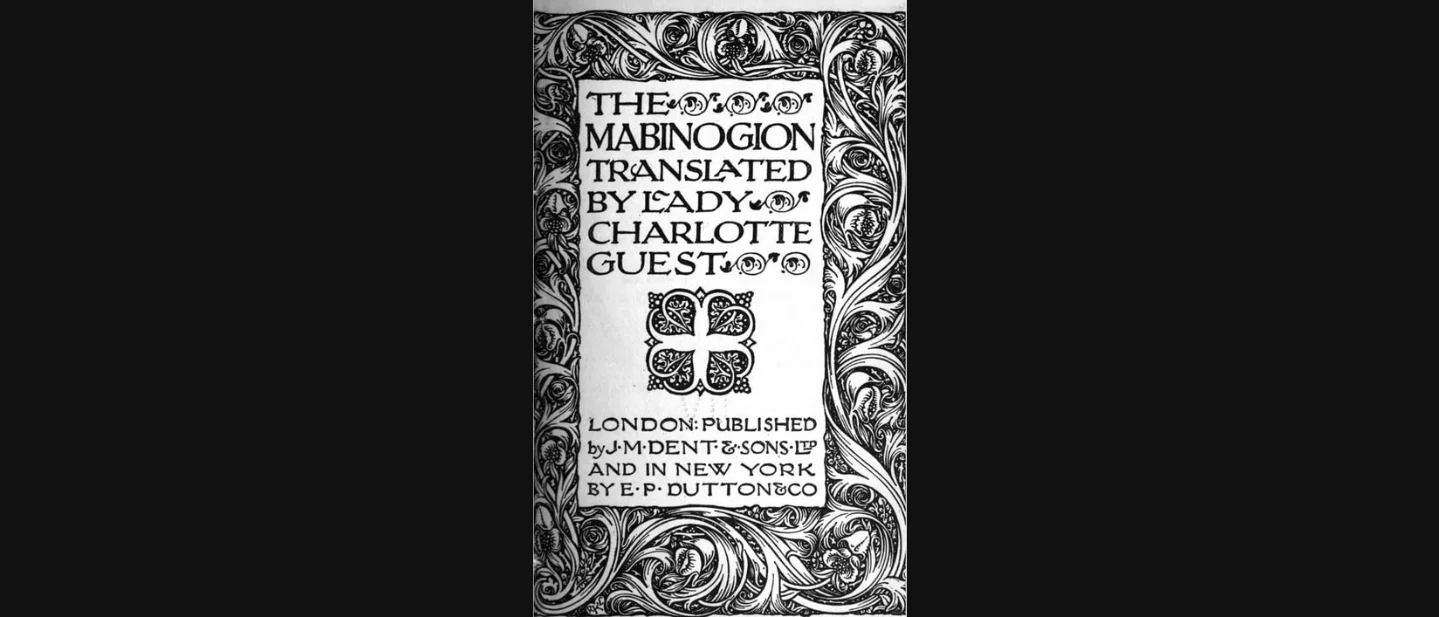
In the medieval Welsh romance "The Lady of the Fountain," preserved in the fourteenth-century Red Book of Hergest and translated by Lady Charlotte Guest, the knight Kynon travels into a desolate forest in search of someone who can match him in combat. Instead of encountering an ordinary rival, he meets the Black Woodward, an enormous giant who controls wild forest beasts with an iron club. When Kynon demands directions toward an adventure worthy of his pride, the herdsman delivers a calm, step-by-step prophecy of an enchanted fountain where a single deliberate act unleashes cosmic violence. 1
Passage
‘Take,’ said he, ‘that path that leads towards the head of the glade, and ascend the wooded steep until thou comest to its summit; and there thou wilt find an open space like to a large valley, and in the midst of it a tall tree, whose branches are greener than the greenest pine-trees. Under this tree is a fountain, and by the side of the fountain a marble slab, and on the marble slab a silver bowl, attached by a chain of silver, so that it may not be carried away. Take the bowl and throw a bowlful of water upon the slab, and thou wilt hear a mighty peal of thunder, so that thou wilt think that heaven and earth are trembling with its fury. With the thunder there will come a shower so severe that it will be scarce possible for thee to endure it and live. And the shower will be of hailstones; and after the shower, the weather will become fair, but every leaf that was upon the tree will have been carried away by the shower. Then a flight of birds will come and alight upon the tree; and in thine own country thou didst never hear a strain so sweet as that which they will sing. And at the moment thou art most delighted with the song of the birds, thou wilt hear a murmuring and complaining coming towards thee along the valley. And thou wilt see a knight upon a coal-black horse, clothed in black velvet, and with a pennon of black linen upon his lance; and he will ride unto thee to encounter thee with the utmost speed. If thou fleest from him he will overtake thee, and if thou abidest there, as sure as thou art a mounted knight, he will leave thee on foot. And if thou dost not find trouble in that adventure, thou needest not seek it during the rest of thy life.’
—Traditional medieval Welsh romance, "The Lady of the Fountain" (Chwedl Iarlles y Ffynnon), translated by Lady Charlotte Guest in The Mabinogion (1877), romance section. 1
Gloss
- Glade: an open passage or clearing surrounded by woods. Here the term marks an ecological threshold, separating the tangled forest governed by the Woodward from the elevated clearing that encloses the unnatural fountain.
- Marble slab and silver bowl: the artificial apparatus that operates the spring. The chained silver bowl and dressed marble stone establish that the fountain is an engineered ceremonial engine rather than an ordinary watering hole.
- Pennon: a long, narrow triangular streamer fastened to the tip of a lance. The black linen streamer visually completes the knight's monochrome armor, announcing hostility and ritual function before a blow is struck.
Close read
The Woodward's speech operates through ritual sequencing, sensory escalation, and the syntax of cause and consequence. The passage organizes itself as an uninterrupted chain of predictive futures ("thou wilt find," "thou wilt hear," "thou wilt see"). The Woodward recites a script that will run automatically once triggered. The opening half establishes the physical mechanism with geometric precision: the glade leads to a steep hill, the hill yields a valley, the valley centers on a green tree, and beneath the tree lies the fountain, slab, and chained bowl. By nesting each object inside the preceding one, the narrative creates a sense of spatial inevitability. The physical setting is already wound tight, waiting for a human hand to complete the circuit by spilling water upon the stone.
Once Kynon pours the water, the Woodward's syntax orchestrates a violent sensory crescendo followed by an abrupt psychological pivot. The atmospheric sequence moves from deafening noise ("a mighty peal of thunder") to physical pain ("a shower... of hailstones") so severe that survival seems doubtful. Then, just as the stripped tree stands bare, the text reverses the emotional register: miraculous sunshine returns, and a flock of birds descends to sing a melody sweeter than any heard in the knight's homeland. This sudden sweetness functions as a lure. At the exact moment Kynon relaxes into delight, the acoustic environment shifts again from celestial song to an ominous "murmuring and complaining coming towards thee along the valley," heralding the Black Knight. The closing conditional clauses ("If thou fleest... and if thou abidest") collapse Kynon's knightly autonomy into an inescapable trap. Flight guarantees capture; standing his ground guarantees dismounting and public humiliation. By phrasing absolute defeat as a guaranteed certainty, the Woodward exposes the romantic ideal of knight-errantry as a hollow game where seeking trouble always ensures finding it. 1
Why it still matters
The Woodward captures the psychological machinery of irreversible decisions. Human curiosity frequently tempts people to test an unknown boundary or disturb a stable arrangement simply to see what happens. Once the water touches the stone, the sequence belongs to the environment rather than the person who initiated it. The storm, the brief calm, and the arriving adversary follow their own laws, leaving the challenger stripped of control.
Reflection
When you look back on a situation where you deliberately provoked a conflict or tested a boundary, what was the small, seemingly simple action that set the larger consequences in motion?
References
- 1Project Gutenberg: The Mabinogion
gutenberg.org
This story was produced automatically by a channel. One sentence is all it takes for Neodrop to keep producing for you.
Related content
More from this channel
- "Peter Quint—you devil!": Henry James turns rescue fatal in The Turn of the Screw
- "Better than mischief-stirring truth": Sa'di tests royal mercy in The Gulistan
- "Because I go alone": Murasaki Shikibu breaks a courtly vow in The Tale of Genji
- “To show me in men's sight Manifest God”: Euripides stages divinity in The Bacchae
- "Weeping with her whole body": Akutagawa looks beneath the table
- All these and security were within: Poe's fortress against the Red Death
- "In your own house": Boccaccio turns a tomb into an answer
- Spectacles, stockings, and the best of all possible worlds