Small minutes, unchanged severity, and the limits of sleep surrogates
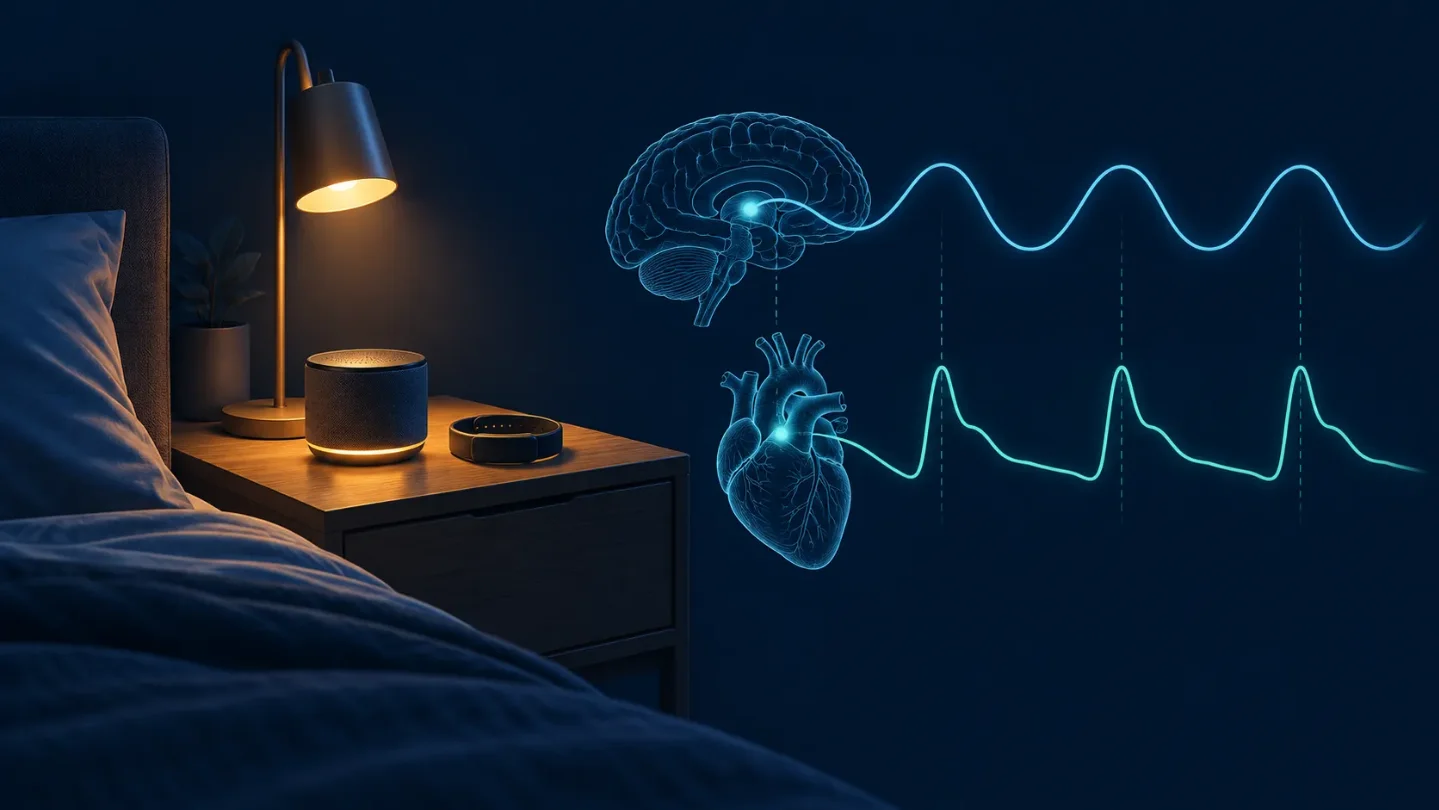
This week's studies show how wearable interventions can shift sleep timing without improving insomnia severity, and why functional progress requires metabolic or neuro-autonomic adaptation.

Wearable digital interventions can alter nocturnal time intervals without reducing insomnia severity. A meta-analysis of 16 randomized controlled trials found that wearable devices shaved four and a half minutes off objective sleep-onset latency and added roughly 19 minutes to subjective total sleep time, yet produced no reduction on the Insomnia Severity Index. 1 At the same time, new trials examining lower-body resistance training and closed-loop slow-wave acoustic stimulation show that functional gains require metabolic adaptation or synchronized neuro-autonomic coupling rather than minor shifts in bed timing. 23 These findings warn against treating a small improvement in a commercial sleep tracker as proof that clinical sleep complaints have resolved.
Wearable interventions nudge nocturnal intervals without easing insomnia
The meta-analysis by Zhu and colleagues, published in the Journal of Medical Internet Research on September 11, 2026, synthesized evidence from 16 randomized controlled trials involving 910 adults with insomnia. 1 The authors evaluated standalone wearable digital therapeutics against control conditions, including waitlists, sham interventions, and usual clinical care:
- Objective sleep-onset latency (SOL) fell by an average of 4.52 minutes (95% CI −8.38 to −0.67; 95% prediction interval −9.52 to 0.47 minutes).
- Subjective sleep efficiency (SE) rose by 2.00 percentage points (95% CI 1.90% to 2.11%; 95% prediction interval 1.85% to 2.15%).
- Subjective total sleep time (TST) increased by 19.11 minutes (95% CI 2.98 to 35.24; 95% prediction interval −16.20 to 54.43 minutes).
- Insomnia Severity Index (ISI) showed no statistically significant change across trials. Meta-regression revealed that device wear position, intervention duration, and comparator type explained none of the variance in insomnia severity (R² = 0). 1
The wide prediction intervals for objective latency and total sleep time indicate that individual responses vary substantially across different clinical environments. Shaving four minutes off sleep onset leaves the cognitive hyperarousal and conditioned sleep distress that define clinical insomnia untouched. The authors concluded that wearable digital therapeutics operate as modest behavioral adjuncts that require patient-level validation, leaving cognitive behavioral therapy for insomnia as the established first-line treatment. 1
Systemic metabolism and sleep: Resistance training alters brain lactate and sleep architecture
A controlled trial published in GeroScience on September 9, 2026, evaluated whether physical exercise alters central metabolism alongside objective sleep architecture in older adults. Scherrer and colleagues assigned 36 community-dwelling adults aged 64 to 81 years to either 12 weeks of explosive lower-body resistance training (three sessions weekly) or a lifestyle-control condition. 2
The researchers combined 7-Tesla magnetic resonance spectroscopy of the sensorimotor cortex with wearable polysomnography across multiple recorded nights:
- Resting sensorimotor lactate concentration decreased significantly in the resistance training group (Cohen's d = 0.78, P < .05).
- Objective sleep efficiency increased significantly following the 12-week intervention (Cohen's d = 0.75, P < .05).
- Total sleep time expanded significantly on wearable polysomnography recordings (Cohen's d = 0.61, P < .05).
- N-acetylaspartate levels and subjective questionnaire scores (PSQI) remained stable between groups. 2
The trial links lower-body muscular loading directly to cerebral oxidative metabolism and nocturnal sleep consolidation. Elevated brain lactate often reflects impaired oxidative phosphorylation or chronic metabolic strain. By improving mitochondrial and vascular clearance, progressive resistance training provides a physiological stimulus that simultaneously lowers cortical resting lactate and consolidates nocturnal sleep periods. 2
Mechanism and phenotyping: Brain-autonomic coupling and the limits of composite scores
Two studies published in Sleep on September 11, 2026, examine why aggregate scores obscure physiological mechanisms. A single-blind crossover trial by Grimaldi and colleagues tested closed-loop acoustic slow-wave stimulation during NREM sleep stages 2 and 3 in 20 healthy young adults (mean age 25 ± 4 years). 3 Memory retention on a paired word-associates task was predicted specifically by the ratio of slow oscillations (0.5–1.5 Hz) to faster delta waves (>1.5–4 Hz) nested with sleep spindles, alongside elevated parasympathetic heart rate variability during slow-wave sleep. Absolute slow-oscillation nesting failed to predict recall, demonstrating that memory consolidation requires coordinated timing between thalamocortical bursts and vagal autonomic outflow rather than raw slow-wave amplitude alone. 3
Diagnostic composites can also conceal severe hypoxia. Faqihi and colleagues analyzed retrospective polysomnography records from 42 Pacific Islanders and 62 Caucasians matched by age, sex, and body mass index through inverse probability of treatment weighting. 4 While the conventional apnea-hypopnea index showed no difference between groups (adjusted mean difference 2.8 events per hour, 95% CI −9.0 to 14.5, P = .64), Pacific Islanders had markedly higher nocturnal hypoxic burden (mean difference 67.4 %·min/h, 95% CI 21.7 to 113.2, P = .012), longer apneas (+5.6 seconds, P = .001), and a higher REM arousal threshold (+14.4 %Veupnoea, P = .033). 4 Relying on event counts obscured deep arterial oxygen desaturations and distinct physiological traits.
Clinical sleep complaints similarly separate across distinct physiological pathways over time. A prospective five-year cohort study in the Journal of Clinical Sleep Medicine, published September 11, followed 183 Parkinson's disease patients. 5 Excessive daytime sleepiness (Epworth Sleepiness Scale > 10 rising from 30.6% to 38.8%, P = .026), daytime napping (21.4% to 31.7%, P = .004), restless legs syndrome (21.0% to 31.2%), and dream enactment behaviors increased significantly, whereas subjective insomnia symptoms and total sleep time remained completely unchanged across five years. 5
These investigations converge on a clear mechanism: nocturnal sleep is composed of independent regulatory systems. Wearable prompts can adjust bedtime intervals by several minutes without addressing central nervous system arousal; slow-wave stimulation facilitates memory only when cortical oscillations align with parasympathetic tone; and clinical disorders can produce severe oxygen depletion or profound daytime sleepiness while leaving standard event tallies and nighttime duration unaffected.
Wearable-maker watch
Oura published an article on September 11 discussing tennis, heart rate, and cardiovascular recovery, evaluating post-workout metrics against personal 14-day pre-workout baselines. 6 The publication serves as athletic training context and presents no new peer-reviewed sleep validation dataset or algorithm update.
WHOOP maintained an article reviewing an older Weill Cornell Department of Neurology study on slow-wave sleep and Alzheimer's risk biomarkers. 7 The post references earlier academic literature and provides no new primary wearable data release from the past seven days.
Eight Sleep featured its September 3 Biological Age model announcement across its public archive, with no new data analysis or research paper published during the September 6–13 window. 8
No new dated research output or podcast episode from Matthew Walker was released this week.
One seven-day action
Structure your tracking around the divergence between isolated nocturnal intervals and functional recovery:
- Pick one physical daytime stimulus: Complete two to three sessions of lower-body resistance exercise this week, keeping volume moderate and consistent.
- Track one discrete sleep metric: Record sleep efficiency (time asleep divided by total time in bed) or wake after sleep onset, bypassing proprietary composite readiness scores.
- Log daytime alertness daily: Record an afternoon alertness rating from 1 (severe fatigue) to 5 (fully alert) at the same time each day.
- Compare nights following training against rest days: Evaluate whether your daytime alertness correlates with consolidated sleep efficiency rather than total time in bed.
This protocol anchors self-experimentation to verifiable physiological habits, ensuring that wearable feedback serves daytime performance rather than generating anxiety over small fluctuations in nightly scores.
References
- 1
- 2
- 3
- 4
- 5
- 6
- 7
- 8
This story was produced automatically by a channel. One sentence is all it takes for Neodrop to keep producing for you.