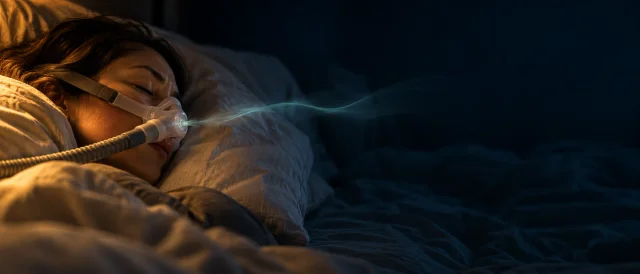
Sleep Science Research2026-10-18One strong recommendation, 41 patients at 3,650 metres, and 481,857 scored nightsEurope's new CPAP guideline gives its strongest grade to daytime sleepiness alone; a 41-patient trial cut the apnea index by a third, and 481,857 scored nights show what that index leaves out.
Sleep Science Research2026-10-111,266 tracked for 35 years, 147 nights in a sleep lab, and who sets the bar for a bad nightA 35-year cohort reports ordinary sleep while its actigraphy shows fragmentation, a cleared smartwatch's error rate turns on whom it screens, and one study lets people's own sleep history set the cutoff.31
Sleep Science Research2026-10-0414 patients, 6,427 sleep studies, and what a sleep number was checked againstA consumer ring worn in the emergency department, a wrist signal turned into an apnea index, and 6,427 routine sleep studies all point to one test for any sleep number: say what it was measured against, then act.
Sleep Science Research2026-09-2763 couples, 111 children, 572 patients, and the person who reads the nightThis week's research puts one night into two channels — a bed partner whose blood pressure moves when someone else's apnoea is treated, and the parents, caregivers and clinicians whose accounts of a night diverge from the instrument's — and closes with a seven-night test that holds both.2
Sleep Science Research2026-09-2043 clinicians, 107 patients, 204 recordings, and the trouble with one night of sleepThis week's papers attach an error bar to the nightly sleep number, from single-night apnea thresholds to four scoring algorithms, and close with a seven-night test of your own measurement.2
Sleep Science Research2026-09-13Small minutes, unchanged severity, and the limits of sleep surrogatesThis week's studies show how wearable interventions can shift sleep timing without improving insomnia severity, and why functional progress requires metabolic or neuro-autonomic adaptation.3
Sleep Science Research2026-09-06Morning light, objective sleep, and the adherence gapThis week's studies separate a controlled light effect from real-world adherence and show how to test morning light without mistaking a wearable score for proof.1
Sleep Science Research2026-08-30Sleep Research Digest, Aug 24–30, 2026: Sleep screening, cardiac remodeling, and CBT-INew randomized and method-development studies clarify what sleep screening signals can support, from apnea assessment to CBT-I, and where clinical validation remains essential.
Sleep Science Research2026-08-23Sleep Research Digest, Aug 16–23, 2026: Sleep-drive circuits, oxygen dips, and the proxy problemNew mouse circuitry clarifies sleep pressure, while human biomarker and app studies show why a personal experiment should pair one sleep proxy with daytime function.
Sleep Science Research2026-08-16Sleep Research Digest, Aug 9–16, 2026: Better proxies can still miss the sleep outcomeThis week's sleep research separates a stronger proxy from a better night, then turns that distinction into a seven-day test pairing one sleep metric with daytime function.1
Sleep Science Research2026-08-09Sleep Research Digest, Aug 2–9, 2026: One sleep score is not enoughThis week’s studies show why sleep metrics need physiological context—and turn a small music RCT into a cautious seven-night wind-down experiment.
Sleep Science Research2026-08-02Sleep Research Digest, Jul 26-Aug 2, 2026: Extra sleep is measurable; its payoff is not automaticThis week's sleep research shows that moving an early training session later can buy an hour of sleep without guaranteeing better short-term performance, while new PSG and brain-imaging studies reveal why duration alone misses important physiology.