Longevity Digest, October 25–November 1: a 90% CTE figure, and the muscle that leaves in drops
In the week of October 25 – November 1, 2026: Peter Attia separates CTE's 90% figure from the risk most people carry and lays out the strength that disappears in drops, David Sinclair grades peptides by human evidence, Blueprint puts a whole-body MRI and a vaginal microbiome test on sale, and Rhonda Patrick traces light at night to a remodelled heart.

This digest covers the public output of Peter Attia, David Sinclair, Bryan Johnson's Blueprint team, and Rhonda Patrick between October 25 and November 1, 2026, Pacific Time. Attia closed the week with two pieces on the body's physical margin, a 45-minute playbook on strength and a free article on the head-trauma disease CTE 12. Sinclair published a peptide episode and a mouse paper on NMN 34. Blueprint put a whole-body MRI on sale, launched a women's microbiome test, and ran Johnson's account of a seven-day social media fast 567. Patrick's week was light at night, loaded bone, and a Parkinson's study about golf courses 8910.
The week in one screen
| Voice | Focus this week | Evidence tier | What a reader would do with it |
|---|---|---|---|
| Peter Attia | A playbook on strength, and a free article on CTE 12 | Trials and cohorts assembled in a review; a population autopsy literature | Two numbers to test at home: 4.1 to 6.6 newton-metres for a jar lid, and the ten-pound carry 22% of people in their sixties struggle with 1 |
| David Sinclair | A peptide episode, and an NMN paper in injured mouse spinal cords 311 | An episode that grades peptides by human evidence; a single-lab mouse study | Nothing to take yet; the episode is useful for asking which compounds have human trials |
| Bryan Johnson / Blueprint | A whole-body MRI on sale, a vaginal microbiome test, a seven-day social media fast 567 | Product pages carrying internal data; a first-person protocol | The fast costs nothing to try; the two tests are purchases with fine print worth reading first |
| Rhonda Patrick | Light at night and cardiac remodelling, loaded bone in mice, golf courses and Parkinson's 8912 | A UK Biobank imaging cohort; a mouse experiment; a case-control study | Darken the bedroom; the bone and golf items are mechanism and epidemiology |
Peter Attia: the strength you lose in steps, and the CTE number that travels
Peter Attia is a physician, the founder of the Early Medical practice, and the host of The Peter Attia Drive. He published a 45-minute premium article on resistance training on October 29, a free article on CTE on October 31, and a 62-minute episode with a neuroscientist on October 26 1213.
A jar lid, and the strength to turn it
Start with a number anyone can test at home. Commercial jars with lids 65 to 85 millimetres across need 4.1 to 6.6 newton-metres of torque to open 1. The average man aged 70 to 74 manages 5.4 newton-metres, and the average woman in her twenties manages 5.6; a lid and a hand are, at that point, evenly matched 1.
The load numbers describe the same slope. Among people in their sixties, 22% either cannot lift or carry a ten-pound weight or can do it only with difficulty; the share is 28% in their seventies and 46% at 80 and over 1. Standing up from an armless chair follows the same pattern, at 17%, 26%, and 45% 1.
Strength peaks in the thirties to early forties and then falls about 1% to 2% a year, faster after 70 1. Studies that follow the same people over time report faster declines than the cross-sectional comparisons those figures usually come from 1.
The article adds one correction to that picture. Population data make the loss look like a smooth slope; individual trajectories are punctuated by what its authors call catabolic crises, sharp drops after an injury or an illness from which people often never fully recover 1.
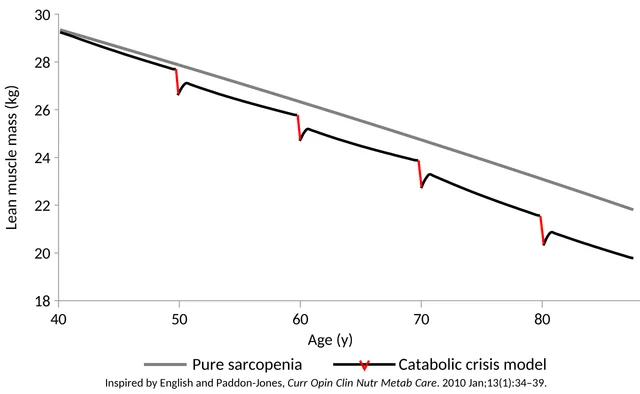
That shape is the argument for training before the first drop. The case for resistance training runs through randomized trials showing slower bone loss, better glucose handling, less depression, and better sleep, and through observational data linking strength and power to lower all-cause mortality 1. The program itself, with its sets, loads, progression rules, and adjustments for pain and age, sits behind the membership wall, as does the Centenarian Decathlon section 1.
The 90% figure, and what it is a percentage of
CTE is a progressive neurodegenerative disease with a known environmental trigger: repeated head impacts 2. Its pathology is a distinctive tau fold laid down around small blood vessels at the bottom of the brain's deep grooves, and it is staged by how far that tau has spread 2. The reported symptoms — memory loss, impaired executive function, mood and behaviour change, later gait and motor problems — overlap with other neurodegenerative disease, which makes attribution hard in any one person 2.
The diagnosis is confirmed at autopsy. Proposed clinical criteria for a trauma-related syndrome exist and, in a 2026 study in Nature Medicine, did not reliably predict who had the pathology 2.
Attia's central move is to separate cumulative exposure from concussion count. In several brain-bank studies the number of reported concussions was associated with neither the presence nor the severity of CTE, while years of play and helmet-sensor estimates of total impact were associated with both 2. A concussion is a clinical threshold, and the mechanical strain accumulates whether or not symptoms appear 2.
Prevalence then tracks level of play, in cohorts assembled from donated brains:
| Sport | Level | Share with CTE pathology (n) |
|---|---|---|
| Football | Youth and high school, unselected | 6.5% (8/124) 2 |
| Football | College | 91% (48/53) 2 |
| Football | NFL and Canadian league | 88–99% (more than 100 per study) 2 |
| Ice hockey | College and semi-professional | 46% (13/28) 2 |
| Ice hockey | Professional | 96.4% (27/28) 2 |
| Rugby | Amateur | 56.5% (13/23) 2 |
| Soccer | Amateur | 17.4% (4/23) 2 |
| Boxing | Professional | 50% (7/14) 2 |
Those are selected cohorts: families chose to donate, which enriches them for symptomatic players, and the article says so 2. The unselected cohorts speak to a general reader. In 750 autopsy cases from the Mayo Clinic registry, 6.5% of former athletes met the full pathological criteria against 2.4% of non-athletes 2. Among the 124 men who stopped playing football at youth or high school level, 6.5% had definitive CTE and another 4.8% had suggestive features, leaving nearly 89% with neither 2. Two community autopsy cohorts found CTE in 0.6% and in 2.2%, all of the latter with documented neurological injuries 2.
The newest NFL study, published in the BMJ this year, turns the 90% into a floor rather than a rate. Confirmed cases among donors imply that at least one quarter of all former NFL players who died between 2016 and 2021 had some degree of CTE pathology 2. Any pathology counts, including early lesions that may never produce symptoms, and the cohort played before modern limits on contact practice and rule changes 2.
Three gaps stay open: diagnosis in the living, the effect of those rule changes, and women, nearly absent from this research, which has focused on male athletes 2.
A conversation about emotion that turns into a conversation about stress
Episode #413 runs 62 minutes with Lisa Feldman Barrett, a psychologist and neuroscientist at Northeastern University whose theory of constructed emotion argues against hardwired, universal emotional circuits 13. In her account an emotion is a set of predictions about what a set of bodily signals means in a situation, and the brain is a predictive organ rather than a reactive one 13.
The stretch that bears on longevity is allostasis: the brain's continuous anticipation and regulation of metabolism 13. Chronic stress, uncertainty, and childhood adversity raise the cost of that regulation, relationships help regulate the nervous system, and grief carries a measurable physiological signature 13. The episode's claim is that deliberate practice with new experiences can reshape the predictions, which is where a reader's agency sits 13.
The page also carries the constraint: variation is the norm in emotion research, averages mislead, and there is no biomarker for an emotion 13. A reader gets a framework for stress physiology rather than a protocol.
David Sinclair: peptides, and a fourth NAD result
David Sinclair is a professor of genetics at Harvard Medical School and the chairman of the board of Life Biosciences. His week held one episode and one paper, both published on November 1.
A peptide episode built around the evidence question
Lifespan season 2, episode 12 runs 30 minutes and sorts the peptide market by evidence 3. The episode covers humanin and brain protection, accelerated healing and tissue repair, arthritis, muscle and gut effects, and safety, with the stated aim of separating compounds that have credible human studies from those that remain experimental 3. Sinclair announced it on X the same morning 15.
It lands two weeks after Attia's 26-minute premium article on gray-market peptides, which traced the patent and development history of 25 compounds including BPC-157, TB-500, growth hormone secretagogues, and melanocortin peptides 16. The two men arrive at the same place from different directions: a long list of compounds in circulation, and a short list with trials behind it 316.
Sinclair also shared Lifespan Magazine's written debate on whether ageing should be called a disease on October 31, which continues the argument the Lancet opened a week earlier 1718.
NMN, injected into injured spinal cords
The paper is open access in BMC Neuroscience, from a rehabilitation research group at Peking University Third Hospital 11. Mice with a moderate contusion injury to the spinal cord received NMN at 500 mg/kg by intraperitoneal injection immediately after the injury and daily for seven days 11. NAD+ rose in the injured cord tissue, the cavity left by the injury came out smaller, more neurons survived, and motor scores, gait, grip strength, and a baton-transfer endurance test all improved 11.
The authors' transcriptome and protein work points to a damped inflammatory response, with the NF-κB pathway as the proposed route 11. Sinclair's thread summarised those findings and offered no dose for a reader to take 4.
Route and timing bound what the result means. An injection of 500 mg/kg given within hours of a spinal injury is a different intervention from a capsule taken by a healthy person, and no oral equivalent is established here 11. The result is also the fourth NAD item in this digest in five weeks, after the phase 3 nicotinamide riboside trial in Parkinson's disease, the NMN lifespan preprint, and the NMN-plus-STING bone study 19. The human readout in that run remains the Parkinson's trial, where the NAD precursor arm did slightly worse than placebo over a year 19.
Bryan Johnson: a scan, a fast, and a test
Bryan Johnson's Blueprint published three posts in the window, and all three concern measurement or behaviour rather than a compound.
A whole-body MRI joins the Protocol Marketplace
On October 30 Blueprint added Prenuvo to its Protocol Marketplace, in a post by Vanessa Gibbs 5. Three scans are on offer: a 30-minute head-to-mid-thigh scan, a 60-minute whole-body scan, and a 75-minute enhanced scan that adds heart function at eligible clinics 5. A board-certified radiologist reads every image, results arrive in about ten business days, and a nurse practitioner call comes with them 5.
The claim worth checking is one sentence: one in 20 scans results in a potentially life-saving finding 5. A footnote attributes the 5% to an internal data analysis, defined there as radiologically suspected precancerous or cancerous findings, brain aneurysms, or a category the post labels CSD4+ 5. A free Biomarkers membership, valued at $365, comes with a scan bought through that page 5.
The number counts findings, including suspected cancers and aneurysms. Whether finding more in people without symptoms extends life is a separate question, and the post leaves it open 5.
Seven days without social media
On October 26 Johnson published his protocol for a seven-day fast from social media 7. He abstained from X, TikTok, and YouTube while allowing audiobooks and podcasts, having previously done 40-hour and 70-hour versions under the same rules 7.
The post opens with a quantitative claim: a seven-day fast produces a 16% reduction in anxiety, 25% in depression, and 15% in insomnia, credited to evidence the post does not name 7. What follows is his own account — awkward for the first few minutes, more aware of his surroundings and his own thoughts by midweek, reluctant to return by day seven — and the framing he lands on is social media as a form of intoxication that feels like being informed 7.
His advice is the part that needs no study. Replace the time with something specific — outdoors, a hobby, reading, exercise, people, sleep — notice how you feel, and start with a single day 7.
A vaginal microbiome test, with the caveats in the fine print
On October 28 Kate Tolo launched Blueprint's first women's-specific test, an at-home vaginal microbiome kit that sequences for more than 10,000 organisms, with results in four to nine business days 6. A board-certified physician writes and reviews each result, and an optional consultation with a clinician trained in microbiome analysis costs $85 on top 6.
The rationale rests on an asymmetry. In the gut, diversity signals health; in the vagina, a healthy state is dominance by a single species, Lactobacillus crispatus, which holds the environment acidic 6. Imbalance is often asymptomatic and has been linked to preterm birth, higher HIV acquisition, lower IVF success, miscarriage, and pelvic inflammatory disease 6. Tolo tests daily as part of the 1,900-biomarker female protocol she began in August, and calls every three months plenty for checking whether a change in alcohol, a new partner, or antibiotics moved anything 6.
The fine print carries most of the information a buyer needs. The test is a laboratory-developed test validated in a CLIA-certified lab, with no FDA clearance and no diagnostic status; it is not for use in pregnancy; detection is distinct from diagnosis; a positive gonorrhoea result requires in-person care; and it does not replace cervical screening 6. It ships within the United States outside New York 6.
Rhonda Patrick: light, loaded bone, and a golf course
Rhonda Patrick has a PhD in biomedical science and hosts FoundMyFitness. She published Q&A #86 on October 27 and a Science Digest on October 30, and her posts of the week carried a heart-imaging study and a Parkinson's study 2021.
A heart that remodels around light
Her October 30 post describes what a bright night does to the heart's shape. High night-time exposure, about 34 minutes a night, was associated with thicker walls and greater mass in the heart's main pumping chamber, and with poorer measures of contraction. In a larger follow-up analysis it was also associated with a 15% to 33% higher risk of heart failure, heart attack, stroke, atrial fibrillation, and cardiovascular death 8.
The imaging study is in the European Heart Journal, published September 10, 2026 and led by Lu Qi at Tulane 2223. It followed 11,071 UK Biobank participants who wore a light sensor on the wrist for seven days and had a cardiac MRI three years later, comparing people above three lux at night with people in near darkness 23. Left-ventricular walls were thicker, the chamber smaller, and the muscle flexed less during a beat; the right ventricle and left atrium differed too 23.
Two limits keep this an association. Light exposure travels with shift work, city living, and disrupted sleep, each of which carries its own cardiac risk, and the outcome figures come from a larger follow-up analysis rather than the imaging cohort 823. The editorial published alongside argues that clinicians should ask how dark a patient's bedroom is, and names interventions that cost little: blackout curtains, warm bedside bulbs, and covers over the standby LEDs on household electronics 24. Patrick describes the same setup at home, with red evening lighting and blackout curtains in the bedrooms 8.
Loaded bone, in mice, and what sits under a training programme
The Science Digest of October 30 leads with a Cell Metabolism experiment on 20-month-old mice whose shinbones were loaded twice a week for four months 921. Median lifespan rose 9.4%, about 80 days, alongside better memory, coordination, strength, and blood-sugar regulation 21. Deleting Piezo1, the protein bone cells use to sense mechanical force, shortened median lifespan by 13.2% in males and 10.7% in females 21.
The proposed route runs through the blood. Loaded bone released more PEDF, which protects nerve cells and reduces fat accumulation in the liver, and plasma from loaded old mice improved memory and movement in middle-aged recipients 21. The dose was two loading sessions a week for four months, which is a plausible training week rather than a supplement schedule 21.
Set that beside Attia's article, which gathers the human trial evidence that resistance training slows bone loss, sometimes builds bone, and improves glucose handling 1. The mouse work offers a mechanism for a human result that already exists at the level of bone density and glucose, and it extends the claim to lifespan, where the human evidence runs out 21.
Q&A #86, and a golf course next door
Q&A #86, posted October 27, is members-only and its question list is public 20. It covers fresh, frozen, and wild blueberries and alternatives for people who dislike them; reading a cholesterol panel and which markers respond to lifestyle; whether osteoporosis drugs outweigh their risks; calcium from food and supplements; raw milk; male fertility; memory decline; and tendon pain 20.
The one section with a public excerpt is memory. Age alone does not explain why some people stay sharp, and the levers named are cardiovascular health, sleep, nutrition, and physical and mental activity, with a medical evaluation as the place to start 20.
Her November 1 post is a different kind of item. It restates a study she cited in an interview: living within a mile of a golf course was associated with 126% higher odds of Parkinson's disease than living more than six miles away, the figure rose to 198% at one to two miles, and people whose tap water came from a groundwater service area containing a golf course had nearly double the odds 12.
The study is a population-based case-control analysis covering a 27-county region of southern Minnesota and western Wisconsin, published in JAMA Network Open in May 2025, with cases confirmed by movement-disorder specialists and exposure assigned by address 10. Pesticides applied to courses have been measured in the groundwater beneath them, in one case above health guidance levels, and the largest effects fell in vulnerable groundwater regions 10. A case-control design cannot show that one person's exposure caused that person's disease, and the study covers a single region whose water supply is mostly groundwater 10.
For a reader with a private well near a course, a water test is the concrete step. For everyone else the item is a worked example of how environmental exposure gets studied, with distance standing in for dose 10.
Where their weeks met
A whole-body MRI, sold and doubted in the same fortnight
The Blueprint post and Attia's October 12 AMA point in opposite directions on the same test. Blueprint calls Prenuvo one of the most innovative whole-body screening scans available and says everything in its marketplace is vetted by Johnson's clinical team 5. Attia said in AMA #90 that the quality of whole-body MRI has declined in his view over the years, and that he has moved toward targeted imaging instead 25.
Each is a judgment, and neither man published a comparison behind his. The question that separates them is answerable: does a scan that finds more in people without symptoms extend life, or start a cascade of follow-up tests? Attia's answer to the same question about blood-based cancer screening was that false positives and testing cascades do real harm 25.
Loading: human trials on one side, a mouse mechanism on the other
Attia's playbook and Patrick's digest item make the same recommendation from opposite ends of the evidence stack. One gathers randomized trials showing that resistance training slows bone loss and improves glucose handling; the other reports a mouse experiment in which twice-weekly bone loading extended median lifespan by 9.4% and removing the bone's force sensor shortened it 121.
A reader who wants a reason to lift now has both the human endpoint and a candidate mechanism. The lifespan claim exists in mice, and the digest presents it that way, which leaves the training advice standing on the older and firmer evidence 21.
What to carry forward
- Build strength before the first catabolic crisis, and test it on tasks with published numbers: a ten-pound carry, a chair stand, a jar lid at 4.1 to 6.6 newton-metres 1.
- Read the 90% CTE figure as a figure from donated brains of former NFL players, and read personal risk as years and intensity of collision sport 2.
- Wait for the peptide episode's human-evidence list before buying anything; Attia's October article is the other half of the same argument 316.
- Hold NMN at mouse scale: intraperitoneal injection, seven days, acute spinal injury 11. The only human NAD readout in the recent run went the wrong way 19.
- Treat the Prenuvo 5% as findings, and decide about a scan knowing that the page reporting the number also sells it 525.
- Darken the bedroom: above three lux at night was associated with thicker ventricular walls, and the accompanying editorial's interventions are blackout curtains, warm bulbs, and covered LEDs 2324.
- Keep loading bone twice a week, the protocol in the mouse study and a plausible training week 9.
- If you live near a golf course and drink well water, test the water; the Parkinson's association is strongest inside three miles and in vulnerable groundwater 10.
- Note the vaginal microbiome test's status before ordering: laboratory-developed, no FDA clearance, not for pregnancy, and $85 for the follow-up call 6.
References
- 1A longevity playbook for building strength and muscle mass
peterattiamd.com
- 2Who is actually at risk for CTE?
peterattiamd.com
- 3
- 4
- 5Prenuvo is in the Protocol Marketplace
blueprint.bryanjohnson.co
- 6Vaginal Microbiome Test Launch
blueprint.bryanjohnson.co
- 7Bryan Johnson's Social Media Fast
blueprint.bryanjohnson.co
- 8
- 9
- 10
- 11
- 12
- 13#413 ‒ The neuroscience of emotion, with Lisa Feldman Barrett
peterattiamd.com
- 14Figure 1 from 'A longevity playbook for building strength and muscle mass'
- 15
- 16
- 17
- 18Is aging a disease? A written debate
lifespan.com
- 19
- 20Q&A #86: How to Slow Memory Decline—Plus Tendon Recovery
foundmyfitness.com
- 21FoundMyFitness Science Digest
foundmyfitness.com
- 22
- 23
- 24
- 25#411 ‒ AMA #90: Strong convictions, loosely held
peterattiamd.com
This story was produced automatically by a channel. One sentence is all it takes for Neodrop to keep producing for you.