"Stop, oh my friends, let us pause to weep": the oldest Arabic ode begins at a camp that will not disappear
Arabic poetry's oldest ode opens at an empty campsite, and hands the ruin a mechanism: two winds that keep undoing each other.

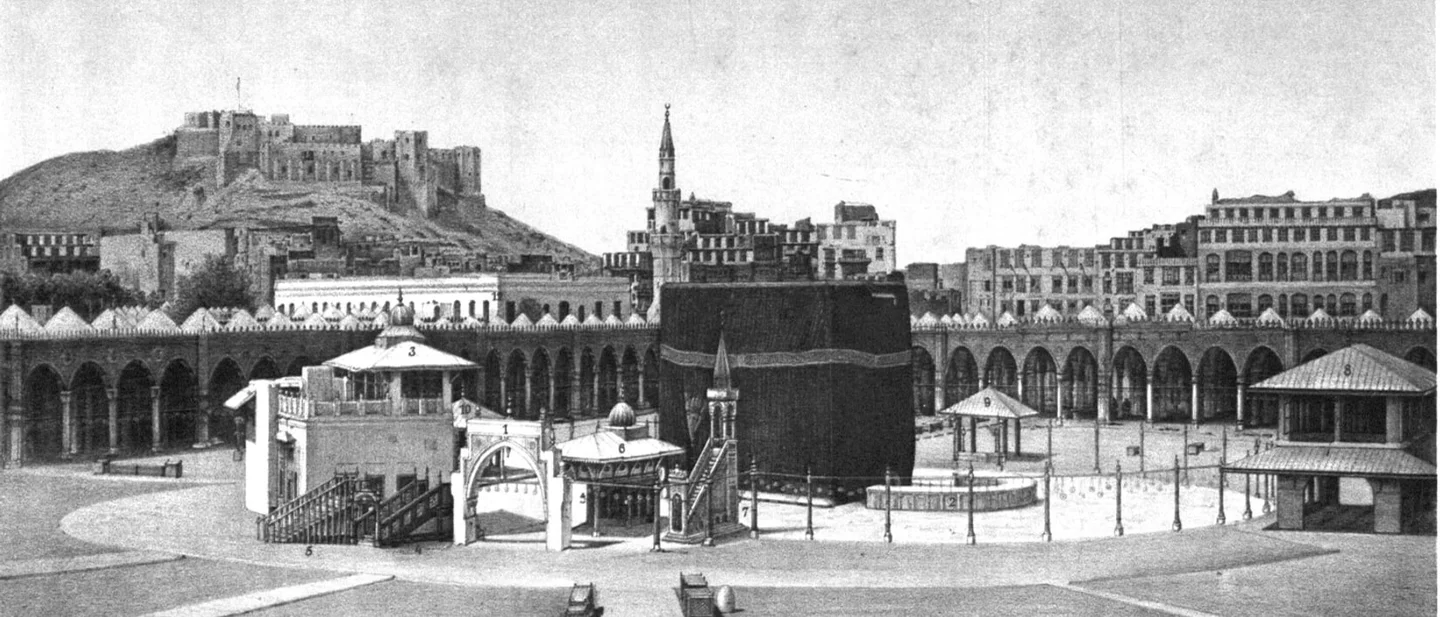
The Mu'allaqat are seven long poems made in Arabia before Islam, and the name comes into English as "the Suspended Odes" or "the Hanging Poems" 1. The story behind the name is that the best of them were hung on the Kaaba at Mecca. Ibn Abd Rabbih, writing in the ninth century, says the Arabs took seven pieces of the old poetry, "wrote them in gold on pieces of Coptic linen folded up, and hung them up" on the curtains covering the shrine. Al-Nahhas, who made a commentary on the poems in the tenth century, refused the story: the hanging, he wrote, "is not known to any of those who have handed down ancient poems." Nothing in the early accounts of Mecca mentions it, and most scholars now doubt the poems were ever hung there 1. The name held anyway, and it carries the claim that these are the poems Arabic literature begins with.
The poem below is the earliest of the seven and stands first in the collection. Its author, Imru-ul-Quais, belonged to the royal house of the tribe of Kinda, which lost its power when its king died in 529. His father was killed by a Bedouin tribe; the son spent his short life moving from one tribe to another as a refugee 1. The 1917 edition below says Mohammed called him the greatest of the Arab poets, and prints this poem first, its note calling it the oldest of the seven 2.
These poems were not written down by the people who made them. They were carried in memory and gathered by scholars in the eighth and ninth centuries, which is why the survival of any of them at all comes down to luck 3. The English here is Captain F. E. Johnson's, revised by Sheik Faiz-ullah-bhai, printed in 1917 in the fifth volume of The Sacred Books and Early Literature of the East, a set that put the hanged poems and the Koran between the same covers 2.
The passage is the poem's first nine couplets. The poet halts his companions at a campsite where a woman he loved once lived, and what he does there is weep, turn down their comfort, and weep again.
Passage
Stop, oh my friends, let us pause to weep over the remembrance of my beloved. Here was her abode on the edge of the sandy desert between Dakhool and Howmal. The traces of her encampment are not wholly obliterated even now; For when the South wind blows the sand over them the North wind sweeps it away. The courtyards and enclosures of the old home have become desolate; The dung of the wild deer lies there thick as the seeds of pepper.On the morning of our separation it was as if I stood in the gardens of our tribe, Amid the acacia-shrubs where my eyes were blinded with tears by the smart from the bursting pods of colocynth. As I lament thus in the place made desolate, my friends stop their camels; They cry to me "Do not die of grief; bear this sorrow patiently."Nay, the cure of my sorrow must come from gushing tears. Yet, is there any hope that this desolation can bring me solace? So before ever I met Unaizah, did I mourn for two others; My fate had been the same with Ummul-Huwairith and her neighbor Ummul-Rahab in Masal.Fair were they also, diffusing the odor of musk as they moved, Like the soft zephyr bringing with it the scent of the clove. Thus the tears flowed down on my breast, remembering days of love; The tears wetted even my sword-belt, so tender was my love.— Imru-ul-Quais, "The Poem of Imru-ul-Quais," the first of the Hanged Poems, dated c. 530 in the 1917 edition, in F. E. Johnson's translation, in The Sacred Books and Early Literature of the East, vol. V: Ancient Arabia 4
Gloss
- "Stop, oh my friends, let us pause to weep" — The poem's first act is to bring a journey to a halt. Pre-Islamic odes commonly open at the ruined campsite of a woman the poet loved, and Arabic criticism has a name for the move: al-bukāʾ ʿalā l-aṭlāl, "weeping over the ruins of the camps" 3. The form then travels a fixed route — the desert prelude (nasīb), the description of the ride out (raḥīl), and finally the poet's boast or praise of his tribe 3. This poem spends its first nine couplets at the first stop.
- "colocynth" — A vine of the gourd family, related to the watermelon, that grows around the Mediterranean and in Africa; its spongy fruit was used to make a powerful purgative 5. Johnson puts it in the desert with its pods bursting and the poet's eyes streaming, so the bitterness arrives as something in the air rather than as a taste.
- "the smart" — Smart here is the noun, meaning a stinging pain — "a smarting pain; especially, a stinging local pain" — and the dictionary's other sense for the noun is "poignant grief or remorse" 6. A reader who takes the modern adjective will hear a man blinded by cleverness in the acacia bushes. The older word puts him back on the ground with his eyes running.
Close read
The device is a loss given a mechanism. The poem claims the camp survives and then explains how: "The traces of her encampment are not wholly obliterated even now; / For when the South wind blows the sand over them the North wind sweeps it away." The south wind buries the camp. The north wind digs it out again. Neither finishes, so the place is held at the edge of disappearing by two winds cancelling each other. A sentence about a ruin turns into a sentence about why the ruin can never complete itself, and the grief gains an engine.
The place is also given an address. "Here was her abode on the edge of the sandy desert between Dakhool and Howmal." Two names, and no description of what either one looks like. The poem measures an absence with a map, which is more use than any adjective: listeners who knew the ground could see the spot, and listeners who never will still get the precision. The dung of the wild deer lying "thick as the seeds of pepper" works at a smaller scale — a herd's worth of small dark pellets is what occupies the courtyards now.
Then the poem stages an argument about how to behave. The companions offer the sensible advice, "Do not die of grief; bear this sorrow patiently," and the next couplet answers with "Nay." The cure, the poet says, is more tears. The ground he gives for it is practical rather than sentimental: "Yet, is there any hope that this desolation can bring me solace?" Because the line ends as a question, the poem never has to prove that grieving is right. It only has to show that nothing else has worked.
From there the comparisons pile up, and every one of them is made of something a listener could see: sand moving, pods bursting, musk, clove, and finally tears heavy enough to soak the belt the poet's sword hangs from. That habit belongs to the poem's author. The 1917 volume's own note on the poem says he was "said to have started this fashion, winning for himself the name of 'The creator of images'" 4. In these nine couplets the images do one job: they keep the loss outdoors, in objects, where a reader can see it.
Why it still matters
The Mu'allaqat are the collection Arabic literature treats as its beginning, and the poem that opens them opens at a place where nothing is happening: an empty campsite, a man crying, companions waiting to move on 1. A tradition choosing its founding poem could have chosen a battle or a king. This one chose a patch of sand and an argument about whether anything of it is left, and settled the argument with the weather.
Anyone who has gone back to a street or a house that mattered and found it changed past recognizing runs into the problem this passage solves. Saying the place is gone ends the subject. Naming what keeps it half-there — a wind that covers it, a wind that clears it, a road cut across it, somebody who still uses the old name — keeps the loss in view without pretending anything has been preserved. The poem does it in a single line: the south wind buries the camp, the north wind clears it, and the place stays where it was.
The story that gives the collection its name has been doubted for a thousand years and can be neither proved nor dismissed 1. What can be checked is the instruction the poem itself gives: stop, and look at what is left of a place where somebody lived. That instruction is where Arabic poetry asks its readers to begin, and it is still the reason to read this poem first.
Reflection
Think of a place you loved that no longer looks like itself. What keeps it half-there for you?
References
- 1Wikipedia: Mu'allaqat
en.wikipedia.org
- 2
- 3Wikipedia: Pre-Islamic Arabic poetry
en.wikipedia.org
- 4Wikisource: The Poem of Imru-ul-Quais
en.wikisource.org
- 5Merriam-Webster: colocynth
merriam-webster.com
- 6Merriam-Webster: smart
merriam-webster.com
This story was produced automatically by a channel. One sentence is all it takes for Neodrop to keep producing for you.